Book I · The Republic in Italy
Chapter 1
The Gallic Catastrophe
The Coming of the Senones
The Gauls who descended upon Rome in the year traditionally given as 390 BC — and which modern chronologers, working from Polybius's independent dating, would place either in 387 or 386 — were the Senones, the southernmost of the great Celtic peoples who had been pressing across the Alps and into the Po valley for at least a century. Polybius, who had the best access to early sources, tells us that the Celts had first come over the mountains in the early fifth century, displacing the Etruscans from the rich agricultural lands of the terramare in what would become Cisalpine Gaul. By the time of the Roman catastrophe, the Celtic settlement of northern Italy was complete and pressing southward. The Insubres held Mediolanum (Milan); the Cenomani held Brixia (Brescia); the Boii had crossed the Apennines into the area of Bononia (Bologna); and beyond them, on the Adriatic coast where the rivers Aesis and Rubico ran into the sea, the Senones had settled the land that would, for centuries afterward, be called the ager Gallicus.
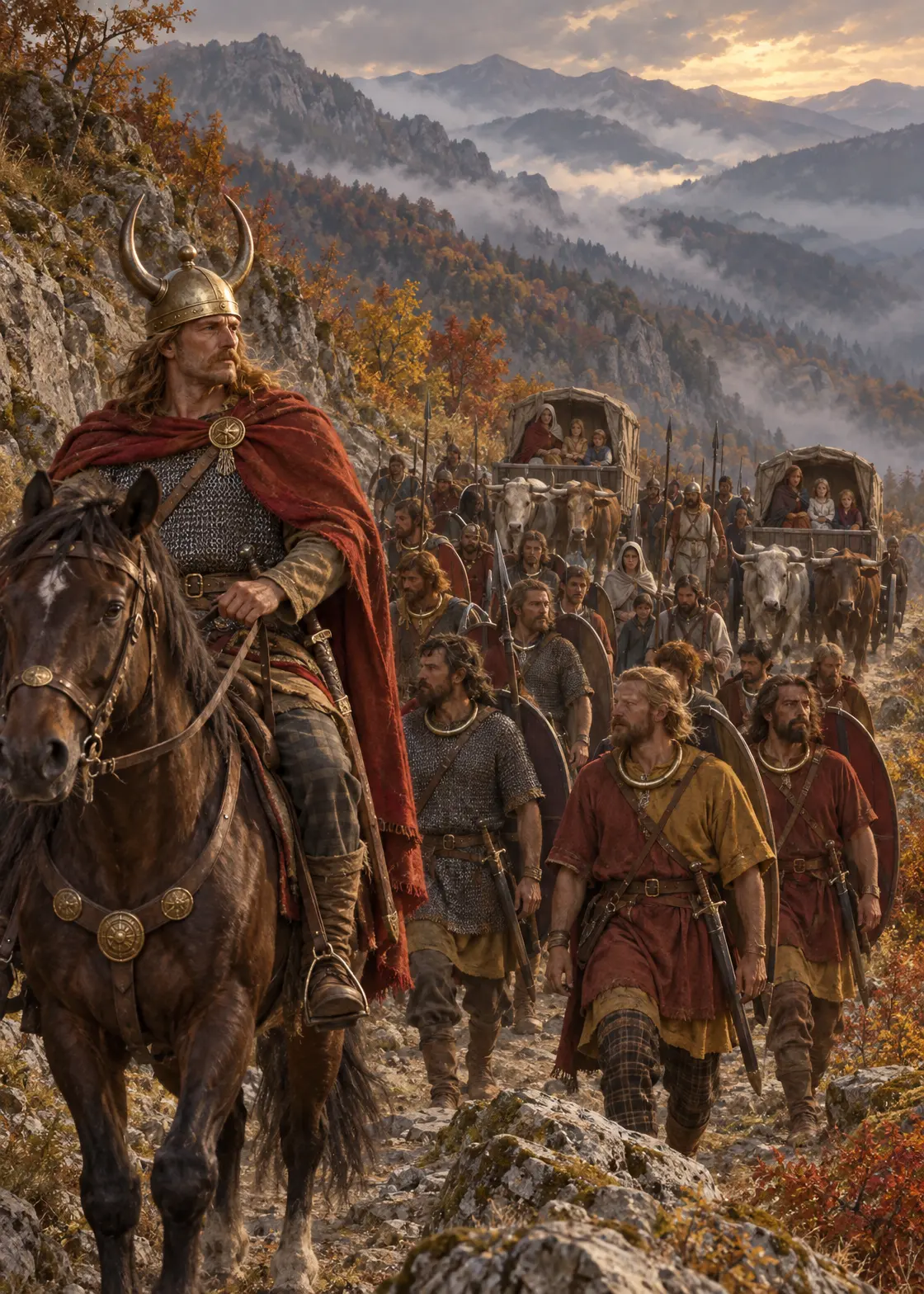
The Senones were not a numerous people. Estimates from later Roman sources should be treated with caution, but the war-band that came south in 390 was probably between twelve and thirty thousand strong, accompanied by some thousands of women, children, and dependents in the manner of Celtic migrations. They were led, according to Livy and Plutarch, by a chieftain named Brennus — a name which would become, through subsequent Celtic invasions, a kind of generic Roman shorthand for any Gallic leader of importance. (The same name appears attached to the leader of the Celtic invasion of Greece in 279 BC, which is either historical coincidence, dynastic naming, or annalistic conflation; the question is unresolved.) What brought them south was the report of rich plunder to be had in central Italy, communicated possibly by Etruscan merchants but more probably, the sources suggest, by an embittered exile from Clusium named Arruns, who had business of his own with the powerful family of the Lucumones and was happy to direct foreign arms against them.
The Senones therefore came not as conquerors seeking land but as raiders seeking spoil. This distinction matters. The Gauls who would settle permanently in the ager Gallicus would prove a continuing strategic problem for Rome through the middle Republic, requiring repeated campaigns and only finally being subdued in the late third century. But the Gauls who took Rome in 390 came for treasure, took it, and went home. The catastrophe was real but the threat was bounded. This was not understood at the time. To the Romans of 390 it appeared that the world had ended.
The Embassy to Clusium
The casus belli, in so far as one can be reconstructed from Livy's account in his fifth book, involved an act of Roman diplomatic incompetence which the annalistic tradition seems to have inherited and which there is no compelling reason to doubt. The Senones, encamped before the wealthy Etruscan city of Clusium (modern Chiusi), had demanded a portion of its territory in exchange for peace. The Clusines, with no army of their own capable of resistance, appealed to Rome. Rome was not bound to Clusium by treaty; the city lay outside the Roman alliance system and indeed outside the Roman sphere of influence properly speaking. But Rome sent ambassadors — three brothers of the Fabian gens, sons of the consul Marcus Fabius Ambustus — with instructions to mediate.
The Fabii arrived, listened to both parties, and, by an act of folly which Livy describes with evident embarrassment, took up arms on the side of Clusium when a skirmish broke out before the walls. One of the brothers killed a Gallic chief in single combat and was recognized while stripping the corpse. The Senones, incensed at this violation of the inviolable status of ambassadors — a status the Gauls themselves observed with some scrupulousness — sent their own embassy to Rome demanding the surrender of the Fabii for punishment. The Senate, after debate, refused. Worse: the Roman comitia elected all three Fabii to the military tribunate for the following year. The Gauls broke off the siege of Clusium and marched on Rome.
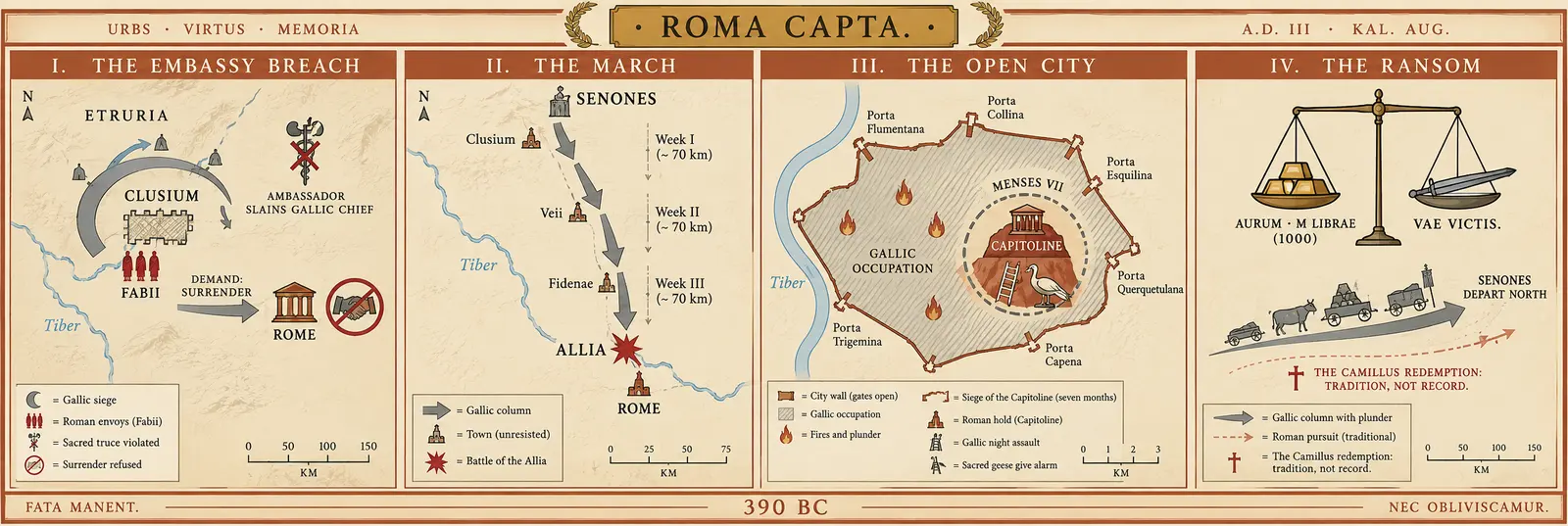
This sequence of events is so unflattering to Rome that there is little ground for suspecting it of being a later fabrication. Annalistic invention generally tended in the direction of Roman virtue; the picture of the Fabii violating the ius gentium, the Senate refusing to act on the demand, and the Roman people then ratifying the offense by elevating the offenders to high office, has the awkward ring of remembered reality. What is doubtful in Livy's account is not the diplomatic catastrophe but the speed with which everything subsequently moved. The march from Clusium to the Allia is something like ninety Roman miles; the Senones, encumbered with wagons and dependents, would have taken perhaps three weeks to complete it. Rome had time, in principle, to prepare. She did not, in any event, prepare well.
The Battle of the Allia18 July, traditional date
The Allia is a small stream that joins the Tiber on its left bank about eleven Roman miles north of the city, near the modern village of Settebagni. The Roman army — a force which Livy gives as four legions raised in haste, perhaps thirty thousand men in all, with allied contingents — marched out to meet the Gauls and took up position with the Tiber on its left and the Allia, running roughly east-to-west into the Tiber, before it. The Roman commander was, by the sources, one of the military tribunes with consular powers for the year (the office of consul having been temporarily suspended in favor of this collegial alternative). The army was commanded therefore by committee, which is rarely a good thing in the face of an enemy who is not.
The Gauls arrived in front of the Roman position in the late morning. The two forces faced one another across a low plain, with the Roman line stretched thin along an unusually long front in an attempt to prevent envelopment. Livy reports that the Roman commanders, fearing the Gallic charge on their center, had withdrawn their best troops onto a rising ground behind the main line as a reserve. This was not a foolish disposition in the abstract; but it had the consequence of leaving the front line thin and uncertain. The Gauls, seeing what they took to be the principal Roman strength on the rise, threw themselves first against that flank.
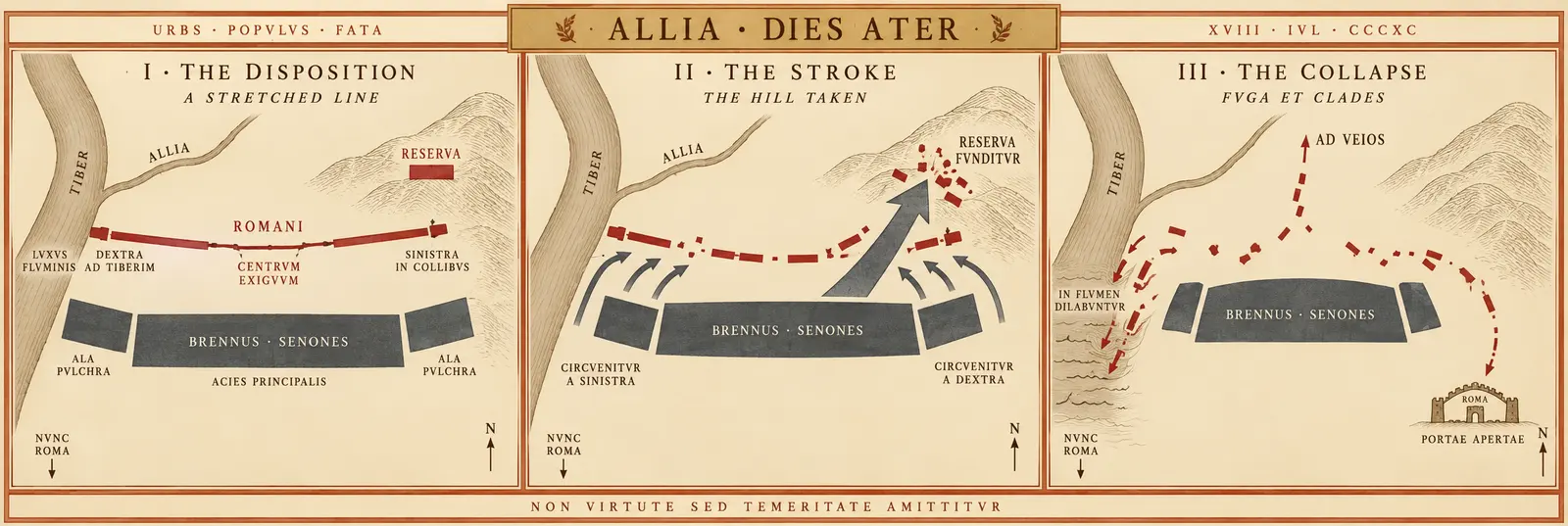
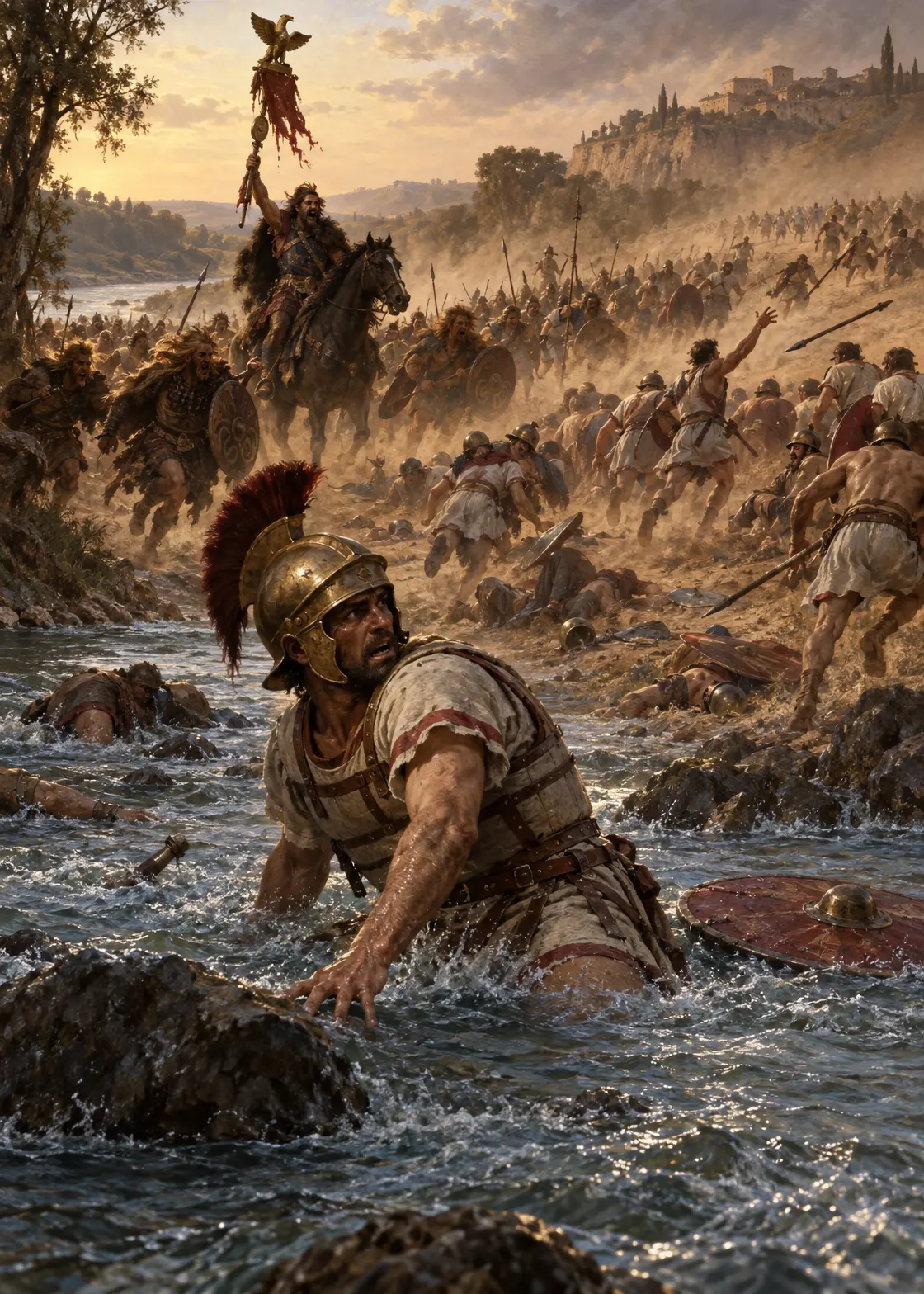
The reserve broke. Livy is honest enough to record that they did not so much give ground as turn and run, abandoning the rise without serious combat. The collapse of the reserve uncovered the right of the main Roman line, which the Gauls then took in flank. The center, already attenuated, was rolled up from right to left. The Roman left, with its back to the Tiber, fared somewhat better in the sense that those who could swim survived; those who could not, drowned in their armor. A portion of the right and center, perhaps a thousand or two, escaped eastward and made for the abandoned Etruscan city of Veii, which the Romans had taken and emptied a generation before. The remainder were killed in the rout or driven into the Tiber.
The whole engagement, by Livy's account, lasted scarcely an hour. There is no record of any tactical adjustment by the Roman commanders after the Gauls' initial advance; the army was simply not capable, in its hastily mobilized state and under the divided command of the military tribunes, of responding to a battle that did not unfold as expected. The Romans had marched out to fight a phalanx-style engagement on level ground and had instead met an army of warriors whose preferred mode of fighting was the headlong charge in loose order, screaming and bare-chested or in mail, with long iron swords and a complete disregard for the orderly progression of a hoplite battle. The Roman line, designed for a different war, did what the hoplite line did when its order broke: it ceased to exist.
The dating of 18 July (the eighteenth day before the Kalends of Sextilis in the pre-Julian calendar) was preserved in Roman religious memory long after the year of the battle had been disputed. The day became permanently ater, ill-omened; no Roman would willingly begin a campaign or engage in battle on that anniversary. The Senate would, in the centuries to come, schedule its most important campaigns to avoid it. As late as the principate of Augustus, the dies Alliensis remained marked in the public calendar. For a people who valued continuity of religious observance above almost everything else, this was as severe a memorialization of catastrophe as their culture could produce.
The Sack of Rome
The Senones reached Rome perhaps three days after the battle. The interval would have been longer except that they paused, the sources tell us, to bury their own dead and to assess what kind of place they were about to attack — for the war-band had not, evidently, expected the road to the Roman capital to be quite so suddenly open. They arrived to find the city mostly undefended. The greater part of the Roman fighting men were dead or had fled to Veii; the remainder, with the older citizens and the priesthoods and the most precious of the city's sacred objects, had withdrawn to the Capitoline Hill, which was steeper and more defensible than the rest of the city and which still bore traces of its archaic fortification. The lower city — the Forum, the Subura, the Palatine, the Aventine — was abandoned. The Vestal Virgins, carrying the sacred fire and certain unnamed sacra whose nature was kept secret, were spirited away to the friendly city of Caere in southern Etruria. The Senones, finding the streets empty and the Capitoline alone garrisoned, sacked what was there to be sacked and began a siege of the Capitoline that would last, by tradition, seven months.
Among the famous episodes of the sack — episodes which the Roman tradition rehearsed and embellished across the centuries — three deserve particular notice for what they tell us, not necessarily about what happened, but about what the Romans wished to remember:
The first is the death of the senators. Livy reports that those senators who were too old to fight and unwilling to flee remained in the Forum, seated on ivory chairs in their full magisterial regalia, awaiting death. When the Gauls entered the city they found these old men sitting motionless in their robes and, mistaking them at first for statues, hesitated to approach. Eventually one Gaul stroked the beard of the senator Marcus Papirius, who responded by striking him with his ivory staff. The massacre then began. The story is improbable in its details — it is hard to credit that eighty old men would arrange themselves in this Stoic tableau, harder still that the Gauls would mistake them for statues — but the broader claim, that the Roman tradition remembered the sack as a moment in which the men of the older generation chose dignity over flight, is consistent with the Roman ethical imagination.
The second is the geese of Juno. The Capitoline was being besieged with insufficient effect, the Gauls being unable to storm it directly. One night, however, a party of Senones attempted to climb the cliff face on the eastern side, where the rock was least guarded because it was thought too steep to be scaled. They had nearly reached the summit when the sacred geese kept in the temple of Juno on the hill — geese which, despite the dire shortage of food among the besieged garrison, had not been eaten because of their religious status — began to cackle. The noise woke the commander of the garrison, Marcus Manlius, who rushed to the eastern edge and, in single combat, pushed the leading Gaul back over the cliff. The alarm was raised, the assault was repelled, and Manlius was forever after surnamed Capitolinus. This story too is suspicious in its details — the precision of the eastern face, the convenient awakeness of Manlius, the dramatic single-combat resolution — but the survival of the Capitoline through the long siege is not in dispute, and the cult of Juno Moneta and the practice of keeping sacred geese in her temple are independently attested as ancient. Something of the kind, perhaps, happened.
The third is the ransom and the sword. The siege having dragged on past the point of profitability, and the Gauls being in possession of nothing they could not have got more easily by direct plunder elsewhere, the besieged Romans negotiated a withdrawal at a price. The sum agreed was a thousand pounds of gold — an enormous figure for the Roman treasury of the fourth century but plausibly within reach when one considers the votive offerings in the Capitoline temples. At the weighing, the Romans complained that the Gauls were using false weights. Brennus, the Senone chieftain, then unbuckled his sword and threw it on the scale, with the words which Livy renders into Latin as vae victis — "woe to the conquered." The story has the look of a literary improvement, but the underlying transaction — gold paid to make the Gauls go away — is preserved in independent traditions and is not in doubt.
Then, by the account Livy chooses to follow, the Roman dictator Camillus arrived. He had been in exile at Ardea but had been recalled in absentia, and he now appeared at the head of a relieving force composed of the survivors of the Allia who had gathered at Veii. He countermanded the treaty (which, he argued, had been concluded by a magistrate without authority), recovered the gold, and defeated the Gauls in an engagement somewhere on the road south of the city. Non auro sed ferro recuperanda est patria — "the fatherland is to be recovered not by gold but by iron." This last episode is almost certainly a later fabrication, an attempt by the Roman tradition to deny that the ransom had ever actually been paid. Polybius, whose access to early sources was better than Livy's, records simply that the Gauls left with their loot and were not pursued. The Camillus-redemption story is the kind of consolation that nations construct after defeat, and we should treat it as such.
The Aftermath and the Question of Camillus
What happened next, in immediate political terms, is reasonably clear in outline. The Gauls departed northward, encumbered with plunder, perhaps to be harried in passage by various Italian peoples (the Etruscans of Caere, by some accounts, exacted some revenge) but in no sense decisively defeated. The Romans returned to their city to find it largely burned. There was a serious proposal, recorded by Livy, that the population should simply abandon the site and resettle in Veii, which had walls and was uninjured. The proposal was rejected, by Livy's account because of a speech of Camillus invoking the religious bonds of the city to its sacred ground; more probably because the political and economic interests of the Roman elite were tied irrevocably to the Tiber crossing and the salt road, which Rome controlled and Veii did not. The city was rebuilt, hastily and without urban planning — Livy reports that the streets of his own day still followed the disorderly lines of the post-sack reconstruction, where each man had built on whatever ground was available.
The figure of Camillus — Marcus Furius Camillus, the dictator who is supposed to have saved Rome — is a problem the historian of this period cannot avoid and cannot resolve. The Roman tradition by Livy's day had built up around him an aura of providential salvation. He had taken Veii in 396 BC (which is firmly historical) and was therefore the senior Roman military man at the moment of the Gallic crisis. He had been exiled before the crisis on charges related to the distribution of Veientine plunder. He was, by the orthodox account, recalled, made dictator, raised an army, and saved the city. He is then credited with a series of further victories — against the Volscians, the Aequi, the Hernici, the Etruscans — across the next two decades. He died, in deep old age, in 365.
The difficulty is that almost every detail of this account is contested by some strand of the tradition itself. The recovery of the gold may be invention. The defeat of the Gauls outside the city may be invention. The dictatorship in 390 itself may be a later insertion to account for what otherwise would be an embarrassing absence of high-magistracy leadership at the moment of catastrophe. Modern scholarship — Cornell, Forsythe, Oakley — has reached no consensus on what to do with Camillus. The most that can be said with security is that he was a historical figure, that he played some role in the Veientine campaign, and that he became, in the later tradition, the focal figure for everything the Romans wished to believe about their recovery from the sack. The man and the legend are by now inseparable.
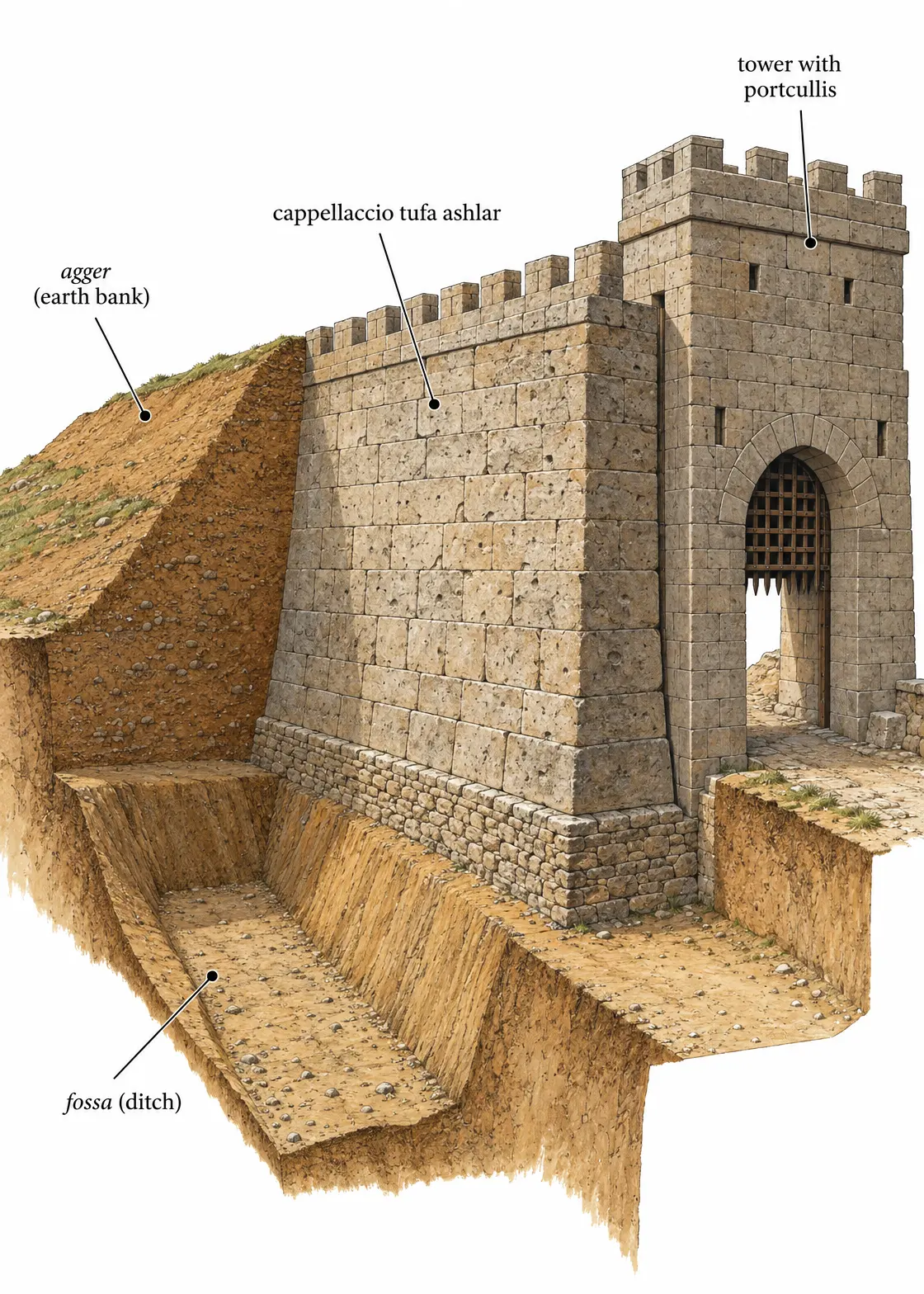
What is clear, and what matters for the military history, is the practical response of the Roman state to its catastrophe. In the years following the sack, Rome undertook three programs of reform which can be documented with reasonable confidence. The first was the construction of the Servian Walls — the great masonry circuit of cappellaccio tufa blocks which still stands in places in modern Rome, and which dates archaeologically to the second quarter of the fourth century. (The name "Servian" is misleading; the walls are not the work of the sixth-century king Servius Tullius, though there had been an earlier earthwork associated with him.) The second was the expansion of the citizen army from four legions to a larger establishment — though exactly when this happened and in what stages is debated. The third was the beginning of a transition in tactical doctrine away from the closed phalanx and toward the looser, more flexible manipular formation that we would see fully developed by the time of the Samnite Wars. None of these reforms can be dated with precision. All of them are part of the Roman answer to the question the Gauls had posed: how do you fight a war against an enemy whose mode of battle is not your own?
The Gallic Raids of the Fourth Century
The Senones did not return in force for many decades, but smaller Gallic raids continued to threaten central Italy through the middle of the fourth century. Livy reports a Gallic descent on Latium in 367 BC, the year of the Licinio-Sextian reforms, which was repulsed by Camillus (now extremely old, by the tradition) at the Anio. A further raid is recorded in 361, in which the young Titus Manlius reportedly killed a Gaul in single combat on the Anio bridge and took from his neck the gold torc that gave him his surname Torquatus. Another came in 358, defeated by the dictator Gaius Sulpicius Peticus near Praeneste. A serious incursion in 350 was beaten at the Alban hills by Lucius Furius Camillus, son of the great Camillus. A final raid in 348 was bought off rather than fought, the Romans being engaged at the time with the Latins and Volscians.
These episodes are recorded in unusual detail because they were the subject of family histories — the gens Manlia in particular preserved the Torquatus story with care — but their broader significance lies in what they reveal about Roman strategic posture in the half-century after the sack. Rome had survived the catastrophe. She had not, however, achieved any kind of decisive solution to the Gallic problem. The Senones and their neighbors remained in their territories north of the Apennines, and small war-bands continued to descend periodically into central Italy in search of plunder. The Roman response was reactive: each raid was met with whatever force could be assembled, the Gauls were beaten or bought off, and the threat receded until the next time. A genuine offensive strategy against the Gauls of the Po valley would not be undertaken for another century. It is significant that, when the Romans came in subsequent generations to remember the great early Republican wars, the wars they remembered as defining were the Samnite Wars, not the Gallic. The Gauls had been a recurring nuisance and a single great catastrophe; the Samnites would prove a generational rival.
The conclusion of the Gallic raiding cycle of the 360s and 350s coincides, not accidentally, with the Roman political settlement of the same period — the Licinio-Sextian rogations of 367, which opened the consulship to the plebeian order, and the gradual consolidation of the patricio-plebeian nobility that would govern Rome through the great expansion of the fourth and third centuries. A state at internal peace with itself could project force outward more effectively than one at war with itself; the Romans of the post-Camillan generation built, in their political compromises, the foundations of the military expansion to come. The story of how they came to fight the Samnites belongs to the next chapter.
The Crossroads · 390 BC (traditional date; 387 or 386 BC by Polybian chronology) · Rome, in the Senate
The Demand of the Senones
You are a Roman senator taking counsel with your peers after the envoys of the Senones have delivered their demand.
Envoys from the Senones have arrived in Rome demanding justice. Their war-band of twelve to thirty thousand warriors, accompanied by families and dependents, marched south seeking spoil and laid siege to the Etruscan city of Clusium. Although Clusium lies outside Rome's treaty alliances, the Senate sent three brothers of the Fabian gens, sons of Marcus Fabius Ambustus, to mediate peace. Instead, the Fabii took up arms alongside the Clusines; one brother killed a Gallic chieftain and was discovered stripping the body. The Senones broke off negotiations, citing this violation of the inviolable status of ambassadors under the ius gentium. They now stand before the Senate demanding that all three Fabii be surrendered to them for punishment, or Rome must face the consequences of their crime.
How shall the Senate answer the Senone embassy demanding the surrender of the three Fabii?
Weigh each course: open it to hear your own inner voice. Then decide. Nothing is scored.
- Your inner voiceThe course taken
We must reject this barbarian demand. The Fabian gens is ancient and noble, and the sons of consul Marcus Fabius Ambustus cannot be delivered like common criminals to northern raiders. To hand over Roman citizens to Celtic executioners would destroy Roman dignity throughout central Italy. Clusium lay outside our alliance, yet Roman honor forbids bowing to foreign threats. If the Senones break off their siege and march ninety Roman miles against us, our legions will crush them.
- Your inner voiceThe course taken
We cannot surrender patrician envoys to barbarian wrath, but neither can we condone their folly. The Fabii exceeded their instructions to mediate and broke the ius gentium. Let the Senate refuse their extradition, yet formally censure the three brothers and bar them from high magistracies, denying them the military tribunate. We must dispatch fresh envoys to Clusium to calm the Senones with words before a war-band of thirty thousand turns its march toward the Tiber.
- Your inner voiceThe course taken
We must surrender the three sons of Marcus Fabius Ambustus to the Gauls. By taking up arms at Clusium and stripping a fallen chief, our envoys violated the ius gentium, an inviolable law which even these northern warriors observe. To shield our patricians from punishment would make Rome an outlaw among nations. It is better that three men of the Fabian gens perish than that thirty thousand Celtic warriors march south to burn our city.
What was done
The Senate debated and refused the Gallic demand, unwilling to surrender patrician ambassadors to barbarians (BGrade B for outline). Worse followed: the Roman comitia ratified the offense by electing all three Fabii to the military tribunate with consular powers for the upcoming year. The Senones broke off their siege of Clusium and marched ninety Roman miles south along the Tiber toward Rome. Encumbered with wagons and dependents, their war-band of twelve to thirty thousand completed the march in about three weeks, but Rome failed to prepare adequately. Mobilizing four legions under a divided command of military tribunes, the Romans took position eleven Roman miles north of the city at the Allia. On 18 July, the Gallic headlong charge smashed the Roman reserve on the rising ground and rolled up the thin line in scarcely an hour. The rout cleared the road to Rome, leaving the city defenseless and exposed to the seven-month sack.
The evidence The diplomatic crisis and Senate debate are recorded in Livy 5.32–55, evaluated as BGrade B for outline but CGrade C for dramatic detail. Polybius (1.6, 2.18, BGrade B) provides an independent narrative of the Gallic descent without the later annalistic embellishments. Supplementary accounts appear in Plutarch's Camillus (CGrade C), Diodorus 14.113–117 (CGrade C, fragmentary), Florus 1.13 (CGrade C), and Eutropius 1.20 (CGrade C). The Editor's Note assigns an overall attestation grade of C to the episode due to heavy legendary accretion, while classifying the bare outline of the conflict as BGrade B.
If you choose to walk through itAt every scale
- Yourself
When aristocratic solidarity and personal pride urge one course, what does duty require when that course threatens the survival of the entire community?
- Those beside you
How far should a ruling council go to protect members of an influential family like the Fabii against the consequences of their own reckless actions?
- Rome
Does a republic compromise its constitutional and religious foundation when its citizens elevate law-breakers to high military commands out of collective defiance?
- The wider world
Can customary international standards like the ius gentium endure between nations when one power dismisses its adversary as uncivilized?
- Our own time
Under what circumstances do modern states shield their own officials or armed forces from external accountability, and at what eventual cost?
When foreign states demand the extradition of military officers or diplomatic envoys who committed atrocities or violated treaties abroad, governments frequently refuse out of nationalist pride and internal political solidarity. Domestic assemblies often rally around their accused citizens, viewing foreign demands as intolerable violations of sovereignty. By sheltering their agents from external legal standards, such states prioritize domestic prestige over international obligations, escalating localized diplomatic incidents into severe geopolitical confrontations or open warfare.
Where the comparison fails. This comparison fails because modern diplomatic crises operate within formalized international frameworks and rarely result in the complete destruction of a national capital within weeks. Furthermore, fourth-century BC Rome possessed neither standing professional diplomacy nor codified international courts, confronting instead an immediate, existential threat from an armed migration.
What does the chapter tell us?
What was the immediate diplomatic catalyst that caused the Senones to abandon Clusium and march on Rome?
The chapter explains that Roman ambassadors from the Fabian gens violated their mediating role by fighting Clusium's attackers. When Rome refused the Gallic demand to surrender them and instead elected them military tribunes, the Senones broke off their siege of Clusium and marched on Rome.
Livy 5.32–55 (BGrade B for outline, C for dramatic detail)
Why do modern historians prefer Polybius's account of the aftermath of the sack over Livy's narrative of Camillus's intervention?
The chapter notes that Polybius had better access to early sources and simply recorded that the Gauls departed with their loot unpursued. Livy's account of Camillus arriving to defeat the Gauls and recover the gold is regarded as an annalistic invention to console Roman pride after defeat.
Polybius 1.6, 2.18 (BGrade B)
According to the chapter, what primary tactical error contributed to the Roman collapse at the Battle of the Allia?
Fearing a Gallic charge against their center, the Roman commanders withdrew their best troops to a hill as a reserve, attenuating the main front line. When the Gauls routed this reserve, they swept around the exposed right flank and rolled up the thin Roman line within an hour.
the chapter's narrative
Why was the proposal to abandon the burned ruins of Rome and resettle at Veii ultimately rejected?
While Livy attributes the decision to Camillus's speech invoking sacred religious attachments to Roman ground, the chapter emphasizes that the political and economic interests of the Roman elite were tied irrevocably to the Tiber crossing and the salt road, which Rome controlled but Veii did not.
the chapter's narrative
What grade does the Editor's Note assign to the overall narrative of the Gallic sack of Rome, and why?
The Editor's Note assigns CGrade C (Tier T2/T3) because, although the bare facts of the sack, ransom, and Capitoline defense are BGrade B, the dramatic episodes—such as the geese, the motionless senators, and Camillus's rescue—are heavily embellished legendary overlays from later traditions.
the chapter's Editor's Note (CGrade C)