Book I · The Republic in Italy
Chapter 2
The Latin Twilight and the Samnite Dawn
The Italy of the Mid-Fourth Century
To understand the wars into which Rome was about to enter, the reader must hold in mind a map of fourth-century peninsular Italy quite different from the one familiar to anyone whose mental image of the region was formed in school. The unified Italy of the Augustan age — Latin-speaking, Roman-administered, organized into regions with the cursus publicus running through it — lay nearly three centuries in the future. The Italy of 350 BC was an Italy of perhaps two dozen distinct peoples speaking eight or nine different languages, organized into political units that ranged from the federated city-leagues of the Etruscans and Latins, through the tribal confederations of the Samnites and the Lucanians, to the Hellenic city-states of Magna Graecia on the southern coast.
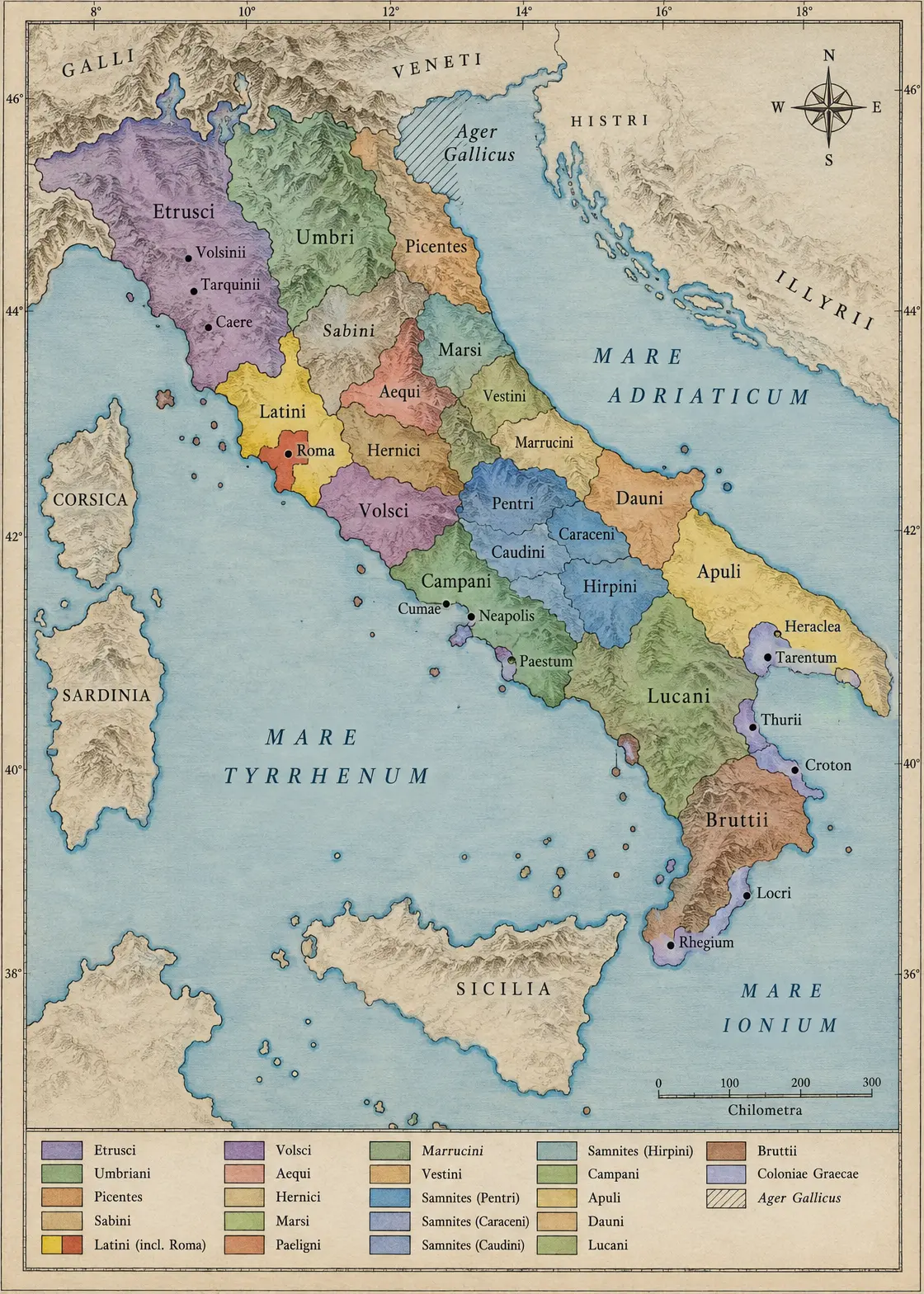
Rome at this moment was a city-state of perhaps thirty to forty thousand citizens controlling, with her Latin allies, a territory of some five thousand square kilometers. She was the largest single power in central Italy, but she was not yet dominant. The Etruscans to her north remained capable of fielding substantial armies, though the loss of Veii in 396 had broken their southern frontier and they were increasingly preoccupied with the Gallic threat above them. The Volscians and Aequi to the southeast continued the chronic frontier warfare with Rome that had marked the entire fifth century, gradually losing ground but not yet beaten. The Hernici and the various peoples of the central Apennines had relationships with Rome that fluctuated between alliance and hostility.
Beyond this immediate ring of neighbors lay the Samnites. The Samnites are the most underestimated of all Rome's Italian opponents, in part because they did not produce a literary tradition of their own and are known to us almost entirely through their enemies. They were a federation of four tribal cantons — Pentri, Caraceni, Caudini, and Hirpini — occupying the rough mountain country of the central-southern Apennines from the Sangro valley in the north to the upper Calore in the south. Their political organization was looser than that of the Roman or Latin city-states but more cohesive than the loose Volscian or Aequian arrangements: each canton had its own assembly and its own meddix (a chief magistrate), and in time of major war the four cantons could be coordinated under a single supreme meddix tuticus. Their population was probably between four and five hundred thousand, perhaps half a million, comparable to Rome's after her Latin alliances are added. They could field, when fully mobilized, armies of forty or fifty thousand men. They fought, by preference, in their mountains. And they regarded the rich plain of Campania, lying between their highlands and the sea, as a legitimate sphere of their own expansion.
In Campania lay the third pole of fourth-century Italian politics: the city of Capua, second only to Rome in size and wealth in the peninsula, occupying the volcanic plain north of Vesuvius and dominating a confederation of Campanian cities (Cumae, Suessula, Acerrae, and the rest) that had originally been Greek and Etruscan but had passed in the fifth century into the hands of Oscan-speaking Italic peoples — Campanians who were, ethnically and linguistically, related to the Samnites of the highlands. The Campanian relationship to the Samnites was therefore that of a wealthier, more urbanized cousin to a poorer, more warlike one. The cousins did not get on. The Samnites of the highlands periodically came down to raid Campania; the Campanians, lacking the manpower to repel them indefinitely, sought outside assistance.
It was the Campanian appeal to Rome in 343 BC that produced the First Samnite War. This was not the only possible casus belli the Romans might have found in Italy at that moment — they were simultaneously engaged with the Volscians and the Aurunci — but it was the one that mattered, because it brought Roman and Samnite into direct collision over a prize both wanted.
The First Samnite War343–341 BC
The opening of the war was a piece of political theater whose exact mechanics Livy reports with greater care than they perhaps merit. The Campanians, attacked by the Samnites and unable to defend themselves, sent ambassadors to Rome seeking alliance. The Romans, who had recently concluded a treaty with the Samnites, were embarrassed and refused. The Campanians thereupon offered an unconditional deditio — surrender of themselves and all their territory to Rome — which placed Rome in a position to defend what was now technically her own. The Senate accepted, sent an embassy to inform the Samnites, and, when the Samnites would not agree to leave Campania alone, declared war. The legalistic care with which Livy reports this transaction suggests that he is following a tradition in which Roman aggression had been carefully repackaged as Roman fidelity to a surrendered ally. The underlying reality was simpler: Rome saw a chance to extend her influence into the richest agricultural plain in central Italy, and took it.
The war itself was brief and inconclusive. The principal engagements recorded by Livy are three:
The Battle of Mount Gaurus (343 BC), fought near the volcanic crater of the Phlegraean fields on the northern flank of the Campanian plain, between the consul Marcus Valerius Corvus and a Samnite force. The Romans had the better of it after a long day's fighting, though the casualties (Livy gives no figures) were heavy. The engagement is notable principally because it gave Valerius Corvus the cognomen Corvinus, from a famous earlier episode in which a raven (corvus) was reputed to have alighted on his helmet during a single combat against a Gallic champion. The Mount Gaurus engagement is the first recorded clash between Roman and Samnite arms, and Livy's account suggests that the Samnites fought in a manner the Romans found unsettling — neither in compact phalanx nor in the headlong charge of the Gauls, but in a fluid, dispersed style adapted to broken country.
The Battle of Saticula (343 BC), fought near the eastern edge of Campania between the consul Aulus Cornelius Cossus and a Samnite army. The engagement is famous chiefly for the deed of the military tribune Publius Decius Mus — father of the man who would die at Sentinum forty-eight years later — who saved the army from envelopment by seizing a hilltop with a small detachment and forcing the Samnites to choose between continuing their attack on the main Roman position (which they had nearly carried) and turning to deal with the troops on the hill. They turned; the Roman main body was thus relieved; and Decius and his men, attempting a night withdrawal, broke through the Samnite encirclement and rejoined Cossus's army with the loss of only a fraction of their number. The episode is the first appearance of a name — Decius Mus — that will recur with singular significance in the wars to come.
The Battle of Suessula (343 BC), fought later in the same year between Valerius Corvus and a regrouped Samnite army, in which the Romans were victorious after a flank attack by a body of Roman cavalry concealed behind a wood. The Samnites broke and fled, the Roman victory was significant but not decisive, and the campaigning season closed with both sides claiming the year.
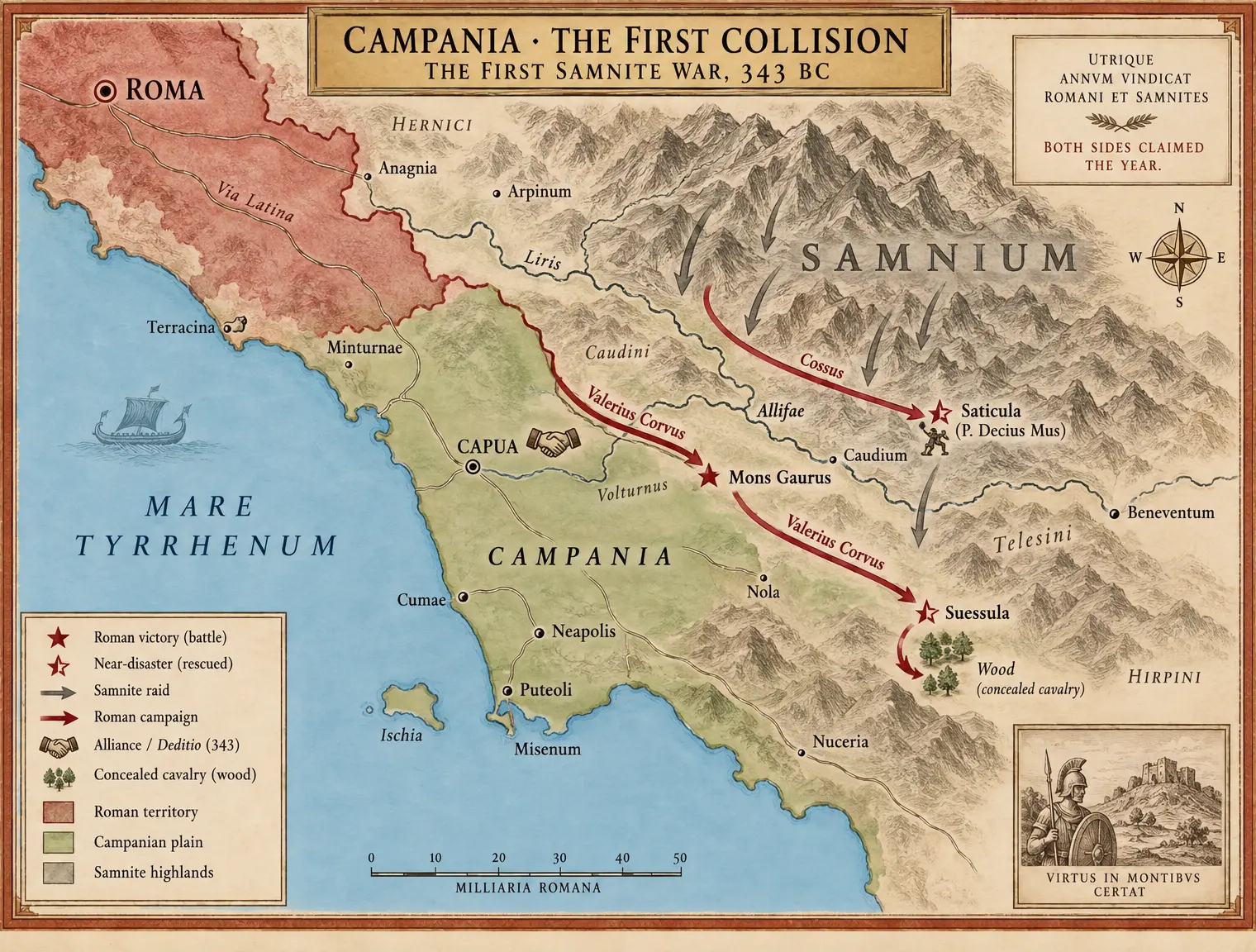
The war ended in 341 BC not because either side had achieved decisive military success but because circumstances changed elsewhere. The Roman army in Campania, restive from extended service and underpaid (the stipendium — soldier's pay — was a recent innovation and not yet reliable), mutinied. The mutiny was suppressed by political concessions including the appointment of Valerius Corvus, who was popular with the troops, as dictator. Meanwhile, the Latins — Rome's nominal allies — had begun to make common cause with the Volscians against Rome herself, and a far more serious war loomed to her south. Rome therefore concluded a hasty peace with the Samnites — restoring the prewar status quo, retaining the alliance with Capua, and ceding nothing of substance — in order to free her hands for the Latin crisis. The First Samnite War was, in retrospect, a probing engagement: each side had taken the measure of the other, and neither had liked what it found.
The Latin War340–338 BC
The Latin League, with which Rome had been associated since the Cassian treaty of 493 BC, had originally been a federation of city-states of roughly equal weight, organized for mutual defense against the Aequi and Volscians and bound by ceremonies on the Alban Mount. By the mid-fourth century the equality had become a fiction. Rome alone had grown faster than her allies; she alone had emerged strengthened from the wars of the fifth century; she alone controlled the principal cult sites and a disproportionate share of the spoils of joint campaigning. The Latins had grown to resent the dominance and to fear, with reason, that their own civic independence would not long survive Rome's continued ascendancy. The Samnite war had exposed Roman strain and Roman manpower demands; the Latins concluded that the moment for a final assertion of their independence had come.
The principal grievance the Latins put forward was specific and constitutional: they demanded full incorporation into the Roman state, with one of the two consulships reserved annually for a Latin and half the Senate to be drawn from Latin cities. The Roman consul Titus Manlius Torquatus reportedly replied that if the demand were ever heard in the Capitoline temple itself he would kill the speaker with his own sword. The reply, if it was made, reveals the depth of the Roman determination not to share power with the cities she had come to regard as subordinates. The Latins, having received no satisfaction, took the field. The Volscians and several Campanian cities (including, treacherously from the Roman point of view, Capua herself) joined the Latin coalition. The Samnites, in a development the Romans had hoped for and apparently negotiated, remained neutral or even supported Rome — the Samnite-Latin enmity over Campanian influence proving stronger than any anti-Roman solidarity.
The war was fought principally in 340 BC and was decided in two great engagements.
The Battle of Vesuvius (340 BC), the first of the two, was fought on the plain north of the volcano (which was, at this date, dormant and not yet recognized as a volcano at all). The Roman army was commanded by the two consuls of the year: Titus Manlius Torquatus and the younger Publius Decius Mus — son of the Decius Mus of Saticula and father of yet another Decius Mus who would die at Asculum. The Latin army was commanded by their own collegial leadership, with the Campanian and Volscian contingents supporting. The two armies, drawn up against each other on level ground, presented an unusual problem: the Latins fought in exactly the Roman style. Their language, their equipment, their tactical organization, even their drill and their command vocabulary were all but identical to the Roman. The combat, when it came, would be one Roman army against a near-mirror image of itself.
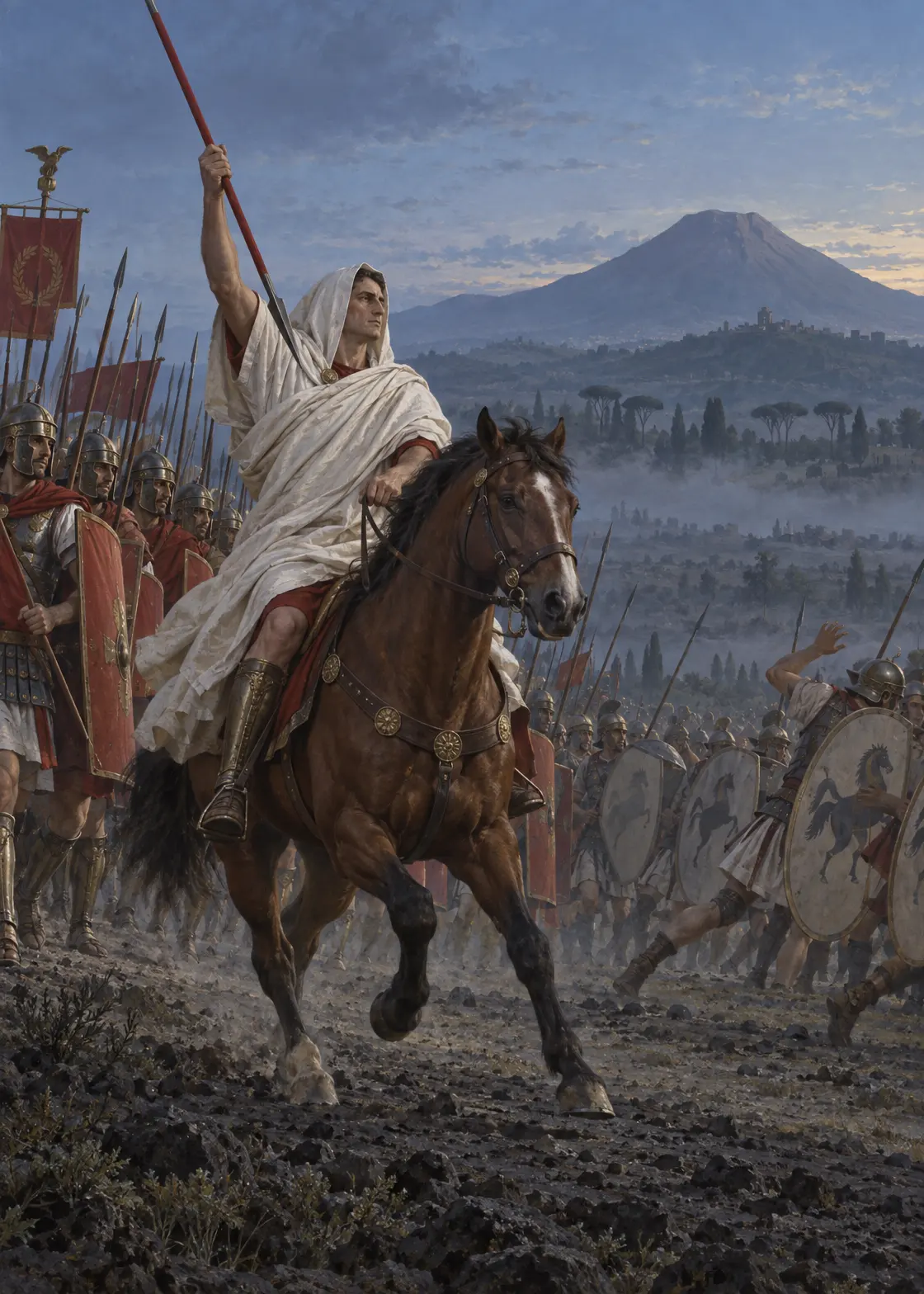
It was on the eve of this battle that the two consuls received, according to the tradition Livy follows, a shared portent in their sleep: a vision in which it was revealed that the army whose general devoted himself to the gods of the underworld would win, and the army whose general was so devoted would lose. The consuls agreed between themselves that whichever wing first showed signs of giving way, the commander of that wing would perform the ritual of devotio — devoting himself and the enemy army to the gods below — and ride into the enemy line to die.
The devotio of the Decii is the single most extraordinary tradition in the early Republican military record. The ritual itself, of which we have a reasonably full description, involved the general standing on a javelin, draping his toga in a particular manner, and reciting a long formula addressed to Janus, Jupiter, Mars, Quirinus, Bellona, the Lares, the Novensiles and Indigetes, the gods of the dead, and the gods of the place. The formula consigned the speaker and the enemy army to the gods of the underworld. The speaker would then ride against the enemy unarmed or fighting recklessly until killed. If the ritual was performed correctly and the devotus fell, the gods were bound to deliver the enemy army to destruction. If the devotus survived, an effigy had to be buried in his place and the man was forever after disqualified from religious office. The ritual was, evidently, archaic; it preserved something of the deep substrate of Italic religion at a moment when Greek and Etruscan rationalism had not yet wholly displaced the older formulations.
At Vesuvius, Decius Mus performed the devotio. The Roman left, where Decius commanded, had begun to give way; he summoned the pontifex Marcus Valerius to dictate the formula, mounted his horse, and charged the Latin line until killed. The Latins, the tradition reports, faltered in superstitious dread at the sight; the Roman line stiffened and held; Manlius Torquatus, commanding the right, pressed his advantage; and the Latin army broke and was destroyed. The casualties on both sides were severe — Livy gives a figure of seventy-five percent loss for the Latins, which is doubtless inflated but reflects the Roman memory of the engagement as a battle of annihilation.
But Manlius Torquatus's own contribution to the day's discipline was no less remarkable. Before the battle, his own son — Titus Manlius the younger — had violated explicit orders by accepting single combat with a Latin champion named Geminus Maecius. The son had won the combat and brought the spoils to his father. The father, in the most famous act of disciplina militaris in the Roman military tradition, had his son executed on the spot. Imperia Manliana — Manlian commands — became the proverbial expression for orders enforced with absolute and unbending severity. Livy reports the episode at length and with evident discomfort, recognizing that the Roman tradition celebrated it as an exemplary act while finding it personally horrifying. The combination of the devotio of Decius and the execution of the younger Manlius gave the Battle of Vesuvius an exemplary force in Roman memory disproportionate to its purely military significance.
The Battle of Trifanum (340 BC), the second of the year's great engagements, was fought somewhere on the river Liris between Sinuessa and Minturnae — the precise location is disputed — between Manlius Torquatus, now commanding alone, and a combined Latin-Campanian-Volscian force. The Romans were again victorious, and decisively so; the Latin army that had survived Vesuvius was now broken, the war effectively over. The two consular battles of 340 had together decided the conflict in a single campaigning season.
The Latin Settlement of 338
What followed in 338, after two further years of mopping-up operations, is one of the most important political-military decisions in Roman history. The Romans had to determine what to do with the defeated Latins. The available models were familiar from Greek practice: outright annexation; vassalage with tribute; expulsion of populations; the establishment of garrisons. The Romans chose none of these, or rather they chose all of them, in a graduated arrangement matched to the specific circumstances of each defeated community.
The Latin League itself was dissolved as a political entity. The principal Latin cities — Tusculum, Aricia, Lanuvium, Pedum, Nomentum — were granted full Roman citizenship and incorporated directly into the Roman state. Their populations became Roman citizens with all rights and obligations; their territories became Roman territory; their magistrates were absorbed into the Roman political class. Other Latin communities, less central or less reliable, received a status known as civitas sine suffragio — citizenship without the vote — which gave them the protections of Roman law and the obligation of Roman military service but withheld the franchise. Some communities (Tibur, Praeneste) were left as nominally independent allies but bound to Rome by treaty. The Latin colonies — settlements founded jointly by the League — were preserved but were now Roman colonies under Roman supervision. Capua and the Campanian cities, despite their defection, were given civitas sine suffragio on remarkably generous terms, the Romans evidently calculating that goodwill in Campania was worth more than punishment. Velletri and Antium, however, the most stubborn of the Volscian cities, were treated harshly — their walls torn down, their fleet's prows ripped off and brought to Rome to decorate the speaker's platform in the Forum that would forever after be called the Rostra.
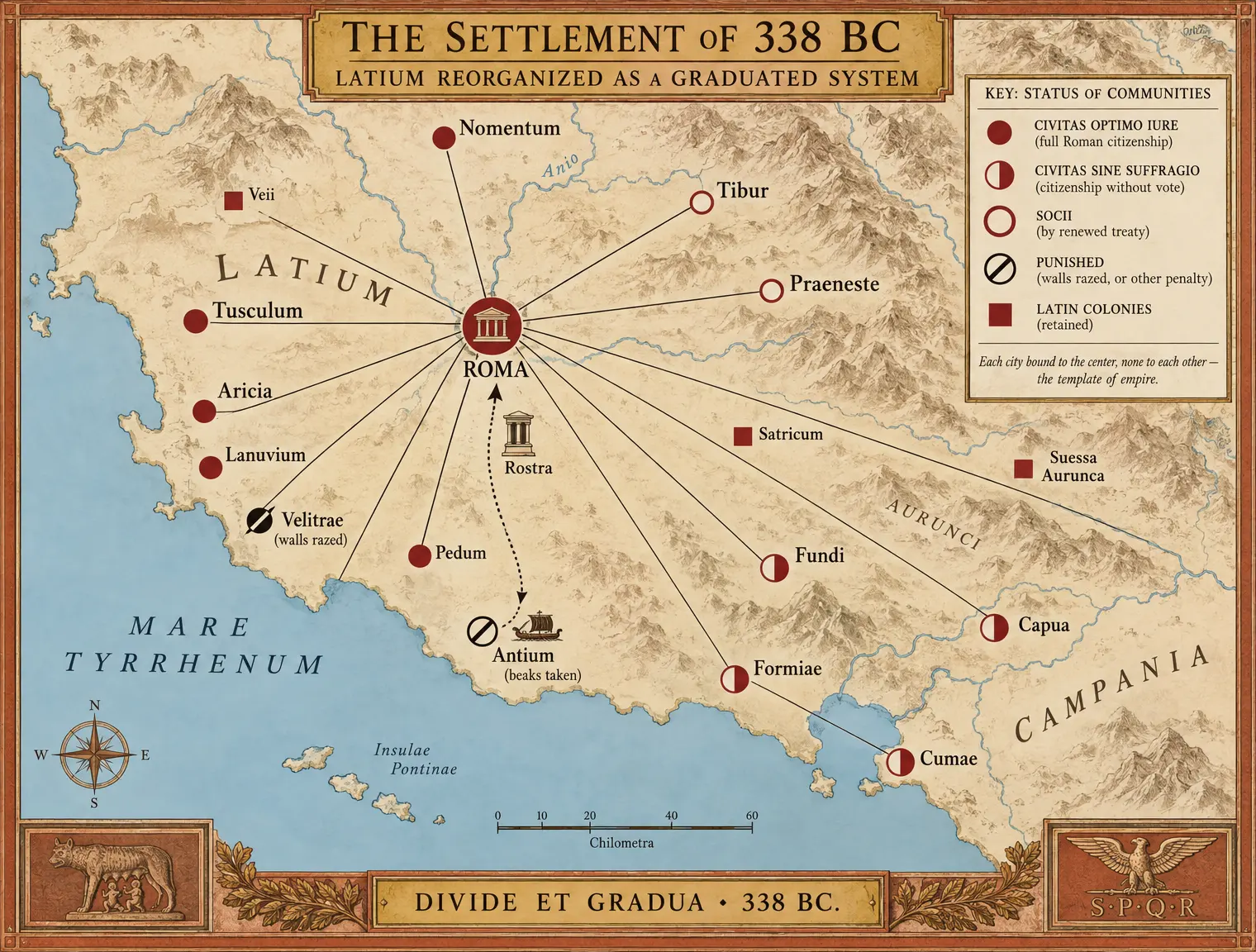
The genius of the settlement was not in any single one of its provisions but in their combination. The Romans had invented, or perfected, a political technology unknown to the Greek world: a graduated alliance system that combined incorporation, partial citizenship, and treaty alliance in proportions matched to the particular history of each defeated community. The system gave every defeated party a stake in the Roman order, varying levels of obligation, and varying levels of privilege, without surrendering Roman strategic control of any of them. It also produced, almost immediately, a vast expansion in Roman military manpower: the Latin allies became contingents in the Roman army, fighting alongside the legions under Roman command but recruited and equipped at allied expense. The Roman army of the late fourth century, the army that would fight and win the Samnite wars and would face Pyrrhus, was institutionally an army of Romans and socii — Romans and allies — in roughly equal proportions. Without the manpower mobilized by the Latin Settlement, the conquest of Italy could not have proceeded.
The historian Theodor Mommsen, writing in the 1850s, called the Latin Settlement "the greatest political achievement of the Roman state" before the wars with Carthage, and the judgment has stood. What was achieved in 338 was not merely the suppression of a revolt; it was the creation of the institutional framework within which all subsequent Roman expansion in Italy would be carried out. Every defeated Italian people — Volscian, Samnite, Etruscan, Greek — would receive, in time, some variant of the Latin Settlement: incorporation or partial incorporation, with graduated rights, with military obligations, with the apparatus of Roman law and Roman administration superimposed on local self-government. The Italian alliance system would prove flexible, resilient, and (until the Social War of 91–88 BC, two centuries later) durable. It was the Latin Settlement, more than any single battle, that determined that Rome and not some other Italian city would dominate the peninsula.
The Crossroads · 338 BC · The Curia Hostilia, Rome
The Settlement of Latium
You are a Roman senator sitting among the patres in the Curia, deliberating the fate of the defeated Latin League, the Campanian cities, and the Volscians after the final victories at Vesuvius and Trifanum.
The two-year Latin War is over, leaving Rome absolute master of Latium and northern Campania. The Latins, who share Roman speech, tactical doctrine, and Alban cults, rebelled when Rome refused to share the consulship and Senate. Traditional Greek imperial models offer obvious paths: extract tribute and install standing garrisons, annex the land outright, or raze cities and expel their inhabitants. Yet to Rome's east and south loom the Samnites, a confederation of half a million highlanders fielding forty thousand warriors, who observed the conflict with keen interest. Rome must settle Latium so it never rebels again, without bleeding her own strength or driving her neighbors into Samnite arms.
How should the Roman Senate organize and treat the defeated Latin cities, their Campanian allies, and the rebellious Volscians?
Weigh each course: open it to hear your own inner voice. Then decide. Nothing is scored.
- Your inner voiceThe course taken
Total conquest demands finality. If we raze their walls, expel the hostile populations from the plains, and divide their fertile lands among our plebeians, we extinguish the Latin threat forever. But the cost in blood and fury will be immense. To uproot kin who share our speech, our cults, and our blood will brand us as tyrants across Italy, driving Etruscans and Samnites together into a desperate war against our naked greed.
- Your inner voiceThe course taken
Let us follow the well-tested Greek model. By exacting tribute and planting garrisons in their citadels, we enrich our treasury while keeping our citizenship unpolluted by those who recently raised their spears against us. Yet garrisons demand standing expenditures and invite ceaseless local resentment. We would sit atop a sullen ring of subjects, watching day and night for the next rebellion while the Samnites watch us both from their mountain ridges.
- Your inner voiceThe course taken
We cannot govern as tyrants, nor can we pretend the rebellion never occurred. If we dissolve their league, we must divide their interests. Let Tusculum and our nearest neighbors share our full citizenship and magistrates. Let less reliable towns and Capua receive our law and obligations without the vote, while Tibur and Praeneste stand as bound allies. It dilutes our exclusive primacy, but it binds their swords to ours for the greater trials ahead.
What was done
The Senate dissolved the Latin League as a political body and instituted a graduated arrangement matched to each community. Core Latin cities—Tusculum, Aricia, Lanuvium, Pedum, and Nomentum—received full Roman citizenship, absorbing their magistrates into the Roman elite. Other Latin communities and the Campanian cities, including Capua despite its defection, received civitas sine suffragio, binding them to Roman law and military levy without political franchise. Tibur and Praeneste were kept as treaty-bound allies, while joint Latin colonies were preserved under Roman supervision. Antium and Velletri were punished harshly; Antium's naval prows were mounted upon the Forum speaker's platform to create the Rostra. This settlement (BGrade B) created a novel political architecture. It doubled Roman military manpower through allied contingents (socii) serving at their own expense, giving Rome the institutional engine that would sustain her across the coming Samnite wars.
The evidence The principal narrative is Livy 8.1–14 (BGrade B), supplemented by fragmentary text in Dionysius of Halicarnassus 15 (BGrade B) and Diodorus 16 (CGrade C). Later summaries appear in Florus 1.14 (CGrade C) and Eutropius 2.5–7 (CGrade C). The institutional categories of the settlement—full citizenship, civitas sine suffragio, and treaty allies (socii)—are independently verified by epigraphic evidence (AGrade A) and later Republican legal tradition. The Editor's Note assigns an overall Attestation BGrade B to the Latin Settlement.
If you choose to walk through itAt every scale
- Yourself
As a senator who may soon command these very men in the field, can you trust a soldier whose city you have stripped of its ancient independence?
- Those beside you
Will your patrician family tolerate sharing magistracies, land, and civic honors with defeated Latin aristocrats whose hands are stained with Roman blood?
- Rome
Can the Republic preserve its ancestral constitution if it absorbs dozens of foreign communities into the citizen rolls and army rolls?
- The wider world
Does granting graduated rights reconcile defeated neighbors, or does it leave them waiting for a Samnite army to champion their liberation?
- Our own time
When an expanding power overcomes cultural cousins, under what conditions does incorporation succeed where military subjugation breeds permanent insurgency?
Following World War II, Western policymakers rejected the punitive extraction and territorial dismemberment that had destabilized Europe after 1918, crafting instead a graduated framework of institutional, economic, and defensive ties for West Germany. By integrating a defeated adversary through tiered structures—the European Coal and Steel Community, the Western European Union, and eventually NATO—the Western bloc transformed an existential enemy into an indispensable frontier bastion and military contributor during the Cold War.
Where the comparison fails. The Federal Republic retained domestic sovereignty and negotiated multilateral treaties as a diplomatic peer, whereas Rome imposed the Settlement unilaterally, dismantling the Latin League and placing allied military contingents under the direct command of Roman magistrates without giving them a vote.
What does the chapter tell us?
What was the primary constitutional demand made by the Latin League prior to the outbreak of the Latin War in 340 BC?
Livy records that the Latins demanded full incorporation into the Roman state, specifically insisting on one of the two annual consulships and half of the Senate seats, which the consul Titus Manlius Torquatus furiously rejected.
Livy 8.1–14 (BGrade B)
Why did Rome conclude a hasty peace with the Samnites in 341 BC, ending the First Samnite War without decisive territorial gains?
Rome faced military mutiny in Campania caused by unreliable soldier's pay (stipendium) and the far more dangerous threat of a Latin-Volscian coalition on her southern border, forcing the Senate to restore the prewar status quo with the Samnites.
the chapter's narrative; Livy 7.29–38 (BGrade B/C)
According to the chapter's Editor's Note, how do modern scholars evaluate the tradition of the Decian devotio?
Modern historians such as Cornell and Oakley treat the three generations of Decian devotio with varying skepticism, generally accepting the historicity of the Sentinum sacrifice while doubting the later Asculum account as family-historical embellishment.
Editor's Note (CGrade C for dramatic episodes; Oakley/Cornell cited)
What legal status did Rome grant to Capua and other Campanian cities under the Latin Settlement of 338 BC despite their defection?
Rome granted Capua and its Campanian confederates civitas sine suffragio on remarkably generous terms, calculating that securing Campanian goodwill and military obligations was far more valuable than inflicting punitive damage.
Livy 8.1–14 (BGrade B); epigraphic evidence (AGrade A)
What was the decisive strategic consequence of the Latin Settlement for Rome's subsequent military expansion in Italy?
By turning defeated Latin communities into allied contingents (socii) equipped at their own expense, the settlement built a military system where Roman and allied troops fought in roughly equal proportions, enabling Rome's subsequent conquest of peninsular Italy.
the chapter's narrative; epigraphic evidence (AGrade A)