Book I · The Republic in Italy
Chapter 3
The Long Samnite War
The Drift to a Second War
The peace of 341 between Rome and Samnium had been an exhausted truce rather than a settlement of differences. The fundamental issue between the two powers — who would dominate Campania and the strategic corridor between the central Apennines and the Tyrrhenian coast — had not been addressed but only deferred. Across the fifteen years that followed, both powers continued to expand in directions that were bound, eventually, to bring them again into collision.
The Roman expansion was the more visible and the more aggressive. After the Latin Settlement of 338, Rome found herself in command of a military and political instrument of unprecedented power in central Italy. The Latin allies provided manpower for offensive war; the new system of Roman colonization — the founding of coloniae Latinae and coloniae civium Romanorum at strategic points — provided a means of consolidating conquests as they were made. Cales (modern Calvi Vecchia) was founded in 334 as a Latin colony commanding the road from Latium into northern Campania, twenty miles from Capua. Fregellae, refounded as a Latin colony in 328 on the middle Liris, gave Rome a permanent military presence in territory the Samnites considered their own legitimate sphere of influence. The Romans were, in essence, building forward positions for the next war while still ostensibly at peace.
The Samnite expansion, less visible because we have it only from hostile Roman sources, was directed principally southward and southwestward into Apulia and Lucania. The Greek cities of Magna Graecia — Tarentum especially, but also Thurii and Heraclea — had begun to feel pressure from the inland Italic peoples whom they had previously been able to keep at arm's length. The Samnites and the Lucanians (their southern kin) were extending their political and military reach into areas the Greeks regarded as their own. Tarentum, the wealthiest of the Greek cities of the south, had begun to hire mercenary armies from the Greek homeland to defend her interests — a pattern of dependency on outside military force that would continue for the next sixty years and would, in 281, produce the appeal to Pyrrhus.
The immediate trigger for the second war between Rome and Samnium was the city of Neapolis (modern Naples) — a Greek foundation on the Bay of Naples, with a substantial mixed Greek and Oscan-speaking population. Neapolis had been pressured by Samnite raids and had appealed to Rome for protection. Rome had concluded an alliance with the city and had stationed a garrison there. The Samnites, regarding Roman intervention in the Bay of Naples as a direct violation of the spheres of influence implied by the peace of 341, took up arms. The Roman response, in 326 BC, was a formal declaration of war.
The Opening Campaigns326–322 BC
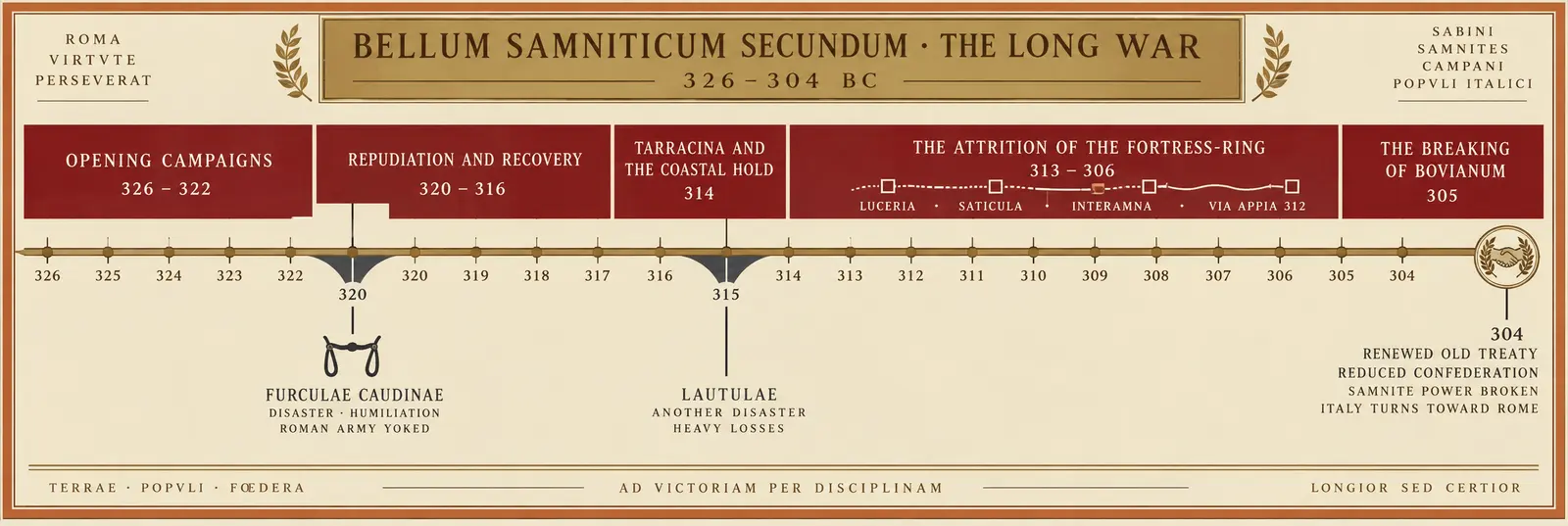
The first five years of the war were marked by Roman advances in the broad theater between the Liris and the Volturno, with a series of fortified positions either taken from the Samnites or established to control the country. The Romans took Rufrium (the location is now uncertain but was probably in northern Samnium), captured the town of Allifae on the upper Volturno, and pushed forward into the Caudine country. Major engagements were fought, but Livy's narrative for these years is repetitive and the details suspicious — he frequently records two consular battles per year, each ending in a Roman triumph and each followed by no perceptible advance in Roman strategic position. Modern scholarship treats the year-by-year battle record of this period as largely annalistic invention, with the underlying truth being a series of Roman raids and Samnite counter-raids producing no decisive change in the strategic situation.
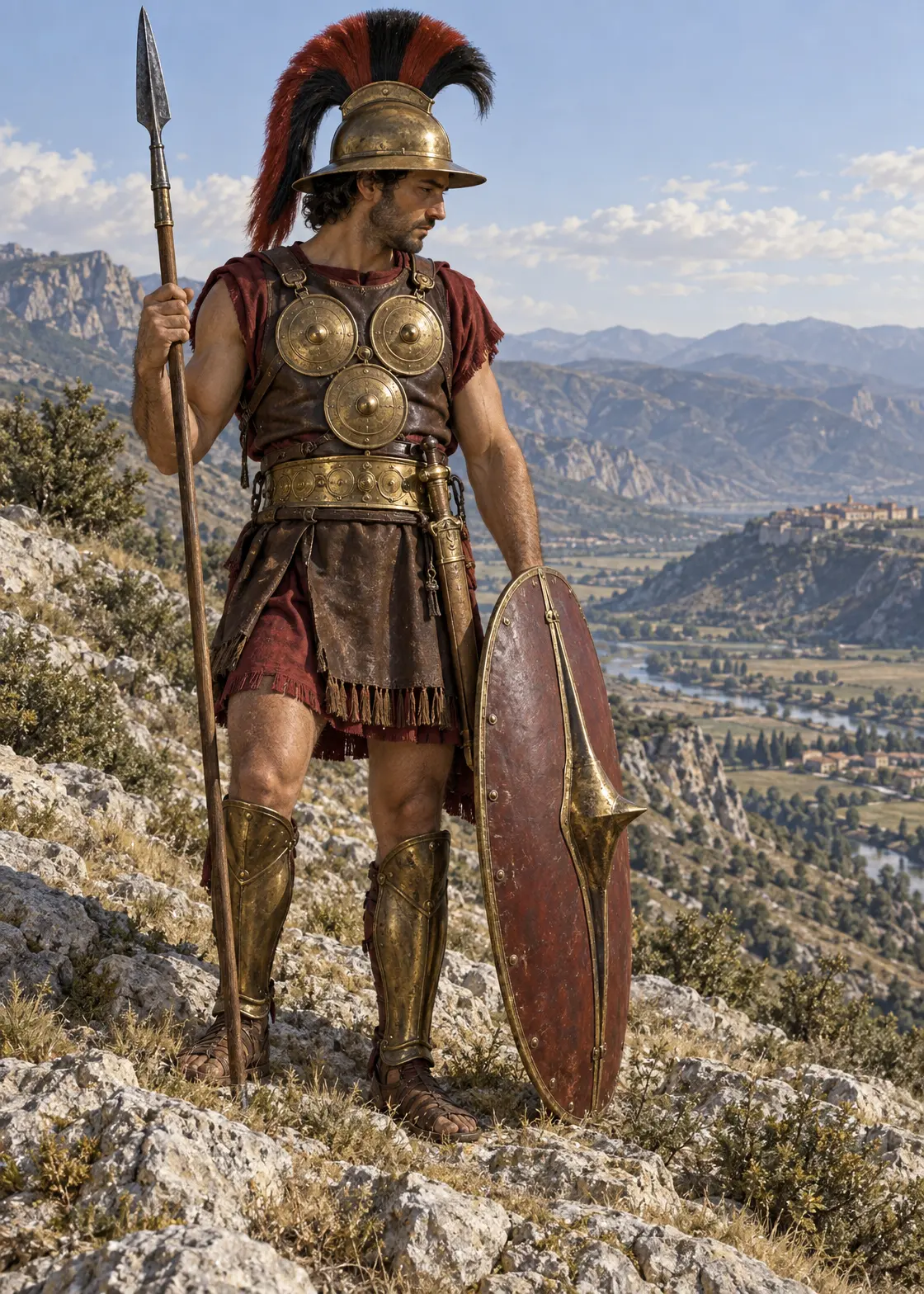
What is reasonably well attested is the development, during these years, of a new Roman military doctrine. The Samnites, fighting in their mountains and forests, did not present themselves for the kind of set-piece battles in which the Roman phalanx could be brought to bear with full weight. They preferred ambush, harassment, and the disruption of Roman columns on the march. The Roman response, evolving across the campaigns of the late 320s, was the manipular legion — a formation that broke the close-order phalanx into smaller tactical units (manipuli, "handfuls") capable of independent maneuver. The legion of about 4,500 men was organized into thirty maniples of varying size (the hastati and principes in maniples of 120, the triarii in maniples of 60), drawn up in a three-line triplex acies with intervals between maniples that the second and third lines could cover. This formation could fight on broken ground; it could absorb local pressures without breaking the line; it could maneuver in detachment to flank or exploit; and it could, in extreme need, retire by lines, with the hastati falling back through the intervals to be replaced by the principes, and the principes in turn by the triarii.
Whether the full manipular system was in place by 326 or developed during the war itself, and whether it should be credited to the reforms of Camillus (as the later Roman tradition held) or to the demands of the Samnite terrain (as modern military historians prefer), is impossible to say with certainty. The manipular legion as Polybius would describe it in the second century BC was a mature system; somewhere between the phalanx of the Allia and the manipular triplex acies of the Punic Wars, the transformation took place, and the Samnite Wars are the most plausible context for it.
What is sometimes called the equipment revolution — the abandonment of the round Greek-style clipeus in favor of the long oval Italic scutum, the substitution of the throwing pilum for the thrusting spear, the standardization of the gladius hispaniensis (though that adoption is somewhat later) — is part of the same transformation. The Roman soldier of 280 BC, fighting Pyrrhus at Heraclea, was equipped and trained for a different war than the Roman soldier of 390 BC, lying dead on the field of the Allia. The Samnite Wars were the principal forge in which the change was effected.
The Caudine Forks321 BC
The Caudine Forks (Furculae Caudinae) are a defile in the mountains between Capua and Beneventum, on the road that crossed the Apennine spine through the territory of the Caudini — the third of the four Samnite cantons. The pass takes its name from the steep wooded valleys at either end, which constrict the road to a narrow track passable only in single file or in column of small units, with the road then opening out into a broader middle valley before constricting again at the second defile. An army marching through the Forks is, for a stretch of two or three Roman miles, almost entirely committed to the road; it cannot deploy, cannot maneuver, cannot easily turn back. An enemy holding the two ends of the defile holds the army in a vise.
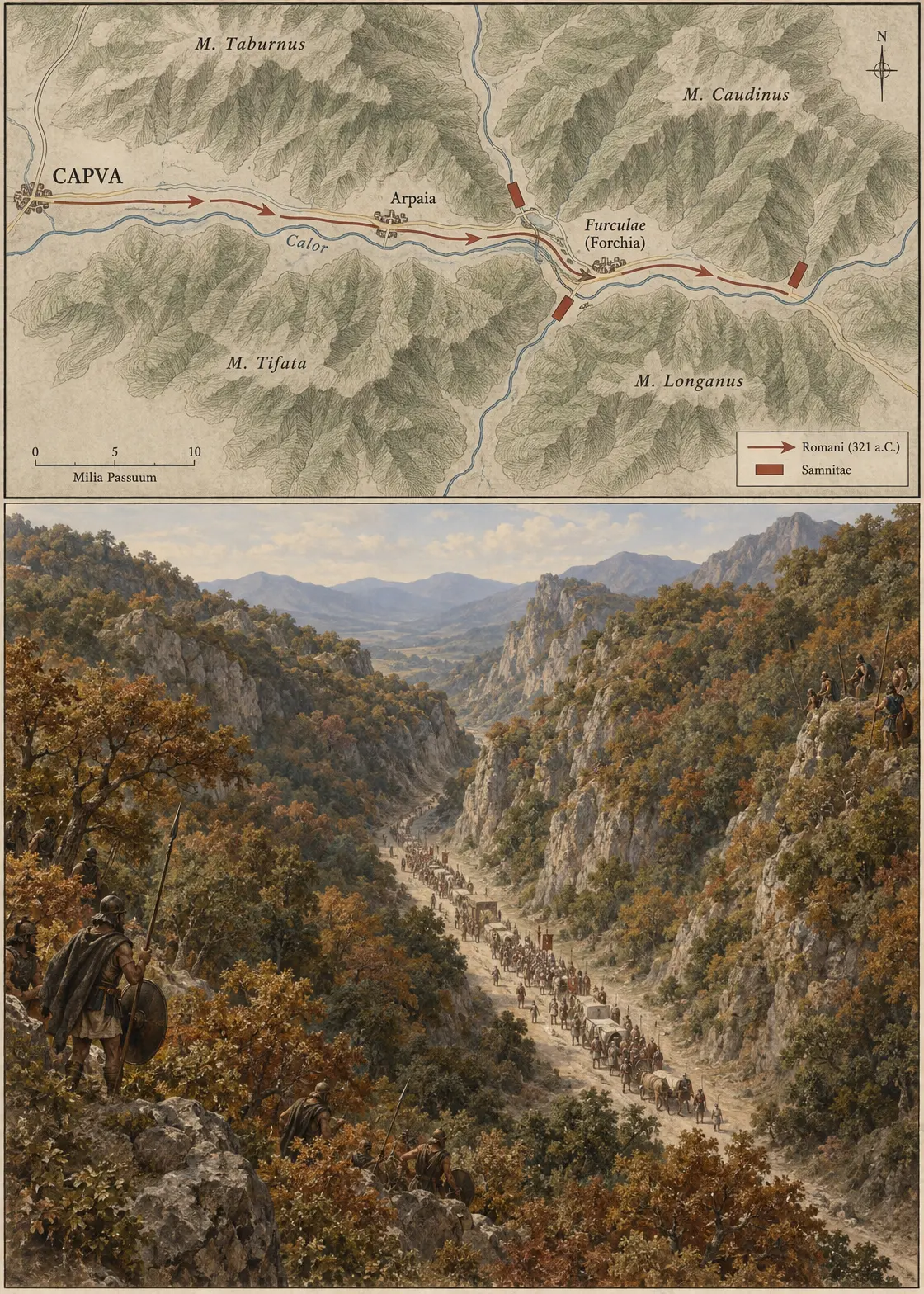
In the spring of 321 BC, the two Roman consuls of the year — Titus Veturius Calvinus and Spurius Postumius Albinus — were operating in northern Samnium with a combined army of perhaps thirty thousand men, four legions and the corresponding allied contingents. The Samnite commander, Gaius Pontius (son of Herennius Pontius, the most respected of the Samnite elder statesmen), had withdrawn his army southeastward into the Caudine country. The Romans, hearing that Pontius was threatening the Roman ally Lucera in northern Apulia, set out from Capua to relieve it. The road they chose led through the Caudine Forks.
How the Romans came to make this choice is not entirely clear from the sources. Livy reports that Pontius had circulated false intelligence through captured Roman scouts — peasants who, on being released by the Samnites, reported to the consuls that the Samnite army was at Lucera. The consuls, accepting this report, chose the shortest route to Lucera, which went through the Caudine Forks. Modern military historians have been more skeptical: the Forks were a known dangerous position and the Romans should have had better intelligence than to march into them blind. But the sources are unanimous that the Roman army entered the western defile, traversed it without resistance, debouched into the middle valley, found the eastern defile blocked by Samnite forces, attempted to retreat through the western defile, and found that closed behind them by additional Samnite forces. The trap was sprung. The Roman army of two consuls — approximately a fifth of the total Roman military establishment — was caught in the middle valley with no possibility of breaking out by force.
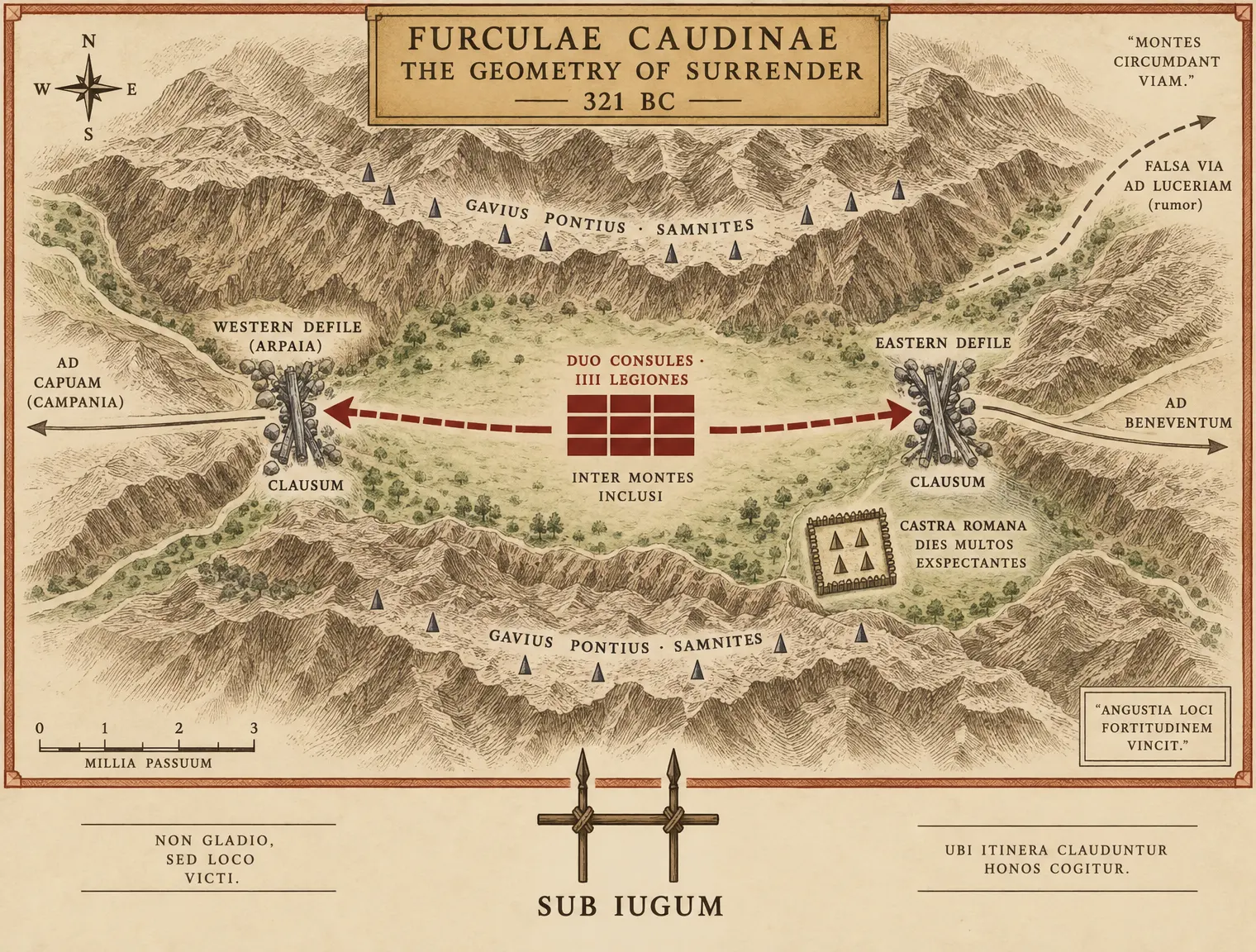
What followed is among the most extraordinary episodes in Roman military history. The Samnites did not attack. Pontius, the Samnite commander, recognized that the Romans were entirely at his mercy and could be massacred at his leisure; but he also recognized, with a strategic vision that the Roman tradition itself acknowledges, that the long-term political consequences of massacring a Roman consular army would be ruinous for Samnium. He sent to his father Herennius Pontius, who was old and wise and was consulted as the Samnite tradition's elder counselor, asking what to do. Herennius gave an answer in two parts. First option: release the Romans completely unharmed, without conditions, as an act of generosity that would create a basis for lasting friendship. Second option: kill them all to a man, breaking Roman military power for a generation. Both were possible courses; neither was clearly better than the other; but the worst possible course, the one combination of cruelty and weakness that would produce only resentment without producing strategic security, was to humiliate them and let them go.
This last option was the one Pontius chose.
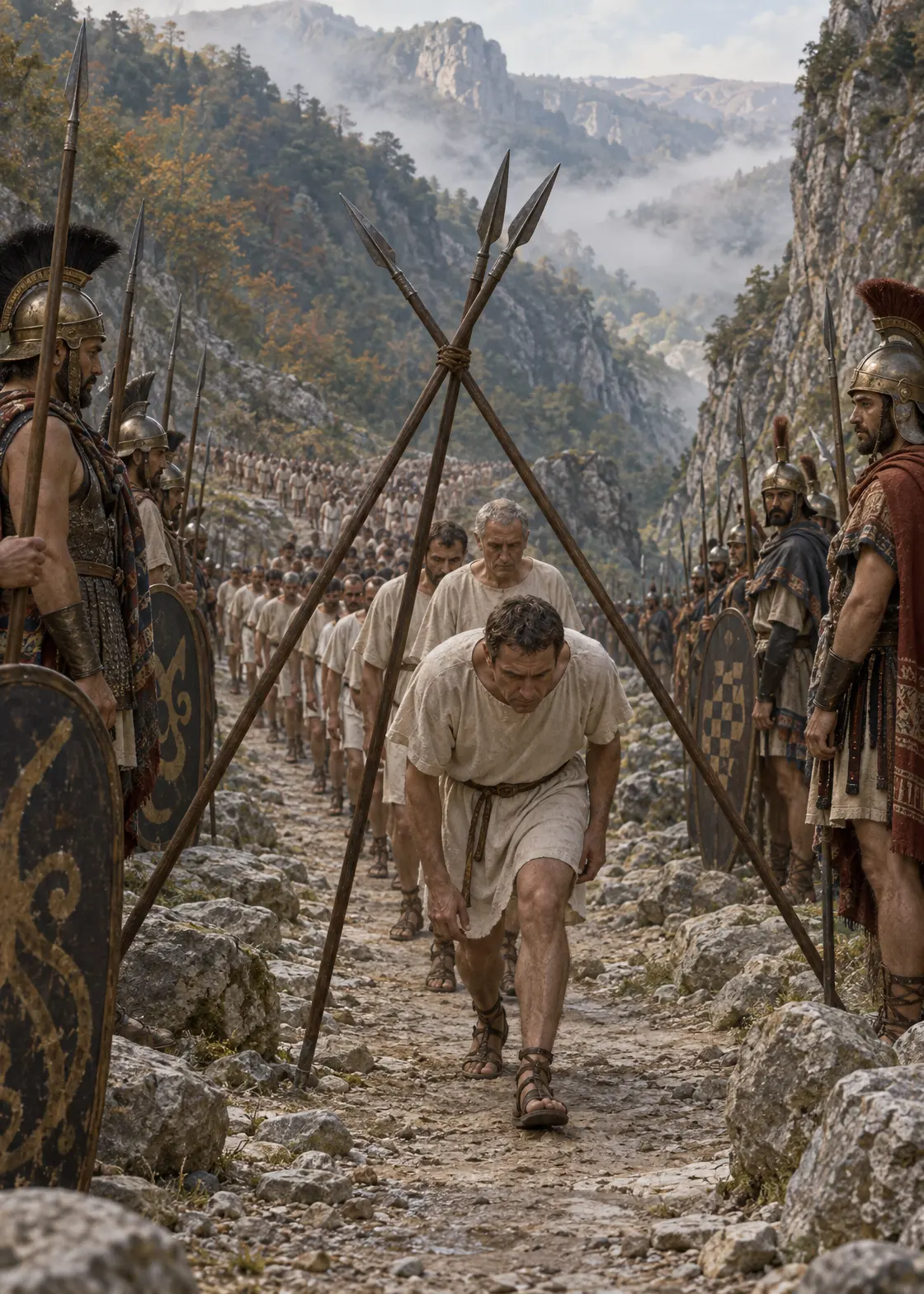
The terms imposed on the Roman army were calculated to inflict the maximum possible disgrace short of bloodshed. The consuls, the army's officers, and the soldiers were to surrender all their arms and armor. They were to be stripped to their tunics. They were to be made to pass under the yoke — a low arch of three javelins set in the ground, under which a man could pass only by bending and stooping. The yoke was an ancient Italian symbol of military submission, the equivalent of being marched in chains, and the Romans found it more humiliating than they could express. The two consuls were required to swear, on behalf of the Roman state, to a peace treaty that would withdraw Roman positions from Samnite territory, dissolve the recent colonies of Cales and Fregellae, and acknowledge a permanent boundary at the line of the Liris. Six hundred Roman knights were taken as hostages to ensure the treaty's observance. With these conditions met, the army was released.
The Roman army returned to Capua in a state of unprecedented humiliation. The consuls reportedly entered the city at night, by the side gates, and did not attempt to convene the Senate or the popular assemblies. The shame was sufficient that some of the survivors are said to have committed suicide rather than face their fellow citizens. The Senate, debating what to do, eventually reached a position which Livy presents at length and with evident relish: the treaty (Senate argued) was not valid, because the consuls had had no authority from the Roman people to conclude it, and was therefore not binding on Rome. The consuls themselves and the chief officers who had sworn to the treaty were to be returned to the Samnites — stripped, bound, and offered up at the boundary — as the only persons whom the treaty bound. The Samnites would then be free either to accept these officers as the only persons obligated, or to do with them as they pleased.
The fetial priest Spurius Postumius — who had been one of the consuls — was the one who proposed and carried out this transaction. Bound and offered at the Samnite border, he was reportedly rejected by the Samnites, who recognized that the Romans were attempting a sophistical evasion of a binding treaty and who returned him with the message that they would not be made parties to such a juridical farce. The treaty, the Samnites declared, had been concluded between armies in the field, and Rome was either bound by it or had broken faith. The Romans chose to consider themselves not bound. The hostages were lost. The war resumed.
The historicity of the foedus Caudinum and the subsequent juridical maneuver is a contested problem. Livy reports the episode in detail and with conviction. Cicero in De Officiis uses it as an exemplary case of the relationship between civic obligation and individual conscience. The institutional memory of Roman shame at the Caudine episode is so strong, and the legal fiction by which the treaty was repudiated so peculiarly Roman, that the broad outline is generally accepted as historical. The dramatic details — the speech of Herennius Pontius, the specific terms of the yoke, the wording of the Senate's eventual repudiation — are reconstructions whose accuracy cannot be tested. What is certain is that something went catastrophically wrong for the Roman army in the Caudine country in 321, and that the Roman political and military system absorbed the catastrophe and continued the war.
The Roman Recovery320–315 BC
What followed the Caudine catastrophe is, in some ways, more remarkable than the catastrophe itself. The Romans repudiated the treaty, returned to the war, and within five years had reversed every territorial concession the Caudine peace would have required. The recovery was achieved partly by tactical adjustment and partly by the long-term advantages — manpower, alliance system, political coherence — that the Roman position in central Italy had built over the preceding generation. The Romans could absorb a catastrophic defeat in a way the Samnites, with their looser confederation and smaller demographic base, could not.
The principal engagements of the recovery years are less famous than Caudine but were militarily more important. Roman armies under successive consuls (Lucius Papirius Cursor and Quintus Publilius Philo were the most prominent commanders of the period) recovered Fregellae, retook the Caudine country, and pushed forward into Apulia and northern Samnium. Papirius Cursor in particular emerges as the dominant military figure of the period — a stern disciplinarian who was twice dictator and five times consul, who reportedly forbade his cavalry to drink wine while on campaign, and who is credited by Livy with the principal victories of 319 and the years following.
It is during this period that we should probably locate the formal development of the manipular legion in its mature form. Livy attributes a series of military reforms to this period, including changes in equipment, in tactical drill, and in the organization of the army's lines. The detail is suspect (Livy tends to assign reforms to particular individuals when in reality the changes were probably gradual and anonymous), but the broader claim — that the Roman army of 310 BC was tactically more flexible and more effective than the Roman army of 326 BC — is supported by the campaign record. The Samnites had taught the Romans how to fight on broken ground; the Romans, characteristically, had learned the lesson and surpassed their teachers.
Lautulae and the Crisis of 315 BC
In 315 BC the war turned again. A Samnite army under the meddix tuticus Gellius Egnatius — a name that will recur in connection with the later Coalition War — broke out of the Apennine fastness and drove south into Latium, threatening Rome's own frontier. The dictator of the year, Quintus Fabius Maximus Rullianus (grandfather of the famous Cunctator), confronted the Samnite army near Lautulae, a pass on the coast between Anxur (Terracina) and Fundi.
The Battle of Lautulae was, by Livy's account, a Roman defeat — a rare admission for the annalistic tradition and probably therefore reliable. The Samnites broke the Roman line, killed the magister equitum Quintus Aulius Cerretanus, and forced Fabius to retreat northward. The defeat exposed Latium to Samnite raids; the loyal cities of the Latin alliance were tested; some Campanian cities, including Capua, wavered. The crisis was severe and threatened to undo the Latin Settlement of 338 only twenty-three years after its conclusion.
But the crisis passed. Fabius regrouped, was joined by additional forces under the new consul Publius Decius Mus (the father of the man who would die at Sentinum five years later, the grandson of the man who had died at Vesuvius twenty-five years before — the Decian devotio tradition produced multiple generations of consuls who shared the family name and, on occasion, the family fate), and inflicted a defeat on the Samnites at Tarracina that restored the position. The Latin allies remained loyal. Capua's wavering was punished by political reorganization (the city was placed under a Roman prefect and lost some of the local autonomy it had retained since 338), but it was not allowed to defect. The 315 crisis was contained; the war continued; the strategic balance, narrowly, held in Rome's favor.
Bovianum and the End of the Second Samnite War
The closing years of the war, from 314 to 304, were a slow Roman grinding-down of Samnite capacity for resistance. The Romans took fortified positions in northern Samnium one after another. They established new colonies — Luceria in Apulia (314), Interamna (312), Sora (303) — as forward bases. They built the first stretches of the Via Appia, the great military road that ran from Rome to Capua and would eventually extend to Brundisium, providing strategic communications across the conquered territory. The censor Appius Claudius Caecus, after whom the road was named, was the architect of much of this consolidation; his political program (which included the inclusion of the sons of freedmen in the Senate and the redistribution of various ritual functions) was bitterly contested at Rome but his strategic vision for the conquest of central Italy is reasonably clear from the works he undertook.
The decisive engagement of the war's closing phase was fought near Bovianum (modern Boiano), the principal town of the Pentri Samnites, in 305 BC. The Roman consuls — Lucius Postumius Megellus and Tiberius Minucius Augurinus — converged on Bovianum from two directions and engaged the Samnite army of the meddix tuticus Statius Gellius in a major battle. The details of the fighting are not well preserved, but the outcome is firmly attested: the Samnite army was broken, Statius Gellius was captured, and Bovianum itself was sacked. The Pentri canton, the largest and most populous of the four Samnite cantons, had been reduced to a strategic ruin.
The peace was concluded in 304 BC. The Samnites accepted a treaty that recognized Roman dominance in Campania and along the western Apennines, that ceded the Liris valley and the upper Volturno definitively to Roman colonization, and that placed strict limits on Samnite political independence. The Caudine humiliation had been reversed many times over. The Latin colonies that the foedus Caudinum had ordered dissolved were now reinforced. The Samnite confederation, though not destroyed, had been reduced from a co-equal rival of Rome to a defeated power within the Roman sphere.
But the Samnites had not been broken in spirit. The peace of 304 was a recognition of defeat, not an acceptance of subjugation. Within seven years they would be at war again, this time as the senior partner in a coalition that would include the Etruscans, the Umbrians, and the Senonian Gauls. The decisive engagement of that war would be fought at Sentinum, and a Decius Mus would again perform the devotio upon a battlefield where the fate of central Italy was in the balance. The Long Samnite War had decided the question of Campania; the Coalition War would decide the question of Italy.
The Crossroads · Spring 321 BC · The Caudine Forks, between Capua and Beneventum
The Trap at the Caudine Forks
You are Gaius Pontius, commander of the Samnite army, standing above the enclosed middle valley of the Caudine Forks.
Following false intelligence that your forces were threatening Lucera in Apulia, the two Roman consuls, Titus Veturius Calvinus and Spurius Postumius Albinus, marched their combined army into the defile. You have blocked both the eastern and western exits. Four Roman legions and their Latin allied contingents—some thirty thousand men, roughly a fifth of Rome's entire military establishment—are trapped in the middle valley with no possibility of breaking out by force. You have sent a messenger to your father, Herennius Pontius, the most respected elder statesman of Samnium, asking how to handle an entire consular army at your mercy.
How will you dispose of the trapped Roman army?
Weigh each course: open it to hear your own inner voice. Then decide. Nothing is scored.
- Your inner voiceThe course taken
This is Herennius's other counsel: destroy them to the last man. Thirty thousand soldiers constitute a fifth of Rome's total military strength, including both consuls. Annihilating them breaks Rome's offensive power for a generation and protects our cantons from further encroachment. But slaughtering an enclosed, helpless army will earn Samnium undying Roman vengeance. If Rome can replace these legions from her Latin allies, we will face an implacable enemy fighting not for land, but for extermination.
- Your inner voiceThe course taken
My father Herennius urges this as true wisdom. If I release thirty thousand soldiers without extracting ransom, blood, or territory, Rome will be bound by an unpayable debt of gratitude. Such unmatched generosity could extinguish the hatred between our peoples and establish lasting peace on our western border. Yet my warriors have cornered our bitterest enemy; to let them march home untouched risks squandering the greatest tactical advantage Samnium will ever possess.
- Your inner voiceThe course taken
Herennius calls this course the worst of both worlds, yet it seems to secure our borders without unnecessary slaughter. By making them surrender their armor and pass beneath the yoke, we break their proud spirit and demonstrate our supremacy. In exchange for their lives, the consuls must swear to withdraw from Samnite land, dissolve Cales and Fregellae, and surrender six hundred knights as hostages. We gain our strategic frontiers while sparing thirty thousand lives.
What was done
Pontius chose the middle course. The trapped consuls and their thirty thousand men were stripped to their tunics and forced to pass beneath the yoke of spears. In exchange for their release, the consuls swore to the foedus Caudinum, agreeing to withdraw from Samnite territory, dissolve the Latin colonies of Cales and Fregellae, observe the Liris boundary, and surrender six hundred Roman knights as hostages. The humiliated legions returned to Capua by night. The Roman Senate immediately repudiated the treaty as unauthorized by the people (Livy, BGrade B). Spurius Postumius and the swearing magistrates were delivered bound to the Samnite frontier to clear Roman religious obligations, a juridical maneuver Pontius rejected as a farce (Cicero, BGrade B). Rome wrote off the hostages, resumed the war, and within five years reversed every concession under commanders like Lucius Papirius Cursor, fulfilling Herennius's warning that humiliation without destruction would produce only implacable enmity.
The evidence Livy 9.1–12 (BGrade B for outline, CGrade C for detail) provides the principal narrative of the Caudine Forks and the subsequent repudiation. Cicero De Officiis 3.30 (BGrade B) cites the surrender of Postumius as an exemplary case of civic obligation and legal repudiation. Additional fragments are preserved in Diodorus 19–20 (BGrade B) and Appian's Samnite Wars (CGrade C).
If you choose to walk through itAt every scale
- Yourself
Can a commander resist the urge to display immediate mastery over a hated enemy, even when advised that only absolute mercy or total destruction yields lasting security?
- Those beside you
How will soldiers and allied chieftains, eager for plunder and retribution, react if their general orders them to let a cornered foe walk away untouched?
- Rome
Can a constitutional republic remain bound by an emergency capitulation sworn by its senior magistrates if domestic assemblies never ratified the surrender of territory?
- The wider world
Does inflicting public ritual humiliation upon a defeated power ever deter future aggression, or does it merely ensure that subsequent wars will be fought without quarter?
- Our own time
When modern coalitions impose settlement terms on defeated adversaries, how does the symbolic humiliation of the vanquished influence postwar stability and democratic reconstruction?
Following the First World War, the Allied powers imposed the 1919 Treaty of Versailles on Germany. Rather than entirely dismantling the German state's future industrial capacity or magnanimously integrating the new republic into European affairs without punitive terms, the victors enforced heavy reparations, territorial cessions, military restrictions, and formal war guilt. This compromise inflicted intense national humiliation while leaving intact the demographic and economic core that permitted rapid rearmament and aggressive revisionist war twenty years later.
Where the comparison fails. Where the comparison fails: Germany was not an encircled field army trapped in a mountain defile under immediate threat of massacre, and the Versailles settlement resulted from months of diplomatic wrangling rather than an emergency convention extorted by a field commander from surrounded generals.
What does the chapter tell us?
Why did the Roman consuls Titus Veturius Calvinus and Spurius Postumius Albinus march their army into the Caudine Forks in 321 BC?
Livy reports that Gaius Pontius circulated false intelligence through captured scouts, leading the consuls to choose the shortest route through the Forks to relieve Lucera, though modern historians note the pass was a known danger.
Livy 8.22–9.46 (BGrade B for outline, C for detail)
What counsel did Herennius Pontius offer when consulted about the trapped Roman army?
Herennius Pontius argued that releasing the Romans without conditions would earn lasting friendship, while killing them all would destroy Roman power for a generation. Humiliating them under the yoke would merely breed resentment without producing strategic security.
Livy 8.22–9.46 (BGrade B for outline, C for detail)
By what legal rationale did the Roman Senate repudiate the treaty sworn at the Caudine Forks?
The Senate argued that the foedus Caudinum was invalid because the popular assembly had never authorized it. To clear the state of religious guilt, the consuls and officers who swore it were delivered bound to the Samnites.
Cicero De Officiis 3.30 (BGrade B) and Livy 8.22–9.46 (BGrade B for outline, C for detail)
What primary military transformation is associated with the Roman army's experience during the Second Samnite War?
To counter Samnite mountain tactics and ambushes, the Romans developed the manipular legion organized in thirty manipuli across a triplex acies, adopting the long oval scutum and throwing pilum for fighting on broken ground.
the chapter's narrative
Why do modern historians consider Livy's record of the Roman defeat at Lautulae in 315 BC reliable?
The annalistic tradition frequently invented Roman victories and triumphs, so Livy's rare admission of a severe Roman defeat—where the magister equitum was killed and the dictator retreated—is treated by historians as historically reliable.
the chapter's narrative and Livy 8.22–9.46 (BGrade B for outline, C for detail)