Book I · The Republic in Italy
Chapter 4
The Coalition War: Sentinum and Its Antecedents
The Pause Between Wars
The seven years between the peace of 304 and the resumption of hostilities in 298 are the only sustained period of peninsular peace Rome would enjoy between the Latin War and the conclusion of the Pyrrhic. They were used by both sides for institutional consolidation. The Romans completed the strategic colonization program of the late 310s, extended the Via Appia, and absorbed politically the populations that had come into the Roman alliance system through the Latin Settlement and its various subsequent modifications. The censorship of Appius Claudius Caecus in 312, with its controversial inclusion of low-status citizens in the higher voting centuries, had begun a debate about the proper boundaries of the Roman political class that would continue across the period. The Samnites, for their part, used the peace to rebuild what could be rebuilt of their fortified positions, to reorganize their alliance system, and to look about for partners who might join in a future war.
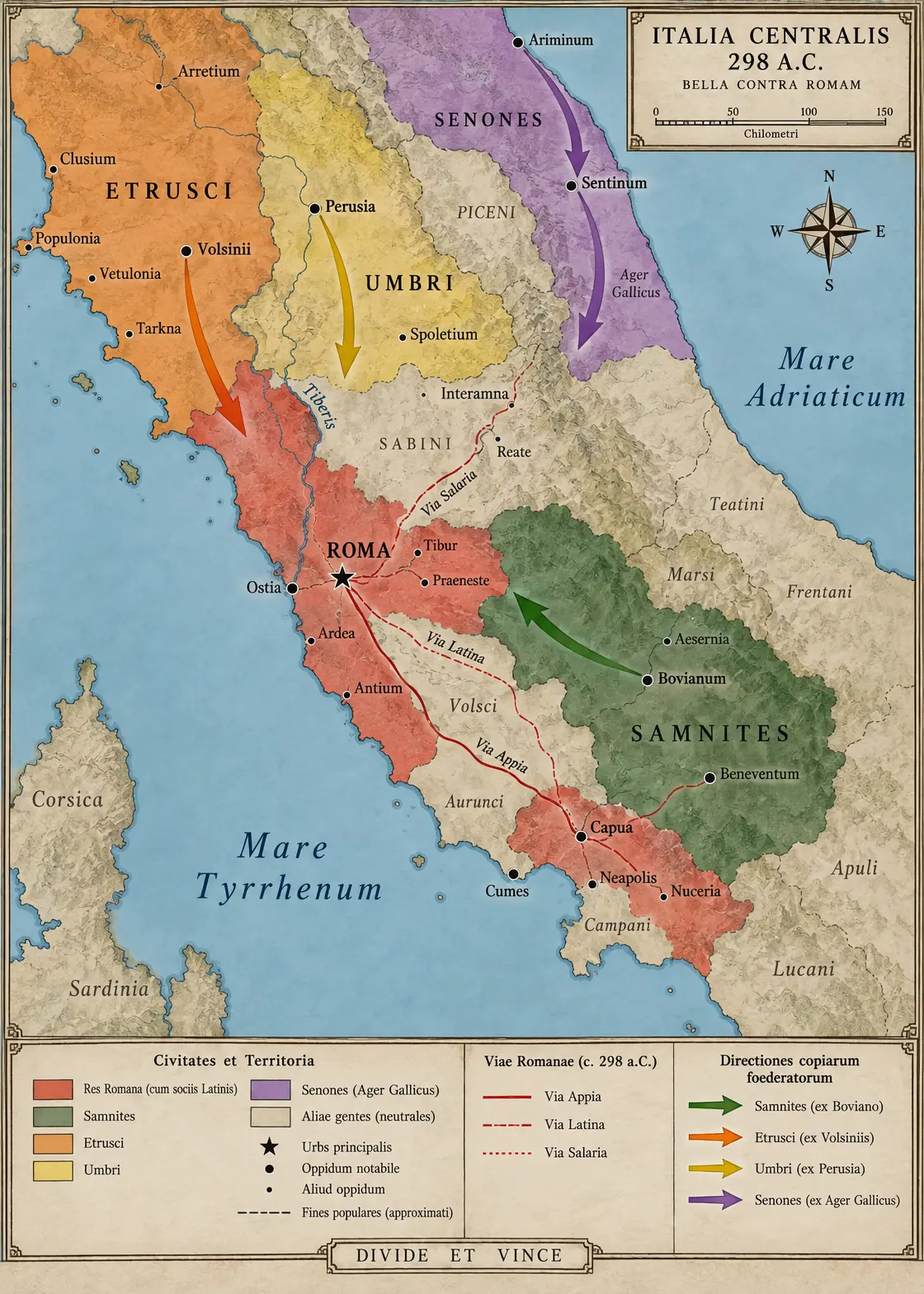
The partners they found were three. The Etruscans, who had not been actively at war with Rome since 308 but who had watched with mounting concern the Roman absorption of southern Etruria and the establishment of colonies in the Tiber valley, were now ready to make common cause. The Umbrians, occupying the central spine of the Apennines north of the Sabines, had been an intermittent enemy of Rome but had not previously committed major resources to opposition; they were now drawn in by the Samnite-Etruscan coalition and by their own perception of Roman pressure on their southern frontier. And the Senonian Gauls — the same people who had taken Rome a century before — were prepared, for a sufficient subsidy, to provide a war-band that could march south into Italy and put pressure on Rome from the north.
This was the four-way coalition that confronted Rome from 298 onward. It was the most formidable threat the Roman state had faced since the Latin War. The combined manpower of Samnium, Etruria, Umbria, and the Senones, if coordinated, could put forty or fifty thousand fighting men in the field against Rome. The strategic problem was the coordination: the four powers were geographically distant from one another, with the Apennines separating Etruria from Samnium and the Po valley separating the Senones from both. A single defeat could break the chain of cooperation; if the Roman armies could bring superior force against one ally before the others arrived, the coalition would dissolve into manageable separate enemies.
The Roman strategic response was, accordingly, an offensive of unprecedented mobility. Two consular armies were put in the field each year and operated in different theaters; a third army was sometimes raised under a propraetor or under a former consul serving pro consule. The censuses of the period — though their precise numbers are debated — show that the Roman manpower base was now of the order of three to three and a half hundred thousand iuniores (men of military age), with the allied populations roughly doubling the available pool. Rome could afford, as no Italian power could, to fight two-front and three-front wars simultaneously.
The Third Samnite War298–290 BC
The war began in 298 BC with Roman pre-emptive offensives in both Samnium and Etruria. The consul Lucius Cornelius Scipio Barbatus — whose surviving sarcophagus in the Vatican Museums preserves an elogium claiming victories against the Samnites and Lucanians in this year, and is one of the few pieces of contemporary epigraphic evidence we have for the entire early Republic — fought a successful campaign in northern Samnium, taking the towns of Taurasia and Cisauna. The other consul, Gnaeus Fulvius Maximus Centumalus, operated against the Etruscans. The campaigns of 297 and 296 followed a similar pattern: Roman armies engaged the Samnites in their own country and the Etruscans in theirs, with a series of small to medium engagements producing no decisive battle but slowly grinding down both opponents.
It was in 295, the year of the great convergence, that the war reached its crisis. The Samnite meddix tuticus, Gellius Egnatius (the same who had broken through to Latium in 315 and whose strategic vision had now produced the broader coalition), led a Samnite army north out of his own country, crossed the Apennines, joined forces with the Senonian Gauls in northeastern Umbria, and prepared to move south against Rome with combined Samnite-Gallic-Umbrian forces while the Etruscans pressed from the west. The Roman strategic position was, for a moment, more precarious than at any point since the Latin War.
The Roman consuls of 295 — Publius Decius Mus (son of the Decius who had died at Vesuvius, father of the Decius who would later be associated, in some sources, with Asculum) and Quintus Fabius Maximus Rullianus (the same Fabius who had been defeated at Lautulae twenty years before, now serving his fifth consulship) — moved north with the principal Roman armies. Their strategic objective was to prevent the four-way junction by engaging the Samnite-Gallic force in northeast Umbria before the Etruscans could arrive. They marched fast; they marched well-supplied; they had reliable scouts. They found Gellius Egnatius's coalition force drawn up near the town of Sentinum, in the upper valley of the Aesis river, in what is now the modern province of Ancona.
The Battle of Sentinum295 BC
Sentinum was the largest land battle ever fought in central Italy up to that time. The numbers are uncertain — ancient figures cluster around forty to fifty thousand on each side, which is probably high but not impossible — but the scale of the engagement is firmly indicated by the casualties: in the order of twenty-five thousand dead on the coalition side, eight to nine thousand on the Roman side. By comparison the Battle of Cannae a century later would kill perhaps forty-five thousand Romans in a day, the largest single-day loss in Roman military history; Sentinum was on roughly half that scale but was fought by smaller total forces and was for that reason in some senses an even more concentrated slaughter.
The two armies drew up on a plain bounded by low hills on either side — terrain that allowed maneuver but constrained the wings, the kind of ground the Romans preferred. The coalition force was organized in two main bodies: the Samnites on the right (facing the Roman left under Decius), the Senonian Gauls on the left (facing the Roman right under Fabius). The Umbrian contingent was apparently held in reserve or operating against Roman supply lines to the south; the Etruscans had not arrived in time to participate. (Both Etruscans and Umbrians may have been drawn off by a Roman feint — a propraetorian column ordered to raid Etruscan territory and so compel the Etruscans to break off from the main force. The maneuver, if it occurred as Livy describes, was a brilliant piece of operational deception.)
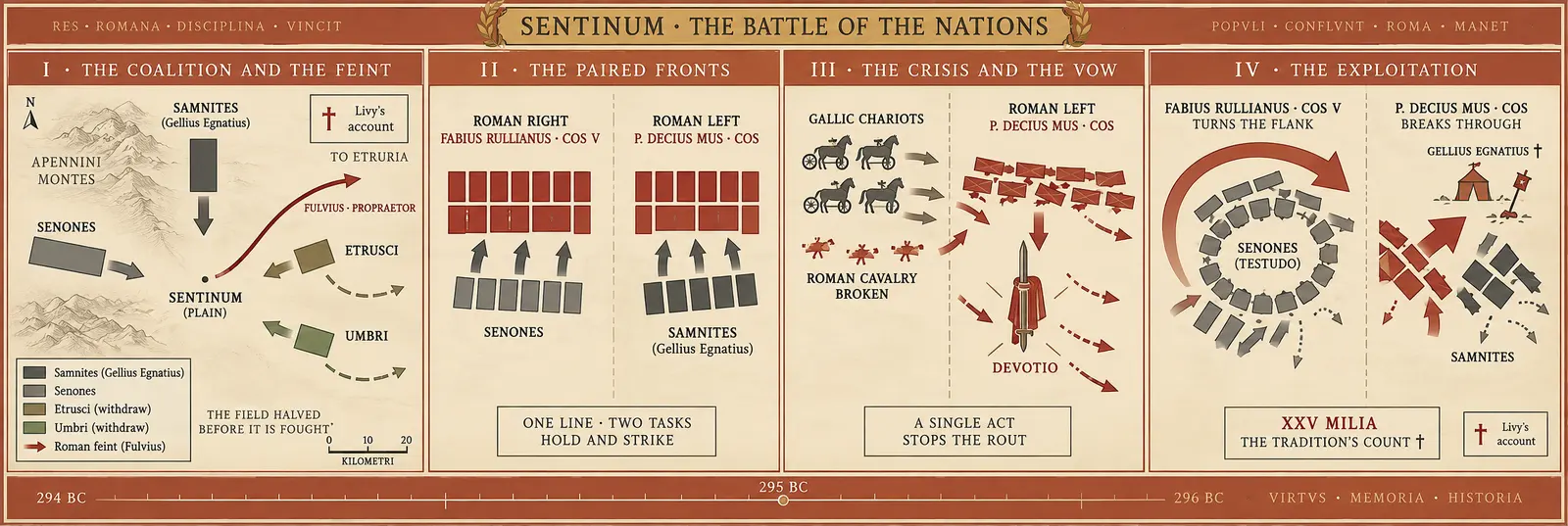
The battle began with the customary skirmishing of light troops, followed by the engagement of the main lines. On the Roman left, Decius Mus pressed his attack against the Samnites with characteristic aggression. On the Roman right, Fabius Rullianus — older, more cautious, deeply experienced — fought a deliberately defensive holding action against the Gauls, declining to commit his reserves and refusing to be drawn out of his line. The two consular wings were fighting different battles. This was deliberate; the two consuls had divided the army's tactical doctrine between them; the engagement was, in a sense, two engagements joined at the center.
What happened next is, again, the centerpiece of the family-historical tradition of the Decii. The Gauls on the coalition left, frustrated by Fabius's refusal to engage, fell back on a tactic for which their war-bands were famous: the carrus charge — a mass assault by chariots and mounted warriors, supported by the foot, designed to break a stationary line by sheer impact. The chariots came forward in a thunder of noise and movement, and the impact, when it struck, was severe enough to drive a portion of the Roman line backward. The Romans had not seen war chariots used in this way in their own military experience for at least a generation; the legions on the right wing, under Fabius, held. But on the left, where Decius was engaged with the Samnites, the Roman line came under pressure that began to look critical.
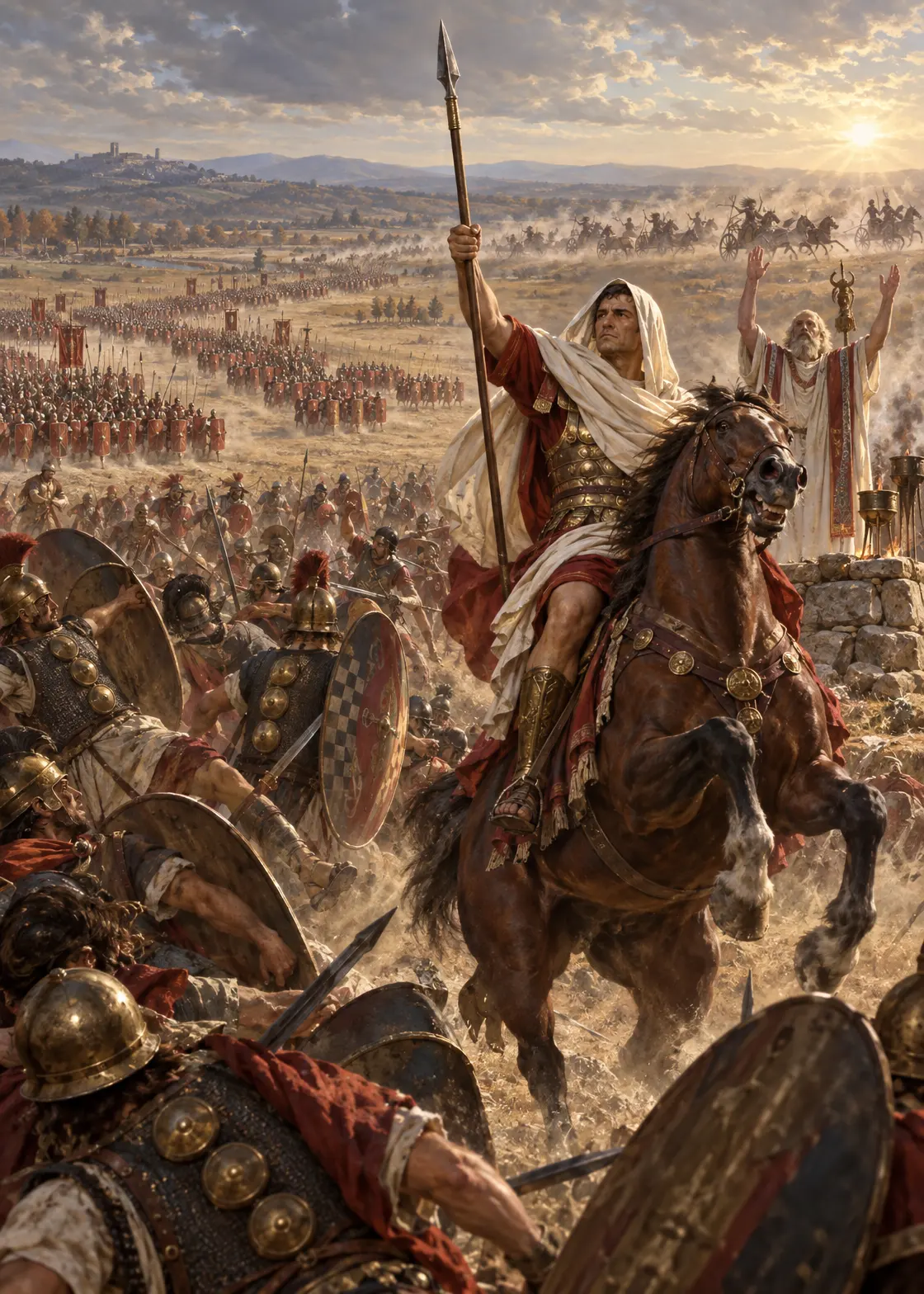
Decius, watching his line begin to bend and aware that a further collapse would expose Fabius's flank and possibly lose the battle, summoned the pontifex Marcus Livius Denter and called for the rite of devotio. He recited the formula, drew the veil of his toga over his head in the prescribed manner, mounted his horse, and rode against the Samnite line. The tradition has him saying — though the words were perhaps reconstructed afterward — that he was now consigning himself to the gods of the underworld and the Samnite army with him, that the gods of his fathers should grant the Romans the field. He rode until he was killed.
The effect upon the Roman army was apparently as decisive as the tradition reports. The legions stiffened, the line was reformed, and Decius's troops attacked with the desperate confidence of men whose general had given himself up to the gods to win their victory. On the right, Fabius — informed of his colleague's death — committed his reserves at last, broke the Gallic line by the timing of the counter-attack, and rolled forward across the field. The Samnites, with Egnatius killed in the fighting, broke and were destroyed. The Gauls, finding themselves alone and with their chariots committed and lost, broke also. By evening the coalition army no longer existed as a coherent force.
The casualties at Sentinum, as already noted, were enormous on the coalition side and severe on the Roman. Egnatius died on the field; the Samnite contingent was broken irrecoverably; the Senones lost the bulk of their war-band. Decius's body was found by the Romans after the battle, in the heaps of the Samnite dead, and was buried with the full honors of his magistracy. The funeral oration that Fabius reportedly delivered for his colleague survives only in Livy's reconstruction, but the institutional fact — that Decius's devotio was thereafter celebrated by the Roman state with annual sacrifices and ritual — is independently attested. The Decian devotio tradition acquired, after Sentinum, a peculiar place in Roman religious-political memory. It was understood as the supreme expression of pietas and self-abnegation in the service of the state; it was the model against which all subsequent Roman heroism would be measured; and it was, in retrospect, the last fully archaic Italic ritual to be performed by a Roman magistrate in his official capacity. The future would be a different kind of war.
The Aftermath: 294–290 BC
The coalition broke apart immediately after Sentinum. The Etruscans, who had been drawn off by the Roman feint, never reformed as a serious threat; they sued for peace within the next year and were granted truces on terms that effectively removed them from the war. The Umbrians did the same. The Senones, badly hurt at Sentinum but not destroyed, withdrew to their own country and were not heard from again as a serious factor in this war (though they would return as enemies in the 280s, leading to a final Roman campaign against them and the destruction of their tribal independence in 283). The Samnites alone continued to fight.
The war's final five years, from 294 to 290, were a prolonged Roman campaign against a Samnite state now without allies. Roman armies invaded Samnium repeatedly. Towns were besieged and taken. The Samnite meddix tuticus who succeeded Egnatius — by some accounts a man named Statius Minatius, though the sources are confused — continued to put armies in the field, but the manpower no longer existed to match Rome's. The decisive engagement of the war's closing phase was fought at Aquilonia in 293 BC. The consul Lucius Papirius Cursor (son of the great disciplinarian of the Second Samnite War) commanded the Roman army; the Samnite force was the famous legio linteata — the "linen legion," a corps of warriors sworn under linen banners to obey their commanders and to fight until victory or death, and equipped, the sources tell us, in gleaming armor of polished bronze and white linen tunics. The Romans broke the legio linteata in a hard-fought day, and Aquilonia itself was sacked. The remaining Samnite forces capitulated piecemeal across the following two years. The peace of 290, concluded by the consul Manius Curius Dentatus, ended the Third Samnite War on terms that effectively dissolved the Samnite Confederation as an independent political-military power.
The Samnites were not exterminated. They were not enslaved. The settlement of 290 followed the pattern of the Latin Settlement of 338 in being graduated, flexible, and aimed at incorporation rather than extinction. The four cantons were broken apart and treated separately; some Samnite communities were given civitas sine suffragio and incorporated into the Roman alliance system; others were left with treaty status as socii obligated to provide military contingents on demand; the most stubbornly anti-Roman were treated harshly, with land confiscated for Roman colonization. (The colony of Venusia, founded in 291 BC with twenty thousand colonists — an unusually large number — on what had been Samnite territory along the Apulian frontier, was the largest such settlement of the period and was clearly intended as a permanent strategic obstacle to any future Samnite resurgence.) Samnium would never again, as a unified power, threaten Rome. But Samnite military manpower would be a major component of the Roman alliance system for the next two centuries; Samnite soldiers would fight, under Roman command, at the Trebia and Cannae against Hannibal, would campaign in Greece and Asia under Roman generals, would garrison the western Mediterranean for the Republic. The relationship of victor and incorporated ally was, again, the Roman institutional innovation that gave the conquest its durability.
The Crossroads · 295 BC · A plain near Sentinum, in the upper valley of the Aesis river
The Left Wing at Sentinum
You are Publius Decius Mus, consul of Rome, commanding the left wing of the Roman army against Gellius Egnatius's Samnites at Sentinum.
The coalition of Samnites, Senonian Gauls, Umbrians, and Etruscans has threatened Rome with encirclement. At Sentinum, your colleague Quintus Fabius Maximus Rullianus holds the Roman right defensively against the Gauls, while you pressed the attack on the left against the Samnites. Now, a massive Gallic carrus chariot charge has shaken the Roman lines, and the Samnites are pressing your wing to the point of collapse. If your line shatters, Fabius's flank will be completely exposed, and the consular army will be destroyed.
How will you arrest the collapse of your legions and prevent the destruction of the Roman army?
Weigh each course: open it to hear your own inner voice. Then decide. Nothing is scored.
- Your inner voiceThe course taken
A commander's duty is to preserve his army, not to seek an early grave. The plain is bounded by low hills; if I sound the retreat, my legions can fall back in discipline to higher ground, where the Samnite assault will lose its momentum. Yet retreating under pressure risks turning withdrawal into an uncontrollable rout, leaving the Gallic chariots free to sweep across our rear before we ever set our shields anew.
- Your inner voiceThe course taken
Fabius keeps his seasoned men held in reserve, refusing to be drawn by the Senonian Gauls. If I dispatch swift messengers across the field, his fresh centuries can wheel into the flank of the Samnites and relieve my exhausted ranks. But this shatters the plan we agreed upon. If Fabius strips his line to save me, the Gauls may sense his weakness, renew their chariot charge, and shatter our center.
- Your inner voiceThe course taken
My father rode into the Latin ranks at Vesuvius, buying Rome's victory with his blood. If my legions break, Fabius will be flanked and Italy lost to the coalition. By summoning Marcus Livius Denter to speak the solemn formula, I can bind my life and the Samnite army to the gods below. The cost is my own breath and my house left fatherless, but fear would turn to fury in my soldiers' hearts.
What was done
Publius Decius Mus summoned the pontifex Marcus Livius Denter and called for the ancient rite of devotio (B+Grade B+). Veiling his head with his toga, he spoke the sacred formula consigning himself and the enemy to the underworld, mounted his horse, and charged the Samnite line until he was slain. The dying consul's act transformed the battle: his wavering legions stiffened, rallied, and pressed forward. On the right, Quintus Fabius Maximus Rullianus received word of his colleague's sacrifice and unleashed his uncommitted reserves, breaking the Gauls whose chariot assault was spent. The Samnite leader Gellius Egnatius fell on the field, and the coalition fractured irreparably. The Roman army suffered eight to nine thousand dead, but coalition casualties reached twenty-five thousand. Decius's body was recovered among the Samnite slain and buried with magistral honors, establishing a legacy of pietas celebrated in annual state rituals.
The evidence The Battle of Sentinum and Decius's devotio are narrated by Livy (10.27–29, BGrade B), who makes the sacrifice the centerpiece of the engagement, with parallel notices in Polybius (2.19, BGrade B) and Diodorus (20, BGrade B). Cicero refers to the devotio as proverbial across several philosophical works (BGrade B). The death of Decius II in office is corroborated by the Fasti (AGrade A), and the state's subsequent annual ritual commemorations support an attestation grade of B+ for the devotio itself, though Livy's casualty figures are inflated.
If you choose to walk through itAt every scale
- Yourself
What leads a commander to conclude that his personal death is the only effective instrument left to him on a battlefield?
- Those beside you
How do comrades, family, and subordinates bear the burden of an ancestral tradition that demands voluntary self-destruction?
- Rome
How does a state balance reliance on formal military command against the unpredictable authority of archaic religious sacrifice?
- The wider world
When an opposing leader sacrifices himself, what effect does such absolute religious conviction have upon the resolve of allied enemies fighting for their independence?
- Our own time
In what modern circumstances do organizations still call for absolute personal sacrifice from leaders to restore institutional morale?
In severe industrial catastrophes or naval accidents—such as damage control aboard a sinking warship or a containment breach at a toxic processing facility—senior engineers or officers sometimes deliberately enter lethal compartments to manually seal valves or secure bulkheads. They trade their individual lives to halt systemic panic, buy time for the evacuation of their crews, and prevent a regional disaster.
Where the comparison fails. Modern emergency sacrifices rely entirely on mechanical intervention rather than sacred vows or metaphysical exchange with chthonic deities, and they lack the civic sanctification of an elected magistrate acting under archaic legal and religious formulas.
What does the chapter tell us?
Why did the four-way coalition formed in 298 BC present such a grave threat to Rome, and what was its fundamental vulnerability?
The chapter explains that Samnites, Etruscans, Umbrians, and Senones could field forty to fifty thousand men, but Apennine geography and the Po valley separated them, meaning Roman mobility could defeat them before they fully united.
the chapter's narrative
What contemporary epigraphic artifact provides rare confirmation for Roman military campaigns at the start of the Third Samnite War?
The chapter notes that the sarcophagus of consul Lucius Cornelius Scipio Barbatus in the Vatican Museums bears an elogium claiming victories against Samnites and Lucanians in 298 BC, serving as unique contemporary epigraphy.
CIL VI 1284–1285 (AGrade A)
According to the narrative, how were Etruscan and Umbrian forces likely prevented from fighting alongside the Samnites and Gauls at Sentinum?
Livy describes a propraetorian column raiding Etruria, which drew the Etruscans away from Sentinum to defend their homeland; the Umbrians were likewise absent from the main clash, possibly diverted by this feint.
Livy 10.1–46 (BGrade B)
Why do modern historians generally accept the historicity of Publius Decius Mus's devotio at Sentinum, in contrast to later traditions?
Modern historians accept Decius II's devotio because his death in battle is confirmed in the Fasti and the Roman state instituted annual sacrifices and rituals to celebrate the act, unlike the disputed account at Asculum.
Editor's Note (B+Grade B+)
Following the dissolution of the Samnite Confederation in 290 BC, what institutional approach did Rome take toward Samnium?
Instead of extermination or enslavement, Rome broke the four cantons apart, granting some civitas sine suffragio, leaving others as treaty allies (socii), and founding Venusia with twenty thousand colonists as a strategic check.
the chapter's narrative