Book I · The Republic in Italy
Chapter 5
The Pyrrhic War
The Last Great Hellenistic Adventurer
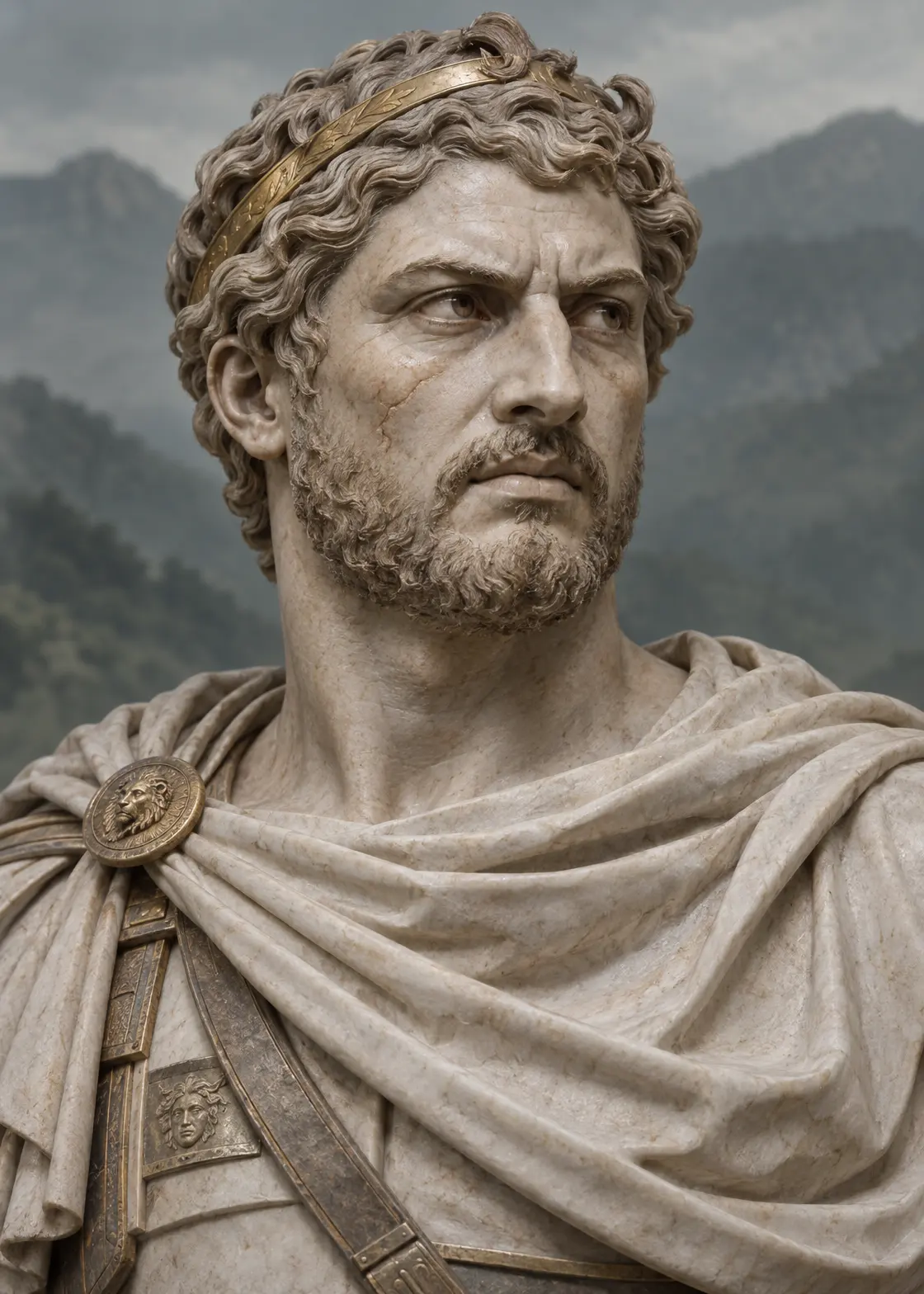
It is a curiosity of military history that the most formidable foreign adversary Rome faced in the entire fourth and third centuries before the rise of Carthage was a king of a peripheral Greek mountain state, with no compelling national interest in Italy, who came to fight Rome by accident, fought her with brilliance, and went home defeated by a combination of his own restlessness and the structural advantages of the people he had attempted to subdue. Pyrrhus of Epirus is among the most attractive and the most tragic of the figures of the Hellenistic age, and Plutarch — who devoted to him one of the longer of the Parallel Lives — clearly found him irresistible as a subject. The reader of these pages will find him irresistible too.
Pyrrhus had been born about 319 BC into the royal house of the Aeacids of Epirus, a Greek-speaking kingdom in the mountains of western Greece that had been only superficially Hellenized and that retained much of its tribal Illyrian-Greek character into the fourth and third centuries. He was related, through his mother, to Alexander the Great (his great-aunt Olympias was Alexander's mother), and the family connection mattered to him personally; he saw himself as Alexander's continuator, the heir to a kind of campaign-conducting kingship in which mobility, audacity, and personal heroism in the front line were the marks of legitimate rule. He had been raised, in part, at the court of Ptolemy I in Alexandria, where he had married a Ptolemaic princess (Antigone, daughter of Berenice) and had learned the bureaucratic-administrative side of Hellenistic kingship that he would, in the event, never have the patience to practice himself. He had served at the Battle of Ipsus in 301 at the age of eighteen, fighting on the losing side under his brother-in-law Demetrius Poliorcetes against the coalition of Cassander, Lysimachus, Seleucus, and Ptolemy that broke the empire of Antigonus the One-Eyed. He had been hostage, returned king, lost his throne, regained it, lost it again, and regained it a second time across the decade following Ipsus. By 280 BC, the year of his Italian expedition, he was about forty years old, restless, formidable, and increasingly desperate for a theater in which he could exercise the talents he believed himself to possess on a scale appropriate to his Alexander-aspiration.
He had tried Macedon, fighting for it as an ally of Demetrius against Lysimachus; he had held it briefly as joint king with Lysimachus before being displaced. He had tried alliance and proxy-politics in the Greek city-state world, with diminishing returns. The west, for the wandering Hellenistic king of the early third century, was the obvious next theater. Sicily was perpetually in turmoil; Carthage was always there; the Greek cities of Magna Graecia were rich and badly defended; the western Mediterranean was wide and underdeveloped and the kingdoms had not yet fully partitioned it. When the embassy from Tarentum arrived in Epirus in 281 BC asking him to come west, Pyrrhus had been looking for an excuse to go.
The Tarentine Crisis
Tarentum (modern Taranto), the wealthiest of the Greek cities of southern Italy, was a Spartan foundation of the late eighth century BC located on the great natural harbor in the instep of the Italian boot. Its wealth came from a combination of agriculture (the fertile coastal plain), commerce (its position on the trade route between the Adriatic and the central Mediterranean), and industry (the famous Tarentine wool was traded throughout the Greek world). Its population in the late fourth century was probably between two hundred and three hundred thousand, of whom a substantial portion were Greek citizens with the political rights of a Greek polis and a larger portion were dependent or enslaved Messapian and Apulian natives. The Tarentine democracy was famously raucous, even by Greek standards, and gave the city a reputation among its more sober neighbors for political instability and military weakness.
The Tarentines had a treaty with Rome, dating from approximately 303 BC, by which Roman warships were prohibited from sailing past the Lacinian promontory — the western horn of the Tarentine gulf — into Tarentine waters. The treaty had been concluded at a moment of Tarentine weakness when Roman intervention in Italy had not yet reached the south and the Tarentines wished to preserve their freedom of action in the gulf and in Apulia. It had been observed for over twenty years; both sides found it convenient. The casus belli of 282 BC was a Roman violation of this treaty so flagrant, and so apparently calculated, that one must suspect deliberate provocation.
A small Roman naval squadron under one Lucius Valerius — ten ships, by the principal accounts — sailed past the Lacinian promontory and entered the Tarentine gulf. The mission's stated purpose was a friendly visit to other Greek cities of the south; whether Rome had legitimate diplomatic business or whether the squadron was testing the treaty is unclear. The Tarentines were in the midst of their religious festival of the Dionysia, the citizens assembled in the great theater of the city which overlooked the harbor. A Tarentine demagogue named Philocharis (the sources also call him Ainesias) pointed out the Roman ships to the assembled people and incited them to act. The Tarentine fleet sortied; the Roman squadron was attacked; four ships were sunk, one was captured, and the rest fled. The Roman admiral was killed. The Tarentine democracy then proceeded to compound the offense: the Roman embassy that arrived demanding satisfaction was insulted, the Roman ambassador (Lucius Postumius) was reportedly soiled by a drunken Tarentine who relieved himself on the ambassador's toga, and the embassy was sent home with mockery rather than reparation.
Postumius, on his return to Rome, displayed the soiled toga to the Senate with the words that the stain would be washed out with Tarentine blood. The Senate's response was swift: the consul Lucius Aemilius Barbula was sent into the gulf with an army; Tarentine territory was raided; the city was placed under serious military pressure. The Tarentines, having compounded their offense beyond repair, sought outside help. They tried first to enlist the cities of Magna Graecia — Rhegium, Locri, Croton, Thurii — but found them either already in Roman alliance or unwilling to commit to what now looked like a serious war. They tried the Lucanians and Messapians, who were Tarentine clients on the mainland; these joined readily enough but were militarily inadequate. The Tarentines therefore did what they had done before in earlier crises: they sent abroad for a Greek mercenary commander to defend them. The previous decades had seen Tarentine appeals to a series of Greek kings and condottieri (Archidamus III of Sparta in 343, Alexander I of Epirus in 334 — uncle of Pyrrhus, killed in southern Italy — Acrotatus of Sparta in 314, Cleonymus of Sparta in 303). The natural next step was to ask the most distinguished Greek-speaking military figure available. They sent to Pyrrhus.
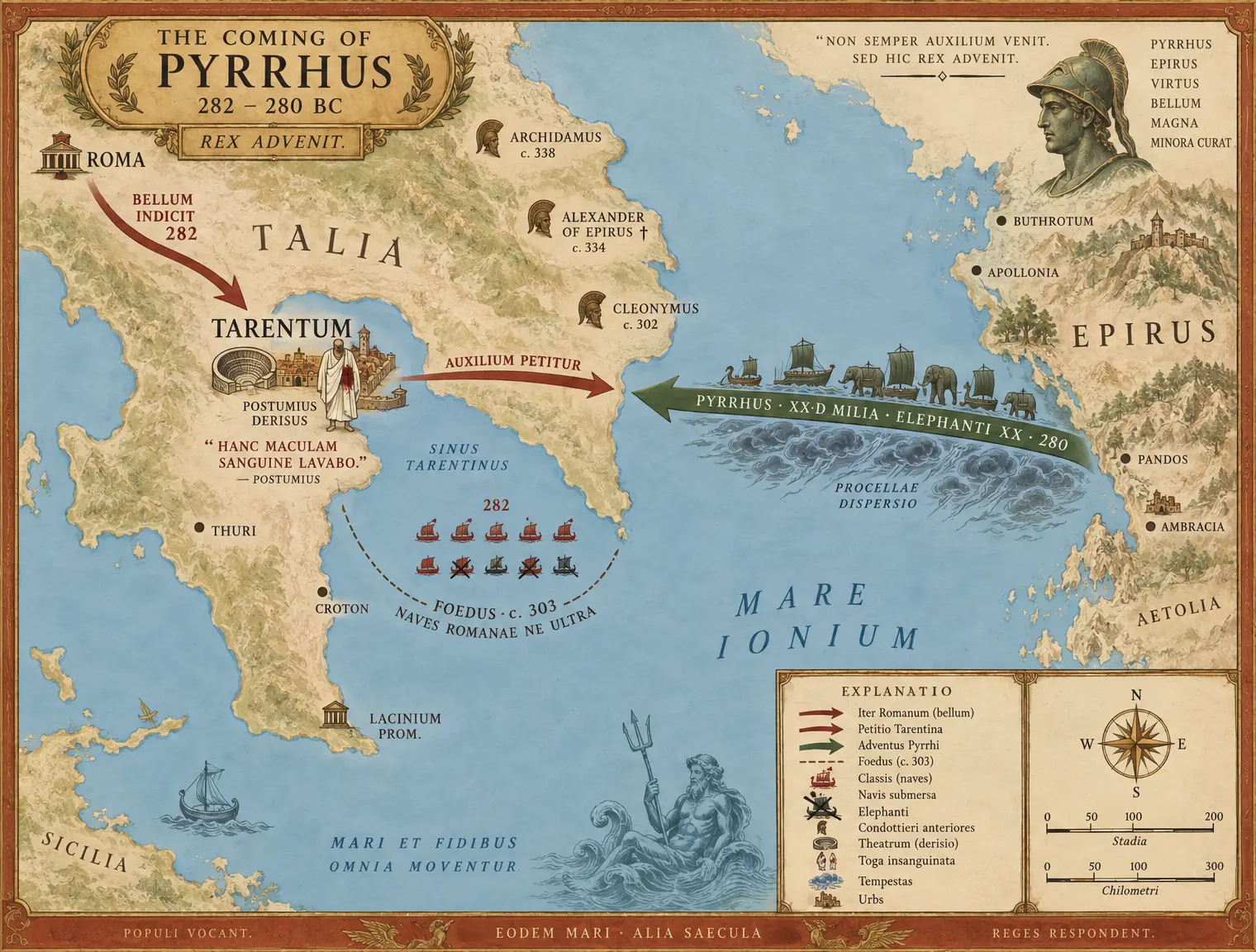
The terms of Pyrrhus's contract with Tarentum, as best they can be reconstructed, gave him an army of about 20,500 men (3,000 cavalry, 2,000 archers, 500 slingers, with 15,000 phalangites and supporting infantry), 20 war elephants, the necessary transport, and a substantial subsidy in coin. In return, Pyrrhus would assume command of Tarentine and allied forces in Italy, would conduct the war against Rome on Tarentum's behalf, and would receive — this was understood — whatever territorial or political benefits the Italian theater might develop into. Pyrrhus, for his part, intended much more than the defense of one Greek city. He intended, by his own statements as preserved in Plutarch, an empire in the west. Sicily was to be taken first; then Carthage; then perhaps the African coast. His army was equipped and manned for a much larger campaign than the defense of Tarentum required. He was using the Tarentine commission as the seed of a much larger ambition.
The Crossing and the Reception at Tarentum
The crossing from Epirus to Italy was nearly a disaster. A storm caught the fleet in the strait of Otranto, scattered the transports, drowned some of the war elephants, and arrived Pyrrhus in Tarentum with perhaps two-thirds of his force. He rallied the stragglers across the next several weeks. He also discovered, on his arrival, the truth of the Tarentine military situation — that the citizen militia of the famous Greek city was, after a generation of dependence on mercenaries, militarily worthless. The Tarentines were unwilling to fight and incapable when willing. Pyrrhus closed the city's gymnasia, prohibited public festivals, instituted compulsory military training for the citizens, and began a forced reorganization of the Tarentine democracy under what amounted to martial law. The Tarentines, who had imported Pyrrhus to fight their war for them, found themselves transformed under his hand into a properly militarized client of his ambition. They were not pleased with the development but they were not in a position to object.
The Roman response was equally rapid. The consul Publius Valerius Laevinus marched south with a substantial army — eight legions and the corresponding allied contingents, perhaps fifty thousand men in all, in two consular armies operating together — and pressed into Lucania. Pyrrhus, having recovered as much of his force as he could and reinforced it with Tarentine and allied troops to a total of perhaps thirty-five thousand, marched out to meet him. The two armies converged near the Greek city of Heraclea, on the coast of Lucania, on the river Siris (modern Sinni).
The Battle of Heraclea280 BC
The Battle of Heraclea was the first encounter in Italian history between a Roman manipular army and a fully developed Hellenistic combined-arms force. The Roman army was organized in the now-standard three-line triplex acies of the manipular legion, with the heavy infantry in the center supported by light auxiliaries and Italian allied contingents, the cavalry on the wings. Numbers were probably about 30,000 to 35,000 Roman effectives engaged. Pyrrhus's army was Hellenistic in style and composition: a center of phalangites in the long-spear (sarissa) formation that had been the Macedonian standard since Philip II, with cavalry on the wings (the famous Thessalian heavy horse on one wing and Pyrrhus's own household squadrons on the other), light troops between and ahead of the main bodies, and — held back in reserve, behind the phalanx — the twenty war elephants. Numbers were probably about 30,000 effectives.
The Roman tactical doctrine was to engage the phalanx frontally with the hastati and principes, using the triarii as reserve, and to count on the pilum — the heavy throwing javelin — to disrupt the close-order phalanx before contact. The phalanx was, by this period, the most formidable infantry formation in the Mediterranean world for set-piece engagement on level ground; the standard view among Hellenistic military theorists was that a phalanx properly formed and properly led could not be broken from the front. The Roman manipular system had been developed against Samnites and Gauls; it had never been tested against a fully developed Macedonian phalanx, and it was not entirely clear that the legion as currently constituted was capable of breaking the wall of sarissai it would face.
The battle, by Plutarch's account, opened with the engagement of the cavalry on the wings — the Roman cavalry, against expectations, gaining the advantage on its left, the Hellenistic cavalry holding its own on its right. The infantry lines then engaged in the center. The Roman hastati threw their pila and charged. The phalanx, locked behind its wall of pikes, did not break, but neither did it advance. The two main lines ground against each other for what Plutarch suggests was several hours, with neither side gaining significant ground. Pyrrhus himself, fighting in the front line in the Hellenistic-monarch style (a habit Plutarch reports was already worrying his officers, who feared losing him by an arrow), exchanged armor with one of his bodyguards in the course of the day — the bodyguard was killed, and the news that "Pyrrhus is dead" momentarily wavered Pyrrhus's own line, until Pyrrhus removed his helmet and rode along the line to show that he lived.
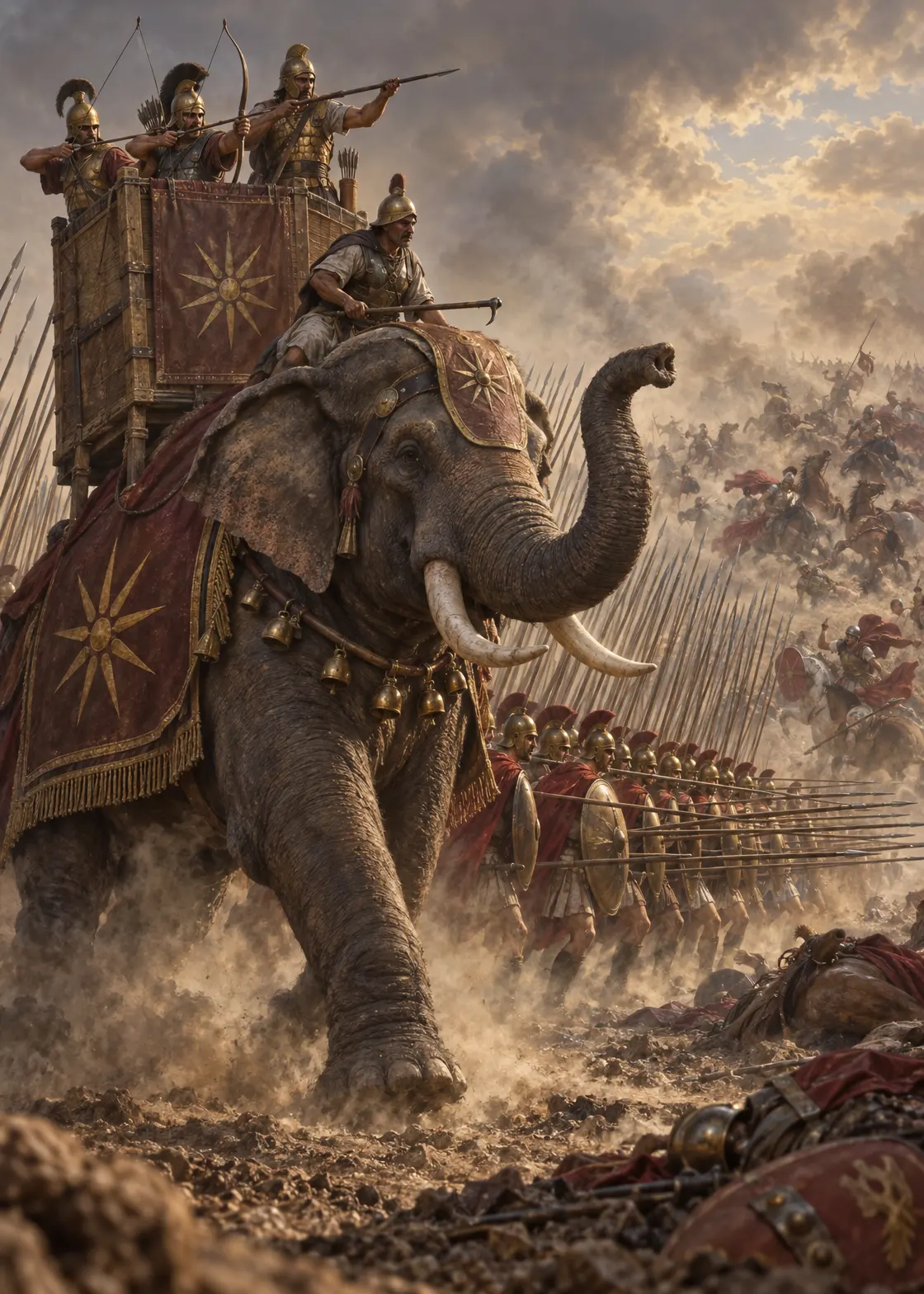
The decisive moment came when Pyrrhus, recognizing that the infantry stalemate would not break in his favor before nightfall, ordered the elephants forward. The Roman line had never seen war elephants before. The animals were Indian elephants — the larger and more aggressive species, distinct from the smaller African forest elephants that the Carthaginians would later employ — equipped with wooden towers on their backs from which Pyrrhus's mahouts and javelin-men fought. Twenty of them advancing in line presented something the Roman tactical system was not designed to absorb. The Roman cavalry on the wings broke first: the horses, terrified by the unfamiliar sight and smell, would not advance and would not hold. The Roman infantry line, exposed on the flanks by the cavalry's collapse, came under pressure from a converging attack: the phalanx in front, the elephants on the flanks, Pyrrhus's cavalry returning to roll up what the elephants had broken. The Roman line collapsed sector by sector. The army's withdrawal — Plutarch and Dionysius of Halicarnassus both report this — was conducted with discipline, the triarii covering the retreat in the third line, but the day was lost.
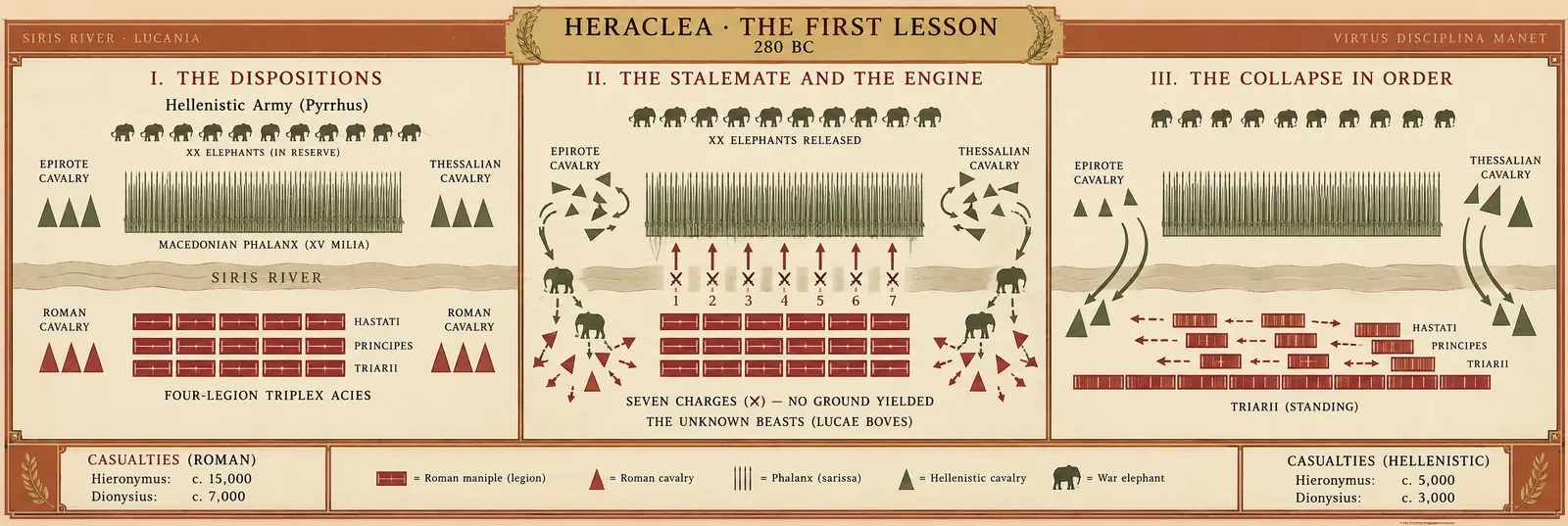
The Roman losses at Heraclea are given by Hieronymus of Cardia (a contemporary historian whose work survives only through later citation, but who is generally the most reliable source for the period) as 7,000 killed; by other sources at 15,000. Pyrrhic losses, by Hieronymus, were 4,000 killed; by other sources, lower. Whichever figures are correct, the engagement was a Roman defeat decisive enough to give Pyrrhus possession of the field and the strategic initiative in Lucania, but costly enough on the Pyrrhic side that Pyrrhus himself, walking across the field of dead the morning after the battle, is reputed to have remarked that another such victory would ruin him. The phrase has become proverbial — a "Pyrrhic victory," one too costly to be worth the winning — but it captures something real about the strategic logic of Pyrrhus's situation. He could win battles. He could not win the kind of war Rome was prepared to fight.
Cineas at Rome
In the immediate aftermath of Heraclea, Pyrrhus moved north into Latium, taking the Roman colony of Praeneste and approaching to within a few miles of Rome itself. The military pressure was severe; the strategic moment, from Pyrrhus's perspective, was the right one to negotiate a settlement on favorable terms. He sent his chief diplomatic agent, Cineas of Thessaly — a Greek of considerable culture, a student of Demosthenes' rhetorical tradition, considered by Pyrrhus himself to have won by his eloquence more cities than Pyrrhus himself had won by arms — to Rome with terms of peace.
Cineas's terms, as Plutarch reports them, were that Rome should withdraw from Lucania, Apulia, Bruttium, and Samnium, restoring to those peoples their independence; that Tarentum's independence should be guaranteed; and that Rome should accept Pyrrhus as an arbiter of further disputes in Italy. In exchange, prisoners would be returned without ransom and a treaty of friendship would be concluded. The terms were, by the standards of Hellenistic diplomacy, generous: Pyrrhus was offering to recognize Rome's existence as a major power, to accept her sphere of influence in central Italy, and to constitute himself as a balancing factor rather than as a conqueror.
The Senate debated the proposal at length. Some members favored acceptance, recognizing the military weight of Pyrrhus's army and the strategic difficulty of continued resistance. The decisive intervention was made by Appius Claudius Caecus — the censor of 312, now ancient and blind, retired from active politics — who had himself carried into the Senate house to address the body. His speech, reported by Plutarch and by Cicero (who quotes from a version still extant in his own day), is one of the famous orations of early Roman tradition. He told the Senate that the Romans were the people of Mars, that they did not negotiate with armed enemies on Italian soil, that the moment an enemy army stood north of the Liris was not the moment to discuss peace, and that no foreign king should be permitted to determine the boundaries of Roman power. The Senate, swayed by his vehemence and by the political weight of his accumulated authority, rejected Pyrrhus's terms. Cineas, returning to Pyrrhus, reportedly described the Roman Senate as an assembly of kings — senatum video regum — and warned his master that the war against Rome would be a different kind of contest than the wars Pyrrhus had fought in the Hellenistic east.
Pyrrhus, denied a negotiated settlement, withdrew from Latium and returned to winter quarters in southern Italy. The war, contrary to his expectations, was going to continue.
The Battle of Asculum279 BC
The campaign of 279 BC was fought principally in Apulia, where Pyrrhus had moved his army to threaten the loyal Roman ally Lucera. The Roman consuls of the year — Publius Decius Mus (the third Decius, son of the Decius who had died at Sentinum) and Publius Sulpicius Saverrio — converged on Pyrrhus's position with a combined force of perhaps forty thousand. Pyrrhus had approximately the same number, reinforced now by Samnite, Lucanian, and Bruttian allies (the Italian peoples not yet reconciled to Rome having taken the opportunity of Pyrrhus's presence to join him).
The Romans had spent the winter preparing for the next encounter with Pyrrhus's elephants and his phalanx. They had developed, by some accounts, special wagons armed with brazier-tipped poles, scythes, and grappling hooks — the plostella — intended to be driven against advancing elephants to disrupt them. They had reorganized the cavalry's training to accustom the horses to the smell and sight of elephants (using captured Pyrrhic elephants from Heraclea for the purpose, or possibly other large pack animals as substitutes). They had reinforced the manipular legion with auxiliary javelin-men and pike-armed light infantry equipped to target the elephants' more vulnerable points — eyes, trunk, the legs at the join with the body. The Roman tactical doctrine had begun to adapt.
The two armies met near Asculum (modern Ascoli Satriano, in northern Apulia, not to be confused with the more famous Asculum Picenum further north). The ground was — and here the sources differ in detail — partly broken and partly level, with a wood and stream complicating the tactical geometry. The battle was fought across two days, the first day on the broken ground (where the Roman troops had the better of the engagement, being more accustomed to broken terrain than the Hellenistic phalanx and able to disrupt the close-order Macedonian formation by attacking from oblique angles), and the second day on level ground, where the phalanx could deploy in its preferred conditions and where Pyrrhus could employ his elephants without the terrain constraints of the previous day.
The second day at Asculum was, in tactical terms, a re-enactment of Heraclea: the phalanx engaged the legion in a head-on infantry contest that neither side could break by main force, while the cavalry actions on the wings produced indecisive results, and the elephants — eventually committed to the center after the plostella had been overrun by Pyrrhus's light infantry — broke the Roman line by flank attacks once the cavalry could no longer protect the wings. Pyrrhus was again victorious in the sense that he held the field and the Romans withdrew. But the casualties were again Pyrrhic in the proverbial sense: 3,500 dead by Hieronymus of Cardia's figure, perhaps higher by other accounts; Roman losses of 6,000. The Pyrrhic army had won twice; it had now lost something between 15 and 20 percent of its strength in two engagements. Pyrrhus's own letter to Antigonus Gonatas (king of Macedon), preserved by Plutarch, contains the sentence that has become the proverb: "If we win one more such victory over the Romans, we shall be utterly ruined."
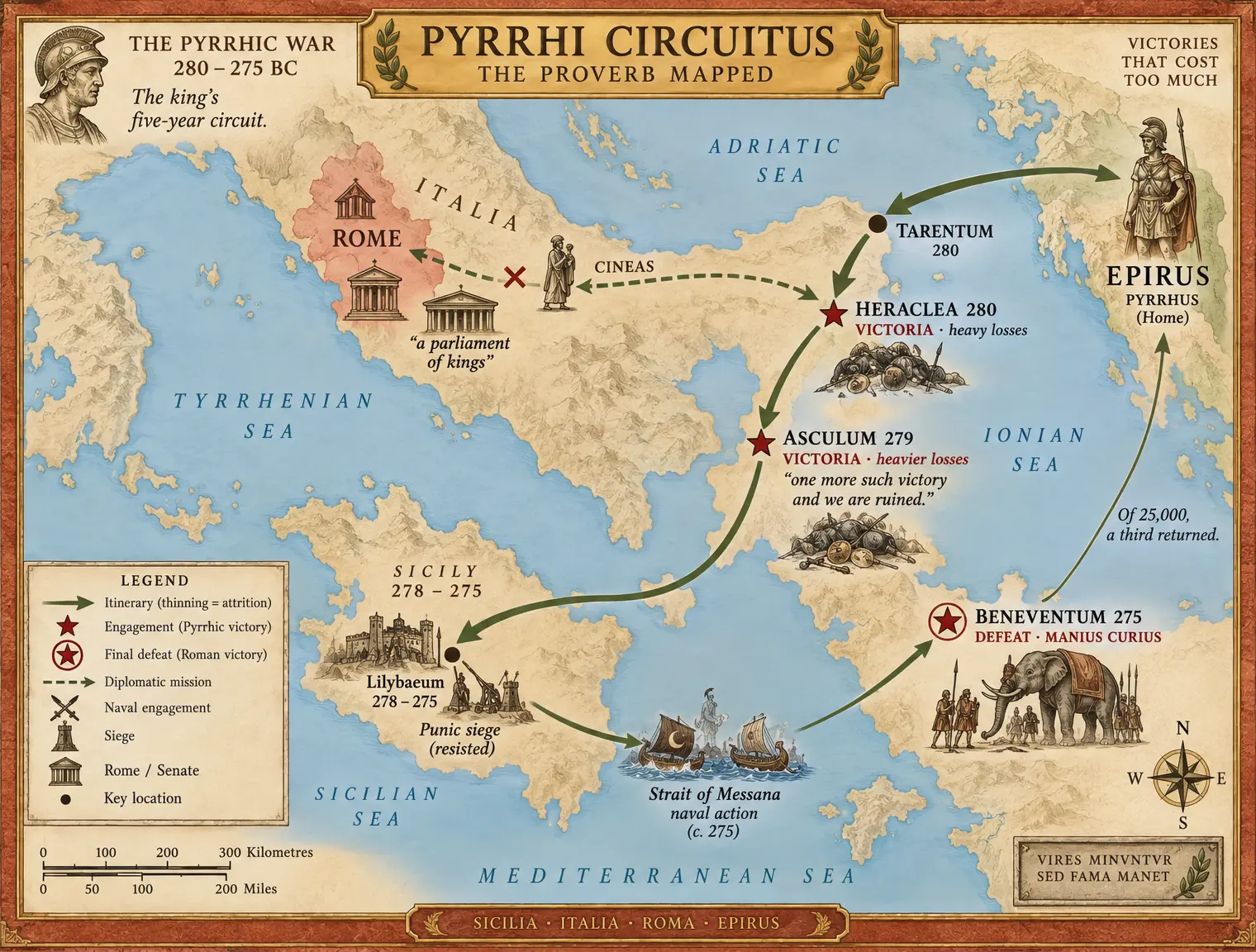
The strategic position after Asculum was, by all rational calculation, unsustainable for Pyrrhus. He could not hope, with the army he had brought from Epirus and even with the Italian reinforcements available, to fight a third such engagement at the same loss-ratios and continue the war on Italian soil. The Romans, by contrast, had absorbed Heraclea and Asculum without strategic dislocation. The manpower base of Roman Italy — Romans, Latins, Campanians, and other socii — was capable of generating two new consular armies of equivalent strength for the campaign of 278 even after the losses of 280 and 279. Pyrrhus had no comparable reserves. He could not even count on Tarentum to provide effective reinforcements, the city having grown increasingly resentful of his quasi-dictatorial control and being increasingly inclined to wish his Italian adventure ended.
It was at this point that the offer from Sicily arrived.
The Sicilian Adventure278–275 BC
The Greek cities of Sicily — Syracuse, Acragas, Catane, Tauromenium, and others — were at this moment under heavy pressure from Carthage, which had used the death of Agathocles of Syracuse in 289 to expand her control of the western half of the island. Carthaginian armies had taken or surrounded most of the Greek cities except Syracuse itself, which was holding out under a precarious leadership. The Sicilian Greeks, looking about for a champion, came to the same conclusion the Tarentines had reached: the available figure was Pyrrhus. An embassy from Syracuse arrived in southern Italy in the late summer of 279 with an offer that Pyrrhus found, in his strategic situation, irresistible.
The terms were generous. Pyrrhus would be made commander-in-chief of the Sicilian Greek forces; he would be given control of Syracuse and recognition as king of Sicily; the prize of the campaign — the expulsion of Carthage from the island — would be his alone. The Sicilian theater offered something the Italian theater did not: a clear path to a major Hellenistic kingdom in the western Mediterranean, on the model Pyrrhus had been pursuing all along. The Italian situation had become tactically successful but strategically blocked; the Sicilian situation offered a strategic breakthrough.
Pyrrhus accepted. He left Tarentum garrisoned by his lieutenant Milo, retained nominal title to his Italian campaign, and crossed to Sicily in the late autumn of 278 BC. He took with him the bulk of his veteran troops, the elephants that had survived Asculum, and his court. His Italian allies — the Samnites, Lucanians, Bruttians — were left to fight their own war with what assistance Milo could provide. The Tarentines, finding themselves abandoned to their fate, were not pleased but were also not in a position to recall their hired king.
The Sicilian campaign was, in its opening, brilliantly successful. Pyrrhus marched across the island in a series of swift movements, raised the siege of Syracuse, took the Carthaginian-held cities of the south coast in rapid succession (Eryx, where Pyrrhus himself led the storming party and was reportedly the first man over the wall, was the most famous of these), and reduced Carthaginian holdings on the island to a single fortified base at Lilybaeum on the western promontory. By the end of 277 BC, Carthage controlled only the tip of the island and was negotiating for peace. Pyrrhus's strategic vision — the western Hellenistic kingdom, the heir of Alexander stretching his power across the seas — seemed within reach.
But the Sicilian Greeks proved no easier to govern than the Tarentines had been. Pyrrhus's autocratic methods, accepted in the heat of campaign, became resented when peace seemed close. He imposed garrisons, demanded contributions, executed local opponents, and behaved generally in the manner of a Hellenistic monarch rather than the commander of an allied league. The Greek cities, who had imported him as a defender against Carthage, found themselves under the kind of monarchic control they had specifically wanted to avoid. Resistance began to grow; conspiracies were uncovered; cities began to make their own arrangements with Carthage. By 276 BC Pyrrhus's position on the island had deteriorated to the point where he could no longer count on his Greek allies. The siege of Lilybaeum, which had dragged on for over a year, was abandoned. The Carthaginian fleet, regrouped, was again threatening Pyrrhus's communications. And meanwhile, in Italy, the situation had also deteriorated: Roman armies had retaken much of the territory that had been Pyrrhic-controlled in 279, the Italian allies were being beaten one by one, and Milo's garrison at Tarentum was in danger of being besieged in turn.
The Tarentines and the remaining Italian allies sent an embassy to Pyrrhus in early 275 BC, asking him to return and renew the war against Rome. He accepted, partly from obligation, partly because the Sicilian situation had become unsustainable, partly because the prospect of returning to Italian campaign was a relief from the political quagmire Sicily had become. The crossing back was made in the summer of 275. He arrived in Italy with substantially fewer troops than he had taken to Sicily, with most of his elephants lost to the campaign and the sea voyage, and with the prestige of his Sicilian failure trailing behind him.
The Battle of Beneventum275 BC
The decisive engagement of the war was fought near Beneventum (the Roman name had been deliberately changed from the original Maleventum — "bad event" — to Beneventum, "good event," after the Roman victory), a town in the Caudine country of central Samnium on the Calor river. The Roman consul Manius Curius Dentatus, one of the great captains of the early third century and a man whose proverbial simplicity (he was reputed to live on turnips and to refuse Samnite gold) had made him a heroic figure in Roman memory, commanded the Roman army. The other Roman consul, Lucius Cornelius Lentulus Caudinus, was operating against the Lucanians elsewhere and was not present.
Pyrrhus's plan was characteristic of his strategic vigor. Rather than wait for Curius to deploy in front of his Beneventum position, Pyrrhus undertook a night march around the Roman flank, intending to surprise Curius from an unexpected direction at first light. The maneuver was bold; it was also, in the circumstances, ill-advised. Pyrrhus's army was tired from the Italian crossing, his troops were partly Italian allies of uncertain quality, his elephants were a reduced and increasingly nervous corps, and his guides — through what may have been deliberate misdirection or simple incompetence — led his column astray in the woods. Pyrrhus's force arrived in front of the Roman position not at first light but in the middle of the morning, after a difficult night-march through wooded country, with his troops exhausted before the day's fighting began.
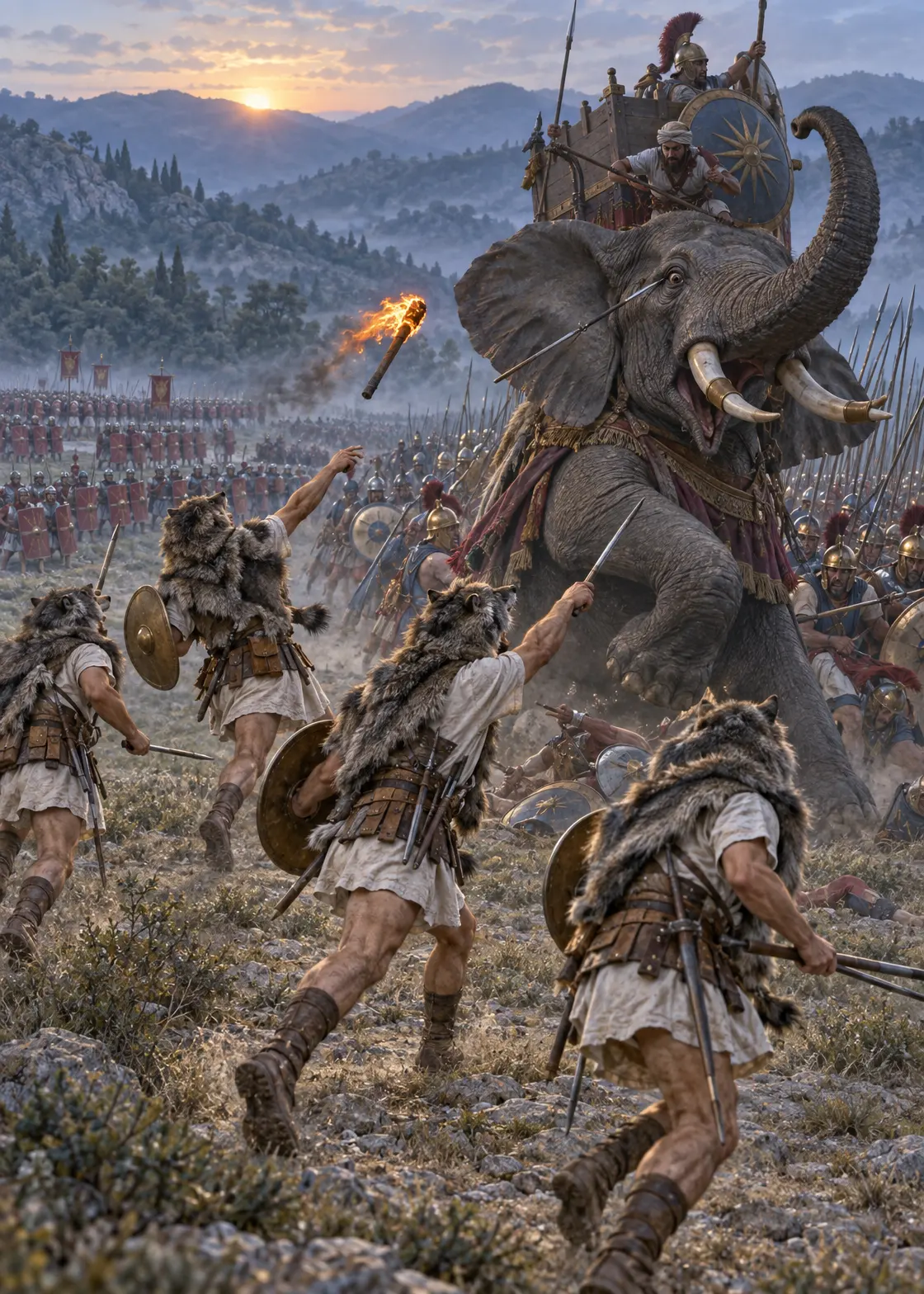
The Romans, having been alerted by their scouts to Pyrrhus's approach, had time to deploy. Curius drew up his legions on the level ground in front of his fortified camp, with the Roman cavalry on the wings and the elephants — those few that Pyrrhus had managed to bring forward — facing the Roman center. The Roman tactical doctrine for engaging elephants had now been worked out: the velites (light troops) were equipped with javelins and torches, and on Curius's command they advanced ahead of the main line to throw burning material at the elephants and to attack them with javelins from short range.
The elephants, harassed by the velites and frightened by the burning materials, broke ranks. Several of them turned back into Pyrrhus's own line, trampling phalangites and disordering the formation. The Roman heavy infantry then advanced into the disrupted Pyrrhic line and pressed it backward. Pyrrhus's cavalry, attempting to retrieve the situation, was countered by the Roman wings. Within perhaps two hours the engagement was decided. Pyrrhus's army was driven back from the field, with severe casualties, and the elephants — those that had not turned on their own troops — were either killed or captured.
The casualty figures for Beneventum are not given by the surviving sources in a way that can be trusted, but the outcome was unambiguous. Pyrrhus's army was no longer capable of continuing the campaign. He withdrew through the Apennines to Tarentum, where he found the city in open rebellion against Milo and his Hellenistic garrison. Pyrrhus made the strategic decision that the entire western enterprise was no longer viable. He arranged the withdrawal of his army from Italy, leaving a small garrison at Tarentum under Helenus (his son), and crossed back to Epirus in the late autumn of 275 BC. He never returned. He spent the remaining three years of his life campaigning in Greece — at Sparta, where he failed; at Argos, where in 272 BC he was killed in a street fight when an old woman watching from a rooftop threw down a roof-tile that struck him on the head and broke his neck. The end was as characteristic of his life as the campaigns had been: the kind of restless, unpredictable, half-comic death that suited a man whose whole career had been an improvisation against the limits of his circumstances.
The Tarentines, abandoned by Pyrrhus, held out for three more years. The Roman siege of the city was undertaken by the consul Lucius Papirius Cursor (a third-generation military man bearing the famous Samnite-war name) in 272 BC. Tarentum fell after the Pyrrhic garrison commander Milo surrendered the citadel on terms; the city itself was incorporated into the Roman alliance system on harsh terms, with its political autonomy curtailed and a Roman garrison installed. The defeat of Tarentum effectively ended Greek political independence in southern Italy. The remaining Greek cities — Rhegium, Locri, Croton, Heraclea, Thurii — were incorporated as Roman allies, with varying degrees of nominal autonomy preserved, in the years immediately following Tarentum's fall.
The Crossroads · 280 BC · The Senate House, Rome
The Embattled Curia: Cineas at the Gates
A Roman senator present in the Curia during the debate over Pyrrhus's peace terms
Following the defeat of the consul Publius Valerius Laevinus at the river Siris near Heraclea, King Pyrrhus of Epirus has advanced through Latium, taken Praeneste, and encamped within miles of Rome. His envoy Cineas of Thessaly has addressed the Senate with terms of peace: Rome must evacuate Lucania, Apulia, Bruttium, and Samnium, guarantee Tarentine independence, and accept Pyrrhus as arbiter in Italy. In return, Roman captives will be returned without ransom and a treaty of friendship concluded. As senators waver between exhaustion and survival, the aged and blind former censor Appius Claudius Caecus is carried into the chamber to urge total resistance.
How should the Senate resolve the terms of peace offered by Pyrrhus through Cineas?
Weigh each course: open it to hear your own inner voice. Then decide. Nothing is scored.
- Your inner voiceThe course taken
We should not surrender half of Italy at the first blow, yet we cannot ignore the enemy army north of the Liris. Let us reject Cineas's demand to cede Samnium, Lucania, and Apulia, but offer a truce and ransom for our captured soldiers if Pyrrhus pulls his phalanx back into the south. That spares Rome an immediate assault, recovers our men, and gives our consuls time to raise fresh legions from loyal allies.
- Your inner voiceThe course taken
We have lost thousands of citizens at the Siris, and Publius Valerius Laevinus could not halt the phalanx or the beasts. Pyrrhus stands at Praeneste, only miles from our gates. His envoy Cineas offers peace, our captives returned without ransom, and a recognized sphere in central Italy. To surrender southern Italy hurts our pride, but to fight an invincible king with our allies wavering invites the complete ruin of the Republic.
- Your inner voiceThe course taken
Appius Claudius speaks the truth: we are the people of Mars, and Rome does not bargain while an invader tramples Italian soil. If we yield Samnium, Apulia, and Lucania now and make this Epirote king an arbiter over Italy, we become his subjects by another name. Let Cineas take his eloquence back to his master. We will raise fresh legions, summon our allies, and drive Pyrrhus into the sea or perish.
What was done
The Senate, swayed by the vehemence and accumulated authority of Appius Claudius Caecus, rejected Pyrrhus's terms without compromise. The senators declared that Rome would not negotiate with an armed enemy on Italian soil, instructing Cineas that talks could begin only after Pyrrhus evacuated Italy. Cineas returned to his king, warning him that the Senate was an assembly of kings (senatum video regum) and that this war would not resemble his eastern campaigns. Denied the swift diplomatic triumph he expected, Pyrrhus withdrew from Latium into winter quarters in southern Italy. Rome immediately mobilized new forces, calling upon its Latin and Campanian allies to replace the losses from Heraclea. The war resumed the following year in Apulia, culminating in the bloody two-day clash at Asculum, where Pyrrhus won the field at ruinous cost but found Roman strategic resolve entirely unbroken.
The evidence Cicero in Cato Maior de Senectute 15–16 (BGrade B) preserves fragments of the speech of Appius Claudius Caecus from Roman archival or family tradition. Plutarch in Pyrrhus (BGrade B) recounts the embassy of Cineas and the Senate debate, drawing on the contemporary history of Hieronymus of Cardia (AGrade A, frag. via Plutarch and Diodorus). Parallel accounts survive in Cassius Dio (BGrade B, frag. via Zonaras 8.2–6) and Appian's Samnitica (CGrade C, frag.).
If you choose to walk through itAt every scale
- Yourself
Can you vote to send fresh legions against the phalanx and elephants when an honorable treaty would restore your captured countrymen without ransom?
- Those beside you
How will you answer the leading families of Rome whose sons and brothers remain prisoners in Pyrrhus's camp if you turn Cineas away empty-handed?
- Rome
Does the Republic preserve its greatness by refusing all compromise under threat, or does rejecting peace while Praeneste is lost risk Rome itself?
- The wider world
If Rome relinquishes Samnium, Lucania, and Apulia, will the remaining Italian allies stay loyal or submit to Pyrrhus as the supreme arbiter of Italy?
- Our own time
When an adversary with superior arms offers peace in exchange for disputed border regions, how can a nation distinguish between pragmatic compromise and fatal capitulation?
A democratic state suffers severe military reversals against an invading adversary possessing advanced technical capabilities. The invader advances near the capital and offers a settlement: retain home sovereignty, cease fighting, and receive captured personnel in exchange for relinquishing regional alliances and ceding authority over contested border territories. National leaders must determine whether accepting limited terms guarantees survival or merely legitimizes the aggressor's supremacy and dismantles the state's security perimeter for the next confrontation.
Where the comparison fails. Unlike modern international systems bound by codified multilateral charters, early Roman diplomacy was shaped by an uncompromising aristocratic culture of military reputation, where treating with an enemy army present on native soil was seen as existential capitulation rather than a legitimate ceasefire.
What does the chapter tell us?
What immediate event provoked Rome to send an army under consul Lucius Aemilius Barbula into Tarentine territory in 282 BC?
After ten Roman ships sailed past the Lacinian promontory, Tarentine vessels sank four and captured one. When Roman envoy Lucius Postumius arrived demanding redress, he was mocked and soiled, prompting the Senate to dispatch Barbula's army.
the chapter's narrative
At the Battle of Heraclea in 280 BC, what tactical element decisively broke the Roman manipular infantry and cavalry lines?
The Roman cavalry broke first when horses panicking at the sight and smell of Pyrrhus's twenty Indian war elephants refused to advance. The elephants and returning Hellenistic cavalry then rolled up the exposed flanks of the Roman infantry lines.
Plutarch Pyrrhus (BGrade B)
Why did the aged and blind former censor Appius Claudius Caecus urge the Senate to reject Cineas's peace terms?
Carried into the Senate house, Appius Claudius insisted that Romans were the people of Mars who must never negotiate while an enemy army stood north of the Liris, and that no overseas monarch should dictate the limits of Roman power.
Cicero Cato Maior de Senectute 15–16 (BGrade B)
What strategic consideration prompted Pyrrhus to leave Italy for Sicily in 278 BC despite his battlefield victories at Heraclea and Asculum?
Having lost 15 to 20 percent of his army at Heraclea and Asculum without breaking Roman resolve, Pyrrhus saw that Italy was strategically blocked. The Syracusan appeal offered an attractive opportunity to build a Hellenistic kingdom by expelling Carthage.
Plutarch Pyrrhus (BGrade B) and Hieronymus of Cardia (AGrade A)
How did Roman tactical doctrine adapt at the Battle of Beneventum (275 BC) to neutralize Pyrrhus's war elephants?
Consul Manius Curius Dentatus deployed velites equipped with javelins and burning torches ahead of the legion. Harassed by short-range missiles and fire, several elephants panicked and turned backward, trampling the advancing phalangites.
the chapter's narrative