Book I · The Republic in Italy
Chapter 6
The Consolidation of Italy
The State of the Peninsula After Pyrrhus
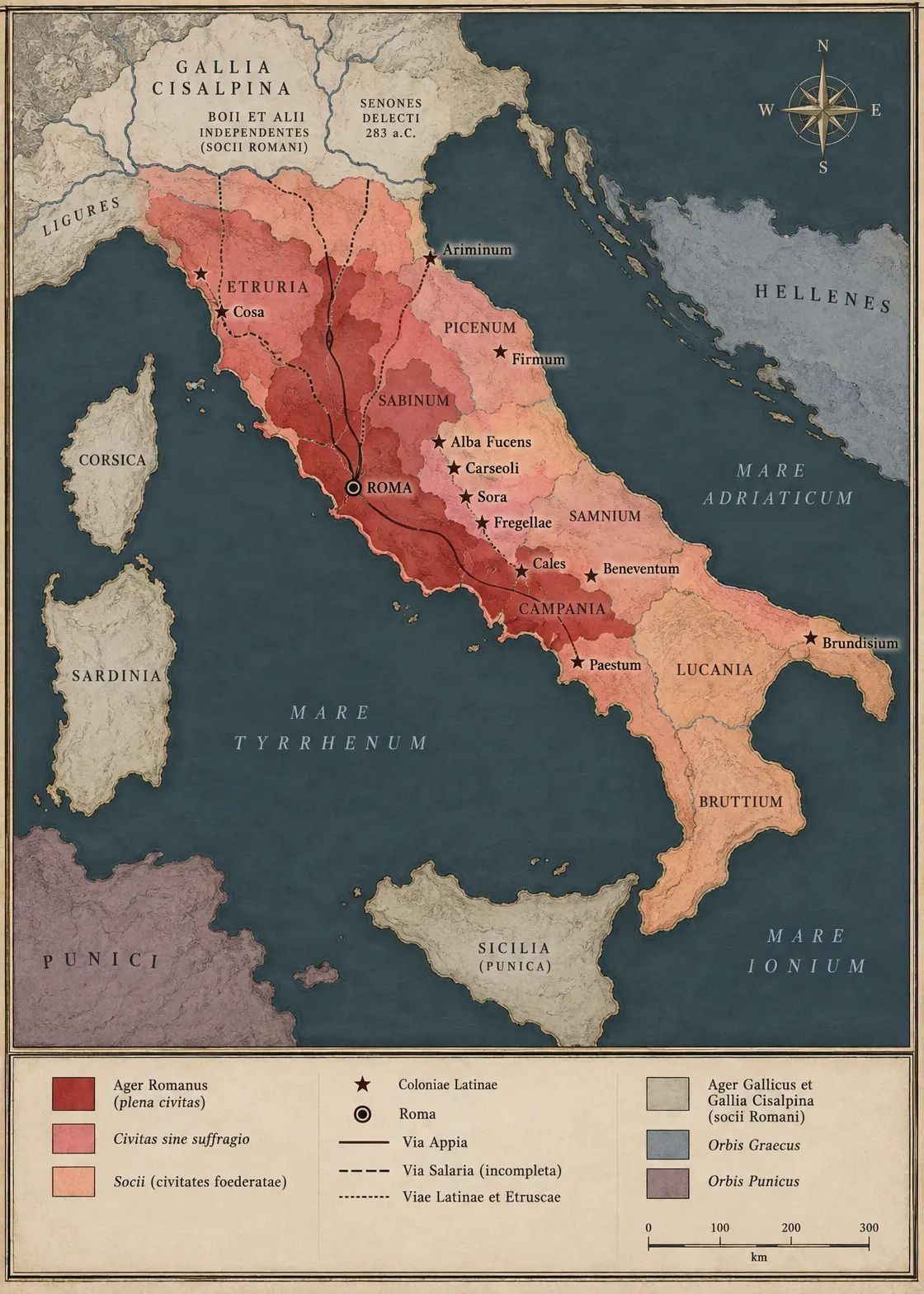
When Pyrrhus's ships withdrew from the Italian coast in the autumn of 275 BC, they left behind a peninsula whose political configuration had been altered, in the space of half a century, more thoroughly than in any comparable period before the Augustan settlement. The Italy that Pyrrhus had entered in 280 had been a patchwork of independent and semi-independent peoples — Samnites, Lucanians, Bruttians, Tarentines and the other Greek cities of the south, Etruscans and Umbrians to the north — among whom Rome was the strongest single power but not yet the dominant one. The Italy he left behind in 275 was an Italy in which every one of these peoples had been compelled, by force of arms or the threat of arms, to choose either Roman alliance or Roman subjugation. The choice was not, for any of them, between independence and dependence; it was between the terms of dependence on offer. Within a decade of Pyrrhus's departure, the choice would have been made for every remaining people of the peninsula, and the political map of pre-imperial Italy would have assumed the shape it would retain until the Social War nearly two centuries later.
The military campaigns of these eleven years are, by comparison with the great set-piece battles of the preceding wars, undramatic. There were no further engagements on the scale of Sentinum or Heraclea. The Roman state had emerged from the Pyrrhic War with a manpower base, a fortification system, a road network, and an alliance system so far in excess of any remaining Italian opponent that further resistance could only be local, partial, and ultimately futile. The consuls of these years — Manius Curius Dentatus, Lucius Cornelius Lentulus Caudinus, Quintus Marcius Philippus, Gaius Genucius Clepsina, and others whose names mean little to modern readers but who were, in their own time, the principal architects of the Roman conquest of southern Italy — campaigned annually against one or another of the remaining hold-outs, taking towns, defeating tribal forces, and incorporating territory by treaty into the Roman system. The Roman Senate appears, from the surviving records, to have been remarkably consistent in its strategic vision across this period: the goal was the complete political consolidation of peninsular Italy under Roman hegemony, the means was the graduated incorporation of each defeated people on terms suited to its particular case, and the timetable was as fast as the campaigning season and the available consular armies could manage.
The Fall of Tarentum272 BC
Tarentum had been left, by Pyrrhus's departure, with a small Hellenistic garrison under Milo holding the citadel, a divided and exhausted citizen body, and no remaining external protector. The city's situation was the more difficult because the Tarentine democracy had, by this point, fractured into factions whose disagreements were not principally about Rome but about the wisdom of the Pyrrhic adventure itself, the proper relationship between the Greek and Italian populations of the city, and the question of who was to be held responsible for the catastrophe the city had brought upon itself. Some among the Tarentines wished to surrender to Rome on the best terms available; others to negotiate with Carthage, which had sent a fleet into the gulf in 272 to test what advantage might be extracted from Tarentine weakness; still others wished to continue resistance in the hope of further external intervention which would never come.
The Roman consul Lucius Papirius Cursor — the third generation of his family to bear that famous name, grandson of the great disciplinarian — led the principal Roman army against Tarentum in 272. His campaign was conducted with the deliberation of a man whose strategic position was unchallengeable; he established blockading positions, cut the city off from inland supply, and waited. The Carthaginian fleet, finding Tarentum unwilling to commit to a clear alliance and unwilling to be taken under Carthaginian protection, withdrew. (This Carthaginian intervention of 272 is interesting in its own right: it represents one of the last moments at which the Italian and Sicilian theaters were strategically connected in the pre-Punic Wars era, and it suggests that the broader strategic competition between Rome and Carthage was already a recognized factor in the calculations of both states a decade before the open break of 264.)
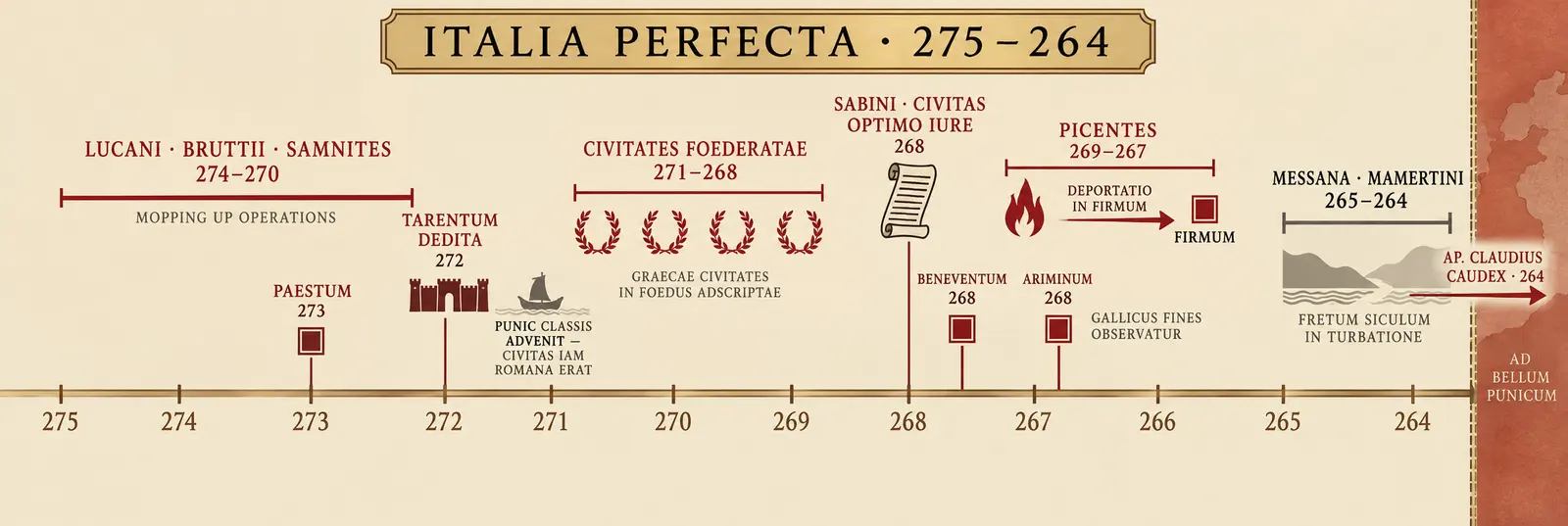
Inside the city, the Hellenistic garrison commander Milo, recognizing that the situation was hopeless, opened negotiations with Papirius. The terms agreed were that Milo and his Epirote troops would be allowed to withdraw to Greece with their personal effects and military honors, surrendering the citadel and the city itself to Rome. The Tarentines, who had not been parties to these negotiations, found themselves in late autumn 272 BC the residents of a Roman-occupied city, their citizen government suspended, a Roman garrison installed in the citadel, and the terms of their incorporation into the Roman system to be determined by the Roman Senate.
The settlement was relatively lenient. Tarentum's walls were not demolished. The Greek civic institutions of the city were preserved in form, though under Roman supervision. The city's status was that of a foederata civitas — a federated city, formally an ally of Rome, with internal self-government but bound by treaty to provide military contingents and to follow Rome in matters of foreign policy. The Tarentine fleet — the most substantial Greek naval force in the Mediterranean still under independent command — was retained by the city but was committed by treaty to Roman service. The Tarentine territorial holdings on the mainland — substantial estates in Apulia and the Salentine peninsula — were not confiscated but their administration was modified to favor Roman colonial settlement in strategic positions. Brundisium, the great natural harbor on the Adriatic coast of the Salentine peninsula, was identified as a future site for Roman colonization, though the colony itself would not be formally established for another forty years.
The fall of Tarentum effectively ended the Greek political independence in southern Italy. The remaining Greek cities — Croton, Locri, Thurii, Heraclea, Metapontum, Rhegium — all entered the Roman alliance system across the next several years on terms broadly similar to Tarentum's: nominal civic autonomy, federated status, military obligations, gradual cultural absorption. The conscious Hellenism of the southern Italian Greeks would persist for centuries — Greek would remain a language of administration and culture in much of Magna Graecia into the imperial period — but the political independence of the Greek city-state in Italy was over. The world in which Tarentum had been a power capable of bringing a Hellenistic king across the sea to defend its interests was now closed.
The Reduction of the Italian South
The campaigns of 272 through 270 BC dealt successively with the Lucanians, the Bruttians, and the various Apulian peoples who had supported Pyrrhus and who had not yet been incorporated into the Roman alliance system. These were, by and large, wars of attrition and political pressure rather than wars of major set-piece engagement. The Lucanians, after losing the bulk of their fighting men in the Pyrrhic campaigns, were no longer capable of fielding a coherent army; the Roman strategy against them consisted of taking their fortified hill-towns one by one, establishing small garrisons in key positions, and waiting for the local political elites to seek terms. The Bruttians (occupying the toe of the peninsula) followed the same pattern with slight variations. The Messapian and Apulian peoples of the Salentine peninsula were brought into the Roman system in part by alliance with the Greek cities of the coast (which had themselves been brought under Roman influence through Tarentum's fall) and in part by direct Roman military pressure.
The most extensive new colonial program of the period was the founding of three large Latin colonies in the south: Paestum on the Tyrrhenian coast in 273 (on the site of the former Greek city of Posidonia, conquered earlier from the Lucanians), Beneventum in the Caudine country of Samnium in 268, and Ariminum on the Adriatic coast in 268 (this last not in the south but at the northern Adriatic frontier, in former Senonian territory after the destruction of that Gallic tribe in 283). These colonies, each settled with several thousand colonists drawn from Latin and Roman families, established permanent Roman demographic and military presence at strategic points across the peninsula. The earlier colonial program of the 320s through the 290s had focused on the central Apennines and the Latin-Campanian frontier; the colonies of the 270s and 260s consolidated Roman control of the south and the north simultaneously. By 264 BC, the network of Latin and Roman colonies extended from Ariminum on the upper Adriatic to Paestum on the southern Tyrrhenian coast, with permanent settlements at perhaps thirty key strategic positions in between. The infrastructural foundation of Italian unification under Roman hegemony was, by the eve of the First Punic War, substantially complete.
The Sabine and Picene Settlements
In the same period, two further peoples in central Italy completed their incorporation into the Roman system. The Sabines, who had been a recurring Roman frontier opponent through the entire fifth and early fourth centuries, had been progressively reduced through the wars of the late fourth century and had received civitas sine suffragio in 290 BC under the censorship of Manius Curius Dentatus. In 268 BC, by an act of the popular assembly, the Sabines were granted full Roman citizenship and incorporated into the Roman voting tribes. The Sabine elite — by this point thoroughly Romanized in language, dress, and political behavior — entered the Roman political class on the same terms as the older Latin gentes. (The Claudii, one of the great patrician families of the Roman Republic, were originally Sabine and remembered the connection; the Sabine incorporation completed a process that had been underway since the legendary period of Roman origins.)
The Picentes — a people occupying the northern Adriatic coast between the ager Gallicus and the Sabine frontier — had revolted against Rome in 269 BC in what would be the last serious independent insurrection against Roman rule in peninsular Italy. Their revolt was crushed in two years of campaigning, the principal Picene cities were taken, and the people were incorporated into the Roman alliance system on graduated terms (full Roman citizenship for a portion of the population, socii status for the remainder, with a Roman colony at Firmum to consolidate the conquest). The Picene war is the last entry in the Roman fasti before the First Punic War in which Roman armies fought against an independent Italian people.
The Mamertine Crisis and the Eve of War
The chain of events that would draw Rome into the First Punic War, and so out of peninsular Italy into the larger Mediterranean theater that would define the next two centuries of her history, began far from the Italian mainland — in the city of Messana (modern Messina), on the Sicilian side of the strait that bears its name, in the year 288 BC. Messana had been seized in that year by a band of Campanian mercenaries — the Mamertines, so called from their devotion to Mars (Mamers in the Oscan dialect) — who had been hired by Agathocles of Syracuse and who, on his death, had found themselves without employment and not inclined to return to Italy. They had taken Messana by treachery, massacred or expelled the male citizen population, taken the women and children as their own, and established themselves as a kind of mercenary city-state controlling the strait. They had survived through the next two decades by alternating piracy, mercenary contract work, and tribute extracted from the surrounding Sicilian Greek cities. They were detested by everyone in Sicily and feared by their neighbors on both sides of the strait.
By 265 BC, the Mamertine position had deteriorated. Hiero II of Syracuse — a brilliant military and political figure who had risen from junior officer to king in the years following Pyrrhus's Sicilian campaign — had defeated the Mamertines in a major engagement at the river Longanus, and was pressing the siege of Messana itself. The Mamertines, recognizing that they could not hold the city without external help, made the kind of appeal that the Italian peoples of the previous century had made to Rome, and that the Greeks of southern Italy had made to Pyrrhus, and that the Greeks of Sicily had made to Pyrrhus again: they sought an external protector. They sent embassies in two directions simultaneously — to Carthage and to Rome.
The Carthaginian embassy arrived first. Carthage, recognizing the strategic importance of Messana and the threat that Syracusan control of the strait would pose to Carthaginian interests in western Sicily, accepted the appeal. A Carthaginian garrison was installed in Messana, the siege by Hiero was lifted, and the Mamertines found themselves under Carthaginian protection. This arrangement was, however, almost immediately resented by the Mamertines, who had not bargained for Carthaginian governors and had no wish to exchange the threat of Syracuse for the certainty of Carthaginian dependence. They therefore renewed their appeal to Rome, asking for Roman intervention to displace the Carthaginian garrison and to take Messana under Roman protection on terms more favorable to Mamertine autonomy.
The Roman Senate was divided. The legal basis for accepting the Mamertine appeal was tenuous: the Mamertines were a band of mercenary brigands who had murdered their hosts and taken a city by treachery, and to receive them as allies was to associate Rome with their crimes. Worse, accepting the appeal would mean direct conflict with Carthage, a power with which Rome had been at peace for over a century and a half through three successive treaties (the most recent dating from 279, during the Pyrrhic War, when Carthage had briefly contemplated joint action against Pyrrhus in Italy). It would also mean projecting Roman power across the strait into Sicily — a step beyond the peninsular Italian theater that had defined Roman strategic operations for more than a generation. The conservative voices in the Senate argued against acceptance.
The arguments for acceptance, however, were also strong. To allow Messana to remain in Carthaginian hands was to permit a Carthaginian foothold within sight of the Italian mainland — a foothold that could be developed, in time, into a strategic threat to the Roman position in southern Italy. The Italians of the south, only just incorporated into the Roman system, might be tempted to seek Carthaginian alliance if Roman strategic capability could be made to seem limited to the peninsula. The Mamertines themselves, however unsavory their history, were ethnically Italian — Campanians, Romanized in language and military culture, and not so different from Roman allies elsewhere — and to abandon them to Carthaginian or Syracusan disposal would be to abandon a population with at least nominal Italian connections.
The debate was unresolved in the Senate. The constitutional position was that, when the Senate could not reach consensus on a war declaration, the question went to the popular assembly. The consuls of 264 BC put the question to the assembly, framed in the terms most likely to produce a favorable vote: the question was whether Rome should accept the Mamertine appeal and send an army across the strait to Messana. The argument for the affirmative, as preserved in fragments of Cassius Dio and reconstructed by modern scholarship, emphasized the strategic threat of Carthaginian expansion, the moral obligation to fellow Italians, and the prospect of significant plunder in a wealthy theater. The argument for the negative, less well preserved, emphasized the moral question of allying with the Mamertines and the danger of war with Carthage. The popular assembly voted for the affirmative.
The consul Appius Claudius Caudex was assigned to the operation. He marched south with one consular army (the legions assigned to the consular provincia of Sicily for that year), assembled the transport at Rhegium on the Italian side of the strait, and prepared to cross. The Carthaginian garrison commander at Messana, finding himself caught between the Mamertines (who now wished him gone) and the approaching Roman army, and unwilling to be the man who started a war with Rome on his own initiative, evacuated the city. The Mamertines admitted Caudex and his army; the Roman garrison was installed; Hiero of Syracuse, recognizing that the strategic situation had shifted decisively, allied himself with Carthage to oppose Roman intervention; and the war that would later be called the First Punic War — though no one yet knew there would be more than one — had begun.
The crossing of Appius Claudius Caudex to Messana in 264 BC is the conventional terminus of the period covered by this volume. It is a conventional terminus, but it is also a real one. With Caudex's crossing, the Roman state stepped beyond the peninsular Italian theater in which her entire prior military history had taken place. The wars of 390 through 264 had been wars for the consolidation of Italy under Roman hegemony. The wars that would follow — against Carthage, against Macedon, against the Seleucid empire, eventually against the Hellenistic world entire — would be wars for the consolidation of the Mediterranean under Roman hegemony. The conceptual leap involved in this transition was not made in 264; it would be made gradually across the subsequent generation, as the Carthaginian war developed in directions no one had anticipated. But the act of leaving Italy was made in 264, and from that act there would be no withdrawal.
The Crossroads · 264 BC · Rome
The Threshold of the Strait
You are a Roman citizen voting in the popular assembly in 264 BC, summoned to decide whether the Republic should accept the Mamertine appeal and cross into Sicily.
Messana has sent a renewed embassy begging Rome for aid. The Mamertines—Campanian mercenaries who seized the Sicilian city by butchering its citizens—are trapped between King Hiero II of Syracuse and a Carthaginian garrison they admitted to their citadel and now deeply regret. The Roman Senate has deadlocked, unable to reach consensus on allying with murderous brigands or risking war with Carthage after more than a century of peace. Now the consuls of 264 BC bring the question directly to the popular assembly: should Rome accept the Mamertines into alliance and send a consular army across the strait?
How should the Roman popular assembly vote on the Mamertine appeal?
Weigh each course: open it to hear your own inner voice. Then decide. Nothing is scored.
- Your inner voiceThe course taken
We cannot soil our hands by allying with treacherous brigands, nor should we recklessly plunge into an overseas war against Carthage. Yet we cannot leave our southern coast unwatched while Carthaginian ships and troops hold the opposite shore. Let us refuse the Mamertines their treaty, but station our legions firmly at Rhegium on the Italian coast. We protect our newly incorporated allies, preserve our ancient treaties, and defend Italy without taking the fateful step across the sea.
- Your inner voiceThe course taken
If we permit Carthage to hold Messana, their garrison sits within sight of our shore, threatening all southern Italy. Our newly won Italian allies will doubt our strength if they see Roman arms halt at the water's edge. These Mamertines are Campanians, our own kin by blood and speech. We must cross the strait, displace the Carthaginian garrison, and secure the crossing. Our soldiers will find rich plunder, and Rome will secure her southern flank.
- Your inner voiceThe course taken
We have sworn three successive treaties of peace with Carthage across a century and a half. Shall we break our faith for blood-stained mercenaries who murdered their hosts and stole Messana by treachery? Associating Rome with such brigands covers us in dishonor. Stepping beyond the Italian peninsula exposes us to war against a great naval power across the sea. Let Carthage and Syracuse contend for Sicily; our duty and our borders remain here in Italy.
What was done
The popular assembly voted for the affirmative. The consul Appius Claudius Caudex was assigned to the command, led a consular army south, and assembled transports at Rhegium. In Messana, the Carthaginian garrison commander found himself trapped between the fickle Mamertines and the advancing Roman force; unwilling to provoke war on his own initiative, he evacuated the citadel. Caudex and his legions crossed the strait, entering Messana and installing a Roman garrison. Confronted by this foreign intrusion, Hiero II of Syracuse allied with Carthage to oppose Roman intervention. The resulting conflict, known later as the First Punic War, drew Rome decisively beyond the peninsular Italian theater. The Mamertine crisis and Rome's intervention are recorded by Polybius (BGrade B), Cassius Dio via Zonaras (BGrade B), and Livy's Periochae (BGrade B), though fragments of Diodorus (CGrade C) also preserve the sequence. From this crossing, there would be no turning back.
The evidence The Mamertine crisis and the intervention of 264 BC are attested at BGrade B overall. The principal surviving account is Polybius 1.7–11 (BGrade B), supplemented by Livy Periochae 16 (BGrade B), Cassius Dio fragments preserved via Zonaras 8.7–9 (BGrade B), and fragmentary notices in Diodorus 22–23 (CGrade C) and Frontinus's Strategemata (CGrade C). The exact sequence of the Mamertine appeals and the internal politics of the Senate are reconstructed primarily from these later retrospective sources.
If you choose to walk through itAt every scale
- Yourself
Can you justify allying with dishonorable brigands if doing so advances your own ambition and wins glory for your family name?
- Those beside you
What do you owe to the soldiers of your household and voting century who will be rowed across the sea into an overseas war against a maritime empire?
- Rome
Does the Republic compromise its ancestral legal and moral authority when the popular assembly overrides conservative senatorial hesitation for the promise of plunder?
- The wider world
How will newly subdued Italian allies view Rome if it tolerates a Carthaginian military foothold directly across the narrow strait?
- Our own time
When a powerful nation is invited to intervene in a regional conflict by an unsavory local faction, where does strategic necessity end and moral complicity begin?
In modern geopolitics, established powers frequently face urgent appeals from rogue militias or insurgent factions occupying critical maritime chokepoints. Intervening shields a strategic border and denies a rival empire a permanent foothold, but it forces the intervening state to embrace disreputable allies and converts a peripheral skirmish into an open, multi-theater conflict with another major power.
Where the comparison fails. Modern states possess codified international law, multilateral alliances, and diplomatic embassies to mediate border disputes. Rome and Carthage lacked permanent diplomatic legations, and Rome possessed no standing navy or experience in overseas administration, transforming a single tactical crossing into an unprecedented institutional transformation for the Republic.
What does the chapter tell us?
Why did the decision to intervene in Messana pass to the popular assembly rather than being resolved by the Roman Senate?
According to the chapter, conservative senators opposed allying with brigands and risking war with Carthage, while others urged intervention. Because the Senate was unresolved and could not reach consensus on a war declaration, the constitutional position required the consuls to put the question to the popular assembly.
the chapter's narrative
How did Rome acquire control of Tarentum in 272 BC?
Recognizing that the situation was hopeless, Milo, the Hellenistic garrison commander left by Pyrrhus, negotiated with consul Lucius Papirius Cursor. Milo secured safe withdrawal to Greece with his troops and military honors, surrendering the citadel and leaving the Tarentines to be occupied without their participation.
Polybius and Cassius Dio (BGrade B)
Who were the Mamertines, and why did they appeal to Rome in 264 BC?
The Mamertines were Campanian mercenaries hired by Agathocles of Syracuse who seized Messana by treachery in 288 BC. After Hiero II defeated them, they admitted a Carthaginian garrison, but soon resented Carthaginian control and appealed to Rome to displace it and protect their autonomy.
Polybius 1.7–11 (BGrade B)
What political change did the Sabines experience in 268 BC?
Having received civitas sine suffragio in 290 BC, the Sabines were granted full Roman citizenship by an act of the popular assembly in 268 BC. Their Romanized elite entered the Roman political class, completing a long incorporation process exemplified by ancient Sabine families like the Claudii.
Velleius Paterculus 1.14 (BGrade B)
What was the strategic purpose of founding Latin colonies like Paestum, Beneventum, and Ariminum between 273 and 268 BC?
The Latin colonies of the 270s and 260s BC placed thousands of Roman and Latin families at key positions across Italy. By extending from Ariminum on the northern Adriatic to Paestum on the southern Tyrrhenian coast, Rome completed the infrastructural foundation of peninsular hegemony before the Punic Wars.
Velleius Paterculus 1.14 (BGrade B) and CIL inscriptions (AGrade A)