Book I · The Republic in Italy
Proem
Proem
There is a date which the Romans of the late Republic could neither remember without shuddering nor pronounce without superstition. Dies Alliensis — the day of the Allia, the eighteenth before the Kalends of Sextilis — was held religious in perpetuity, an ater dies on which no public business could be transacted and no army would willingly take the field. The defeat which gave the day its name was, in strict military terms, neither the costliest nor the most decisive that Rome ever suffered. But it had a quality possessed by no other Roman disaster: it was the only one that ended with the enemy walking unopposed through the streets of the city. For three centuries afterward, the descendants of those who had run from the Allia would build legions and conquer empires partly to ensure that no such procession would ever take place again. They mostly succeeded. It is the story of how they mostly succeeded that this volume undertakes to tell.
The period spanned in these pages — from the Gallic sack of 390 BC to the year 264 BC, when the consul Appius Claudius Caudex crossed the strait to Messana and Rome found herself committed to a war with Carthage she had not quite intended to start — is a century and a quarter during which the Romans transformed themselves from a battered Latin city-state confined to the lower Tiber valley into the mistress of peninsular Italy. They did this through a series of wars whose names are now memorized chiefly by undergraduates: the First Samnite War, the Second Samnite War, the Third Samnite War, the Pyrrhic War. Each was harder than the last. Each ended with Rome more powerful than she had been at its beginning. And each contributed something to a military and political instrument that would, in the centuries to follow, prove capable of subduing the Mediterranean.
The reader who comes to this period expecting the literary clarity of Caesar's commentaries or the dense documentation of the late Empire must be warned at the outset: the historical record for these years is fragmentary, partisan, and in many places frankly legendary. Our principal narrative source is Livy, who wrote in the reign of Augustus three and a half centuries after the events of the Gallic sack. Livy himself drew upon a chain of earlier writers — the so-called Roman annalists, beginning with Fabius Pictor in the late third century BC and extending through Valerius Antias and Claudius Quadrigarius — none of whose works survive complete. The annalistic tradition was already, by Livy's own admission, contaminated with family legends, doublets, and inflated casualty figures. To this Livy added his own moralizing and his own occasional confusions. Polybius, whose surviving books begin with the First Punic War, refers backward to the events of our period only in passing and only where they help explain his own narrative. Plutarch, writing nearly five hundred years after the Gallic sack, gives us a Life of Camillus and a Life of Pyrrhus — biographies built upon sources we can no longer cross-check.
What this means is that the present volume must, more so than its successors, distinguish carefully between what the sources allow us to say and what they only encourage us to imagine. We will name the legions where Livy names them, knowing that the legion-numbers of the fourth century are not always reliable. We will recount the deeds of Camillus and Decius Mus and Manius Curius Dentatus where the tradition recounts them, while noting where the tradition shades into legend. The reader who wishes to know, with confidence, the casualty figures of the Battle of Sentinum or the precise dispositions of Pyrrhus's elephants at Heraclea will leave these pages disappointed. The reader who wishes to know, as nearly as the surviving evidence permits, how the Roman state learned to fight and to win in a world of rival Italian peoples, of Greek mercenaries, of Macedonian phalanxes and of Gallic war-bands — that reader will, the present author hopes, leave with the outline at least of a coherent story.
A word, before we begin, on the army of which we are about to tell the early history. The Roman military instrument of 390 BC bore little resemblance to the legion of Marius or Caesar; it bore little resemblance even to the manipular legion that Polybius would later describe with such admiration. At the moment of the Gallic sack, the Romans still fought in some version of the hoplite phalanx — a dense formation of heavy-armed infantry equipped with the round clipeus shield, the thrusting spear, and a short sword. They had taken this style of war from the Etruscans, who had taken it in turn from the Greeks of southern Italy and Sicily. It was a style of war well suited to set-piece battles on level ground between roughly equal opposing forces of citizen militia. It was poorly suited to fighting Gauls who came down in headlong charge from the mountains, or Samnites who fought in loose order across broken country, or war elephants advancing in line. The legion would evolve, across the century and a quarter covered in this volume, in response to each of these challenges. By 264 BC the Romans would possess in the manipular legion an instrument unique in the ancient world: an army capable of fighting and winning on almost any terrain against almost any opponent. The evolution by which they arrived at this instrument is one of the principal stories these pages will trace.
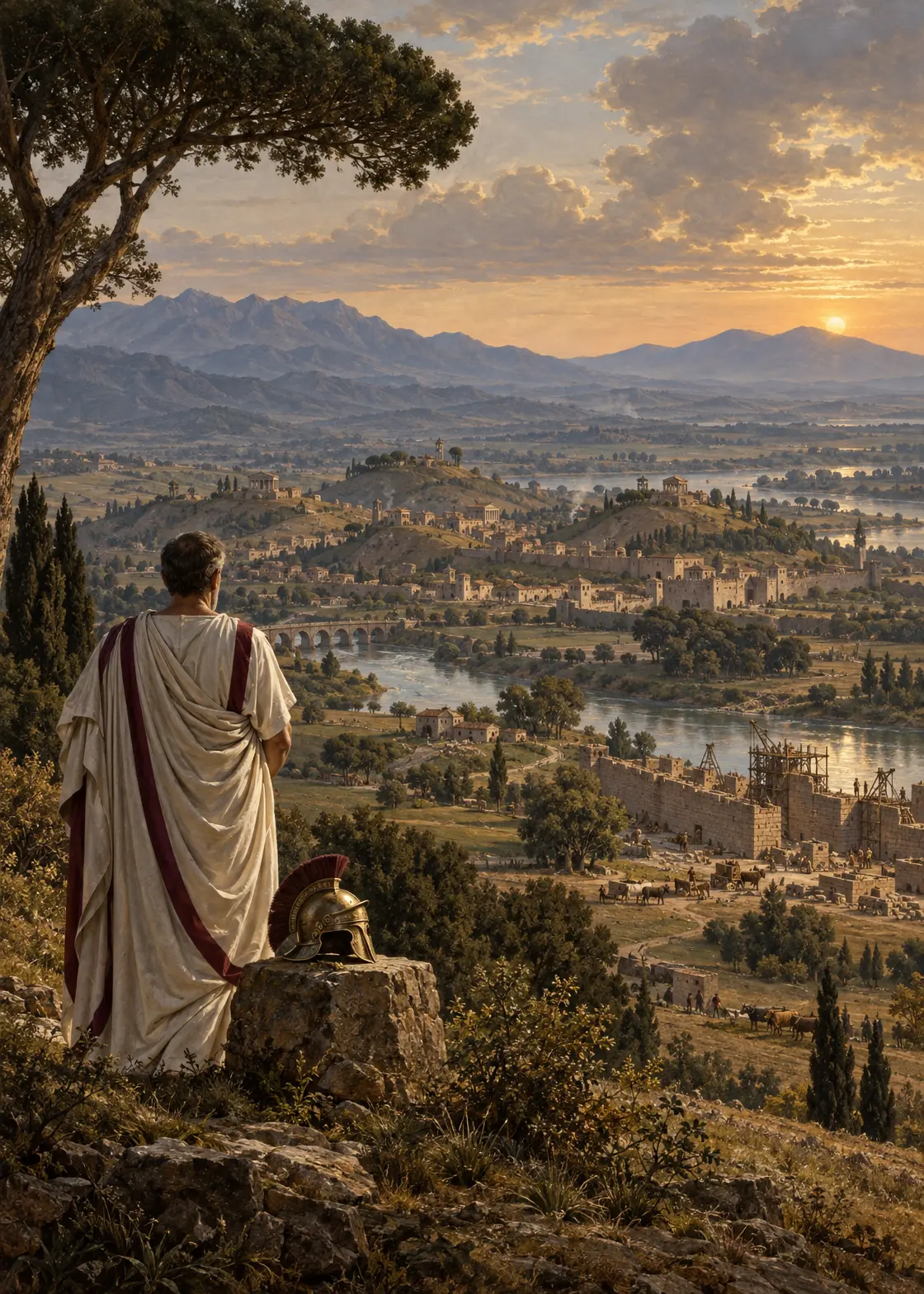
The reader will also encounter, throughout this volume, an apparatus of supplementary materials. Where the narrative invites visual reconstruction, image-plate prompts have been embedded for the production pipeline. Where tactical dispositions or campaign geography can be clarified through schematic representation, Mermaid diagrams have been provided. At the conclusion of each entry an Editor's Note assesses the state of the sources, assigns an attestation grade in the manner established for the Codex Kythagoras compendium series, and identifies known gaps in our knowledge. The grades range from A (strict eyewitness or contemporary archival access) to D (suspect attribution or problematic transmission); the great majority of entries in this volume will receive grades of B or C, reflecting the retrospective nature of nearly all surviving sources for the period.
Let us, then, turn to the Allia, and to the day on which the city of Rome was, for the first and last time in its long history before the empire's fall, simply walked into by an enemy.