Chapter 1
The Aftermath of Cannae: Recovery, Capua, and the Macedonian Threat
The Recovery at Rome
The political and military response of the Roman state to Cannae in the late summer and autumn of 216 BC was, in retrospect, the moment at which the war was decided. Not, to be sure, because Cannae was reversed — it was not, and could not have been — but because the institutional response demonstrated that the Roman state was not, in fact, structurally incapable of absorbing the catastrophe. Hannibal's strategic conception had been built on the assumption that a sufficient demonstration of Roman military weakness would produce political dissolution; what occurred at Rome in September and October of 216 BC was the demonstration that no demonstration of military weakness, short of the literal destruction of the city, would produce such dissolution. The strategic asymmetry of the war was thereby reversed: where Hannibal had previously possessed the operational initiative and Rome had been on the strategic defensive, the post-Cannae mobilization meant that Hannibal would henceforth be the one fighting a war whose underlying logic was against him.
The institutional measures taken at Rome across the autumn of 216 are themselves worth recapitulating in some detail, because they constitute the institutional foundation upon which the entire post-Cannae war would be conducted. The dictatorship of Marcus Junius Pera, with Tiberius Sempronius Gracchus as master of horse, was the first measure: a constitutional emergency response that placed the state under unified military direction without the divided-command difficulties that had produced both the Fabius–Minucius conflict of 217 and the Varro–Paullus catastrophe of 216. The recruitment of the volones — eight thousand slaves, purchased by the state from their owners and freed upon enlistment — was the second: an unprecedented broadening of the citizen-soldier base that signaled the state's willingness to draw upon resources previously regarded as inadmissible for legionary service. The recruitment of younger men down to age seventeen and of debtors and criminals (granted relief of their obligations in exchange for service) further extended the manpower base. The Senate's own contribution was substantial: senators contributed their personal silver and gold for the war effort, with the temple treasuries opened to public use under emergency procedures that the religious authorities approved with what was, by Roman standards, unusual dispatch. By the late autumn of 216, the new armies were being formed: two new urban legions for the immediate defense of Rome itself, four legions under Marcus Claudius Marcellus to be deployed against Hannibal in Apulia, two additional legions under Gracchus to be raised from the volones and other irregular recruits, and reinforcements for the Spanish, Sicilian, and Sardinian theaters.
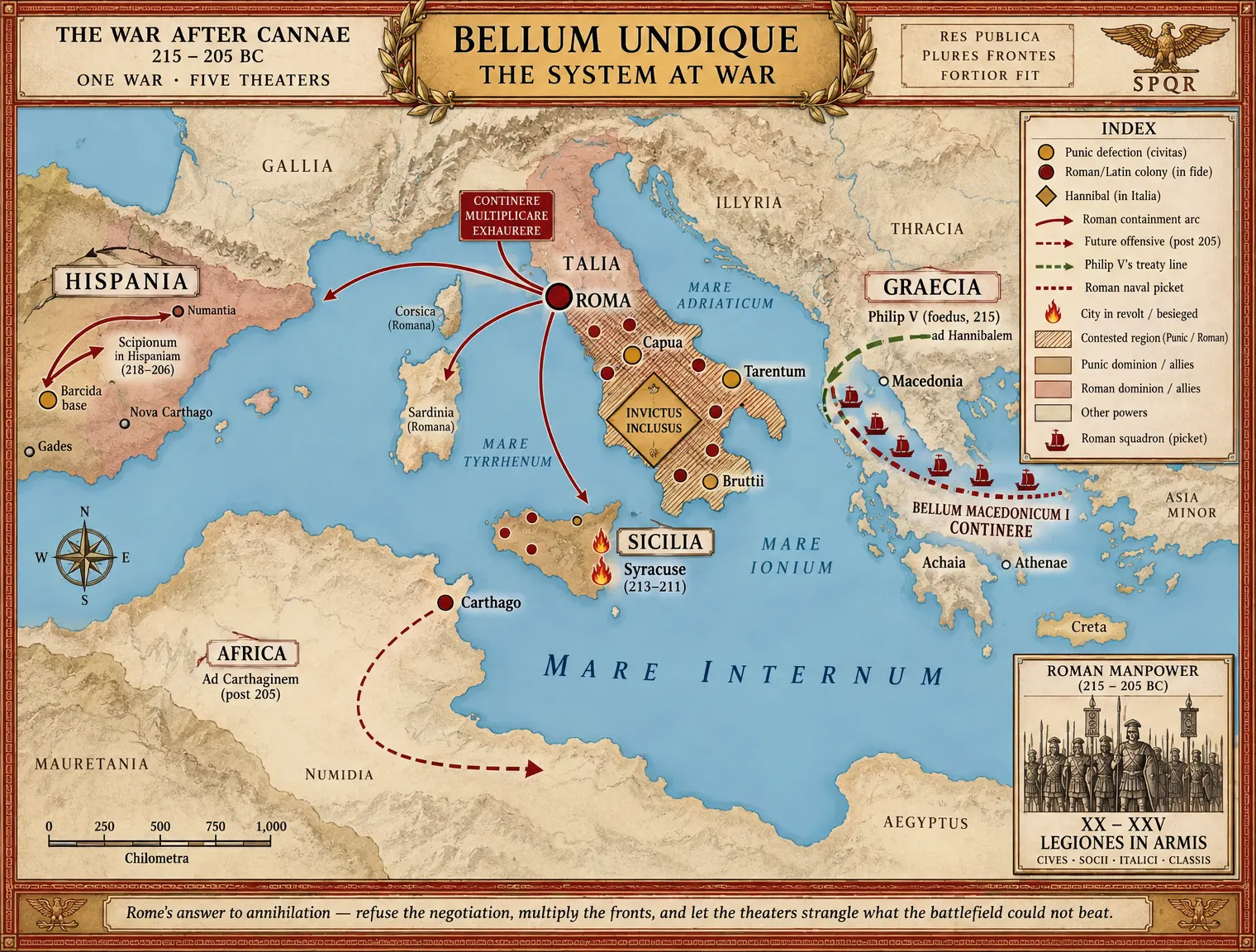
The institutional decision that most distinguished the post-Cannae Roman political order from any contemporary Hellenistic state was the refusal of negotiations. Hannibal, in the days immediately following Cannae, dispatched a Carthaginian officer named Carthalo to Rome with a Roman officer-prisoner under safe-conduct, offering to release the surviving Roman prisoners on payment of moderate ransom and presumably (the sources are not fully explicit, but the intent is clear) to enter into discussions on the terms of a peace. The Senate refused even to receive the embassy. The Roman ambassadors who had been part of the captured group sent their own delegation seeking authorization to negotiate their ransom; the Senate refused this as well, in a debate that Livy preserves at length (22.58–61) and that Polybius confirms in substance. The argument carried by Titus Manlius Torquatus and the senatorial conservatives was the argument that became Roman doctrine for the remainder of the war and remained Roman doctrine throughout the imperial period: Rome did not negotiate with armed enemies on Italian soil. The captured prisoners — between eight and ten thousand Romans and Italian allies — were left to whatever fate Hannibal chose for them. (He sold them into slavery in due course, partly to defray his army's expenses and partly because the political logic of holding them indefinitely had ceased to apply.) The Roman political class had committed itself, definitively, to the proposition that the war would continue until one side or the other could not continue it.
The Defection of Capua216–215 BC
The most strategically significant of the post-Cannae Italian defections to Hannibal — and the one whose recovery would prove the principal Roman political-military achievement of the next five years — was the defection of Capua. Capua was the second city of Italy by population and probably the first by per-capita wealth: a Campanian city of approximately one hundred and fifty thousand inhabitants, with a fertile agricultural hinterland, a substantial commercial economy, and the strategic position dominating the road network of northern Campania. The Capuan defection was therefore not the defection of a peripheral or marginal community; it was the defection of one of the principal pillars of the Roman alliance system in the south, with consequences that the Roman political order felt as a personal humiliation and that the strategic situation required to be reversed at whatever cost.
The political mechanics of the Capuan defection are preserved by Livy (23.2–10) with the kind of detail that suggests he had access to substantial documentary sources, including possibly the senatorial decrees and Capuan civic records that survived into the late Republican antiquarian tradition. The Capuan civic order had been internally divided between a pro-Roman aristocratic faction (associated with the city's senatorial families and with the Magii in particular) and a popularis faction (associated with the urban commercial class and with the Calavii) since at least the mid-third century. The Capuan disasters during the post-Cannae period — the loss of substantial numbers of Capuan citizens in the Roman armies of 218 through 216, the disruption of trade with Roman-controlled territories, the appearance of Hannibal's victorious army within marching distance of the city — radicalized the popularis faction and weakened the aristocratic one. The decisive figure was Pacuvius Calavius, the principal popularis leader, who in late summer 216 BC orchestrated a sequence of political moves that ended with the Capuan civic assembly voting to admit a Carthaginian alliance and to expel the Roman garrison.
The terms of the Capuan alliance with Carthage, as preserved in summary by Livy (23.7), were unusually favorable to Capua: the city would retain her own laws, her own magistrates, her own military forces; she would provide no troops to Hannibal's army; she would not be subject to Carthaginian taxation; she would be guaranteed by treaty as the head of the Campanian league after the war's conclusion, with the implication that Capua would replace Rome as the dominant power in central-southern Italy. The terms were so favorable, in retrospect, that they revealed how desperately Hannibal needed political success in Italy after the strategic disappointment of the post-Cannae weeks: he was prepared to grant terms that effectively created a competing major power in Italy in order to secure the alliance that would (he hoped) trigger the broader defection of the Italian alliance system.
The defection of Capua did not, however, produce the broader defection. Several smaller Campanian cities followed Capua (Atella, Calatia, Sabatia), but the principal Latin and Roman colonies of the area — Cales, Suessa Aurunca, Casinum, Venusia — remained loyal. Most of Samnium remained loyal (the Hirpini canton defected; the Pentri did not). The Lucanians divided; the Bruttians went over to Hannibal but had little military value; the Greek cities of the south defected one by one over the following two years, with Tarentum following in 212 as the major late addition. The Italian alliance system, taken as a whole, lost perhaps a quarter of its territory and a fifth of its manpower to Carthaginian alliance across the post-Cannae period. The loss was substantial but not catastrophic; the Roman strategic problem after 216 was not whether the alliance system could survive (it did), but how to reverse the defections that had occurred and to bring the lost territories back into the Roman political order.
The Macedonian Complication215 BC
While the Italian alliance system was being tested by the post-Cannae defections, a strategic complication of major proportions was developing in the Greek east. Philip V of Macedon, then twenty-three years old and recently established on the throne as the third Antigonid king of his dynasty, had been watching the Roman war with Carthage with the calculating attention of a Hellenistic monarch looking for opportunity. Philip's strategic interests in the western Mediterranean were principally focused on the Adriatic coast: the Illyrian principalities of the eastern Adriatic had been brought under Roman protection by the wars of 229 and 219 (treated in Book II), and Philip regarded the Roman strategic presence on the Illyrian coast as a constraint on Macedonian expansion that he wished to remove. The Roman catastrophe at Cannae appeared to Philip to provide the opportunity for such removal.
Philip's diplomatic agents reached Hannibal's camp in southern Italy in the spring of 215 BC. The negotiations that followed produced a treaty between Macedon and Carthage that has, by remarkable good fortune, been preserved in substantially complete form. A Macedonian delegation under one Xenophanes was returning to Greece after concluding the treaty when their ship was intercepted by a Roman naval patrol in the Adriatic; the treaty document, along with letters of Philip to Hannibal, were captured intact and forwarded to Rome. Polybius (7.9), who clearly had access to the captured document or to senatorial copies of it, preserves the treaty's text in full. The terms committed Macedon and Carthage to mutual military assistance, recognized the territorial integrity of each, committed the Macedonians to military operations against the Roman possessions in Illyria, and (in a provision that would prove the most strategically significant) anticipated a future Carthaginian-Macedonian joint operation against Rome itself. The treaty was, as a diplomatic document, of the formal kind that the Hellenistic monarchies regularly concluded with one another; what was extraordinary was the Carthaginian-Hellenistic combination it implied. Rome was now facing not merely the war with Carthage but the prospect of a coordinated Mediterranean coalition that would unite the major commercial empire of the western sea with the principal land-power of the Greek world.
The Roman strategic response to the Macedonian treaty was the First Macedonian War (214–205 BC), a campaign conducted on what was, by Roman standards of the period, a small scale, but with strategic objectives of considerable subtlety. The Roman conception, articulated principally by the praetor Marcus Valerius Laevinus who was assigned to the Adriatic theater, was that Philip should be prevented from delivering any actual military assistance to Hannibal — which meant maintaining Roman naval superiority in the Adriatic and the Ionian, supporting the Illyrian principalities that had been allied with Rome since 229, and constructing a coalition of Greek powers (principally the Aetolian League, traditional opponents of Macedon) that would tie Philip down in the Greek theater. The strategic objective was not the defeat of Macedon — that would come in a subsequent generation's war, the Second Macedonian War of 200–197 BC, which lies beyond the scope of the present compendium — but the prevention of Macedonian intervention in the Italian theater. The objective was accomplished. Philip's military operations across the next decade were conducted entirely in Illyria and the Greek world; no Macedonian troops crossed to Italy; no joint Carthaginian-Macedonian operation was undertaken. The First Macedonian War concluded in 205 BC with the Peace of Phoenice, by which Rome accepted Philip's gains in Illyria in exchange for his disengagement from the Carthaginian alliance — terms that were strategically tolerable to Rome because by 205 the Italian theater was largely secure and the Spanish theater was won.
The Battle of Nola (216 BC) and the Containment of Hannibal
While these political developments were unfolding, Hannibal's army was operating in Campania, attempting to consolidate the strategic gains of Cannae by securing the principal cities of the region. The Roman strategic response in the Italian theater was the assignment of Marcus Claudius Marcellus — who had been one of the senior consuls-designate for 215 BC and who, after a complex constitutional sequence involving omens and re-elections, was made the principal commander in the south with proconsular authority — to confront Hannibal in Campania. Marcellus was a figure unlike any other in the post-Cannae Roman command. Where Fabius represented the strategic patience of the senatorial conservatives, and Varro the aggressive popularis preference for decisive engagement, Marcellus represented a third tradition: the willingness to engage Hannibal in subordinate actions, to fight him in operations of limited scope, to accept tactical losses in exchange for strategic position. He was the consul who had taken the spolia opima at Clastidium in 222 BC by killing the Cisalpine Gallic chieftain Viridomarus in single combat — the third and last Roman general in history to win this supreme distinction — and he had a personal reputation for combative initiative that the conservative senatorial tradition viewed with some unease. In the post-Cannae period, however, Marcellus's combative initiative was exactly what the Italian theater required.
The first engagement between Marcellus and Hannibal occurred at Nola in late autumn 216 BC, while Hannibal was attempting to bring the city of Nola into the Carthaginian alliance through a combination of political pressure on the Capuan model and direct military threat. Marcellus, marching south from his base at Casilinum, reached Nola before the city could capitulate and installed a Roman garrison; when Hannibal arrived at the city walls and offered battle, Marcellus accepted on terms that gave him the advantage of fighting from a fortified position with the city's gates open behind him for retreat. The engagement that followed — Polybius does not describe it; Livy (23.16) gives a brief account — was a Roman tactical success on a small scale: Hannibal was repulsed, Roman casualties were lower than Carthaginian (though not by a substantial margin), and the city of Nola remained in the Roman alliance. The strategic significance was less in the engagement itself than in what it demonstrated: Hannibal's army, victorious in the great set-piece battles, could be checked in operations of limited scope by Roman commanders willing to engage on disadvantageous terms when the strategic situation required it. The Marcellan doctrine — engage Hannibal in subordinate actions, never in major set-pieces; accept tactical losses in exchange for strategic position; deny him the consolidation of his Italian gains by perpetual harassment — became, alongside the Fabian doctrine of strategic patience, the second pillar of the Roman approach to the Italian theater across the following years.
Two further engagements at Nola followed: a second in 215 BC, also a Roman tactical success on a small scale, and a third in 214 BC, which was inconclusive. The strategic effect of these engagements was cumulative: Hannibal's army was prevented from consolidating his post-Cannae gains in northern Campania, the Roman alliance system in the area held, and the strategic momentum that the catastrophe at Cannae had given the Carthaginian campaign was progressively dissipated by the slow grinding pressure of the Marcellan campaigns. By the spring of 214 BC, the strategic situation in the Italian theater had stabilized: Hannibal controlled southern Italy with substantial allied bases but could not consolidate the southern coalition into a unified force; Rome controlled central and northern Italy with the alliance system largely intact; the war in Italy had become, in effect, a strategic stalemate in which neither side could deliver a decisive blow but both sides were being slowly drained.
The Crossroads · Autumn 216 BC · Rome, the Senate
The Captives of Cannae
You are a Roman senator sitting in the Curia after the disaster at Cannae, hearing the appeals of the captured soldiers and the debate led by Titus Manlius Torquatus.
Hannibal has dispatched the Carthaginian officer Carthalo to Rome under safe-conduct alongside a captured Roman officer. Between eight and ten thousand Roman and allied soldiers remain in Hannibal's hands after Cannae. Hannibal offers to release them for a moderate ransom and seeks to open discussions regarding peace. At the same time, the captured soldiers have sent their own delegation to plead before the Senate for their ransom. Rome faces an extreme deficit of manpower, leading the dictator Marcus Junius Pera to consider arming eight thousand slaves (volones), boys of seventeen, and debtors. The Senate must decide whether to receive Carthalo, pay for the soldiers, or refuse all engagement.
How will you cast your vote on the ransom of the captured soldiers and Hannibal's overture to treat?
Weigh each course: open it to hear your own inner voice. Then decide. Nothing is scored.
- Your inner voiceThe course taken
Cannae has stripped us of our armies, our consuls, and fifty thousand citizens. If Hannibal now offers terms through Carthalo, we would be mad to slam the door. What remains to defend our walls? We are debating arming slaves and children. A negotiated peace now might cost us territory or tribute, but it preserves the city itself and brings ten thousand trained sons of Rome back to their hearths before our alliance wholly dissolves.
- Your inner voiceThe course taken
We need trained soldiers immediately. Enlisting raw youths and buying eight thousand slaves as volones will take months of drill, yet here are eight to ten thousand experienced men awaiting release for a moderate sum. We can turn Carthalo away at the gates to demonstrate our refusal to treat for peace, while paying the gold to restore our legions. Why discard our own citizens when the state is bled nearly dry?
- Your inner voiceThe course taken
Titus Manlius Torquatus speaks the harsh truth of our ancestors: a Roman soldier must conquer or die where he stands, not look to the treasury to buy his surrender. If we ransom them, we supply Hannibal with Roman silver to pay his mercenaries, while teaching every future legion that capture carries no shame. We must close our gates, leave the prisoners to their fate, and show the world that Rome never treats while an invader treads our soil.
What was done
The Senate adopted the doctrine advocated by Titus Manlius Torquatus and the senatorial conservatives: Rome would not negotiate with armed enemies on Italian soil. Carthalo was refused entry, and the Senate rejected the delegation of prisoners seeking authorization for their ransom. The eight to ten thousand captured soldiers were abandoned to Hannibal, who subsequently sold them into slavery to defray his army's expenses when their political value as leverage vanished. To replace the catastrophic losses without bargaining with the invader, the state resorted to radical emergency mobilization under the dictator Marcus Junius Pera: purchasing and arming eight thousand slaves (volones), drafting youths down to age seventeen, and enlisting debtors and criminals. Senators surrendered their personal silver and gold to fund the war, establishing an uncompromising principle that governed the remainder of the conflict.
The evidence Livy 22.58–61 (BGrade B with dramatic elaboration) preserves the senatorial debate over the prisoners and Carthalo's mission, with Polybius (BGrade B) confirming the substance of the refusal to negotiate.
If you choose to walk through itAt every scale
- Yourself
How does a senator reconcile casting a vote that condemns thousands of fellow citizens—men who surrendered rather than died at Cannae—to enslavement in Carthaginian hands?
- Those beside you
How do you face the prominent families, clients, and kin in the Forum whose sons and brothers are held in Hannibal's camp, knowing the treasury refused to buy their freedom?
- Rome
Can a republic maintain military discipline and civic resolve in an existential crisis if it establishes that surrender will be compensated with state ransom?
- The wider world
What signal does an absolute refusal to treat send to wavering Italian allies like Capua and foreign powers like Philip V of Macedon regarding Rome's capacity to endure?
- Our own time
In what circumstances should modern institutions adhere rigidly to an absolute refusal to negotiate with adversaries, even when hostages or prisoners pay the price?
Modern sovereign nations and international alliances frequently debate whether to pay ransoms or offer political concessions to hostile regimes and militant groups holding captured soldiers or civilian hostages. Proponents of absolute refusal argue that paying ransoms finances enemy operations, invites further kidnappings, and signals institutional fragility, whereas advocates for negotiation argue that the state owes an absolute duty of protection to its citizens who were placed in harm's way on its behalf.
Where the comparison fails. Unlike modern hostage crises involving isolated individuals or small units held by non-state actors, Rome faced an invading field army holding thousands of soldiers after a battle that annihilated fifty thousand troops, threatening the immediate survival of the state itself.
What does the chapter tell us?
Why did Titus Manlius Torquatus and the senatorial conservatives oppose paying ransom for the prisoners captured at Cannae?
The senatorial conservatives led by Titus Manlius Torquatus established the doctrine that Rome would not negotiate with armed enemies on Italian soil, refusing to ransom captured men or receive Carthalo.
Livy 22.58–61 (BGrade B with dramatic elaboration)
What unusual emergency measure did the Roman state take under dictator Marcus Junius Pera to rebuild its depleted legions?
Under Marcus Junius Pera, Rome took the unprecedented step of purchasing and freeing eight thousand slaves (volones) to serve as legionaries, alongside enlisting seventeen-year-olds, debtors, and criminals.
the chapter's narrative
What were the terms granted by Hannibal to Capua when Pacuvius Calavius brought the city into alliance with Carthage?
Livy notes that Hannibal offered exceptionally favorable terms—no Carthaginian taxation, no troop levies, retention of civic laws, and post-war leadership of Campania—because he urgently needed an Italian political success.
Livy 23.7 (BGrade B)
How did the Roman state neutralize the alliance concluded between Philip V of Macedon and Hannibal in 215 BC?
Marcus Valerius Laevinus and Roman planners maintained naval superiority in the Adriatic, supported Illyrian allies, and allied with the Aetolian League to contain Philip in Greece, preventing any Macedonian troops from reaching Italy.
Polybius 7.9 (AGrade A)
What was the core operational principle of the Marcellan doctrine established during the clashes around Nola?
Marcus Claudius Marcellus engaged Hannibal in subordinate actions and limited engagements at Nola, accepting tactical risks to check Carthaginian momentum without exposing Rome to another catastrophic set-piece defeat.
Livy 23.16 (BGrade B)