Chapter 2
The Sicilian Theater: Syracuse and the Recovery of the Italian South
The Death of Hiero II and the Syracusan Revolution
The strategic stability of the Sicilian theater across the first six years of the Hannibalic War had depended on a single political fact: the alliance with Syracuse, concluded in 263 BC at the opening of the First Punic War, had been maintained without interruption by Hiero II across half a century of his long reign. Hiero, who had been a young officer in Pyrrhus's Sicilian expedition and had risen by political and military skill to the Syracusan kingship, was now in 215 BC approximately ninety years old, and his death (whether in late 215 or early 214 BC is uncertain) removed from the Sicilian political scene the figure whose personal commitment to the Roman alliance had held the theater stable since the days when Polybius's father might have been a young man.
Hiero's grandson and chosen successor, Hieronymus, was a youth of fifteen at his grandfather's death — sufficient in Hellenistic monarchical practice to assume the throne, but inadequate in personal or political maturity to manage the strategic complexities of the moment. The Syracusan court had divided in Hiero's last years between a pro-Roman faction associated with the older councillors who had managed the alliance across his reign, and a pro-Carthaginian faction associated with younger figures who had calculated that the post-Cannae strategic momentum favored a Syracusan reorientation toward Carthage. The pro-Carthaginian faction, led by the brothers Hippocrates and Epicydes (half-Carthaginian by descent through their mother, raised at the Syracusan court but with Carthaginian political affiliations), gained the new king's confidence within months of his accession. The Carthaginians, recognizing the opportunity, dispatched embassies and probably substantial subsidies. By the spring of 214 BC, Hieronymus had openly broken with Rome and concluded a treaty with Carthage on terms that paralleled the Capuan treaty of two years earlier: Syracuse to be guaranteed independence and dominance over Greek Sicily, in exchange for opposition to Roman military operations on the island.
The Syracusan revolution was almost immediately compounded by a counter-revolution. Hieronymus, whose personal conduct as king displayed the kind of adolescent monarchical caprice that the Hellenistic world had seen too often, was assassinated by a conspiracy of disaffected Syracusan nobles in mid-214 BC, only a few months after concluding the Carthaginian treaty. The conspirators attempted to restore the Roman alliance, but the political process by which this restoration was to be effected — a democratic reorganization of the Syracusan constitution, the replacement of the Hieronian magistracies with a republican system — was hijacked by Hippocrates and Epicydes, who had been left in command of substantial Syracusan forces in the field at the moment of the assassination and who returned to the city at the head of their troops to seize control of the new democratic order. The result, by late 214 BC, was a Syracuse formally committed to Carthaginian alliance under the joint leadership of Hippocrates and Epicydes, with Hieronymus dead and the Hieronian dynastic line extinguished, and with the Roman strategic position in eastern Sicily — which had depended for half a century on the Syracusan alliance — now in active reversal.
The Roman response was the appointment of Marcus Claudius Marcellus to the Sicilian command. Marcellus, having distinguished himself at Nola, was elected consul for 214 BC and assigned the Sicilian provincia; he would hold the Sicilian command across the four years of the Syracusan war, eventually with proconsular extension of his authority, and his name would be permanently associated with the campaign that followed.
The Siege of Syracuse213–211 BC
The siege of Syracuse is the longest and most technically complex of all the operations covered by the present compendium, and it deserves treatment in some detail both for its operational significance and for the famous individual contribution to its conduct made by the Syracusan mathematician and engineer Archimedes. Marcellus's army arrived before Syracuse in the spring of 213 BC: approximately four legions and the corresponding allied contingents, supported by a substantial Roman fleet under the praetor Appius Claudius Pulcher. The total Roman force was perhaps thirty thousand, with sixty quinqueremes and lighter vessels. The Syracusan defense forces under Hippocrates and Epicydes were of comparable size in absolute numbers but inferior in military quality; the strategic advantage of the defense lay not in numbers but in the city's extraordinary fortifications.
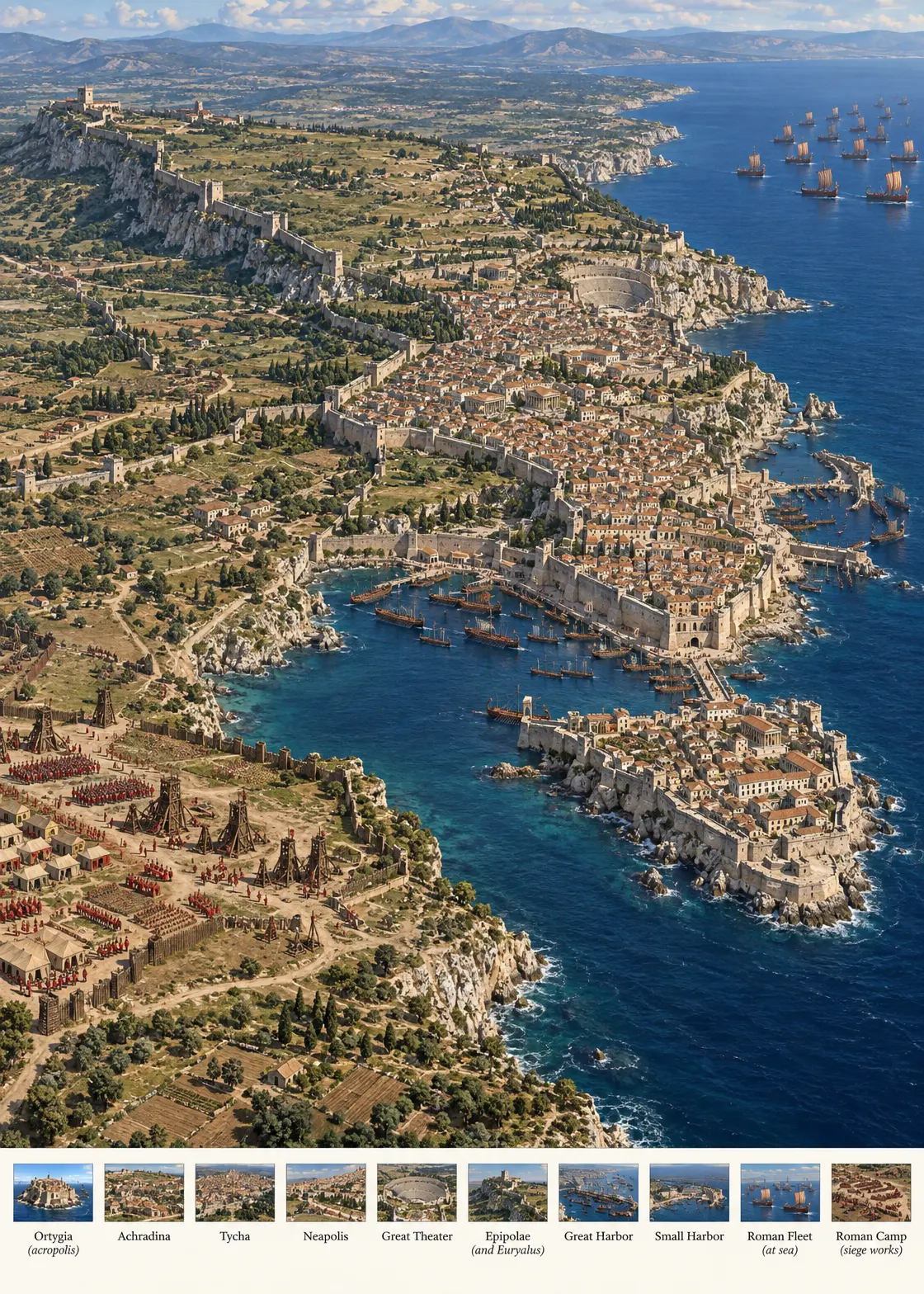
The Syracusan fortifications had been designed across the long peace of Hiero's reign with deliberate care: walls of cut limestone, often eight to ten meters high and two meters thick at the base, equipped with a regular system of towers, gates, and posterns. The walls extended in two principal circuits — an outer circuit enclosing the entire urban area including the Epipolae plateau, and an inner circuit enclosing the Achradina district and Ortygia. The total fortification length was approximately twenty-seven kilometers, the largest defensive perimeter of any ancient Mediterranean city of the period. A successful siege would require either the breaching of the walls at one or more points (which would require sustained engineering and artillery effort against a defense well-supplied with counter-engineering capability) or the storming of the walls by escalade (which would require ladder-equipped assault forces to overcome the height of the walls and the defense's missile cover) or starvation (which would require complete naval and land blockade across what might be a multi-year effort, given the city's substantial granaries and external supply via the Carthaginian fleet).
Marcellus's strategic plan addressed all three approaches simultaneously. Pulcher's fleet would maintain a naval blockade and conduct amphibious assault operations against the seaward walls; Marcellus's land army would conduct siege operations against the landward walls; and a sustained engineering effort would attempt to breach the walls at several points. The plan was conventional by Hellenistic standards. What none of the Roman commanders had reckoned with was Archimedes.
Archimedes and the Defense of Syracuse
Archimedes of Syracuse — by 213 BC approximately seventy-five years old, the foremost mathematician of the Greek world, a man whose theoretical work in geometry, mechanics, and hydrostatics had been recognized for half a century — had been employed by his cousin Hiero II as the chief military engineer of Syracuse during the years of peace. His engineering productions for the Syracusan defenses had been deliberately overdesigned, in anticipation of exactly the kind of siege that Marcellus was now conducting. The Syracusan walls were equipped, at intervals, with siege engines of Archimedean design: catapults of unprecedented range and accuracy, sling-throwers capable of casting stones of two hundred kilograms or more, scorpion-type bolt-throwers for close-range work, and (most famously and most disputed in modern reconstruction) iron-clawed cranes capable of seizing Roman ships approaching the walls and lifting them partially out of the water before dropping them or capsizing them. The technical accounts of these devices are preserved principally by Polybius (8.5–9) and by Plutarch (Marcellus 14–17), with substantial additional material in later writers including Livy (24.34) and the Byzantine writers.
The Polybian account is, characteristically, the more technically restrained. Polybius describes the catapults and sling-throwers in detail, attributing their range and accuracy to Archimedean theoretical work on the relationship between weight, leverage, and projectile motion. He describes the iron claws — large hook-equipped beams operated by counterweighted pulleys — as a real engineering feature of the seaward defenses, though his description leaves the precise mechanics partially obscure. He does not describe the most spectacular of the later legends, the alleged Archimedean "burning mirrors" that supposedly concentrated solar light to set Roman ships on fire from a distance; this story appears first in the Byzantine writer Anthemius of Tralles in the sixth century AD and is almost certainly a later invention. (Modern experimental work has demonstrated that polished bronze mirrors can in principle ignite tarred wooden hulls under exceptionally favorable conditions, but the operational practicality of such a system in third-century BC siege warfare is essentially zero.) The Plutarchan account is more colorful and includes the burning-mirrors story, but Plutarch is writing four centuries after the events and drawing on a later legendary tradition.
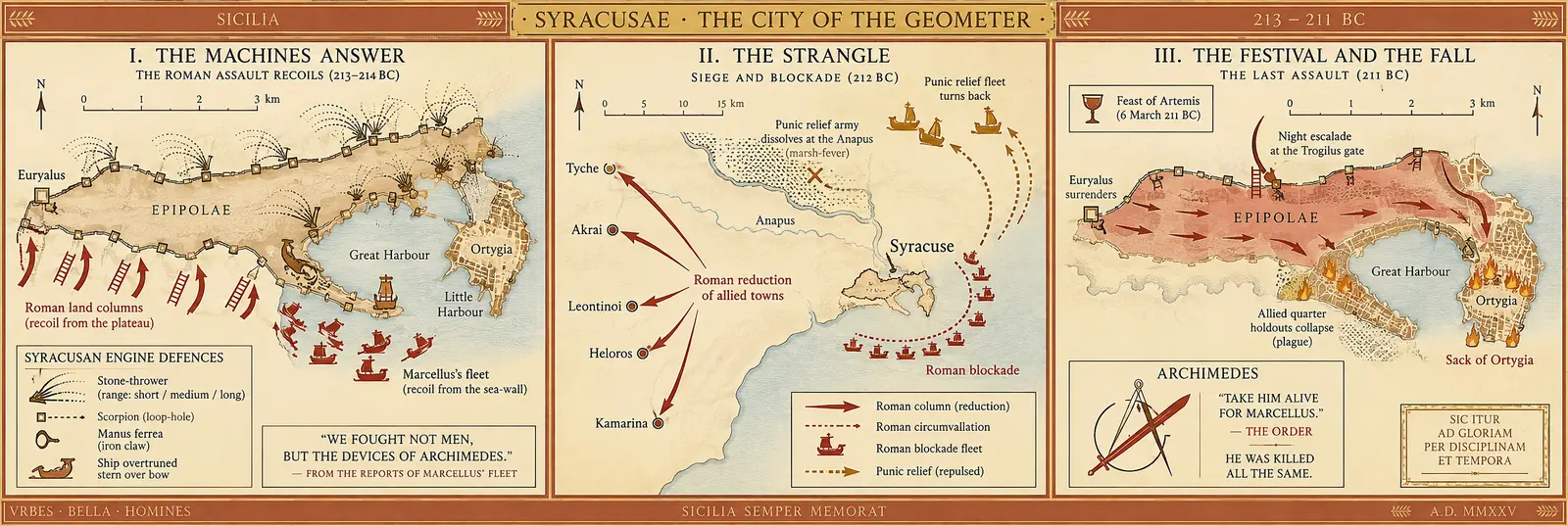
What is firm in the source record is that the initial Roman assault on the walls of Syracuse — conducted both by Pulcher's fleet from the sea and by Marcellus's army from the land, in coordinated attacks across approximately a week in late spring 213 BC — failed completely. The Roman ships that approached the seaward walls were subjected to artillery fire of a range and accuracy that exceeded anything the Roman naval forces had previously encountered; ships were sunk or driven off; several were reportedly seized by the iron claws and capsized. The Roman land forces, attempting to bring up scaling ladders against the landward walls, were similarly repulsed by artillery and by the steady fire of Syracusan defenders working under the cover of the artillery. Marcellus, after a week of frontal assault, abandoned the attempt and committed his army to a long siege of attrition — circumvallation, blockade, and slow strangulation, rather than direct assault on a wall system whose engineering had decisively defeated his ability to take it by force.
The Long Siege and the Storm
Across the long siege of 212–211 BC, Marcellus's strategic effort was directed simultaneously at three objectives: tightening the blockade of the city, reducing the Sicilian cities allied with Syracuse so as to prevent overland reinforcement, and probing the Syracusan defenses for weaknesses that might be exploited by surprise. The second objective produced a series of subsidiary campaigns across central and southern Sicily that occupied much of 212 BC. Marcellus's army reduced Megara Hyblaea, Helorus, and several smaller cities; he defeated a Syracusan field army under Hippocrates that had attempted to break the siege from outside; he intercepted Carthaginian relief expeditions and prevented the bulk of Carthaginian supplies from reaching the city. By the spring of 212 the Syracusan situation was deteriorating rapidly: food was rationed within the city, the popular morale was wavering, the political coalition supporting Hippocrates and Epicydes was fracturing.
The decisive break came not by direct assault but by surprise. During the festival of Artemis in spring 212 BC, the Syracusan defenders relaxed their vigilance on the Epipolae plateau, the most distant and least populated portion of the fortifications. A Roman officer, Tiberius Claudius Quadrigarius (not the later annalist), conducting reconnaissance of the walls during the festival period, observed that the Syracusan sentries at one section of the Epipolae wall were not maintaining their normal alertness, and that the wall at this point was lower than at other sections by perhaps two meters. Marcellus, informed of this observation, organized a night escalade: a picked detachment of approximately a thousand legionaries with scaling ladders approached the wall in darkness, scaled it in silence, killed the sentries at the immediate point of entry, and opened a postern gate to admit a larger Roman force. By dawn, the Romans were in possession of approximately three kilometers of the Epipolae wall and of the Hexapylon gate that controlled the principal entry to the Epipolae plateau from the western approach. The outer fortifications of Syracuse had been turned.
The fall of the outer walls did not mean the immediate fall of the city. The Achradina inner walls — the second defensive perimeter enclosing the principal urban area and the Ortygia citadel — were a separate fortification system in their own right, and the Syracusan defenders, having lost the outer walls, fell back to the inner ones and continued resistance. Marcellus, now in possession of the Epipolae and able to organize his siege operations from inside the outer perimeter, conducted a long reduction across the summer and autumn of 211 BC. The Achradina walls were probed at several points; multiple assault attempts were made; the Syracusan defense was steadily worn down by attrition, by hunger, and by the political fracturing of the Hippocrates-Epicydes coalition (Hippocrates himself was killed in a sortie during this period; Epicydes fled to Africa in the late summer of 211 with what remained of the Carthaginian garrison). The final fall of Syracuse came in the autumn of 211 BC, by a combination of betrayal (a Spanish mercenary officer in Syracusan service named Mericus, having been bribed by Marcellus, surrendered the section of wall he was responsible for) and exhaustion. The Romans entered Achradina; Ortygia, the final defensive position, surrendered on terms shortly afterward.
The Death of Archimedes
The most famous single incident of the fall of Syracuse — the death of Archimedes — is preserved in multiple sources with sufficient variation to indicate that the precise circumstances are uncertain, while the general fact is firmly attested. Plutarch (Marcellus 19) gives three versions of the story. In the first, Archimedes was at work on a geometrical problem at the moment the Roman troops entered his neighborhood; a soldier, finding him unconcerned with the city's fall, ordered him to come to Marcellus, and Archimedes refused, asking for time to finish his proof. The soldier, in irritation or in mistake, killed him on the spot. In the second version, a Roman soldier approached Archimedes with intent to murder and rob him; Archimedes asked the soldier to wait until he had finished his proof, and the soldier killed him in his impatience. In the third version, Archimedes was carrying his geometrical instruments (a sundial, a celestial globe, set-squares) to Marcellus's headquarters, having been summoned, and was killed by Roman soldiers who, seeing the metal instruments, mistook them for valuables and murdered him to steal them.
Whichever version most closely approximates what actually happened, the underlying fact is preserved consistently: Archimedes was killed by a Roman soldier during or shortly after the sack of Syracuse, his death was contrary to Marcellus's explicit orders (Marcellus had ordered that Archimedes specifically be spared, recognizing his scientific importance and probably also recognizing the propaganda value of capturing the foremost mathematician of the Greek world), and Marcellus was reportedly distressed at the news. Archimedes's body was buried in Syracuse, with a tomb decorated with a sphere inscribed in a cylinder (a representation of one of his most famous geometric theorems, that the volume of a sphere is two-thirds the volume of the circumscribing cylinder); Cicero, visiting Sicily in 75 BC as quaestor, found this tomb overgrown with brambles and arranged for its restoration (Cicero, Tusculan Disputations 5.64–66). The tomb has not been certainly identified by modern archaeology, despite repeated investigation; its general location in the Achradina district is preserved by Cicero's testimony but the specific site is lost.
The sack of Syracuse itself was conducted with the methodical thoroughness that Roman military practice prescribed: the city was systematically plundered across several days, with the artistic and luxury wealth of one of the greatest Hellenistic cities being removed in unprecedented quantity to Rome. The volume of art and treasure brought back from Syracuse — temple statuary, painted panels, gold and silver vessels, the celebrated celestial globe of Archimedes himself which would be preserved in Marcellus's family for several generations — initiated, in the judgment of later Roman moralists including Cato the Elder, the transformation of Roman cultural life by Hellenistic influence that would shape the late Republic. Marcellus's triumph upon his return to Rome (delayed by political opposition for some years and eventually celebrated as an ovatio rather than a full triumph) featured the displayed wealth of Syracuse with particular prominence; the Greek world, which had previously regarded Rome as a barbarian power on the margins of the Hellenistic system, was forced after Syracuse to acknowledge that Rome was now a Mediterranean power of the first rank, capable of taking and holding the principal cities of the Greek west.
The Recovery of Capua212–211 BC
While Marcellus was conducting the Syracusan siege, the principal Roman military operation in Italy was the long siege of Capua. Three Roman consular armies — eventually six legions under the joint command of the consuls Quintus Fulvius Flaccus and Appius Claudius Pulcher (the same Pulcher who had been Marcellus's naval colleague at Syracuse before being transferred to the Italian command) — invested Capua in 212 BC and conducted the siege across more than a year. The strategic objective was the recovery of the city that had defected so spectacularly in 216 BC; the operational challenge was the prevention of Hannibal's intervention to relieve the siege.
Hannibal, recognizing that the loss of Capua would represent a devastating reversal of the political-strategic gains of Cannae, conducted across 212 and 211 BC a series of operations designed to compel the Romans to lift the siege. He marched on Roman possessions in Lucania and Apulia, hoping to draw the besieging armies away by threatening Roman strategic interests elsewhere; he attacked the Roman positions around Capua directly in two engagements; and in the spring of 211 BC he conducted the most dramatic strategic maneuver of his Italian campaign: a march on Rome itself, intended to compel the Roman armies before Capua to abandon the siege and rush to the defense of the capital.
The march on Rome of 211 BC is preserved in the Roman tradition with the kind of mythic detail that Livy's narrative tends to attract. Hannibal's army crossed the Apennines, marched up the Latin Way, and arrived within sight of the walls of Rome in late spring 211 BC — the only occasion in Hannibal's seventeen-year Italian campaign on which the Carthaginian army approached the city of Rome itself. Hannibal personally rode up to the Colline Gate of the Servian Walls and (by some accounts) cast a javelin over the walls into the city as a gesture of defiance. The Romans, however, did not lift the siege of Capua. The two consuls before Capua sent only a small detachment back to reinforce the urban defenses; the main armies remained in position; the Capuan resistance, having anticipated relief from Hannibal's march, learned that no such relief would be forthcoming. Hannibal, having spent approximately a week in the vicinity of Rome and finding that his presence had not produced the strategic effect he had calculated for, withdrew southward without giving battle.
The Roman political response to Hannibal's appearance before the walls of Rome was characteristic: a public dinner was held in the Forum at which the senators dined ostentatiously while Hannibal's army camped within sight of the city; the property in Italy on which Hannibal's camp had been pitched was deliberately put up for sale in the Roman markets and sold for the price it would normally have commanded, as a demonstration that the Roman political order regarded the property as still securely Roman despite the temporary Carthaginian presence. These were gestures of political confidence rather than military substance, but their political significance — the demonstration that Rome refused to be intimidated by Hannibal's presence and that the institutional response to the strategic threat was, characteristically, business as usual — was understood by both sides to be considerable.
Capua surrendered shortly after Hannibal's withdrawal, in the late summer of 211 BC. The Roman terms were harsh: the principal Capuan senatorial leaders who had favored the Carthaginian alliance were either executed or committed suicide before they could be captured; the city was stripped of its political autonomy and reduced to civitas sine suffragio on terms that effectively destroyed Capua as an independent political community; the city walls were demolished; substantial Capuan territory was confiscated for Roman colonial settlement. The Capuan settlement of 211 was the harshest Roman treatment of any defeated Italian community in the period and was clearly intended both to punish the original defection and to deter any future Italian community contemplating a similar move. The deterrent effect, on balance, succeeded: no significant Italian community defected to Hannibal after the recovery of Capua.
The Recovery of Tarentum209 BC
The recovery of Tarentum — the second-greatest of the post-Cannae Italian defections to Carthage — was accomplished two years after Capua, in 209 BC, under the command of the elderly Quintus Fabius Maximus, now serving his fifth consulship at approximately the age of seventy-five. Tarentum had been seized by Hannibal in 212 BC by a complex political-military operation in which a Tarentine faction (led by two brothers, Nicon and Tragiscus) had admitted Carthaginian forces into the city through a secretly opened postern gate; the citadel, however, had remained in Roman hands across the four years that followed, defended by a small garrison that resisted all Carthaginian assault attempts. The strategic situation by 209 was therefore one of divided control: Tarentum's city in Carthaginian hands, its citadel in Roman hands, with the Tarentine harbor disputed between the two.
Fabius's reduction of the city was accomplished by a combination of patience, political manipulation, and a brief decisive operation. He invested the city in the late spring of 209 BC; he conducted negotiations through agents with a Bruttian officer in the Carthaginian garrison whose wife was the sister of one of Fabius's soldiers; the Bruttian was bribed to admit a Roman detachment through a section of the wall he was responsible for. The Roman assault that followed was conducted by night, with the Bruttian-controlled section of wall opened to the assault, and the city was taken by surprise. The Carthaginian garrison and the Tarentine defection-leaders were killed in the night fighting; the city was sacked across several days; Tarentum was returned to Roman alliance as a civitas sine suffragio, with the political autonomy substantially reduced and Roman supervision established. The Roman recovery of Tarentum effectively ended the strategic significance of the post-Cannae southern Italian defections; with Capua and Tarentum both back under Roman control, the remaining Italian cities allied with Hannibal — the Bruttian communities, the lesser Greek cities of the south, the Hirpini Samnites — were either rapidly reduced or rendered strategically negligible across the following years.
The famous exchange between Fabius and his political critics about the manner of Tarentum's recovery is preserved by Plutarch (Fabius 23). Fabius had been criticized for taking the city by treachery rather than by force; he reportedly replied that the city had been lost by treachery (the original defection had been a political betrayal of the Roman alliance) and could properly be recovered by the same means. The remark is one of the more cynical observations preserved in the Roman tradition, and is consistent with the impression of Fabius the Cunctator that the sources cumulatively present: a man of considerable institutional patience and political skill, somewhat lacking in conventional military glory, whose contribution to the Roman victory in the Hannibalic War was substantial but indirect, and who recognized this himself with the kind of dry self-awareness that the Roman tradition both noticed and respected.
The Crossroads · Late spring 213 BC · Before the fortifications of Syracuse, eastern Sicily
The Walls of Syracuse
You are Marcus Claudius Marcellus, consul of 214 BC holding the Sicilian command, directing Roman land forces outside Syracuse alongside the praetor Appius Claudius Pulcher.
Your coordinated assault on Syracuse has met total disaster. For a week, Pulcher's sixty quinqueremes assailed the seaward walls while your four legions brought scaling ladders against the landward defenses. Archimedes' war machines shattered both: long-range catapults, massive stone-throwers casting missiles of two hundred kilograms, scorpions, and iron-claw cranes that seized and capsized ships. Syracuse's cut limestone walls extend twenty-seven kilometers, enclosing Epipolae, Achradina, and Ortygia. Hippocrates and Epicydes hold the city with forces comparable to your thirty thousand men, while Carthaginian fleets and Sicilian allies threaten your rear.
How will you prosecute the war against Syracuse now that direct assault has been shattered by Archimedes' defenses?
Weigh each course: open it to hear your own inner voice. Then decide. Nothing is scored.
- Your inner voiceThe course taken
Roman arms do not retreat before engines. If we redouble our efforts, building heavier mantlets and concentrating every legionary and ladder against a single sector of the landward wall, Archimedes cannot cover every yard of stone. To abandon assault is to show weakness across Sicily. A breakthrough ends the war in a day, sparing Rome years of debilitating expense, whereas hesitation invites Carthaginian fleets to land unhindered and relieve the Syracusan defenders.
- Your inner voiceThe course taken
Holding thirty thousand men stationary before twenty-seven kilometers of impenetrable stone leaves us exposed while Carthaginian armies and hostile Sicilian cities gather strength. If we leave Pulcher's fleet to watch the harbor and march our four legions into the interior, we can crush Syracuse's allies town by town and destroy their armies in the open field. Once Syracuse stands utterly alone without food or field allies, its massive walls will become its tomb.
- Your inner voiceThe course taken
Archimedes' artillery has decisively mastered our escalades and battered Pulcher's ships into ruin. Throwing men against eight-meter cut limestone walls under two-hundred-kilogram stones is madness, not courage. We must circumvallate the city, maintain our naval blockade, and slowly starve them into submission. Meanwhile, we can campaign across Sicily to reduce Syracuse's allied cities and intercept Carthaginian relief. It will take years and test the Senate's patience, but it preserves my legions.
What was done
Marcellus abandoned frontal assaults and committed his army to circumvallation, blockade, and attrition. Over the next two years, he tightened the investment, intercepted Carthaginian relief forces, and reduced allied cities including Megara Hyblaea and Helorus, while defeating a field army under Hippocrates. The decisive breakthrough came in spring 212 BC, when Roman reconnaissance noted slack sentries and a lower wall section on the Epipolae plateau during the festival of Artemis; a night escalade of a thousand legionaries turned the outer fortifications (AGrade A). The inner Achradina defenses held until autumn 211 BC, when the Spanish mercenary Mericus was bribed to yield his section of the wall. Syracuse fell to methodical plundering, during which Archimedes was slain contrary to Marcellus's orders (BGrade B). The massive influx of Hellenistic art and wealth transformed Roman cultural life, while demonstrating Rome's capacity to reduce the greatest fortified city of the Greek west.
The evidence Polybius 8.5–9 (AGrade A) provides the primary technical narrative of Archimedes' defenses and the tactical repulse of the Roman land and naval assaults. Polybius 7.7–8 (AGrade A) details the preceding Syracusan revolution. Livy 24.4–25.31 (BGrade B) provides the continuous Latin narrative of the siege, the escalade at Epipolae, and the fall of the city. Plutarch's Life of Marcellus 14–22 (BGrade B for Marcellus, CGrade C for Archimedean legends) details Marcellus's conduct and Archimedes' death.
If you choose to walk through itAt every scale
- Yourself
How do you balance your established reputation for personal aggression and battlefield daring against the unglamorous, patient endurance required to conduct a multi-year siege of attrition?
- Those beside you
What duty do you owe to the legionaries and sailors under your command, who face certain slaughter if thrown against Archimedes' engines, versus the risk of losing men to prolonged disease and hunger in static siege lines?
- Rome
Can the Roman Senate and people, already strained to exhaustion by Hannibal's presence in Italy after Cannae, afford to tie down four legions and sixty warships before a single Sicilian city for years?
- The wider world
How will uncommitted Sicilian cities and the Carthaginian high command interpret Rome's failure to take Syracuse by storm, and will a protracted investment invite wider rebellion across the Greek west?
- Our own time
When confronted by an adversary possessing asymmetric technological superiority that negates conventional doctrine, what determines whether a military power adapts its strategy or doubles down on costly force?
In late 1914 on the Western Front, European military commands whose prevailing pre-war doctrines dictated relentless offensive spirit and rapid decisive maneuvers collided with the reality of rapid-fire artillery, machine guns, and fortified entrenchments. Frontal assaults resulted only in catastrophic slaughter without tactical gain. Reluctantly recognizing that conventional assault had been rendered obsolete by defensive technology, commanders were compelled to abandon open field warfare and adapt to multi-year sieges of attrition, economic blockades, and industrial strangulation.
Where the comparison fails. Modern trench warfare involved millions of conscripted soldiers backed by continental railway supply networks and industrial factories, whereas Marcellus's siege of Syracuse was a localized pre-industrial investment of a single stone-walled city dependent on maritime supply lines, mechanical leverage engines, and regional grain foraging.
What does the chapter tell us?
Why did Marcus Claudius Marcellus abandon his initial plan to storm Syracuse by direct assault in late spring 213 BC?
Polybius and Livy record that Archimedes' catapults, stone-throwers, scorpions, and claw engines defeated both Pulcher's fleet from the sea and Marcellus's escalades from the land within a week, compelling Marcellus to switch to a long siege of attrition.
Polybius 8.5–9 (AGrade A)
What was the primary political cause of Syracuse breaking its half-century alliance with Rome in 214 BC?
Hiero II had maintained the Roman alliance for fifty years until his death in 215 or 214 BC. His fifteen-year-old grandson Hieronymus was influenced by pro-Carthaginian figures, notably Hippocrates and Epicydes, who argued post-Cannae momentum favored Carthage.
Polybius 7.7–8 (AGrade A)
How did Roman forces finally breach the formidable outer defensive perimeter of Syracuse in spring 212 BC?
Roman officer Tiberius Claudius Quadrigarius observed that Syracusan sentries on the Epipolae plateau had relaxed vigilance during the festival of Artemis, and that the wall was two meters lower there. Marcellus exploited this with a picked night escalade of a thousand legionaries.
Livy 24.4–25.31 (BGrade B)
In spring 211 BC, how did the Roman consuls besieging Capua respond when Hannibal marched directly on Rome?
Consuls Quintus Fulvius Flaccus and Appius Claudius Pulcher dispatched only a small detachment to Rome's urban defenses, keeping their main forces in place. Hannibal's bluff failed to lift the siege, and Capua surrendered soon after.
Polybius 9.5–7 and Livy 25.13–27.16 (BGrade B)
What does the chapter conclude regarding the legendary Archimedean 'burning mirrors' said to have set Roman ships on fire?
Polybius does not mention burning mirrors, which first appear in the sixth-century AD writer Anthemius of Tralles and later in Plutarch. While modern experiments show mirrors can ignite tarred wood under ideal conditions, their operational practicality in ancient siege warfare was essentially zero.
the chapter's narrative