Chapter 3
The Spanish Theater: The Elder Scipios and the Rise of the Younger
The Strategic Significance of Spain
The Spanish theater of the Hannibalic War is the theater that most modern readers know least about, partly because the campaigns there were conducted at a distance from the Italian heartland of the war and partly because the source state is conspicuously weaker than for the Italian campaigns. It was, however, the theater whose outcome ultimately determined the war's resolution. The Carthaginian strategic position in 218 BC had depended fundamentally on the Iberian power-base that Hamilcar Barca had constructed after the First Punic War and that his son-in-law Hasdrubal the Fair and his son Hannibal had developed across the subsequent generation. The Spanish silver mines provided the fiscal foundation of Carthaginian military operations; the Spanish manpower (Iberian heavy infantry, Celtiberian troops, Lusitanian skirmishers, Balearic slingers) provided the principal recruitment base for Carthaginian armies; the Spanish geographic position gave Carthage strategic depth in the western Mediterranean and a route by which reinforcements could potentially reach Hannibal in Italy by the same overland route Hannibal himself had pioneered. If Spain could be detached from Carthaginian control, the strategic foundations of the Carthaginian war effort would be progressively eroded; if Spain remained under Carthaginian control, the war could in principle continue indefinitely.
The Roman strategic response to this situation had been articulated in 218 BC by the elder Publius Cornelius Scipio (the same who would be wounded at Ticinus and rescued by his teenage son) when he detached his brother Gnaeus Cornelius Scipio Calvus with the bulk of his original army for Spain while he himself returned to Italy to confront Hannibal. The elder Scipios' Spanish command — Gnaeus from 218 BC, Publius joining him after his recovery from the Ticinus wound and his subsequent service in the early Italian campaigns — would constitute one of the most sustained extraordinary commands in Roman military history to that date, lasting from 218 until their deaths in 211. The two brothers operated jointly across most of this period, dividing their forces between separate theaters when strategic conditions required and combining them for major engagements when possible. Their accomplishment was substantial: they prevented major Carthaginian reinforcement of Hannibal's army across the entire decade of his Italian campaign, they tied down approximately three to four Carthaginian armies in the peninsula across the period, they conducted offensive operations that gradually reduced Carthaginian control of northern Spain, and they constructed a Roman political-military presence on the peninsula that would survive their own deaths and provide the foundation for the eventual Roman conquest under their son and nephew.
The Elder Scipios in Spain218–212 BC
The early campaigns of the elder Scipios are preserved in fragments principally through Livy (21.60–22.22, 23.26–29, 24.41–49, 25.32–39) and through fragments of Polybius. The pattern that emerges is one of slow Roman advance, conducted from a base at Tarraco (modern Tarragona) on the northeastern Spanish coast, with the principal operations directed at preventing the consolidation of Carthaginian political control in central and eastern Spain. The major engagements of the period were:
The Battle of Cissa (218 BC), in which Gnaeus Scipio Calvus, shortly after his arrival in Spain, defeated a Carthaginian army under Hanno (one of the several officers of that common name in the period) and captured Hanno himself along with the Spanish chieftain Indibilis who would feature significantly in subsequent campaigns. The engagement was relatively small but its strategic significance was substantial: it established Roman military credibility in the peninsula at a moment when the Carthaginian command had assumed that no significant Roman force would arrive in Spain in the war's first year.
The Naval Battle of the Ebro (217 BC), in which a combined Roman and Massiliote fleet under Gnaeus Scipio engaged the Carthaginian fleet under Hasdrubal Barca (Hannibal's brother, who held the principal Carthaginian command in Spain across most of this period). The Roman victory secured naval control of the northeastern Spanish coast and prevented the Carthaginian fleet from operating in support of Hasdrubal's land campaigns against the Roman position at Tarraco.
The Battle of Dertosa or the Ebro (215 BC), in which the combined Roman armies of both Scipios engaged Hasdrubal Barca's army in a major engagement near the Ebro river. The battle is preserved by Livy (23.28–29) with insufficient tactical detail for a full reconstruction, but the outcome was a Roman victory of substantial proportions: Hasdrubal's army was defeated and forced to retreat southward, the Roman position in northeastern Spain was consolidated, and (most significantly for the broader strategic picture) the Carthaginian plan to send substantial reinforcements to Hannibal in Italy across the Pyrenees was indefinitely postponed. The Battle of Dertosa was, in this sense, one of the strategic turning points of the entire Hannibalic War, even though the engagement itself was conducted at a scale far below that of the great Italian battles and is known to us in only fragmentary detail.
Across 214 and 213 BC the elder Scipios continued their campaigns with steady if unspectacular success, recovering Saguntum (the city whose siege had been the casus belli of the war eight years earlier) in 212 BC and establishing forward bases as far south as Castulo on the upper Baetis (modern Guadalquivir). The Carthaginian position in central Spain had been reduced to a series of fortified cities (Carthago Nova on the southeastern coast, Castulo as a tenuous frontier post, Gades on the Atlantic, and various inland positions) connected by an alliance system whose loyalty depended significantly on Carthaginian military success in the field. The strategic momentum had shifted to the Romans across the seven years of the elder Scipios' command, and by the end of 212 BC the Carthaginian position in Spain appeared to be progressively eroding.
The Catastrophe of 211 BC
The catastrophe that overwhelmed the elder Scipios in 211 BC is among the most poorly attested major military events of the Hannibalic War, a fact that itself testifies to the strategic dislocation it produced: the Roman command structure that survived the disaster was unable to reconstruct the full circumstances even for the senatorial archive, and Polybius's account (which we lack for this episode) must have depended on indirect testimony filtered through several intermediaries. The principal narrative we possess is in Livy 25.32–39 and in fragmentary parallels.
What can be reconstructed: in the spring of 211 BC, with the war in Italy at the critical phase of the Capuan siege and the Sicilian war concluding with the fall of Syracuse, the elder Scipios undertook an ambitious offensive intended to deliver a decisive blow against the remaining Carthaginian positions in Spain. The strategic conception was to engage the three Carthaginian armies then in Spain (under Hasdrubal Barca, Mago Barca, and Hasdrubal son of Gisgo respectively) in a coordinated operation before they could combine. To accomplish this, the Roman army was divided: Publius Scipio took the larger portion (approximately two-thirds of the Roman force, with substantial Spanish allied contingents) against Hasdrubal Barca and Mago; Gnaeus Scipio took the smaller portion against Hasdrubal son of Gisgo. The division of forces would prove fatal.
Hasdrubal Barca, recognizing the operational opportunity, executed a complex coordinated maneuver with his fellow commanders that concentrated all three Carthaginian armies against the divided Roman forces in sequence. Publius Scipio, engaged separately, was attacked simultaneously by Mago's Numidian cavalry (which had been detached for the purpose and rode hard to reach the engagement) and by reinforcements that arrived from Hasdrubal Barca's main army; his Spanish allied contingents, evidently bribed by Carthaginian agents in advance of the engagement, defected during the battle; Publius's army was destroyed and Publius himself was killed. The date was approximately late spring or early summer 211 BC.
Gnaeus Scipio, hearing of his brother's death and recognizing that the Carthaginian armies were now free to concentrate against his own smaller force, attempted to withdraw northward toward Tarraco. He was overtaken by the combined Carthaginian force near a town that the sources name as Ilorca, approximately a month after his brother's death. His army was surrounded and destroyed; Gnaeus himself was killed; the Roman position in southern and central Spain was effectively eliminated; only the small garrison forces at Tarraco and at the northeastern coastal positions remained as a Roman presence on the peninsula. The Roman strategic position in Spain had been reduced, within a few months, from gradual ascendancy to near-total collapse.
The proximate cause of the disaster was the defection of the Spanish allied contingents — a defection that almost certainly reflected effective Carthaginian diplomatic and financial work over the preceding period, exploiting the inherent instability of the Spanish alliance system. The deeper cause was strategic: the elder Scipios had over-extended their forces by undertaking offensive operations on three fronts simultaneously when the available Roman manpower could have safely supported operations on only one. The miscalculation may have reflected the strategic pressure of the broader war situation (the Roman command in Spain was being asked to deliver a decisive blow at a moment when decisive blows were being sought in every theater) or may have reflected the personal confidence that seven years of generally successful operations had built up in the elder Scipios' assessment of their tactical capacity. Either way, the failure was substantial and the cost was nearly total.
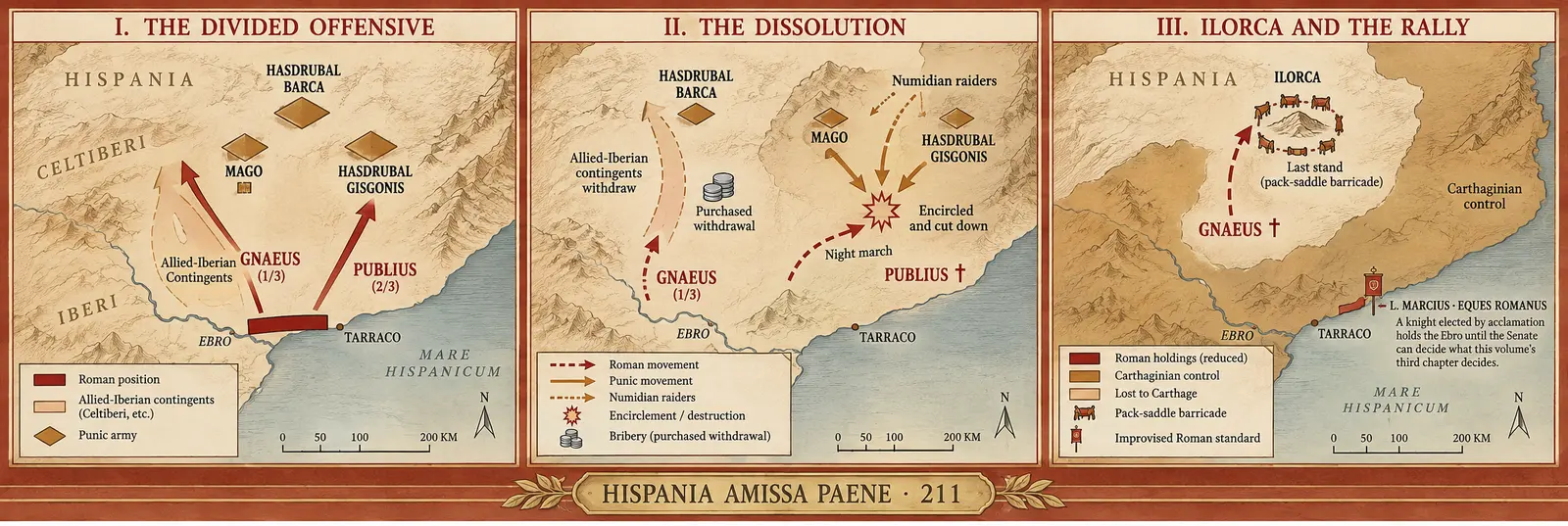
The strategic salvage of the Spanish position was conducted in the immediate aftermath by a Roman knight named Lucius Marcius Septimius, who had been one of the surviving officers of Publius's army and who, by what Livy describes as a spontaneous election of the survivors in the field, took command of the remaining Roman forces and conducted a defensive operation that held the Ebro line through the late summer and autumn of 211 BC. Marcius's improvised command — eventually approved retroactively by the Senate, though with the unprecedented complication that he was technically of equestrian rank and would normally not have been entitled to legionary command — prevented the Carthaginian armies from pursuing their victory across the Ebro into the Roman base areas on the northeastern coast. The strategic position in Spain by late 211 BC was therefore precarious but not yet hopeless: the Romans held a coastal strip in the northeast (Tarraco, Emporion, and the line of the Ebro); the Carthaginians had recovered nearly all of central and southern Spain but had been unable to drive the Romans completely from the peninsula.
The Young Scipio Takes the Spanish Command210 BC
The Senate's response to the Spanish catastrophe was, after some hesitation, the appointment to the Spanish command of the most unlikely figure available — the young Publius Cornelius Scipio, son of the elder Publius and nephew of Gnaeus, who at twenty-five years of age was below the legal minimum age for any of the senior magistracies and who had held only the curule aedileship in the previous year. The political circumstances of his appointment are preserved by Livy (26.18–19) with the kind of dramatic detail that suggests a real political crisis being resolved by an unconventional measure. The Senate had attempted to recruit a senior consular figure to take the Spanish command; no consular had been willing to accept the assignment, on the grounds that the strategic situation was hopeless and the appointment would be a career-ending exposure to a catastrophe already in progress. The popular assembly was then asked to elect a commander from among the available volunteers; the young Scipio came forward, volunteered, and was elected by acclamation.
The historicity of the dramatic political moment has been doubted by some modern scholars (Münzer, Scullard) who have argued that Scipio's appointment was orchestrated by the political faction associated with the Cornelii Scipiones as an extraordinary measure to maintain the family's strategic position; on this reading, the dramatic popular acclamation was political theater concealing a relatively conventional senatorial decision. The dispute does not affect the substantive point: Scipio, at twenty-five, was granted extraordinary command in Spain by the popular assembly with senatorial concurrence, was given imperium proconsular in rank (a constitutional novelty for a man who had not been consul), and was dispatched to Spain in the late spring of 210 BC with reinforcements amounting to two legions and substantial allied contingents. The total Roman force in Spain after Scipio's arrival was approximately 28,000 foot and 3,000 cavalry — not large by the standards of the war's principal Italian theaters, but adequate for the kind of operational mission Scipio was contemplating.
What Scipio was contemplating was not the conservative defensive operation that the Spanish strategic situation might have seemed to require. Scipio had spent the winter of 211/210 preparing for his command with the analytical care characteristic of his subsequent generalship: he had interviewed surviving veterans of the elder Scipios' campaigns; he had reviewed his father's papers and intelligence reports; he had taken into his confidence Gaius Laelius, a young officer of his own generation who would become his lifelong friend and operational partner; and he had constructed a strategic conception that was unconventional in the extreme. Rather than attempting to reconstruct the gradual offensive of the elder Scipios — which would have required years and substantial reinforcements — Scipio proposed to strike directly at the strategic center of the Carthaginian position in Spain: the great fortified city of Carthago Nova, which served as the principal Carthaginian naval base, supply magazine, and political capital on the peninsula.
The strategic logic was: Carthago Nova was geographically isolated from the three main Carthaginian field armies, which were operating in central and western Spain at distances of ten to twenty days' march. A rapid Roman attack on Carthago Nova, executed before the field armies could converge to relieve the city, could capture the strategic center of the Carthaginian Spanish position before the Carthaginian command had time to react. The operational risk was substantial: Carthago Nova was a fortified city of considerable scale, with defensive works developed by Hasdrubal Barca during his Spanish governorship, and would not be easily taken by storm if its garrison held firm. The strategic prize, if the operation succeeded, was equally substantial: the loss of Carthago Nova would deprive the Carthaginian armies of their principal supply base, their naval anchor, their treasury (the Spanish silver was held there in substantial quantities), and the political-symbolic center of their position in the peninsula.
The Capture of Carthago Nova209 BC
Scipio's operation against Carthago Nova in the spring of 209 BC is one of the most carefully planned and tactically creative military operations of the entire Hannibalic War, and it is preserved by Polybius (10.6–15) in a narrative of unusual clarity that almost certainly reflects access to Scipio's own subsequent military memoirs (now lost) and to the testimony of his close associate Laelius, with whom Polybius was personally acquainted through the Scipio Aemilianus circle. The narrative is one of the few episodes in ancient military history in which we can follow the planning and execution of a major operation with something approaching command-level detail.
The operation was executed with a deliberate combination of speed, deception, and tactical innovation. Scipio departed Tarraco in early spring 209 BC with the bulk of his army (approximately 25,000 foot and 2,500 cavalry, leaving a garrison force at Tarraco under his lieutenant Marcus Junius Silanus) and marched south along the coast. The march was conducted with unusual speed — approximately seven days from Tarraco to Carthago Nova, a distance of perhaps 425 Roman miles, with the army covering more than 50 miles a day in places, a pace exceeding any other recorded Roman army's march of the period. The speed was deliberate: Scipio recognized that the Carthaginian field armies would receive intelligence of his march within days of its commencement, and that the strategic window between his departure from Tarraco and the convergence of the Carthaginian armies on Carthago Nova was approximately ten to fourteen days. He had to be at Carthago Nova and in possession of the city before that window closed.
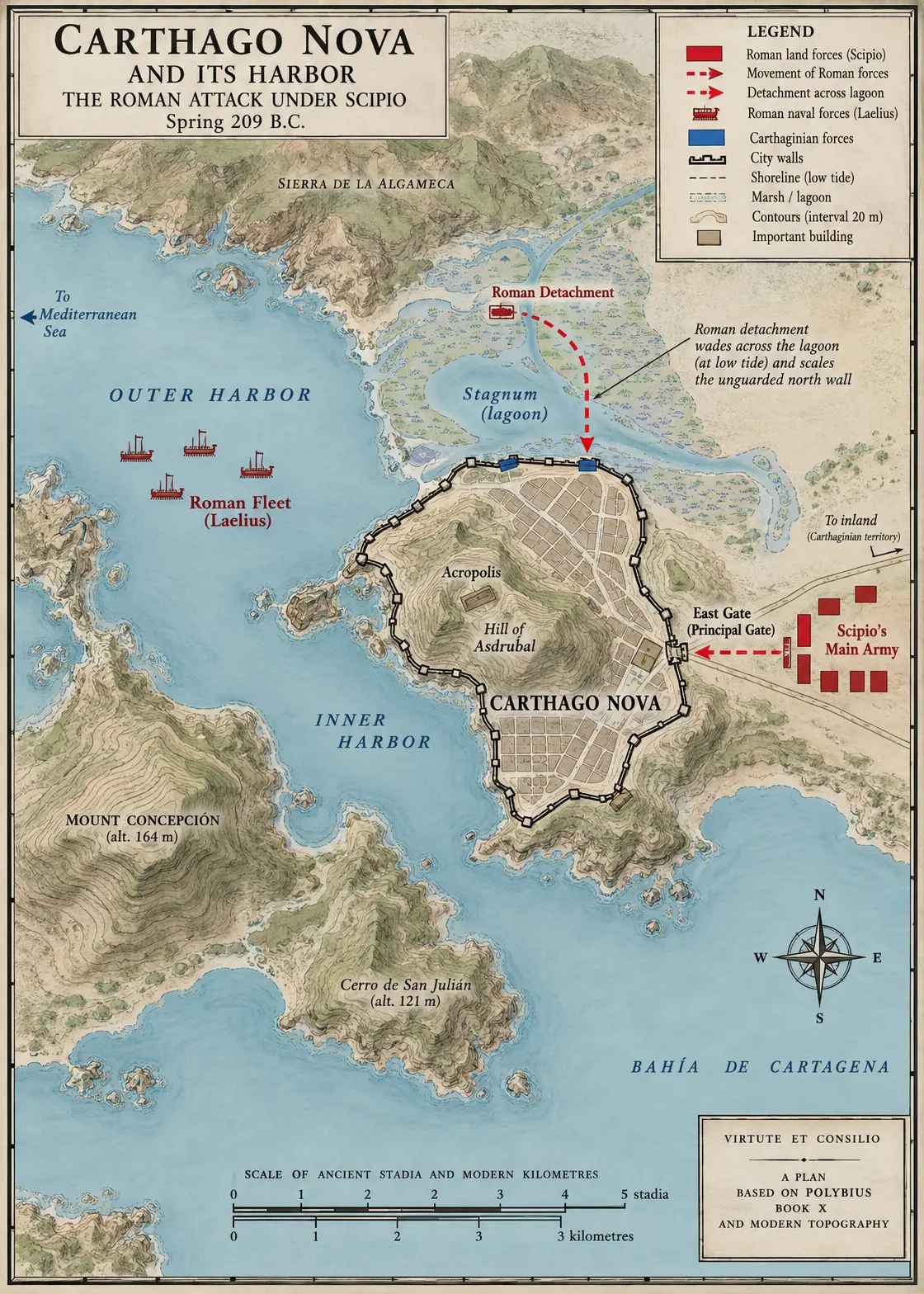
The siege itself was conducted in approximately a single day. Scipio established his camp on the eastern approach to the city on the evening of his arrival; on the following morning he conducted a frontal assault on the eastern walls with the main body of his army, supported by Laelius's naval forces attacking the seaward walls from the harbor. The frontal assault was costly but, as Scipio had calculated, sufficient to draw the defenders' attention. While the principal assault was in progress, Scipio personally led a detachment of approximately 500 picked troops to the northern side of the city, where the lagoon appeared to provide a natural defensive obstacle. Scipio had been informed by local fishermen — Polybius emphasizes the local-intelligence origin of this knowledge — that the lagoon was crossable on foot at low tide under certain combinations of wind and tidal conditions; he had timed his attack for the day on which these conditions were predicted to occur. As the lagoon water level dropped, the Roman detachment waded across, reached the unguarded northern wall of the city, scaled it with prepared ladders, and entered the city from the rear while the defenders were engaged with the frontal assault. The defense collapsed; the city fell that afternoon; the garrison surrendered; and Scipio entered the principal Carthaginian base in Spain on the same day he had begun the assault.
The strategic and material results were spectacular. Scipio captured the entire Carthaginian treasury at Carthago Nova (approximately 600 talents of silver, a substantial fraction of the Carthaginian Spanish war-chest); he captured eighteen Carthaginian warships in the harbor; he captured the principal Carthaginian arsenal in Spain (machines, weapons, supplies for several armies); he captured approximately 10,000 prisoners including the Carthaginian commander Mago (a different Mago from Mago Barca; the name was common in Carthaginian senior officer ranks) and the principal Spanish hostages whom the Carthaginians had held to ensure the loyalty of their Spanish allies. The hostages were a particularly significant prize: Scipio's treatment of them — he assembled them after the city's fall and announced that they would be returned to their families and their tribes without ransom, as a gesture of Roman friendship toward the Spanish peoples — produced an immediate political effect on the Spanish alliance system. The hostage tribes, whose loyalty to Carthage had depended on the threat to their hostages held at Carthago Nova, were now free of that constraint; many transferred their alliance to Rome within the following weeks; the Spanish political-military balance shifted permanently in Roman favor.
The most famous individual episode of the Carthago Nova operation, the so-called "continence of Scipio," is preserved by Polybius (10.19), by Livy (26.50), and by several later writers. After the city's fall, the Roman soldiers brought to Scipio's tent a captured young woman of exceptional beauty, presumably as a portion of his commander's share of the spoils. Scipio learned that the woman was the betrothed of a Spanish nobleman named Allucius, leader of one of the Celtiberian tribes; he ordered the woman returned to her family unharmed, refused any ransom for her, and added to the gesture a wedding gift drawn from the spoils of the city. Allucius, when he received his betrothed back, attached himself and his tribe to the Roman alliance; the political effect of the episode, propagated by Roman official communications and by subsequent Roman storytelling, was substantial. The historicity of the incident has been doubted by modern scholars (the "continence of the general" was a stock topos in Hellenistic biographical literature, with parallels in the Alexander tradition and elsewhere), but the broader pattern of Scipio's deliberate use of political-symbolic generosity as an instrument of alliance-building is consistent with the rest of his career and probably authentic in outline even if the specific Allucius episode is a literary elaboration.
The Crossroads · Early spring, 209 BC · Tarraco, northeastern Spain
The Scipio Gamble at Tarraco
You are Publius Cornelius Scipio, twenty-five years of age, holding proconsular imperium in Spain by extraordinary vote of the Roman popular assembly.
Two years after your father Publius and uncle Gnaeus were killed when their divided armies were overwhelmed and their Spanish allies defected, you command Rome's salvaged foothold north of the Ebro. You have spent the winter studying your father's dispatches, questioning veterans, and consulting your confidant Gaius Laelius. Across central and western Spain, three separate Carthaginian armies—commanded by Hasdrubal Barca, Mago Barca, and Hasdrubal son of Gisgo—hold the peninsula but lie dispersed at distances of ten to twenty days' march. In the south stands Carthago Nova, the fortified Punic naval base, treasury, and hostage magazine. You muster roughly 28,000 foot and 3,000 horse, with Laelius commanding the fleet and Marcus Junius Silanus available to hold Tarraco. The campaigning season has arrived.
How will you direct Rome's peninsular army in the upcoming campaign?
Weigh each course: open it to hear your own inner voice. Then decide. Nothing is scored.
- Your inner voiceThe course taken
My father and uncle won seven years of steady victories by marching inland, recovering Saguntum and pushing Carthaginian lines back toward Castulo. If we strike southwest toward one Punic army before its commanders combine, we might defeat Hasdrubal Barca or Hasdrubal son of Gisgo in the field. But the Carthaginian cavalry is swift, and our Iberian contingents remain unpredictable. Splitting our attention inland invites the same encirclement that destroyed our family.
- Your inner voiceThe course taken
Our father and uncle perished the moment they pushed deep into the interior, abandoned by fickle allies. Lucius Marcius proved that the Ebro line can hold against Carthaginian advances. By staying behind the river, securing Tarraco and Emporion, and drilling our reinforcements, we guarantee Rome will not be cast out of Spain entirely. Yet caution leaves Hannibal supplied and untroubled in Italy, while Carthage retains every silver mine and recruit in the south.
- Your inner voiceThe course taken
Carthago Nova is the enemy's heart—holding their silver treasury, naval docks, weapon magazines, and all their Iberian hostages. The three Punic armies lie dispersed ten to twenty days away, blind to our intent. If Gaius Laelius takes the fleet while I march the army south at extreme speed, we can assault the fortress before relief arrives. It is a terrifying risk: if the walls hold, three hostile armies will trap us against the sea.
What was done
Leaving Marcus Junius Silanus with a garrison at Tarraco, Scipio marched south with roughly 25,000 infantry and 2,500 cavalry, while Gaius Laelius sailed with the fleet. In an extraordinary forced march exceeding fifty miles a day in places, the army covered the distance to Carthago Nova in roughly seven days. Scipio initiated a simultaneous land and sea assault the morning after arriving. While a frontal attack fixed the garrison's attention on the eastern wall, Scipio personally led five hundred picked soldiers across the northern lagoon, which local fishermen had revealed was fordable on foot under specific tidal and wind conditions. Scaling the unguarded northern ramparts, the Romans took the city in a single afternoon. Scipio captured eighteen warships, vast arsenals, 600 silver talents, and roughly 10,000 prisoners, including the commander Mago. By releasing the captive Spanish hostages without ransom—an act dramatized in the restoration of Allucius's betrothed—Scipio detached Carthage's allies and permanently transformed the theater's strategic balance (AGrade A in Polybius).
The evidence Polybius 10.2–20 (AGrade A for the Carthago Nova operation, utilizing Scipio's lost memoirs and direct testimony from Laelius); Livy 21.60–26.51 (BGrade B for continuous narrative); Appian Hispanica 14–24 (CGrade C); Frontinus Strategemata 3.9.1 (CGrade C); Valerius Maximus on the Allucius episode (CGrade C).
If you choose to walk through itAt every scale
- Yourself
How do you separate the filial obligation to avenge a slain father and uncle from the cool, detached operational judgment required of a supreme commander?
- Those beside you
What burden of conscience do you bear toward Gaius Laelius and twenty-eight thousand soldiers when staking their survival on the unverified tidal knowledge of local fishermen?
- Rome
When senior magistrates shrink from a perilous assignment, does granting extraordinary proconsular imperium to an untried youth safeguard the Republic or erode its constitutional foundations?
- The wider world
Can an imperial power establish enduring trust among subject peoples through calculated acts of magnanimity, or are frontier alliances governed solely by military force?
- Our own time
In complex and desperate strategic enterprises, under what conditions does an audacious, all-or-nothing offensive present less collective risk than a conservative defense?
In September 1950, United Nations forces were pinned in the southeastern perimeter around Pusan, confronting a grinding war of attrition against North Korean armies. Rather than mounting a costly frontal breakout, General Douglas MacArthur executed an audacious amphibious assault far behind the front at the port of Incheon. Critics highlighted treacherous mudflats, extreme tidal fluctuations, and the vulnerability of an isolated landing force. The operation caught the defenders unprepared, severed their central logistical axis, recaptured Seoul, and instantly reversed the operational momentum.
Where the comparison fails. The Incheon landing relied on modern industrial sealift, mechanized logistics, and complete naval and aerial supremacy. Scipio commanded an isolated ancient force moving without aerial reconnaissance or wireless communication, staking his army's survival on scaling stone ramparts on foot within a narrow temporal window before three hostile armies converged.
What does the chapter tell us?
What was the primary strategic objective of the elder Scipios' campaigns in Spain between 218 and 211 BC?
The elder Scipios tied down multiple Carthaginian field armies, restricted access to Iberian silver and manpower, and blocked Hasdrubal Barca from marching overland to reinforce Hannibal across the Pyrenees.
Livy 21.60–26.51 (BGrade B) / the chapter's narrative
What immediate tactical event precipitated the death of Publius Scipio and the destruction of his army in 211 BC?
After the elder Scipios divided their forces, Publius was assailed by Numidian cavalry and Carthaginian reinforcements; his Spanish allied contingents defected during the engagement after being bribed, causing total collapse.
Livy 25.32–39 (CGrade C)
Why did senior Roman consular figures decline to seek the Spanish command in 210 BC?
Following the deaths of the elder Scipios and the collapse of the Roman position south of the Ebro, senior statesmen viewed the command as a career-ending disaster, creating the void the young Scipio filled.
Livy 26.18–19 (BGrade B)
How did Scipio's assault force bypass the primary defenses of Carthago Nova during the siege in 209 BC?
Acting on intelligence from local fishermen regarding wind and tidal shifts, Scipio led five hundred men through the drained lagoon to scale the northern wall while the defenders were engaged on the eastern front.
Polybius 10.6–15 (AGrade A)
What was the strategic rationale behind Scipio's decision to release the Spanish hostages captured at Carthago Nova without ransom?
Carthage maintained the loyalty of Iberian tribes by holding their relatives hostage. By restoring these hostages without ransom, Scipio dismantled that coercive mechanism and encouraged widespread tribal defections to Rome.
Polybius 10.19 (AGrade A) and Livy 26.50 (BGrade B)