Chapter 4
Hasdrubal's March and the Metaurus
Baecula and the Strategic Decision208 BC
The Carthaginian response to the loss of Carthago Nova was the convening, in the winter of 209/208 BC, of what amounted to a Carthaginian Spanish strategic conference attended by the three principal commanders on the peninsula: Hasdrubal Barca (Hannibal's brother and the senior Carthaginian commander in Spain), Mago Barca (Hannibal's younger brother, commanding the secondary army), and Hasdrubal son of Gisgo (the third Carthaginian commander, of a different family). The strategic question was how to recover the position lost at Carthago Nova. The answer that emerged from the deliberations was the most strategically significant single Carthaginian decision of the entire war after the original march to Italy in 218: Hasdrubal Barca would lead the bulk of his army northward across the Pyrenees and the Alps to reinforce Hannibal in Italy, leaving the defense of Spain to Mago and Hasdrubal son of Gisgo. The strategic conception was that the reinforcement of Hannibal in Italy was the only path to Carthaginian victory in the war; the Spanish position, however valuable in itself, was secondary to the Italian operation. Hasdrubal Barca would attempt what Hannibal had accomplished a decade earlier — the long march from Spain to Italy — with the objective of joining his brother's army for a coordinated operation against the Roman alliance system in the Italian theater.
The strategic decision required, before it could be executed, the disengagement of Hasdrubal Barca's army from Scipio's force in central Spain. The young Scipio, having spent the winter consolidating his position at Carthago Nova and reorganizing the Spanish alliance system in Roman favor, marched south in the spring of 208 BC to engage Hasdrubal Barca before the Carthaginian commander could begin his northward march. The two armies met near Baecula (modern Bailén) on the upper Baetis (Guadalquivir) in early summer 208 BC. Hasdrubal Barca had taken up a defensive position on a high ridge with two terraces, with his main force on the upper terrace and an advance screen on the lower terrace; the position appeared to be unassailable by frontal attack, and Hasdrubal's evident strategic intention was to fight a holding action sufficient to permit his northward escape with the bulk of his army intact.
Scipio's tactical solution at Baecula was characteristic of the operational creativity that had been demonstrated at Carthago Nova. He committed his velites and light infantry to a frontal attack on the lower terrace, drawing Hasdrubal's attention to the obvious axis of approach; meanwhile, he sent two columns of his heavy infantry — under Laelius and under Lucius Marcius (the same officer who had rallied the survivors of the elder Scipios' disaster the previous year) — around the flanks of Hasdrubal's position to attack the upper terrace from the sides. The flank attacks, executed simultaneously and with the timing that had characterized Hannibal's own use of similar maneuvers, broke the Carthaginian position. Hasdrubal's army was thrown into disorder; his Spanish and Numidian troops in particular suffered heavily; the casualties on the Carthaginian side were approximately 8,000 dead and 12,000 captured.
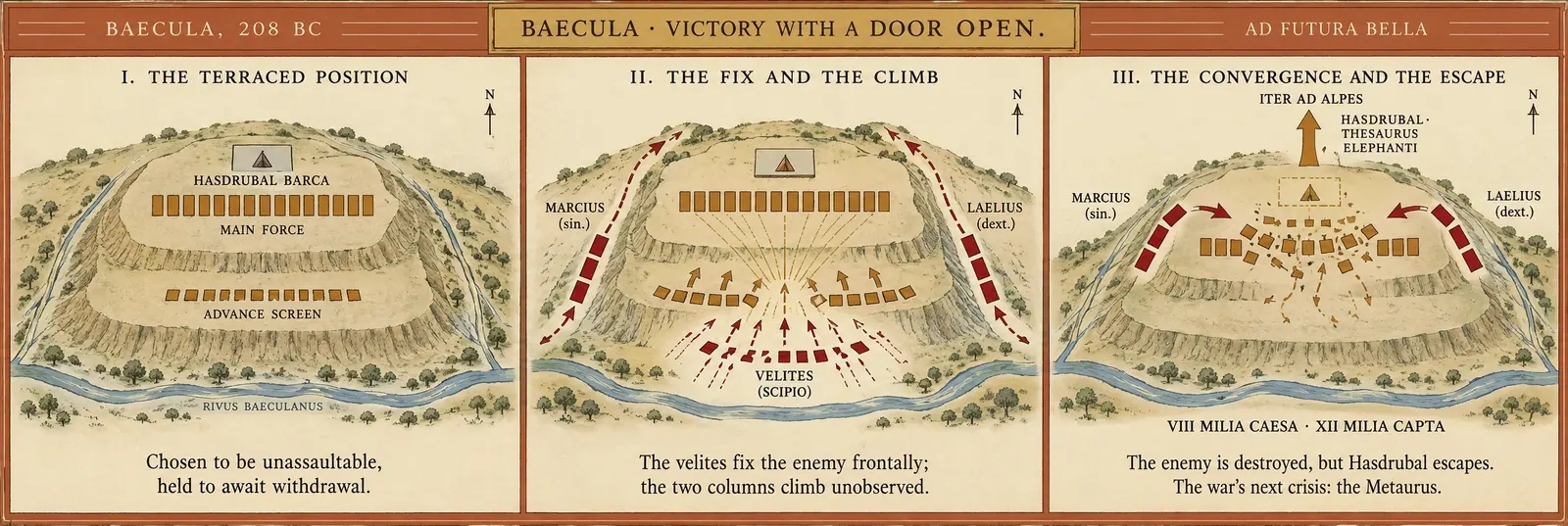
The strategic significance of Baecula, however, was less clear than the tactical victory might have suggested. Hasdrubal Barca, in the face of Scipio's flank attack, had executed a controlled withdrawal that preserved the core of his army (approximately 25,000 men) and that took the withdrawing force in the direction it was already going to go — northward, toward the Pyrenees. Scipio chose not to pursue. The decision has been criticized by some modern historians (notably by Liddell Hart) as a strategic failure that allowed Hasdrubal to execute the northward march that would shortly produce the Metaurus crisis in Italy; it has been defended by others (Scullard, Goldsworthy) on the grounds that the pursuit would have over-extended Scipio's army, would have exposed his rear to Mago and Hasdrubal son of Gisgo (both of whom had armies still operational in southern Spain), and might have resulted in a tactical victory pursued into a strategic disaster. The argument is unresolvable from the available evidence, but the operational fact is clear: after Baecula, Hasdrubal Barca was free to march northward, while Scipio remained in central Spain to consolidate his position and to confront the remaining Carthaginian armies.
Hasdrubal's March to ItalyLate 208–Spring 207 BC
Hasdrubal Barca's march from Spain to Italy was undertaken between late summer 208 and spring 207 BC, with the army crossing the Pyrenees in early autumn 208 and wintering in the lands of the Allobroges (the territory north of the modern Lyon) before completing the Alpine crossing in the spring of 207. The march was substantially easier than Hannibal's a decade earlier: the Gallic populations who had remembered Hannibal's passage now welcomed Hasdrubal's army, the route across southern Gaul was better known, the engineering challenges of the Alpine crossing had been mapped by the Hannibalic operation. Hasdrubal arrived in northern Italy in approximately April 207 BC with an army of approximately 30,000 men (including substantial Gallic reinforcements recruited during the march) and a smaller body of war elephants.
The strategic situation that Hasdrubal arrived to confront was, at first glance, favorable to a Carthaginian operation: Hannibal's army in southern Italy was still operational, Roman armies were dispersed across multiple theaters, and the Carthaginian reinforcement of Italy had been long expected by both sides. The operational challenge, however, was the coordination of the two Carthaginian armies. Hannibal's army was in Bruttium, at the southern end of the Italian peninsula; Hasdrubal's was in Cisalpine Gaul, at the northern end. The distance between them was approximately a thousand Roman miles. The two brothers needed to coordinate their northward and southward marches, respectively, in such a way that they would arrive at a common rendezvous point in central Italy before the Roman armies could prevent the junction.
The Roman strategic response to the Carthaginian opportunity was the deployment of two consular armies in 207 BC to intercept Hasdrubal before he could effect the junction with Hannibal. The consuls of the year were Gaius Claudius Nero (a member of the patrician Claudii Nerones, distinguished from his more famous later imperial namesakes by his consular career and his subsequent celebrated achievement at the Metaurus) and Marcus Livius Salinator (a senatorial figure whose career had previously been blighted by a political scandal that had resulted in his temporary withdrawal from public life, and who was now restored to office in recognition of his strategic competence). Nero was assigned the southern command, with the principal task of holding Hannibal in Bruttium; Livius was assigned the northern command, with the principal task of confronting Hasdrubal as he advanced southward through Italy. The combined Roman force in the field was approximately fourteen legions and the corresponding allied contingents, of which seven were under Nero's command in the south and seven under Livius's in the north.
The Coordination That Failed
The Carthaginian operational plan required precise coordination between the two brothers. Hannibal needed to know Hasdrubal's intended route and rendezvous point; Hasdrubal needed to know Hannibal's expected position and timetable. The coordination depended, in the absence of any direct communication between the two armies (which was operationally impossible given the Roman armies operating between them), on a messenger system. Hasdrubal dispatched six riders southward from his camp in Cisalpine Gaul in late June or early July 207 BC, carrying a sealed letter to Hannibal that specified the proposed rendezvous in Umbria, the timetable Hasdrubal proposed to follow, and the route he intended to take through central Italy. The letter was the operational hinge of the entire Carthaginian plan: without it, Hannibal could not know where or when to bring his army northward to meet his brother.
The six riders, traveling separately through Italy by what they hoped were inconspicuous routes, were intercepted by Roman scouts somewhere in Apulia, possibly near the town of Tarentum, in mid-July 207 BC. Five of the riders were killed in the interception; the sixth was captured alive, and Hasdrubal's letter was recovered from him intact. The letter was carried under guard to the consul Gaius Claudius Nero at his headquarters in southern Italy, who opened it, read it, and within a few hours made the most operationally consequential decision of the entire Hannibalic War.
Nero's decision was, in modern military vocabulary, an interior-lines operation of unusual audacity. He recognized that Hasdrubal's letter gave him precise information that Hasdrubal's army was advancing southward through central Italy, that Hasdrubal was unaware of Roman knowledge of his route and timetable, and that Hasdrubal expected to make the junction with Hannibal at a specific location in Umbria on a specific projected date. Nero further recognized that if Livius's army alone confronted Hasdrubal at the projected junction point, the engagement would be on roughly equal numerical terms and the outcome would be uncertain. If, however, Nero could detach a substantial portion of his own army, march it north with extraordinary speed, and arrive in Livius's camp before the engagement, the combined Roman armies would have overwhelming numerical superiority and could decisively defeat Hasdrubal before Hannibal could intervene. The operational challenge was the speed required: Nero's force would have to march from southern Italy to Umbria — approximately 250 Roman miles — in less time than it would take Hannibal to march north from Bruttium and Hasdrubal to complete his southward advance to the junction point. Nero would have to march, in effect, faster than Hannibal could march, and he would have to do it without Hannibal learning that he was doing it.
Nero detached approximately 7,000 men from his army — picked troops, light infantry, and cavalry, organized for rapid movement — and set out northward in mid-July 207 BC. The march that followed is preserved in the sources (principally Livy 27.43–48) with the kind of admiring detail that suggests it was recognized as exceptional by contemporary witnesses. Nero's column covered the 250 miles in approximately seven days, with the troops sleeping in shifts, marching twenty hours of the twenty-four, and being supplied by the rural Italian population along the route (the populations of central Italy, observing the column passing, voluntarily prepared food and supplied the marching troops; the moral economy of the post-Cannae alliance system was, by this point, sufficiently durable to support extraordinary operational measures). Nero's force arrived at Livius's camp near the Metaurus river in Umbria on approximately 21 or 22 June 207 BC.
The arrival was concealed with operational discipline. Nero's troops entered Livius's camp at night, were quartered among the existing tents to disguise the increase in total numbers, and were forbidden from displaying their separate standards. The strategic objective was to deny Hasdrubal any indication that the Roman force facing him was larger than he had expected. The deception, by the testimony of the sources, was substantially successful: Hasdrubal, observing the Roman camp opposite him on 22 and 23 June, noticed an unusual increase in cooking fires and an unusual concentration of horsemen, but interpreted these signals incorrectly — he attributed them to the presence of senatorial commissioners from Rome rather than to a doubled Roman army.
The Battle of the Metaurus22 or 23 June 207 BC
The Battle of the Metaurus was fought on terrain selected by Livius, who as the local Roman commander had had several weeks to study the country. The position was on the southern bank of the Metaurus river, with the Roman line drawn up perpendicular to the river and the Carthaginian line approaching from the north. Hasdrubal, evidently still under the impression that he faced only Livius's army, had attempted on the previous night to break contact and to march westward to a more favorable position, but his guides had become lost in the dark and his army had spent the night marching in confusion along the river bank; by dawn on 22 June Hasdrubal's army was in disordered formation along the northern bank of the Metaurus, with his troops exhausted from the night's march and his command structure imperfectly organized. The tactical conditions for the battle were thus in Roman favor before the engagement began.
Hasdrubal's army drew up with his Spanish and Ligurian heavy infantry in the center, his Gallic infantry on the left wing (which was anchored on broken hill country to the west), and his cavalry on the right wing. His ten or twelve war elephants were stationed in the center, in front of the infantry line. The Roman army drew up opposite: Livius commanded the left, facing the Gallic infantry on Hasdrubal's left; Nero commanded the right, facing Hasdrubal's cavalry and Spanish infantry. The Roman center was under the praetor Lucius Porcius Licinus.
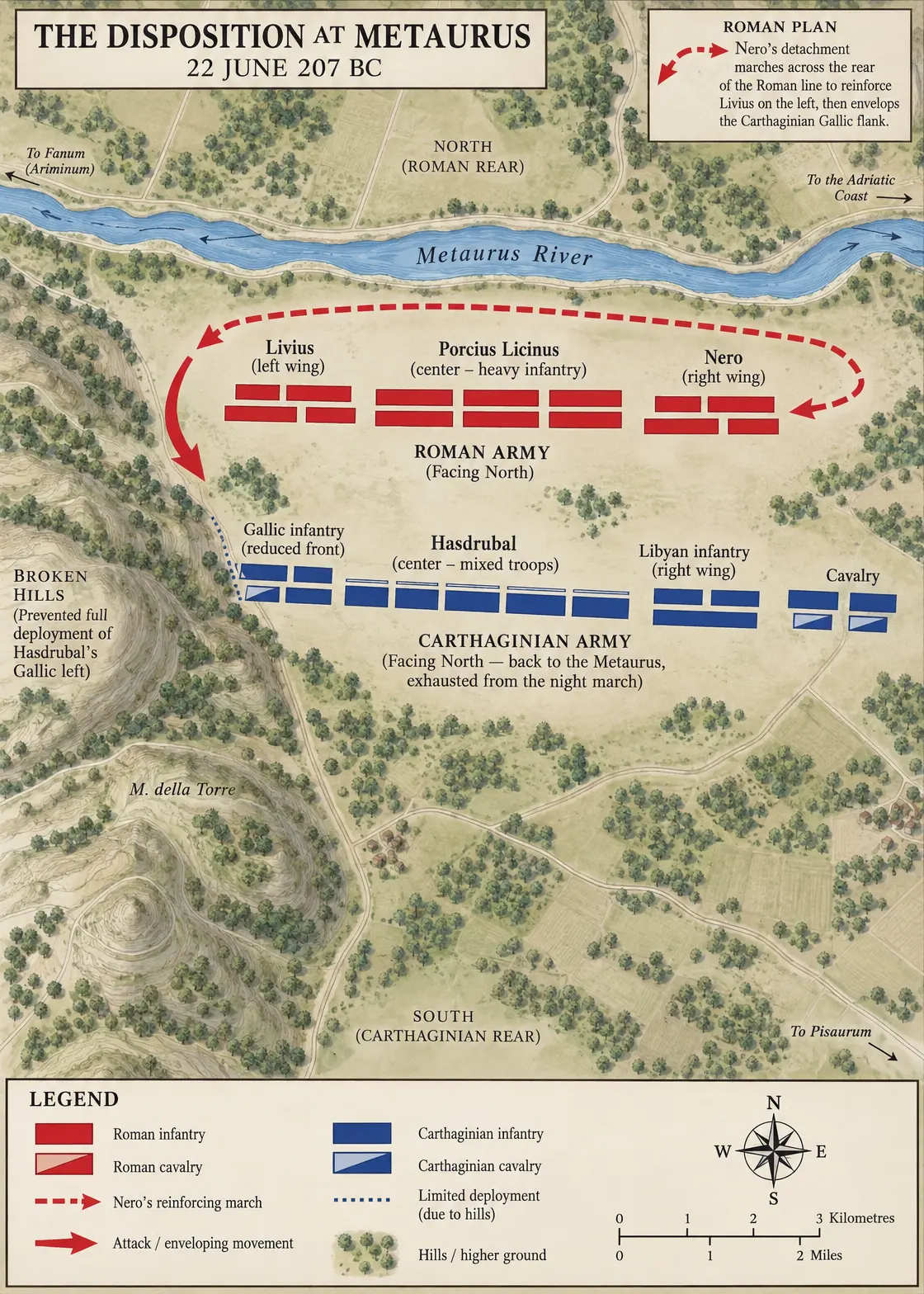
The engagement opened conventionally: the Roman heavy infantry advanced in the center, the cavalry actions began on the wings, the elephants in Hasdrubal's center caused initial disorder in the Roman line. The tactical innovation that decided the battle, however, was Nero's. Observing that Hasdrubal's Gallic left wing was poorly deployed because of the broken terrain on which it was anchored, Nero detached a substantial portion of his right-wing force, marched it across the rear of the entire Roman line (passing behind the Roman center and reaching the Roman left wing), and committed it to a flank attack on Hasdrubal's Gallic left. The maneuver was operationally unusual — Roman tactical doctrine of the period did not normally include cross-line redeployment in the middle of a battle — but it was decisive. The Gallic infantry, attacked simultaneously from front (by Livius's army) and flank (by Nero's detachment), broke; the breaking of the Gallic left exposed the flank of Hasdrubal's center; the entire Carthaginian line was rolled up from west to east.
Hasdrubal himself, recognizing that the battle was lost and that he could not return to Spain or even withdraw with his army intact, rode into the heaviest fighting and was killed in the action. His army was destroyed: approximately 10,000 Carthaginian dead, including most of the Spanish and African core troops; the surviving Gauls broke and dispersed into the surrounding country; the elephants were killed in the rout or captured. Total Carthaginian losses were perhaps 15,000; the Roman losses were approximately 2,000.
Nero's army began its march back to southern Italy on the morning after the battle. The return march was conducted at the same extraordinary pace as the outward march, with Nero's force covering the 250 miles back to its position opposite Hannibal in approximately six days. Nero brought with him a single item: Hasdrubal's head, which he caused to be thrown over the palisade of Hannibal's camp in southern Italy as the first communication of the Metaurus result. Hannibal, finding the head of his brother delivered to him in this manner, is reported by Livy (27.51) to have said that he saw the destiny of Carthage in the moment. The remark is one of the few preserved direct statements of Hannibal in the Roman tradition; whether or not it represents the actual sentiment of the moment, the strategic recognition it expressed was accurate. With the destruction of Hasdrubal Barca's army, the Carthaginian strategic plan that had underwritten Hannibal's entire Italian campaign — the long-projected reinforcement from Spain — was finally and definitively impossible. The war in Italy had become, after the Metaurus, a holding action whose outcome could no longer be in doubt; the Carthaginian state was no longer capable of supporting Hannibal's army adequately, and the Italian theater would eventually be reduced not by Roman tactical victory over Hannibal but by Roman strategic patience while the Carthaginian state's capacity to sustain the operation eroded to insignificance.
The strategic significance of the Metaurus was recognized at Rome with appropriate ceremony. Both consuls were granted triumphs — Livius the conventional triumph as the senior commander on the field, Nero an ovatio (a lesser triumph appropriate to a subordinate or proconsular role) that the Roman tradition recognized as substantively equivalent to a major triumph; the Senate decreed three days of public thanksgiving; the road on which Nero's column had marched northward and southward was reportedly lined for years afterward with monuments commemorating the operation. The Polybian and Livian narratives both treat the Metaurus as the strategic turning point of the war, and modern military historiography has generally agreed: the engagement that destroyed Hasdrubal Barca's army in Umbria in June 207 BC was the engagement that decided the Hannibalic War, even though the war itself would continue for another five years and would conclude at Zama on a different continent.
The Crossroads · Mid-July 207 BC · Southern Italy, at the consular headquarters
Nero at the Crossroads
You are Gaius Claudius Nero, consul of Rome, holding command in southern Italy opposite Hannibal.
Hasdrubal Barca has crossed the Alps into northern Italy with 30,000 men to reinforce his brother. Rome has fielded two consular armies: Marcus Livius Salinator with seven legions in the north to block Hasdrubal, and you with seven legions in the south to pin Hannibal in Bruttium. Roman scouts in Apulia have just intercepted six Carthaginian messengers. Five were killed, but the sixth was captured alive with Hasdrubal's sealed dispatch. Opened before you, the letter outlines Hasdrubal's marching timetable and his plan to unite with Hannibal in Umbria. Hannibal remains unaware of the plan, but Hasdrubal is already advancing south.
How do you act upon the intercepted Carthaginian dispatches?
Weigh each course: open it to hear your own inner voice. Then decide. Nothing is scored.
- Your inner voiceThe course taken
Livius alone faces an equal contest and uncertain odds. If Hasdrubal breaks through, the brothers will unite. I must detach seven thousand picked legionaries, light infantry, and cavalry, marching two hundred and fifty miles north in days while leaving my main force to deceive Hannibal. If Hannibal notices my departure, my remaining men are vulnerable and my command is divided. But if we outpace the enemy, we crush Hasdrubal before Hannibal even knows I am gone.
- Your inner voiceThe course taken
My sworn consular duty is to pin Hannibal in Bruttium. If I abandon my station or divide my seven legions, Hannibal may discover my absence, break out, and ravage Italy unopposed. Livius has seven legions in Umbria—a force equal to Hasdrubal’s. By forwarding these captured plans to Livius and the Senate at once, Livius can choose favorable ground to intercept Hasdrubal, while my army keeps Hannibal blind and trapped in the south.
- Your inner voiceThe course taken
A divided army risks defeat in detail. If I move my entire army of seven legions north, we will assemble fourteen legions against Hasdrubal’s thirty thousand men, guaranteeing overwhelming victory on the Metaurus. Yet marching an entire army cannot be concealed from Hannibal. The moment he realizes my camp is empty, he will follow me north or march directly against an undefended Rome. The risk of leaving Italy’s heart entirely exposed is immense.
What was done
Nero detached approximately 7,000 picked troops and covered 250 Roman miles northward in seven days, sustained by rural Italian communities. Arriving secretly at Marcus Livius Salinator’s camp near the Metaurus river, Nero concealed his troops within existing tents. At the Battle of the Metaurus (AGrade A), Nero broke the stalemate by executing an unprecedented tactical redeployment: marching his right-wing force behind the entire Roman line to assault Hasdrubal’s Gallic left flank. The Carthaginian line collapsed; Hasdrubal Barca rode into the fighting and was killed, his army suffering approximately 10,000 to 15,000 losses against 2,000 Roman casualties. Returning south in six days, Nero flung Hasdrubal's severed head over Hannibal’s palisade. Livy (BGrade B) records Hannibal’s realization that Carthage's strategic plan in Italy was ruined. Livius received a triumph and Nero an ovatio, while the Senate decreed three days of thanksgiving for the victory that decided the war.
The evidence Livy 27.36–51 (BGrade B) provides the principal, unusually detailed narrative of Nero's interception of the Carthaginian messengers, his rapid march to Umbria, and his tactical redeployment at the Metaurus. Fragments of Polybius 11.1–3 (BGrade B) preserve the Metaurus campaign, alongside Polybius 11.19 (frag.) for Hannibal's reaction. Further accounts include Cassius Dio frag. via Zonaras 9.9 (CGrade C), Appian Hannibalica 51–54 (CGrade C), Frontinus Strategemata 1.1.9 and 2.9.2 on Nero's march and maneuver (CGrade C), and Cornelius Nepos Hannibal 5 (CGrade C). The chapter assigns an overall AGrade A to the Metaurus and BGrade B to the march.
If you choose to walk through itAt every scale
- Yourself
How do you balance the personal glory of an audacious strike against the catastrophic dishonor should Hannibal detect your absence and crush your abandoned camp?
- Those beside you
What do you owe to the seven thousand soldiers marching twenty hours a day to exhaustion, compared to the remaining legionaries left vulnerable in the southern camp?
- Rome
When Rome's consular system divides military authority into separate geographic provinces, under what circumstances may a consul abandon his assigned sphere without senatorial authorization?
- The wider world
How does the voluntary logistical support of central Italian communities reflect the resilience of Rome's alliance system under prolonged wartime strain?
- Our own time
When subordinate leaders possess critical, time-sensitive intelligence, how should modern institutions weigh strict adherence to jurisdictional boundaries against decisive, unauthorized initiative?
In August 1914 at Tannenberg, German commanders faced two separated Russian armies advancing into East Prussia. Intercepted unencrypted Russian radio dispatches revealed their routes, speeds, and intentions. Rather than maintaining defensive positions across both fronts, the German Eighth Army left a minimal cavalry screen to distract the Russian First Army while exploiting interior rail lines to shift nearly its entire fighting strength south, surrounding and annihilating the Russian Second Army before the two forces could coordinate.
Where the comparison fails. The 1914 operation relied on modern rail transport and electronic wire interception rather than forced foot marches and captured physical letters. Furthermore, German commanders acted within their assigned theater and general staff doctrine, rather than an ancient magistrate violating consular province boundaries.
What does the chapter tell us?
What strategic priority was agreed upon by the Carthaginian commanders during their winter conference in Spain following the loss of Carthago Nova?
The commanders agreed that reinforcing Hannibal in Italy offered the only path to overall victory in the war. Consequently, Hasdrubal Barca would undertake the march to Italy, leaving the defense of Spain to Mago and Hasdrubal son of Gisgo.
The chapter's narrative (BGrade B)
How did Publius Cornelius Scipio achieve his tactical breakthrough against Hasdrubal Barca's defensive position at Baecula?
Scipio pinned Hasdrubal’s attention by sending velites and light infantry in a frontal assault on the lower terrace, while dispatching two columns of heavy infantry under Laelius and Lucius Marcius around the flanks to strike the upper terrace.
Polybius 10.34–40 (AGrade A)
How did Gaius Claudius Nero discover Hasdrubal Barca's operational route, timetable, and planned rendezvous point?
Hasdrubal sent six riders to carry his dispatch through Italy to Hannibal. Roman scouts in Apulia intercepted them, killing five and capturing the sixth alive along with Hasdrubal’s intact, sealed letter containing his plan to meet in Umbria.
Livy 27.36–51 (BGrade B)
According to the chapter, what logistical factor enabled Nero’s detachment of 7,000 men to cover 250 Roman miles in approximately seven days?
Nero’s troops marched twenty hours a day and slept in shifts, while the rural Italian populations along the march voluntarily prepared food and supplied the men, demonstrating the resilience of the post-Cannae alliance system.
Livy 27.43–48 (BGrade B)
What decisive tactical redeployment did Nero execute during the Battle of the Metaurus?
Noticing that the Gallic left was shielded by broken terrain from frontal assault, Nero shifted a major force from his right wing across the rear of the Roman center and left, rolling up Hasdrubal’s line from the flank.
Livy 27.36–51 (BGrade B) and Frontinus Strategemata 2.9.2 (CGrade C)