Chapter 5
Ilipa and the End of Carthaginian Spain
The Strategic Situation in Spain After Hasdrubal's Departure
The departure of Hasdrubal Barca's army from Spain in the late summer of 208 BC had left the Carthaginian position on the peninsula in the hands of two commanders of conspicuously different temperaments: Hasdrubal son of Gisgo, a competent but not exceptional general of the second generation of the Barcid military establishment, and Mago Barca, Hannibal's younger brother and the most aggressive of the surviving Carthaginian commanders. The two were not natural collaborators; Hasdrubal son of Gisgo's strategic temperament favored consolidation and defensive operations, while Mago preferred offensive maneuver and the pursuit of decisive engagement. The strategic situation they confronted across 207 BC was, however, deteriorating: the loss of Carthago Nova in the previous year had deprived them of their principal base, the Roman alliance system among the Spanish tribes was steadily expanding at Carthaginian expense, and the strategic news arriving from Italy — first of the dispatch of Hasdrubal Barca's army northward, then of his death at the Metaurus in June 207 — indicated that no further reinforcement could be expected from either the Italian theater or from Carthage itself.
The Carthaginian response was a substantial recruitment effort across central and southern Spain during the winter of 207/206 BC, designed to assemble a field army large enough to engage Scipio's force on terms approaching numerical equality. By the spring of 206, the combined Carthaginian army assembled under Hasdrubal son of Gisgo and Mago numbered approximately 50,000 foot and 4,500 cavalry, with 32 war elephants. The composition was substantially Spanish: perhaps 35,000 of the foot were Iberian or Celtiberian troops recently recruited, with the African and veteran Carthaginian core constituting perhaps 15,000. The relatively small core of veteran troops, with the great mass of recently recruited and tactically untested allies, would prove the central weakness of the Carthaginian position at the engagement that followed.
Scipio's Roman force in Spain at the same moment was approximately 45,000 foot and 3,000 cavalry, of whom approximately half were Roman and Italian troops and half were Spanish allies recruited under Scipio's expanding alliance system. The numerical balance therefore favored the Carthaginians slightly in infantry and substantially in cavalry. The qualitative balance, however, favored Rome: Scipio's army included a substantial veteran core of troops who had served through three campaigning seasons in Spain, with the recently recruited Spanish allied contingents stiffened by the experienced Roman and Italian heavy infantry. The Carthaginian numerical advantage, in other words, was a function of recently raised troops; the Roman qualitative advantage was a function of accumulated operational experience.
The Battle of IlipaSpring 206 BC
The Battle of Ilipa is the most operationally sophisticated of all the engagements covered in the present compendium and is the tactical performance that established Scipio's reputation as a general of the first rank, capable of confronting opponents of the Barcid quality on terms of equality and producing decisive results. The engagement took place near the town of Ilipa (also called Silpia in some sources, modern Alcalá del Río near Seville) on the lower Baetis river in southern Spain, in the spring of 206 BC. The terrain was relatively open: a level plain extending several kilometers between two low ridges, with the Carthaginian camp on the southern ridge and the Roman camp on the northern ridge approximately five kilometers distant.
Scipio's tactical plan for the engagement, which he had been developing across the winter, was based on his analytical assessment of the Carthaginian army's composition. He recognized that the Carthaginian veteran core — the Africans and the older Iberian troops — would necessarily be deployed in the center of the line, where they could exert decisive influence on the engagement; the wings would be held by the recently recruited Spanish allied contingents, of inferior quality and morale. The conventional Roman approach to such a deployment would have been to place the Roman heavy infantry opposite the Carthaginian center, attempting to defeat the Carthaginian veterans by main force. Scipio's plan, however, was the opposite: he would deploy his Roman heavy infantry on his wings, opposite the inferior Carthaginian Spanish troops, and would place his Spanish allies in the center, opposite the Carthaginian veterans. The Roman wings would press their attack with full force against the weak Carthaginian wings, breaking them rapidly; the Roman center, holding defensively against the Carthaginian veteran center, would hold position without engaging decisively. The intended result was the destruction of the Carthaginian wings by Roman wing pressure, followed by the envelopment of the now-isolated Carthaginian veteran center by the victorious Roman wings.
The plan was, in effect, the inverse of the Cannae plan: where Hannibal at Cannae had used a weak center to draw the Romans forward into an enveloping pocket, Scipio at Ilipa would use a weak center to hold position while the strong wings broke the enemy wings and then enveloped the enemy center. The conceptual sophistication was high: Scipio had identified the operational logic of the most famous Carthaginian battle of the war and had inverted it to produce a tactical scheme appropriate to the specific conditions of his current engagement. The execution required several supporting innovations.
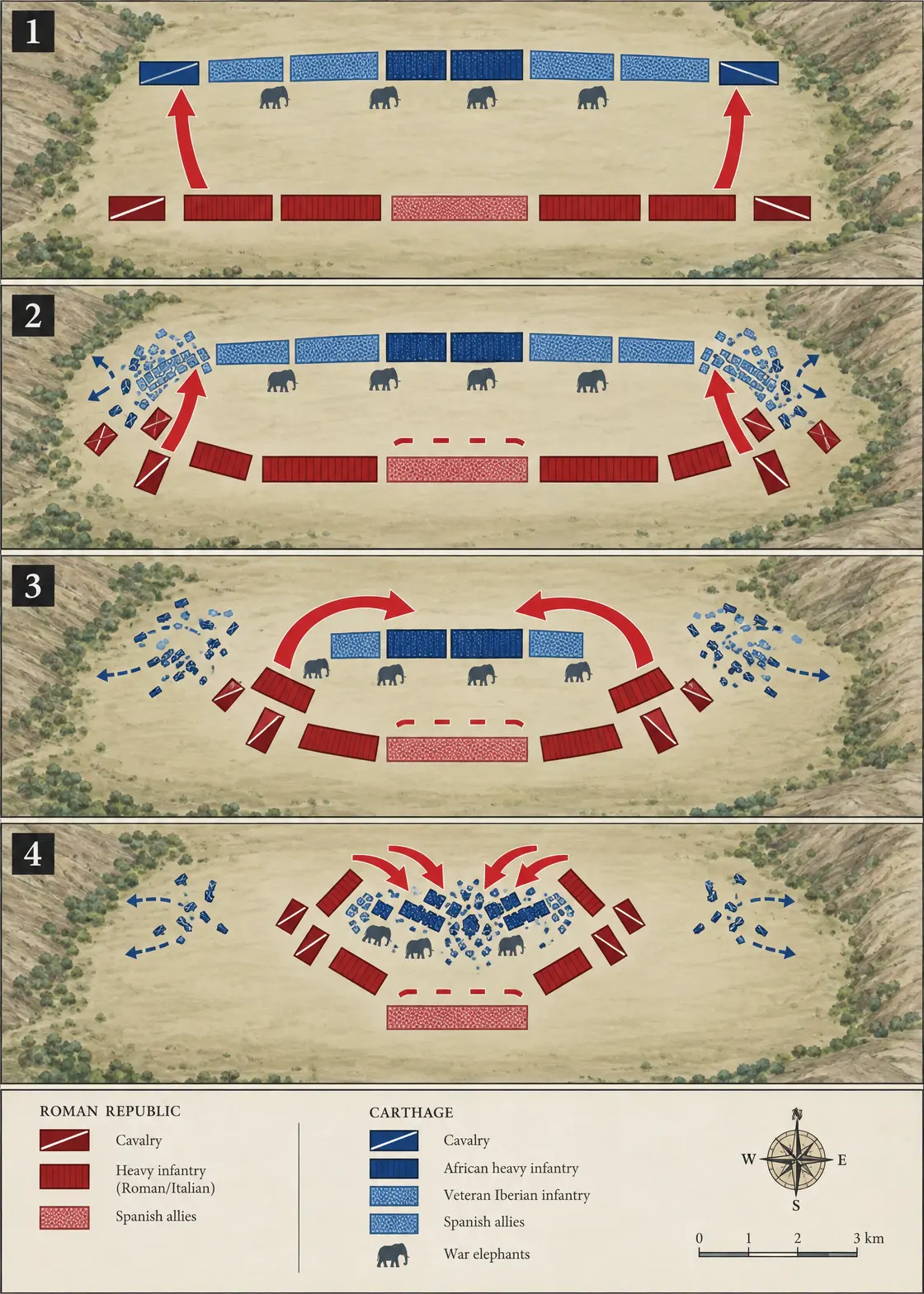
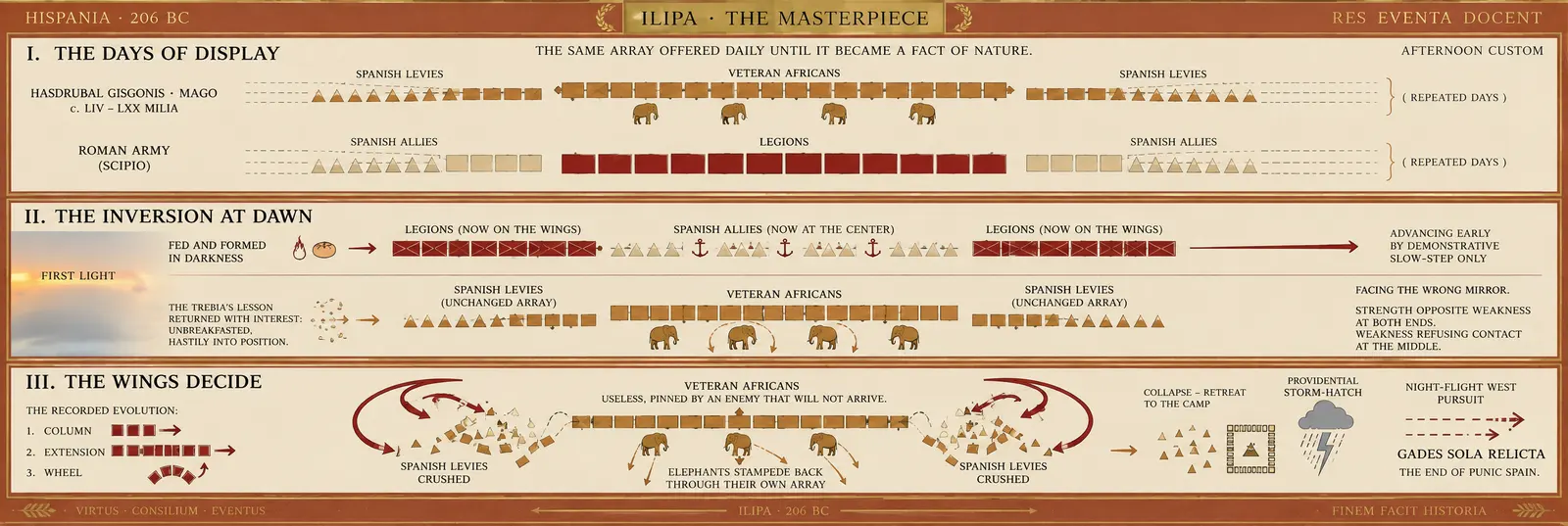
The engagement opened with a tactical surprise of Scipio's design. For several days before the engagement, the two armies had been deployed each morning in their conventional formations (Carthaginian veterans in the center, Romans in the center) for skirmishing along the line between the ridges; the troops on both sides had become accustomed to the daily deployment pattern. On the day Scipio had chosen for the decisive engagement (the date is not preserved in the sources but was probably in late April or early May 206 BC), he had his army deployed at dawn — earlier than the usual time — and in the inverted configuration, with the wings holding the heavy infantry and the center holding the Spanish allies. He sent his light troops and cavalry forward to engage the Carthaginian camp at first light, compelling Hasdrubal son of Gisgo to deploy his army for battle without the time to assess and respond to the Roman tactical change. The Carthaginians deployed in their conventional formation; Scipio's inverted deployment, which would have been visible to careful Carthaginian observation in time to permit response, went unnoticed in the haste of the morning's mobilization. The Carthaginian commanders found themselves committed to an engagement in which their veteran center faced inferior Roman opposition and their inferior wings faced veteran Roman opposition — exactly the conditions Scipio had designed the engagement to produce.
The engagement that followed unfolded substantially as Scipio had planned. The Roman wings advanced rapidly against the Carthaginian Spanish allied contingents; the Carthaginian wings, outclassed in equipment and training, gave way under the pressure within perhaps an hour of the engagement's beginning. The Roman center, holding defensively against the Carthaginian veteran center, did not advance to engage; the Carthaginian veterans, deployed for a frontal infantry contest, found themselves with no opponent to engage decisively and were unable to commit to forward movement without exposing their already-thinning flanks. When the Roman wings, having broken the Carthaginian wings, wheeled inward to attack the Carthaginian center from both sides, the Carthaginian veteran troops found themselves enveloped while still standing in their original formation. The engagement turned within the next hour into a battle of attrition in which the Carthaginian veteran center was destroyed in place by Roman flank attacks, with no possibility of orderly withdrawal because the broken Carthaginian wings had ceased to exist as a coherent formation behind the center.
The casualties at Ilipa are given by Polybius (11.20–24, the latter portion in fragmentary form) as Carthaginian dead at approximately 25,000, with a similar number of captured; Roman losses were approximately 1,500. The numerical ratio of approximately 30:1 against the loser is among the most extreme of any ancient engagement on this scale, exceeding even Cannae as a tactical demonstration of asymmetric outcomes. The Carthaginian field army in Spain had been effectively destroyed; the surviving Carthaginian remnants under Mago and Hasdrubal son of Gisgo escaped southward to the coastal cities of Gades, Castulo, and other remaining strongholds, but the Carthaginian position in Spain had collapsed beyond recovery.
The Reduction of Remaining Carthaginian Positions206 BC
The summer and autumn of 206 BC were spent by Scipio in the reduction of the remaining Carthaginian strongholds in Spain. Hasdrubal son of Gisgo withdrew with the surviving Carthaginian forces to the great commercial city of Gades (modern Cádiz) on the Atlantic coast — the original Phoenician foundation on the Iberian peninsula, dating to perhaps the eleventh century BC, and the principal naval base of the Carthaginian Atlantic operations. Mago Barca attempted independent operations in the Balearic Islands and on the Mediterranean coast but was unable to threaten the consolidating Roman position. Across the summer of 206 BC, Scipio's troops reduced one Carthaginian-allied city after another in southern Spain: Castulo surrendered without resistance, Iliturgi (the city that had reportedly betrayed the elder Publius Scipio to his enemies in 211) was stormed and destroyed with exemplary severity, several other communities of varying loyalty accepted Roman alliance on terms.
The most operationally interesting episode of the closing Spanish campaign was the recovery of the Spanish chieftain Indibilis (whose name has already appeared in connection with the early operations of the elder Scipios) into the Roman alliance, and his subsequent attempt — after Scipio's brief illness in late 206 BC, when rumors that Scipio had died briefly produced political instability in the alliance system — to lead a Spanish revolt against the Roman position. The revolt was suppressed by Scipio's army upon his recovery, in two small engagements that need not detain the present narrative. The political point of the episode is that the Roman alliance system in Spain, established across the previous four years of Scipio's command, was not yet sufficiently institutionalized to survive the death (or even the rumored death) of its principal Roman architect. The construction of a durable Roman administrative system in Spain — the provincial framework that would, across the following century, transform the peninsula into one of the principal sources of Roman wealth and military manpower — was not the achievement of Scipio's Spanish campaign; it was the long subsequent achievement of the second-century provincial governors and of the slow institutionalization of Roman administrative practice. What Scipio accomplished was the strategic destruction of the Carthaginian position in Spain; the political consolidation of what had been gained would be the work of others, over decades.
The siege of Gades was the final operation of the campaign. The city held out across the winter of 206/205 BC under Mago's command, but with no prospect of relief and with its commercial interests in tension with the requirements of military defense, Gades opened negotiations with Scipio's representatives in the spring of 205. The city eventually surrendered on terms that preserved its civic and commercial institutions in exchange for transition to Roman alliance. Mago Barca evacuated with the remaining Carthaginian forces (perhaps 8,000 men, with some elephants and a small fleet) and sailed eastward — initially to the Balearic Islands, where he wintered, and then in 205 BC to the Ligurian coast, where he attempted to open a fourth front against Rome by operations in northern Italy. The Magonian campaign in Liguria would continue until 203, when Mago was wounded in a small engagement and died en route to North Africa where he had been recalled. He was the third of Hamilcar Barca's three sons to die in the Carthaginian war effort, after Hasdrubal at the Metaurus and Hannibal's continuing operations in Italy.
The Spanish theater was, after the surrender of Gades in spring 205 BC, definitively a Roman possession. Scipio departed Spain in the same period, returning to Rome to seek the consulship and to argue for the next strategic step — the African expedition that would carry the war to Carthage itself. The Spanish achievement was: in five years (210–205), starting from a position of near-collapse, Scipio had recovered Roman territory, captured the Carthaginian strategic capital at Carthago Nova, defeated three Carthaginian armies in successive engagements (Baecula, Ilipa, and the smaller operations of the late campaign), destroyed the Carthaginian political-military presence in the peninsula, and constructed (in outline) a Roman alliance system that would mature, over the following century, into the Roman provincial administration of Hispania Citerior and Hispania Ulterior. The strategic foundation of Carthaginian military power in the western Mediterranean — the Iberian fiscal-recruitment base constructed by Hamilcar Barca after the First Punic War — had been irrevocably broken. The war could no longer be supported by Carthaginian resources from Spain; what remained was the operational task of compelling Carthage herself to acknowledge defeat.
The Crossroads · Spring 206 BC, before dawn · The Roman camp on the northern ridge above the Baetis plain near Ilipa
The Inverted Line at Ilipa
You are Publius Scipio, commander of the Roman army in Spain, preparing your forces outside Ilipa.
Across the winter, you assembled forty-five thousand infantry and three thousand cavalry on the lower Baetis river to contest Carthaginian control of southern Spain. Five kilometers south, upon the facing ridge, Hasdrubal son of Gisgo and Mago Barca command fifty thousand foot, forty-five hundred horse, and thirty-two war elephants. For several mornings, both armies have deployed conventionally for skirmishing: African veterans in the Carthaginian center, Roman heavy infantry in yours, and Spanish allies guarding the wings. You know Hasdrubal's center holds his veteran Africans and Iberians, while his wings are newly recruited Spanish levies. The time has come to force a general engagement, but committing forty-five thousand men to battle on an open plain against superior numbers demands a deployment that dictates the terms of combat before the Carthaginian generals realize what they face.
How will you deploy and commit your army for the decisive engagement against Hasdrubal son of Gisgo and Mago Barca?
Weigh each course: open it to hear your own inner voice. Then decide. Nothing is scored.
- Your inner voiceThe course taken
We must invert our entire battle order before sunrise. Placing our Roman veterans on the wings to strike their untried Spanish levies ensures an immediate breakthrough on both flanks. By keeping our Spanish allies in the center held back defensively, we pin their veteran Africans without engaging them directly. If our wings wheel inward swiftly, we envelop their center. But if our center crumbles before the wings close, our army will be cut in two.
- Your inner voiceThe course taken
If I order the Roman and Italian legions into our center, we follow established discipline. Our veterans would grapple directly with the African core. Yet if Hasdrubal's center holds, his superior cavalry and thirty-two war elephants might overwhelm our newly raised Spanish allies on the wings and turn our flanks. We would risk everything upon a bloody frontal collision where numbers do not favor us.
- Your inner voiceThe course taken
We can remain upon our northern ridge and decline general battle on this open plain, continuing only daily skirmishes between the lines. Hasdrubal has fifty thousand infantry to feed from a countryside turning against him. Yet our own alliance system is fragile and new. If we hesitate to offer battle, our Spanish allies may question our resolve and drift away, while Hasdrubal consolidates his position and preserves his veteran core intact.
What was done
Scipio deployed at dawn in the inverted formation, sending his cavalry and light troops to provoke Hasdrubal son of Gisgo before the Carthaginians could observe the Roman shift. The Carthaginians deployed in their customary formation, placing veteran Africans in the center and raw Spanish recruits on the wings. The Roman heavy infantry on the wings broke the Carthaginian Spanish contingents within an hour, while the Roman center of Spanish allies held position defensively without engaging. When the victorious Roman wings wheeled inward, they enveloped the Carthaginian veteran center in place. According to Polybius (AGrade A), Carthaginian losses reached approximately 25,000 dead and 25,000 captured, against roughly 1,500 Roman dead—a ratio of 30:1. Hasdrubal son of Gisgo and Mago Barca fled toward coastal strongholds, leaving their field army destroyed and Carthaginian rule in Spain broken beyond recovery.
The evidence The tactical maneuver and engagement at Ilipa are detailed in Polybius 11.20–24 (AGrade A). Livy 28.12–37 provides a parallel narrative with dramatic elaboration (BGrade B). Supplementary operational details are preserved in Appian's Hispanica 24–37 (CGrade C) and Frontinus's Strategemata 2.3.4 (CGrade C).
If you choose to walk through itAt every scale
- Yourself
How does a commander balance the moral burden of placing untested allies in harm's way against the tactical necessity of fixing an enemy's strongest troops?
- Those beside you
What did Scipio's veteran Roman legions think when told they would advance along the flanks rather than fight at the center of the line?
- Rome
How far did tactical unorthodoxy risk the prestige and traditional military doctrine of the Roman Republic if an inverted deployment failed?
- The wider world
What did the Iberian and Celtiberian warriors on both sides risk in a war fought across their homelands by two foreign Mediterranean empires?
- Our own time
When does discarding standard institutional procedure produce breakthrough innovation, and when does it invite catastrophic failure?
Modern armed forces frequently face moments where conventional doctrine mandates direct engagement against an adversary's primary strength, but innovative operational design achieves disproportionate success by striking fragile supporting elements instead. In coalition warfare, commanders often seek to isolate hardened veteran units by collapsing vulnerable logistics networks or weaker auxiliary contingents on the perimeter, bypassing a bloody head-on contest to induce systemic organizational collapse across the entire theater.
Where the comparison fails. Modern warfare relies on continuous electronic surveillance and mechanized mobility, making total tactical surprise and rigid frontal deception far harder to achieve than on an ancient battlefield where armies deployed visually across several kilometers of open ground.
What does the chapter tell us?
What was the primary qualitative difference between the Carthaginian and Roman infantry forces at Ilipa?
The chapter states that approximately 35,000 of the 50,000 Carthaginian foot were recently recruited Iberian or Celtiberian troops, whereas Scipio's army had a substantial Roman and Italian veteran core tempered by three campaigning seasons.
the chapter's narrative
Why did Scipio invert his battle line by placing Roman heavy infantry on the wings and Spanish allies in the center?
Scipio designed the maneuver as the inverse of Cannae: his Roman heavy infantry would break the Carthaginian Spanish wings quickly, while his center held defensively, allowing the wings to wheel inward and envelop the isolated Carthaginian veteran center.
Polybius 11.20–24 (AGrade A)
How did Scipio prevent Hasdrubal son of Gisgo from adjusting his formation to match the Roman deployment on the day of battle?
Having accustomed the Carthaginians to a daily mid-morning routine, Scipio deployed early at first light and attacked with light troops and horsemen, giving Hasdrubal no time to inspect the Roman line before hurrying his men into their conventional order.
the chapter's narrative
What does the chapter identify as a major limitation of the Roman alliance system constructed by Scipio in Spain?
When rumors spread in late 206 BC that Scipio had died of illness, the Spanish chieftain Indibilis led a revolt, demonstrating that the alliance network rested on Scipio personally rather than stable administrative institutions.
Livy 28.16–37 (BGrade B)
What happened to Mago Barca following the surrender of Gades in 205 BC?
Mago sailed to the Balearic Islands, wintered there, and landed in Liguria in 205 BC to fight in northern Italy until 203 BC, when he was wounded and died en route to North Africa.
Cornelius Nepos Hannibal (CGrade C)