Book IV · The Wars of Mediterranean Hegemony
Chapter 2
The Syrian War: Antiochus, Thermopylae, and Magnesia
Antiochus III and the Strategic Configuration of the East
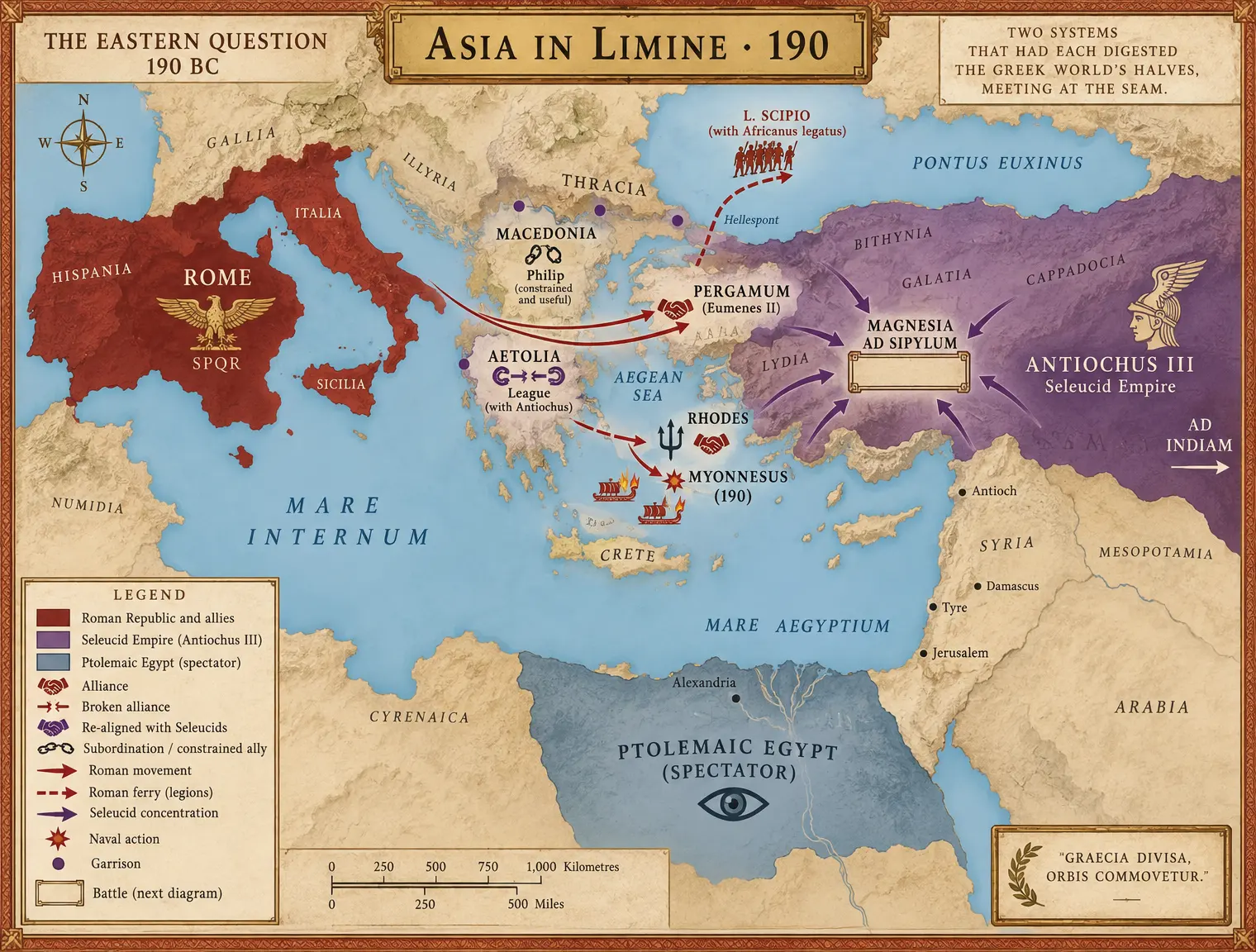
The principal Hellenistic monarchy of the eastern Mediterranean at the close of the Second Macedonian War was the Seleucid kingdom under Antiochus III, who had succeeded to the throne in 223 BC as a youth of approximately eighteen years and who had spent the subsequent quarter-century in the systematic reconstruction of the Seleucid strategic position from the truncated condition in which his father Seleucus III had bequeathed it. Antiochus's reign by 196 BC had produced the recovery of substantial Seleucid territory lost during the third-century dynastic crises: the eastern satrapies as far as Bactria had been brought back under nominal Seleucid suzerainty by the great anabasis of 212 through 205 BC (Antiochus's eight-year campaign through Iran and central Asia, modeled consciously on Alexander's eastern expedition and producing the cognomen Megas — "the Great" — that the Greek world subsequently applied to him); Coele-Syria and Phoenicia had been recovered from Ptolemaic Egypt at the engagement of Panium in 200 BC; the strategic position in Asia Minor was being systematically extended through the diplomatic and military operations of the 190s BC.
The strategic geography of the Seleucid kingdom at the moment of its potential collision with Roman power was extensive but politically fragile. The kingdom extended at its maximum extent from the Aegean coast of Asia Minor through Syria and Mesopotamia to the eastern Iranian plateau and (in nominal terms) to the Indian frontier — a geographic span that exceeded any other contemporary state and that approximated the territorial extent of the Achaemenid Persian empire that Alexander had conquered. The political-administrative system, however, was less robust than the territorial extent suggested. The Seleucid administrative capacity depended substantially on the loyalty of regional satraps whose strategic interests often diverged from those of the central monarchy; the recruitment base for Seleucid armies was a complex layering of Macedonian-Greek settler communities (the so-called katoikiai of military colonists), local levies, and mercenary contingents whose tactical quality varied substantially; the fiscal foundation depended on tribute from the satrapies, which Antiochus had reorganized on conventional Hellenistic principles but which remained vulnerable to interruption by satrapal disaffection or by external military pressure. The strategic position was, in summary, that of a Hellenistic empire of substantial territorial scope but limited operational concentration — capable of fielding very large armies for short campaigns but not of sustaining the kind of long-term military exertion that a major war with Rome would require.
Antiochus's strategic conception in the years after Panium and the recovery of Coele-Syria was the consolidation of Seleucid control over the western Anatolian coast, with the longer-term objective of incorporating the remaining Greek and Asian-Greek cities of Asia Minor into a renewed Seleucid hegemony. The strategic-political collision with Rome arose from the fact that several of these Anatolian cities — including the strategically important commercial center of Smyrna and the principal Anatolian Greek city of Lampsacus — had appealed to Rome for protection during the Second Macedonian War on the basis of the broader Roman political position that Greek cities should be free from Hellenistic monarchical control. The Flamininan policy implicit in the Isthmian Declaration extended, in principle, to Greek cities under Seleucid control; Antiochus, by contrast, regarded the Anatolian Greek cities as historically Seleucid possessions that had been temporarily lost during the third-century crises and were now being legitimately recovered.
The diplomatic exchanges between Rome and Antiochus across 196 through 193 BC were conducted with the kind of mutual misunderstanding characteristic of cultural-strategic systems that have not previously interacted at this level of formal engagement. The Roman embassies (Lucius Cornelius Lentulus in 196 BC, Publius Sulpicius Galba and Publius Villius Tappulus in 193 BC, and others) demanded that Antiochus evacuate Thrace (where he had established forward positions across the Hellespont), withdraw from Smyrna and Lampsacus, and acknowledge the Roman political supervision over the Greek cities of Asia Minor. Antiochus's responses (delivered through senior diplomatic officials such as Heraclides of Byzantium and Lysias) rejected the Roman demands as incompatible with the historical territorial extent of the Seleucid kingdom and proposed a counter-arrangement under which Rome would accept Seleucid hegemony in Asia Minor in exchange for Seleucid acceptance of Roman supremacy in Greece itself. The diplomatic positions were so far apart that no negotiated settlement was possible; the strategic competition would have to be resolved by military engagement.
The complication that accelerated the war was the arrival of Hannibal Barca at Antiochus's court in 195 BC, fleeing the Roman ultimatum that had been delivered to the Carthaginian Senate demanding his surrender. Hannibal's presence at Antioch was, in itself, a strategic-political signal that Antiochus could not ignore: the Roman political class regarded Hannibal's reception by Antiochus as an act approaching the breach of the post-Zama treaty obligations, and the diplomatic exchanges of 194 through 192 BC included substantial Roman pressure on Antiochus to surrender or banish his Carthaginian guest. Hannibal himself, meanwhile, was urging Antiochus toward war with Rome on the basis of a comprehensive strategic conception that he developed during his Antiochene service: the war should be fought in Italy, with a Carthaginian fleet and army landing on the Italian coast while the Seleucid forces engaged Roman power in Greece, replicating in modified form the strategic logic that had nearly succeeded in 218 through 216 BC. Antiochus, however, declined to adopt Hannibal's strategic conception. The Seleucid court — dominated by Macedonian-Greek aristocrats whose strategic-cultural orientation regarded Hannibal as an outsider whose advice could not be entrusted with major operational decisions — was unwilling to grant Hannibal an independent command in any major theater. Hannibal would serve in subordinate positions in the war that followed, with consequences for the Seleucid operational outcome that the historical assessment has generally regarded as substantially negative.
The Aetolian Catalyst and the Opening of the War192 BC
The proximate trigger for the war was the political action of the Aetolian League, which had been Rome's principal Greek ally during the Second Macedonian War but which had become progressively disaffected with the Roman political settlement of 196 BC. The Aetolian disaffection arose from several sources: the territorial gains that the Aetolians had expected from the post-Macedonian settlement (particularly the cities of Thessaly and Acarnania) had been reserved by Rome for distribution to other Greek communities or for direct Roman supervision; the political-cultural status of the Aetolian League within the post-war Greek world had been diminished as the Achaean League gained ascendancy under Roman patronage; the Aetolian leadership, particularly the political figure Thoas (who was the principal Aetolian strategist of the period), had developed a strategic conception in which the Aetolian position could be improved by playing Antiochus and Rome against each other.
The Aetolian initiative of 192 BC was the formal invitation to Antiochus to enter Greece as the "Liberator of the Greeks" — appropriating the Flamininan rhetorical formulation but applying it to the proposition that Roman supervision was itself a constraint on Greek liberty that Antiochus could remove. The Aetolian invitation was accompanied by political-military operations within the Aetolian sphere designed to demonstrate that Greek political resistance to Roman supervision had begun: the Aetolians seized Demetrias (the principal Macedonian port on the Aegean), attempted to seize Chalcis on Euboea (unsuccessful), and conducted a brief and unsuccessful operation against the Achaean-allied position at Sparta. The political-military situation in Greece by late 192 BC was therefore one of incipient anti-Roman insurrection led by the Aetolians, with the expectation that Antiochus would arrive shortly with the Seleucid expeditionary force.
Antiochus's response to the Aetolian invitation was conducted on a scale substantially smaller than the rhetorical situation would have suggested. He committed to the Greek expedition approximately 10,000 infantry and 500 cavalry — a force of secondary scale by Seleucid standards and inadequate to the major operational requirements that the situation would shortly impose. The choice of a small expeditionary force reflected Antiochus's strategic conception that the Greek campaign was a preliminary operation designed to establish Seleucid political authority in the Greek mainland before larger forces would be committed; he intended to bring the bulk of his army to Greece only after the political-strategic foundation had been established and the Aetolian-led anti-Roman coalition had been consolidated. The strategic conception underestimated the Roman operational capacity and overestimated the political coherence of the Greek anti-Roman coalition; the decision to commit a small initial force would prove the central operational error of Antiochus's strategic calculation in the war.
Antiochus's expeditionary force landed at Demetrias in October 192 BC and was received with apparent enthusiasm by the Aetolian leadership. The Seleucid king made his political-military headquarters at Chalcis on Euboea, where he conducted what the sources describe as an extended and somewhat decadent Hellenistic court life — including, according to one persistent tradition, a marriage to a young Chalcidian noblewoman whose youth was conspicuous against Antiochus's own age (approximately fifty at the time). The strategic operational tempo of the Seleucid command across the winter of 192/191 BC was, by all accounts, less rapid than the situation required. The expected Greek political support for the anti-Roman coalition did not materialize on the scale that Antiochus had been led to expect: the Achaean League declared firmly for Rome, the Macedonian king Philip V (now aged and chastened by his defeat at Cynoscephalae) entered the Roman alliance as a senior partner against his former Seleucid competitor, the Athenian and Boeotian communities remained politically neutral or pro-Roman, and the Aetolian-led anti-Roman coalition was reduced to the Aetolians themselves and a few smaller political fragments. The Greek political world had, in effect, chosen the Roman side of the developing conflict, leaving Antiochus's strategic position substantially worse than the Aetolian invitation had suggested it would be.
ThermopylaeApril 191 BC
The Roman strategic response to the Seleucid expedition was the dispatch of a consular army under Manius Acilius Glabrio, consul of 191 BC, to Greece in the spring of that year. Glabrio's army was approximately two legions and the corresponding allied contingents, supplemented by Greek allied forces (Achaean, Athenian, Macedonian, and others), for a total field strength of approximately 22,000 infantry and 2,000 cavalry. Antiochus's available force, after his winter at Chalcis and the failure of major Greek reinforcement to materialize, was approximately 10,000 infantry and 500 cavalry (the original expeditionary force) plus perhaps 4,000 Aetolian allies for a total of approximately 14,500 — substantially outnumbered by the Roman force and qualitatively inferior in the heavy infantry that would constitute the principal arm of the engagement.
Antiochus's strategic conception for the engagement was the defense of the pass at Thermopylae — the famous narrow defile on the eastern Greek coast where Leonidas's Spartan force had held the Persian army of Xerxes for several days in 480 BC and where the geographic configuration permitted a defending force to neutralize numerical disadvantage by holding the narrow passage between the mountain and the sea. The strategic logic was sound: the geographic position at Thermopylae was the principal land approach from northern to central Greece, and any Roman army moving south from the Aegean coast through Thessaly toward central Greece would necessarily pass through or near the Thermopylae position. Antiochus accordingly deployed his army at the western (northern) end of the pass in late winter 192/191 BC and prepared the defensive works that the position required.
The historical parallel with the Persian campaign of 480 BC was conspicuous to both sides of the engagement and was repeatedly invoked in the contemporary sources. The Persian failure at Thermopylae — Xerxes's army had been held for several days by the small Spartan force but had eventually outflanked the position through the mountainous path of Anopaea, leading to the destruction of Leonidas's force and the Persian advance into central Greece — provided the operational template for the Roman approach to the engagement. Glabrio's army arrived at Thermopylae in April 191 BC and, after preliminary reconnaissance confirming that the position was the same one Xerxes had outflanked centuries before, dispatched a detachment of approximately 4,000 troops under Cato the Elder (then serving as a senior subordinate to Glabrio, having previously been consul in 195 BC) to execute the same outflanking maneuver via the Anopaea path. The detachment, guided by local shepherds whose ancestors had reportedly guided Xerxes's expedition through the same path two and a half centuries earlier (a historical-cultural reference that the contemporary sources noted with appreciation), executed the night march across the Anopaea ridge, arrived above and behind Antiochus's defensive position at dawn, and attacked the Seleucid rear simultaneously with Glabrio's frontal assault on the defensive position.
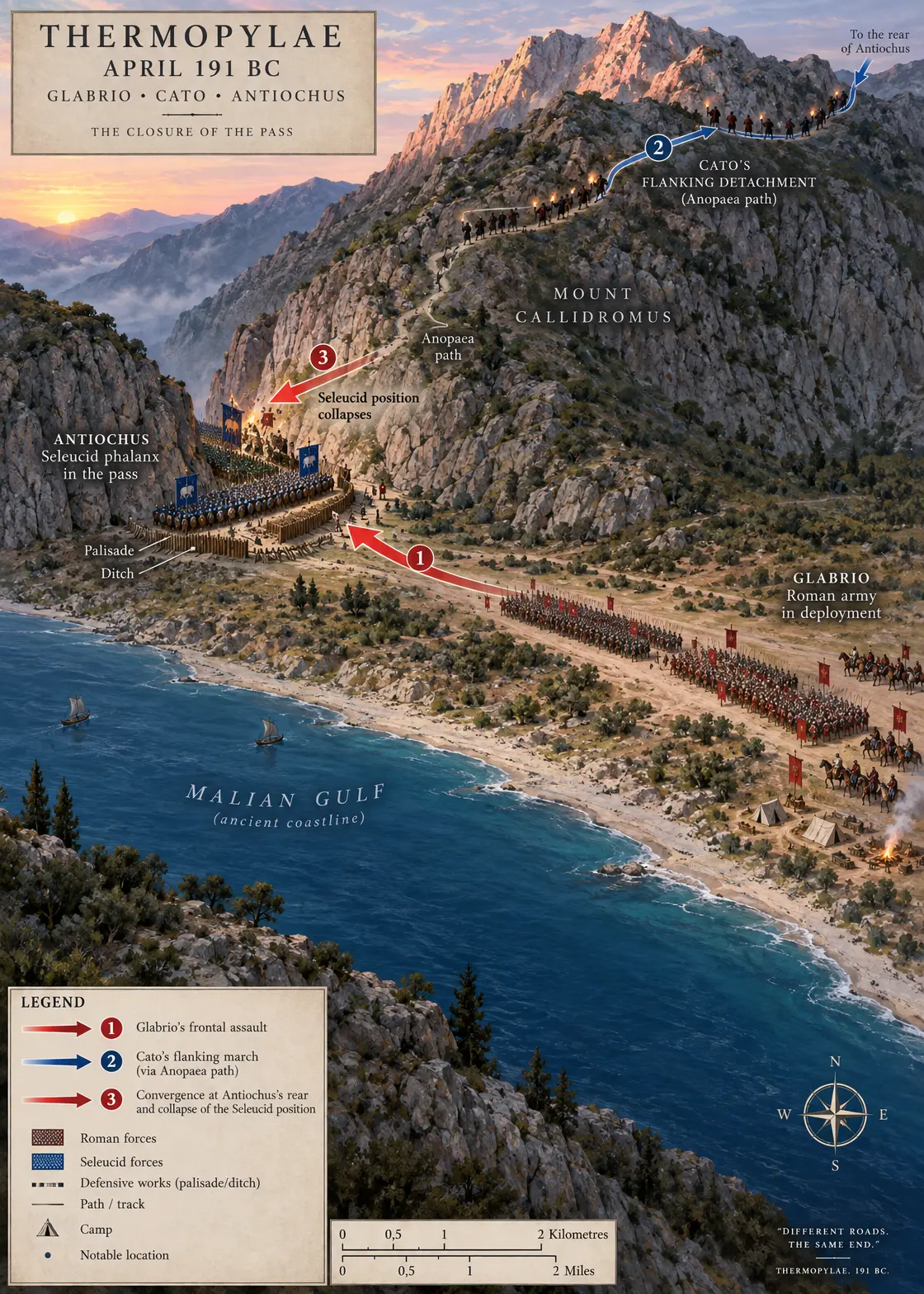
The engagement at Thermopylae on the morning of approximately 24 April 191 BC was substantially decided within an hour of the simultaneous attacks. Antiochus's army, attacked from front and rear, found its phalanx-deployed defensive position structurally incapable of redress; the Seleucid line broke first at the rear (where Cato's flanking force arrived); the broken rear panicked the entire formation; the position collapsed into a general rout within the next hour. Antiochus himself escaped from the field with a small body of cavalry, eventually reaching Chalcis and from there embarking with his remaining forces for return to Asia. The Seleucid losses at Thermopylae are given by Livy (36.19) as approximately 10,000 dead and 4,000 captured — figures that approximate the totality of the Seleucid expeditionary force and indicate that the army had been substantially destroyed in the engagement; the Roman losses were approximately 200. The Aetolian forces, who had been deployed in subordinate positions in the engagement, suffered comparable losses.
The strategic consequence of Thermopylae was the complete collapse of the Seleucid position in Greece. Antiochus had no remaining military forces in the Greek theater; his expected major reinforcements from Asia had not yet been organized; the Aetolian-led anti-Roman coalition had been militarily neutralized; the Roman political-strategic position in Greece had been restored on terms substantially the same as before the Seleucid expedition. The remaining Aetolian resistance was suppressed by Glabrio across the summer of 191 BC in a series of small operations; the Aetolian League was compelled to accept Roman terms by the autumn; the Greek theater was, by the close of 191 BC, again under Roman strategic supervision.
The war, however, was not over. Antiochus had returned to Asia with the bulk of his political-strategic capacity intact; the Seleucid kingdom retained the resources to field a substantially larger army than the one that had been destroyed at Thermopylae; the strategic objectives of the war — Roman political supervision over the Greek cities of Asia Minor — could not be secured by Greek-theater operations alone but required the prosecution of the war into Anatolia itself. The strategic decision of the war would have to be sought in Asia.
The Roman Crossing to Asia190 BC
The Roman decision to extend the war into Asia in 190 BC was the strategic-political watershed of the Republican period to that point. No Roman army had previously crossed the Hellespont; no major Roman expeditionary force had ever been deployed beyond the Aegean; the institutional and operational challenges of an Asian campaign exceeded any previous Roman strategic undertaking. The senatorial decision to undertake the campaign reflected, in part, the operational necessity that Antiochus's continued strategic capacity required military demonstration in his own territory; in part, the political-strategic vision (associated principally with the Scipionic faction) that the Mediterranean strategic position required the elimination of any Hellenistic monarchy capable of contesting Roman supremacy at the level of a major power; and in part, the institutional momentum that the eastward expansion had generated, in which each successful campaign opened the strategic-political horizon for further operations.
The consuls assigned the Asian command were Lucius Cornelius Scipio (the brother of Scipio Africanus, now bearing the cognomen Asiagenes that the upcoming campaign would award him) for 190 BC, with Africanus himself serving formally as senior legate (legatus) but operationally as the principal strategic mind of the expedition. The institutional arrangement — the elder brother as nominal commander, the more famous younger brother as legate — was a constitutional device permitting the strategic command to be exercised by Africanus while preserving the formal senatorial convention that no individual should hold consecutive consulships (Africanus had been consul in 205 BC and could not legally hold the office again in 190; the Asian command was, however, his strategic responsibility in operational substance). The institutional arrangement also reflected the political reality that Africanus's strategic prestige was the principal Roman asset for the Asian campaign, with the Hellenistic political world regarding the conqueror of Hannibal as the senior figure of Roman strategic competence even more than the formally-titled consular commander.
The Roman expeditionary force assembled for the Asian campaign was approximately 30,000 infantry and 2,800 cavalry, plus the Pergamene cavalry contingent under Eumenes II (who had succeeded his father Attalus I as king of Pergamum in 197 BC and who was the principal Roman strategic partner in Asia) of approximately 3,000 horse. The Roman naval forces under the praetor Gaius Livius Salinator (and later under Lucius Aemilius Regillus) operated in coordination with Pergamene and Rhodian naval contingents to maintain control of the Aegean and to prevent Seleucid naval reinforcement of the Asian theater. The total Roman-allied force in the Asian theater across 190 BC was approximately 50,000 men of all arms.
Antiochus's army, prepared across the spring and early summer of 190 BC at the principal Seleucid mobilization center at Magnesia ad Sipylum in western Anatolia, was substantially larger but qualitatively more variable. The total field force assembled for the engagement was approximately 60,000 infantry and 12,000 cavalry, plus 54 war elephants and various specialized units (scythed chariots, camel-mounted Arab troops, Galatian heavy cavalry). The composition reflected the broad ethnic-territorial extent of the Seleucid kingdom: Macedonian-Greek phalangites (approximately 16,000) at the core, Iranian heavy cavalry from the eastern satrapies, Galatian and Mysian infantry from Asia Minor, Syrian and Phoenician contingents, Cretan archers, Arab camel cavalry, and the famous Indian war elephants that had been brought westward from the eastern satrapies for the engagement. The army was, in numerical terms, the largest Hellenistic field force assembled for any single engagement of the second century BC, and in compositional terms a comprehensive demonstration of the strategic-military variety that the Seleucid kingdom could field; the operational coherence of so heterogeneous a force, however, would prove the central tactical question of the engagement.
The Battle of MagnesiaDecember 190 BC
The engagement at Magnesia, fought on a plain near the modern Manisa in western Anatolia in late December 190 BC, was the decisive engagement of the Syrian War and the most strategically consequential battlefield encounter of the entire half-century covered by the present volume. The two armies came into contact in the broken country east of Smyrna in late November 190 BC, with the Roman forces under Lucius Scipio advancing eastward from their landing position and the Seleucid forces under Antiochus advancing westward from Magnesia. Africanus, who had been the principal strategic mind of the expedition, had fallen ill during the late autumn and was not present at the engagement itself — a strategic-personal circumstance that the sources record but whose full operational implications cannot be fully assessed. The Roman command on the day of battle was therefore exercised by Lucius Scipio with the legate Gnaeus Domitius Ahenobarbus serving as the principal tactical adviser; the absence of Africanus deprived the Roman command of the senior strategic-tactical figure but did not prevent the conventional manipular doctrine from being applied with the operational competence that Domitius and the senior tribunes provided.
Antiochus's tactical deployment for the engagement reflected the conventional Hellenistic doctrine of combined-arms massive formation. The Macedonian phalanx of approximately 16,000 sarissa-equipped heavy infantry was deployed in the center, in the customary deep formation with the famous sarissa-frontage projecting forward several meters from the front rank. The two wings consisted of the heavy cavalry of the eastern satrapies (10,000 horse under the satrapal commands), the various specialized units (the scythed chariots in front of the wings, the camel cavalry behind, the elephants distributed at intervals along the line), and the lighter infantry contingents. Antiochus himself commanded the cavalry on the right wing, with the operational intention of executing a decisive cavalry-led envelopment of the Roman left, in the conventional Macedonian-Hellenistic doctrine that traced its tactical lineage to Alexander's engagement at Gaugamela.
The Roman deployment was conventional manipular triplex acies across the center, with the cavalry concentrated on the right wing under Eumenes II of Pergamum (whose Pergamene cavalry was the principal qualitative cavalry asset of the Roman force) and the left wing held by infantry alone with minimal cavalry support. The deployment was, in operational terms, an asymmetric configuration that conceded numerical superiority to Antiochus on the Roman left wing in exchange for qualitative superiority on the Roman right wing — a configuration that reflected Domitius's calculation that the engagement would be decided by the cavalry actions on the right rather than by the principal infantry contest in the center.
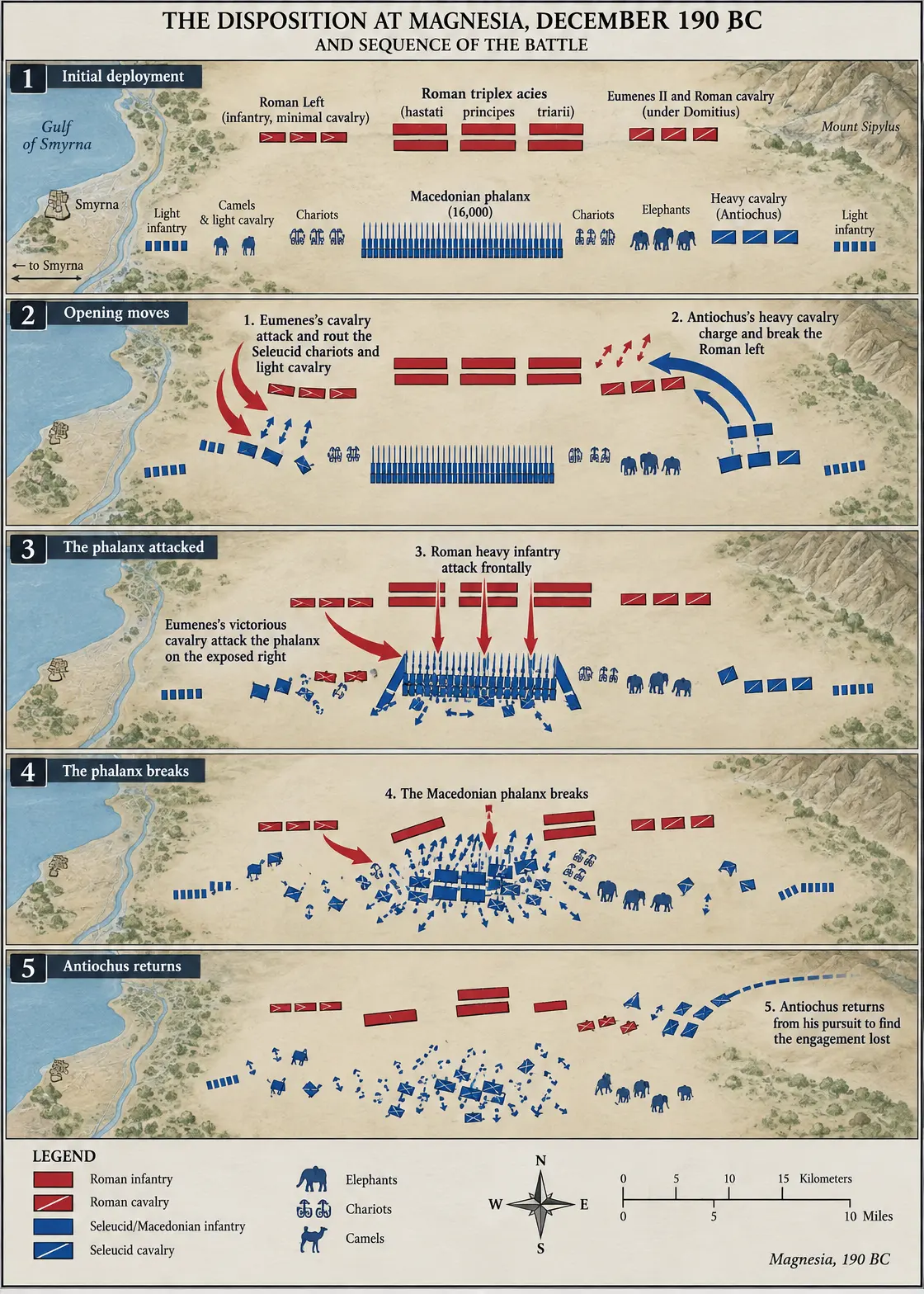
The engagement opened on the Seleucid left wing with the action that Domitius had designed the Roman deployment to produce. Eumenes II's Pergamene cavalry advanced against the Seleucid scythed chariots, which had been positioned in front of the wing with the intention of disrupting the Roman cavalry charge by the rotating blades fixed to the chariot wheels. Eumenes, however, had anticipated the chariot threat and had prepared his cavalry's approach with the operational technique appropriate to it: his light infantry and slingers advanced in front of the cavalry, attacked the chariot teams with missile weapons, panicked the horses, and drove the chariots back into their own lines where the rotating blades inflicted substantial damage on the Seleucid cavalry and infantry positioned behind. The Pergamene cavalry then advanced against the disordered Seleucid left, broke it within the next half-hour, and drove the broken Seleucid wing from the field.
Simultaneously on the opposite wing, Antiochus's heavy cavalry executed the planned envelopment against the Roman left. The Roman left wing, holding only its infantry contingents against the Seleucid heavy cavalry charge, gave way under the cavalry's frontal pressure; the Roman cohorts on the left broke and were driven back toward the camp; Antiochus himself, leading the cavalry charge, pursued the broken Roman left off the field, calculating (correctly, as a matter of immediate tactical fact) that the broken Roman left could be exploited and (incorrectly, as a matter of broader operational understanding) that the engagement would be decided by his cavalry's success.
What Antiochus failed to recognize during his cavalry pursuit was the simultaneous collapse of his left wing under Eumenes's pressure. By the time Antiochus had driven the Roman left to the gates of the Roman camp and was preparing to attack the camp itself, the entire Seleucid army had been broken on the opposite wing and the Macedonian phalanx in the center had been enveloped by Eumenes's victorious cavalry attacking from the flank. The phalanx, deployed for frontal engagement and unable to redress its formation to face flank attack, was destroyed in detail across approximately two hours of compressed slaughter. The Roman heavy infantry advanced from the center to engage the phalanx frontally; the Pergamene cavalry attacked the phalanx's right flank and rear; the Macedonian formation, the principal tactical instrument of Hellenistic warfare for the previous century and a half, collapsed under the combined pressure that no phalanx had been designed to withstand. Within approximately three hours of the engagement's opening, the entire Seleucid army (except for Antiochus's victorious cavalry, still pursuing the broken Roman left) had been destroyed or driven from the field.
Antiochus himself, returning from his cavalry pursuit in the late afternoon to find the engagement lost, escaped from the field with his immediate entourage and fled eastward toward Sardis. The Seleucid losses at Magnesia are given by Livy (37.43) as approximately 50,000 dead with 1,400 captured, against Roman losses of approximately 300. The numerical disparity is among the most extreme of any ancient engagement on this scale, comparable to Ilipa, and reflects the operational reality that the Seleucid army had ceased to exist as a coherent force within hours of the engagement's opening, with substantial portions of it being destroyed in compressed killing rather than in mutual combat. The strategic consequence was the immediate collapse of the Seleucid position in Asia Minor: the Anatolian Greek cities defected to Rome or to Pergamum within weeks of the engagement; the Seleucid administrative system in western Anatolia ceased to function; Antiochus himself was reduced to negotiating peace terms from the diminished strategic position that the engagement had created.
The Treaty of Apamea188 BC
The peace negotiations following Magnesia were conducted across 189 and 188 BC, with the formal treaty (the Treaty of Apamea) ratified in 188 BC. The terms, preserved in summary by Polybius (21.42–46) and by Livy (38.38), were substantially harsh and transformed the Seleucid strategic position across western Asia. The principal provisions were:
First, Antiochus would surrender all his possessions in Europe and in Asia Minor west of the Taurus mountain range. The Taurus boundary, which had been the strategic frontier between the Anatolian Greek world and the Iranian-Mesopotamian core of the Seleucid kingdom for previous centuries, would now function as the political boundary as well; the entire western Anatolian Greek and Asian-Greek territory would be removed from Seleucid sovereignty.
Second, the territories surrendered would be redistributed under Roman political supervision: the principal beneficiary would be Pergamum under Eumenes II, which would receive substantial territorial gains in western Anatolia and would emerge from the war as the principal Roman ally in the eastern Mediterranean; secondary beneficiaries would include Rhodes (which would receive territories along the southern Anatolian coast); various Greek cities would be confirmed in their independence under Roman supervision.
Third, Antiochus would pay an indemnity of 15,000 talents of silver over twelve years (with 500 talents immediately at the treaty's ratification, 2,500 upon Roman senatorial ratification, and the remainder in annual installments). The indemnity was the largest ever imposed by Rome on any Hellenistic state and exceeded by 50 percent the indemnity imposed on Carthage after Zama; the political-fiscal implications would shape Seleucid politics across the subsequent generation.
Fourth, Antiochus would surrender his fleet (except for ten warships) and would not maintain a naval force beyond the limited coastal defense the treaty permitted. The naval restrictions paralleled those imposed on Carthage and would similarly reduce the Seleucid maritime strategic capacity to insignificance.
Fifth, Antiochus would surrender his elephants and would not maintain or train new ones. The provision, like the parallel Carthaginian provision, was perhaps more symbolic than strategically critical, but it removed the most distinctive instrument of Hellenistic military tradition from the Seleucid arsenal.
Sixth, Antiochus would surrender Hannibal Barca and certain other named individuals as political prisoners (including the Aetolian leader Thoas). Hannibal, by this point already an experienced political fugitive, evaded the provision by fleeing further east to Bithynia before the surrender could be effected, beginning the final phase of his career that would conclude with his death at Libyssa in 183 or 182 BC (an episode that has already been treated in Book III).
Seventh, the political-strategic provisions limited Seleucid foreign policy along lines comparable to the Carthaginian post-Zama provisions: Antiochus would not undertake war west of the Taurus, would not interfere with the Greek cities of Asia Minor, would accept Roman supervision over disputes between Seleucid and Roman-allied states.
The Treaty of Apamea was, in its institutional consequences, the moment at which the Hellenistic states recognized formally that Roman strategic supremacy had been established across the Mediterranean basin. The Seleucid kingdom would survive as a major regional power across the following century and a half — until the Roman conquest under Pompey in 63 BC formally incorporated the diminished remnant into the Roman provincial system — but its strategic role in the Mediterranean political-military system was definitively ended. The Hellenistic competitive system that had been established by Alexander's successors and that had dominated Mediterranean and Near Eastern politics for a century and a quarter had been reduced, by the events of the years 200 through 188 BC, to a single dominant power (Rome) and a constellation of subordinate or dependent states whose strategic autonomy was systematically constrained.
The political-cultural consequences of the Syrian War, however, would prove more enduring than its strategic-military results. The Roman expeditionary force that returned from Asia in 188 BC brought back the largest quantity of Greek artistic, literary, and material culture that had ever been imported to Italy in a single campaign; the Roman political class that had served in the Asian campaign returned with personal familiarity with Hellenistic culture and political traditions that would shape the Roman aristocratic generation for the subsequent half-century; the prosecution of Lucius Scipio (and the indirect attack on Africanus through his brother) on charges related to the disposition of Antiochene indemnity funds, which dominated Roman political life in the late 180s BC, reflected the senatorial conservative faction's anxiety about the political-cultural transformation that the eastern wars were producing. Cato the Elder's famous declarations about the corruption that the Greek wars were importing to Roman political life — declarations that would intensify across the subsequent decades and would culminate in his role in the prosecution of the Bacchanalian conspiracy in 186 BC and in his census of 184 BC — were the principal articulation of the senatorial conservative position. The cultural-political tension between the Hellenistic-cultural faction (associated with the Scipionic family and with the broader patron-and-client network they constructed) and the senatorial conservative faction (associated with Cato and his political allies) would shape Roman political life across the following two generations and would constitute one of the principal political dynamics of the period covered by the present volume.
The Crossroads · Autumn 192 BC · Antioch
The King's Crossing
Antiochus III, King of the Seleucid Empire
Having spent a quarter-century reconstructing Seleucid authority from Bactria to the Mediterranean, you have advanced to Thrace to reassert suzerainty over the Anatolian Greek cities. Rome has demanded that you evacuate Thrace, surrender Smyrna and Lampsacus, and accept Roman supervision over Asia Minor. Embassies have reached a complete impasse. Hannibal Barca, living as an exile at your court, urges a daring maritime descent directly upon Italy. Simultaneously, Thoas and the Aetolian League have seized Demetrias and invite you to land in Europe as the Liberator of the Greeks against Roman domination. Your Macedonian-Greek courtiers deeply distrust Hannibal's advice, while the bulk of your imperial levies remain scattered across the distant eastern satrapies.
How should you respond to the Aetolian invitation and commit your empire's forces against Rome?
Weigh each course: open it to hear your own inner voice. Then decide. Nothing is scored.
- Your inner voiceThe course taken
The Aetolian envoys offer Demetrias now, begging for the Liberator of the Greeks to ignite a general rising. I cannot wait two years for the distant satrapies to mobilize while the Romans tighten their grip on the Aegean. A vanguard of ten thousand foot and five hundred horse is sufficient to secure Euboea and rally Philip of Macedon and the Achaean League to our standard. Once European Greece has united beneath my banner, the main royal army can follow.
- Your inner voiceThe course taken
Hannibal urges an offensive across the western sea: land a fleet and army upon Italy itself while our forces tie down the legions in Greece, rekindling the terror of Cannae. Yet Hannibal is a foreign fugitive, and my Macedonian commanders warn against placing royal armaments under a Carthaginian outsider. If his Italian gamble fails, our prestige collapses in the West and Seleucid blood is squandered far from our satrapies. Can I trust Carthage's exile with my empire's destiny?
- Your inner voiceThe course taken
A royal campaign demands royal mass. My eight-year anabasis taught me that victory follows overwhelming preparation. Let the satraps gather the Iranian horse, the Arab camel corps, and the Indian war elephants alongside sixteen thousand Macedonian phalangites from the katoikiai. Delaying our descent upon Europe risks allowing the Roman consuls to intimidate the Aetolians before we arrive, but marching with an incomplete host risks our dynastic authority. We should strike Greece only when our full eastern majesty is assembled.
- Your inner voiceThe course taken
Our historical inheritance lies east of the Aegean. I have recovered Coele-Syria and Phoenicia, and my garrisons hold Thrace across the Hellespont. If I cross into mainland Greece at Thoas's urging, I make war inevitable with a Republic that broke Carthage and Macedon. Better to fortify Smyrna and Lampsacus, hold the Anatolian coast, and renew our diplomatic offer to Rome: let them retain Greece while they acknowledge Seleucid suzerainty over Asia Minor. Why bleed for turbulent Aetolians?
What was done
Antiochus committed an expeditionary force of only 10,000 infantry and 500 cavalry, landing at Demetrias in October 192 BC and establishing headquarters at Chalcis. The broad anti-Roman coalition failed to materialize: the Achaean League declared for Rome, Philip V of Macedon joined the Roman alliance, and only the Aetolians stood with the king. In April 191 BC, the Roman consul Manius Acilius Glabrio confronted Antiochus at Thermopylae with 24,000 men. While Antiochus fortified the defile, Cato the Elder led 4,000 troops along the mountain path of Anopaea to strike the Seleucid rear, routing the king's army with losses reported at 10,000 slain (BGrade B). Antiochus escaped with a remnant of cavalry to Asia. His small initial deployment had cost him Greece, leaving his homeland vulnerable to the subsequent Roman crossing and the catastrophic engagement at Magnesia in 190 BC (AGrade A).
The evidence The narrative of Antiochus's deliberations and campaigns relies on Polybius 20–21 (BGrade B, fragmentary) and Livy 35–38 (BGrade B), alongside Appian's Syriaca 1–39 (BGrade B-C) and Plutarch's Cato Major 12–14 (BGrade B). Modern scholarship includes John D. Grainger's The Roman War of Antiochos the Great and Bezalel Bar-Kochva's The Seleucid Army.
If you choose to walk through itAt every scale
- Yourself
Having earned the title Megas through your eight-year campaign in the East, how does personal pride in your military prestige distort your assessment of an unfamiliar western opponent?
- Those beside you
How should a reigning monarch weigh the strategic genius of an exiled foreign commander against the jealousy and counsel of his own hereditary court?
- Rome
Can an imperial monarchy grasp the institutional resilience of a senatorial republic that does not sue for peace after initial diplomatic or military reverses?
- The wider world
When secondary regional powers like the Aetolians invite foreign empires to liberate them, do they seek genuine freedom or merely an imperial shield against their immediate neighbours?
- Our own time
Why are great powers repeatedly tempted to intervene in foreign conflicts with token military vanguards on the unverified promise of local political support?
A modern power often yields to the temptation of limited expeditionary intervention, sending a modest vanguard of elite troops to back a local faction that promises popular insurrection. Military planners calculate that a small demonstration of imperial resolve will rally regional allies without the fiscal and political burden of full domestic mobilization. When the local rebellion fails to materialize, the deployed vanguard finds itself isolated against a conventional adversary fielding full national resources.
Where the comparison fails. Antiochus faced Hellenistic rivalries governed by dynastic prestige, personal royal command, and seasonal campaigning across narrow sea crossings. Modern interventions operate under continuous digital communication, rapid airlift, and treaty-bound multilateral alliances, where troop commitments can be reinforced or evacuated within days rather than dictated by winter seas and galley fleets.
What does the chapter tell us?
What proximate action by the Aetolian League in 192 BC triggered Antiochus III's direct military entry into mainland Greece?
The Aetolian League, alienated by the post-Second Macedonian War settlement, seized the Aegean port of Demetrias and formally invited Antiochus to enter Greece under the slogan of liberating the Greeks from Roman supervision.
Livy 35–38 (BGrade B)
Why did Antiochus III reject Hannibal Barca's strategic proposal to mount an invasion of Italy?
The Seleucid court was dominated by Macedonian-Greek aristocrats who viewed Hannibal as an untrustworthy foreign exile, refusing to entrust him with an independent fleet or army for an Italian expedition.
Livy 35–38 (BGrade B)
How did Roman forces under Manius Acilius Glabrio overcome Antiochus's defensive position at Thermopylae in 191 BC?
Emulating the Persian maneuver from 480 BC, Glabrio sent Cato the Elder with 4,000 troops along the Anopaea ridge, guided by local shepherds, to attack Antiochus's rear while the main army charged frontally.
Plutarch, Cato Major 12–14 and Livy 36.19 (BGrade B)
What tactical action initiated by Eumenes II decisively broke the Seleucid deployment at Magnesia in 190 BC?
Eumenes anticipated the danger of Antiochus's scythed chariots on the Seleucid left, sending archers and slingers to wound the chariot horses and drive them back into their own cavalry and infantry.
Livy 37.43 (BGrade B) and Polybius 21 (AGrade A)
Under the Treaty of Apamea in 188 BC, what geographic boundary was established to delimit Seleucid territory?
The treaty required Antiochus to surrender all possessions in Europe and all territory in Asia Minor west of the Taurus mountains, which became the new political boundary between the Seleucid kingdom and Roman-allied states.
Polybius 21.42–46 (AGrade A)