Book IV · The Wars of Mediterranean Hegemony
Chapter 3
The Third Macedonian War: Aemilius Paullus and Pydna
Perseus and the Reconstruction of Macedonian Power
The death of Philip V of Macedon in 179 BC, after a long reign of forty-two years that had spanned the entire period from the Hannibalic War through the Cynoscephalae catastrophe and into the post-Apamean Mediterranean configuration, brought to the Macedonian throne his elder son Perseus — a figure whose political-strategic conception would shape the events of the present chapter. Perseus had succeeded after the elimination of his younger brother Demetrius, whom Philip had been compelled to surrender to Rome as a hostage after Cynoscephalae and who had been returned to Macedonia in 184 BC under circumstances that suggested Roman intentions of using him as a political alternative to Perseus when the succession came. Demetrius's prosecution and execution in 180 BC, on charges of conspiring with Rome against his father — the historical reality of which has been contested by both ancient and modern scholars, with the modern consensus favoring Perseus's manipulation of the evidence to eliminate his political rival — was the political-personal precondition of Perseus's succession. The cultural memory of the Roman-Demetrius connection would shape Roman strategic-political attitudes toward Perseus across his reign, with the Roman senatorial conservative faction (now dominant under Cato's continued influence) regarding Perseus as the political-military adversary that Demetrius would have prevented Macedonia from becoming.
Perseus's reign across the years 179 through 172 BC was conducted with the operational discipline that the constrained Macedonian strategic position required. The Treaty of Cynoscephalae had reduced the Macedonian military establishment, fiscal capacity, and foreign policy autonomy to levels that the kingdom's strategic-historical traditions found difficult to accept; Perseus's policy was the systematic reconstruction of Macedonian strategic capacity within (and at the edges of) the post-Apamean political framework. The principal elements of the reconstruction were:
Fiscal reconstruction. Macedonia under Perseus repaid the indemnity obligations imposed at Cynoscephalae and accumulated substantial fiscal reserves through systematic exploitation of the kingdom's mineral wealth (the Macedonian silver and gold mines in the Pangaeus region, which had been a strategic-economic asset since the Philip II's reign in the fourth century, were reorganized for maximum output) and through expanded commercial relations with the Greek and Aegean political communities. By the late 170s BC, Macedonia was again one of the principal fiscal powers of the eastern Mediterranean, with a treasury that approached or exceeded the levels of the late-Antigonid period before Cynoscephalae.
Military reconstruction. The Macedonian field army across the 170s BC was systematically rebuilt to the institutional level that the kingdom's strategic-historical traditions required. The phalanx was retrained, with new recruits being incorporated and the older veterans of Philip V's army being reorganized into the higher-quality units; the cavalry was rebuilt; the supporting arms (light infantry, archers, slingers) were expanded; the war elephants and specialized units were procured or developed. By the late 170s BC, Macedonia under Perseus could field approximately 40,000 infantry (of which 26,000 phalangites of high quality) and 4,000 cavalry — a force substantially larger than the army Philip V had taken to Cynoscephalae and approaching the strategic levels of the high Antigonid period.
Diplomatic-political reconstruction. Perseus conducted across the 170s BC an active diplomatic program designed to construct a Hellenistic political coalition that could provide strategic-political cover for the Macedonian reconstruction. The principal elements of the program were the marriage alliance with the Seleucid kingdom (Perseus married Laodice, daughter of Seleucus IV, in 178 BC); the cultivation of relations with Rhodes (which had been a Roman ally during the Apamean war but whose commercial-strategic interests by the late 170s BC were diverging from Roman political direction); the cultivation of relations with the various Greek confederations (Achaean, Aetolian, Boeotian) whose internal political divisions Perseus exploited for systematic anti-Roman political work; and the cultivation of relations with the Illyrian kingdoms north of Macedonia. The diplomatic program was, in operational terms, a Hellenistic political coalition with the strategic objective of providing political-military counterweight to Roman supervisory hegemony — the kind of coalition that the Roman political class regarded as inherently threatening to the post-Apamean Mediterranean configuration.
The Roman strategic response to Perseus's reconstruction was, across the 170s BC, principally diplomatic and political. The Roman senatorial leadership recognized the strategic implications of the Macedonian reconstruction but was reluctant, in the immediate post-Apamean political environment, to undertake a new major war without political-rhetorical justification that could be presented to the popular assembly. The diplomatic engagement across the 170s BC consisted of repeated Roman embassies to the Macedonian court, requesting clarification of Perseus's intentions and conducting political reconnaissance of his strategic-military capacity; repeated counter-embassies from Perseus to Rome, conducted with the diplomatic-cultural sophistication of which Hellenistic monarchies were capable; and the gradual development, across the years 174 through 172 BC, of a Roman political consensus that the Macedonian reconstruction had progressed to a level requiring military intervention.
The decisive political moment was the embassy of Eumenes II of Pergamum to Rome in 172 BC, in which the Pergamene king delivered a formal address to the Senate cataloging Perseus's diplomatic and military activities and arguing that Macedonian power had been reconstructed to a level that constituted a direct strategic threat to the Roman political position in the eastern Mediterranean. Eumenes's address — preserved in summary by Livy (42.11–13) — combined detailed strategic-political reportage with the rhetorical-political framework that the Roman senatorial conservative faction required to justify war. The Senate, after debate that extended across several sessions, voted for war preparation. Perseus's subsequent attempt to forestall the war by additional embassies and offers of negotiation was rejected; the war was formally declared in 171 BC.
The Failed Roman Campaigns171–169 BC
The opening Roman campaigns of the Third Macedonian War were conducted across 171 through 169 BC with conspicuous operational mediocrity that the contemporary Roman tradition itself recognized as such. The consul of 171 BC, Publius Licinius Crassus, conducted operations in Thessaly that produced an indecisive engagement at Callicinus (where Perseus's cavalry defeated the Roman cavalry but did not exploit the advantage), withdrawal of Crassus's army to defensive positions, and the development of a strategic stalemate in which neither side could deliver a decisive blow. The consul of 170 BC, Aulus Hostilius Mancinus, conducted operations of even less operational distinction, producing further indecisive engagements and the progressive erosion of Roman political-military credibility in the Greek theater. The consul of 169 BC, Quintus Marcius Philippus, conducted a partially successful operation involving the crossing of the Macedonian mountain frontier into the kingdom proper, but failed to exploit the strategic opportunity that the crossing created and concluded the campaigning season without decisive results.
The reasons for the Roman operational failure across the first three years of the war have been the subject of considerable modern scholarly analysis. The principal factors appear to have been: the institutional limitations of the conventional consular command system, with annual rotation of commanders preventing the kind of sustained strategic vision that the Macedonian campaign required; the qualitative decline of the Roman officer corps in the post-Hannibalic generation, as the senior officers with personal experience of Hannibalic-period operational standards were progressively replaced by figures whose strategic-tactical conceptions were less sophisticated; the operational difficulty of the Macedonian terrain, which limited the conventional manipular advantages and required tactical-operational adaptation that the Roman command system was slow to undertake; and the strategic-political coherence of Perseus's Macedonian state, which was substantially more capable of sustained military operation than the conventional Roman strategic calculation had anticipated.
The Roman political class by the end of 169 BC had recognized that the conventional consular-command system was inadequate to the strategic requirements of the Macedonian war. The decision was made — over substantial conservative-senatorial resistance — to appoint an extraordinary command, with the consul for 168 BC to be selected for strategic-military competence rather than according to the usual political-career calculations and to be granted the operational authority and resource support required to bring the war to decision within the campaigning season. The figure selected was Lucius Aemilius Paullus.
Lucius Aemilius Paullus
Lucius Aemilius Paullus, consul for 168 BC at approximately sixty years of age, was the son of the consul of the same name who had been killed at Cannae in 216 BC. His early career had been conducted at the senior levels of the senatorial-military establishment: praetor in 191 BC with assignment to Further Spain, where he had conducted successful operations against the Lusitanians; consul for the first time in 182 BC, with assignment to Liguria where he had conducted further successful operations; subsequent service in various administrative and diplomatic positions. His personal character, as preserved by the contemporary and near-contemporary sources, was one of conspicuous senatorial-aristocratic integrity: he was not a member of the senatorial conservative faction (his political-cultural orientation was Hellenistic, and he was associated with the broader Scipionic political-cultural network), but he was respected by the conservative faction for his personal probity and operational competence; he was personally wealthy but lived in deliberate simplicity; he was deeply learned in Greek literature and philosophy and conducted his Hellenistic-cultural interests with the kind of seriousness that the senatorial conservative tradition could respect even where it disagreed with the cultural orientation. His selection as the consul for the Macedonian war reflected the senatorial recognition that the war required the kind of figure whose operational competence and personal authority could overcome the institutional limitations of the conventional command system.
Aemilius Paullus's preparations for the Macedonian campaign across the spring of 168 BC were conducted with the systematic operational discipline that his subsequent reputation justified. He reorganized the Roman army in Macedonia, conducted thorough reconnaissance of the strategic-military situation, replaced incompetent subordinate officers with figures of his own selection, and developed a strategic conception that would bring the war to decision in a single campaigning season. The army he assembled for the campaign was approximately 26,000 Roman and Italian infantry and 1,800 cavalry, supplemented by the Pergamene cavalry contingent under Attalus (Eumenes II's brother, who had been with the Roman army across the previous campaigns) and various Greek allied forces, for a total of approximately 38,000 men.
Perseus's army for the engagement was approximately 40,000 infantry (of which 21,000 phalangites and the remainder light infantry, mercenary contingents, and specialized units) and 4,000 cavalry, deployed in defensive positions along the Macedonian frontier and the line of the Elpeus river. The numerical balance was approximately equal in infantry; the Macedonian cavalry was somewhat superior in numbers and tactical quality; the phalanx remained the principal Macedonian tactical asset.
Pydna22 June 168 BC
The engagement at Pydna on 22 June 168 BC was, in tactical terms, the most decisive demonstration of the manipular legion's structural superiority over the Macedonian phalanx in any single engagement of the Hellenistic period. The strategic-operational maneuvers preceding the battle were conducted by Aemilius Paullus across early summer 168 BC with the kind of careful preparation that the engagement's tactical execution would justify. Perseus had withdrawn his army from the defensive position along the Elpeus river (which Aemilius Paullus had outflanked by a maneuver across the Mount Olympus passes that recapitulated the tactical logic of the Anopaea outflanking at Thermopylae) and had taken up a new defensive position on the plain south of the small town of Pydna, on the western Macedonian coast about thirty kilometers north of the modern Katerini. The plain at Pydna was the kind of level terrain that favored phalanx deployment; Perseus's strategic calculation was that the open ground would permit his phalanx to engage the Roman army frontally with the full tactical advantages that the Macedonian formation could deliver under optimal conditions.
The engagement was joined in the late afternoon of 22 June 168 BC under circumstances that, like Cynoscephalae, had elements of operational accident. The two armies had been encamped opposite each other on the Pydna plain for several days, with both commanders watching for the operational moment to commit to engagement. The proximate cause of the engagement was a minor skirmish between Roman foragers and Macedonian outposts at a stream that ran between the two camps — a skirmish that escalated through cavalry engagement to infantry commitment, with both armies progressively committing additional forces as the local engagement intensified. By approximately 3 PM, both armies were fully engaged in what had become the principal battle of the war.
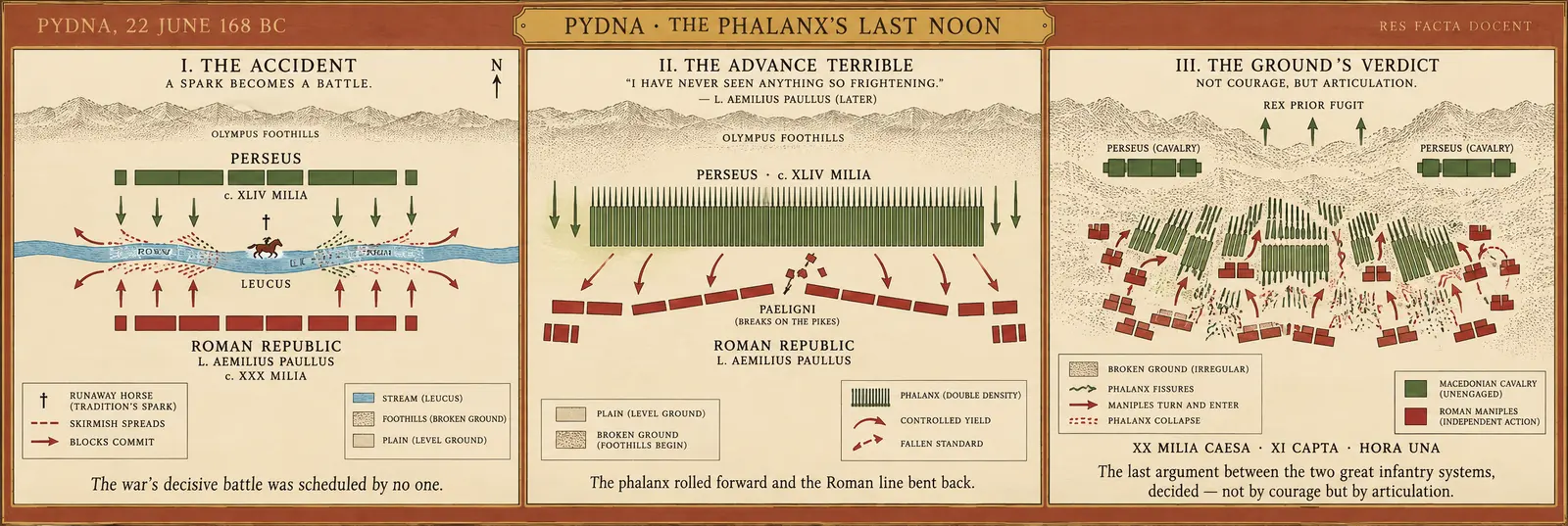
The phalanx's initial advance was, by the testimony of the Roman commanders who survived the engagement (Aemilius Paullus himself, in conversation with Polybius shortly afterward, would describe the moment as the most frightening single experience of his entire military career), a sight of unusual operational power. The Macedonian formation, advancing in compact deep formation with the famous sarissa-frontage projecting forward and the bronze armor of the phalangites flashing in the late afternoon sun, drove the Roman first line back across the plain in the engagement's opening minutes. The Roman heavy infantry, attempting to engage the phalanx frontally with conventional manipular tactics, found that the sarissa-frontage prevented effective close-quarter combat: the legionary's gladius and scutum were ineffective against the sarissa-equipped phalangite at full frontage, with the legionary unable to close with the phalangite before being killed by the sarissa, and the phalangite at full frontage being structurally invulnerable to legionary attack.
What saved the Roman engagement, however, was the failure of the phalanx to maintain its compact frontage as it advanced across uneven ground. The Pydna plain, level when viewed from a distance, was in operational reality broken by minor undulations, watercourses, and irregularities of terrain that the phalanx formation could not negotiate without losing its prepared compact frontage. As the phalanx pursued the withdrawing Roman first line, the formation began to fragment — different sub-units of the phalanx advanced at different rates over the irregular terrain, gaps appeared between units, the sarissa-frontage became broken at points where the phalanx's lateral cohesion failed. Aemilius Paullus, observing the developing fragmentation from his command position, recognized that the operational opportunity for which conventional manipular tactics had been designed was now available. He ordered the Roman maniples — operating in their conventional smaller-unit organization rather than as a continuous line — to penetrate the gaps that had appeared in the phalanx formation, engage the individual phalangites at close quarters within the formation rather than at the sarissa-frontage outside it, and exploit the structural vulnerability that the phalanx exhibited once its frontage was broken.
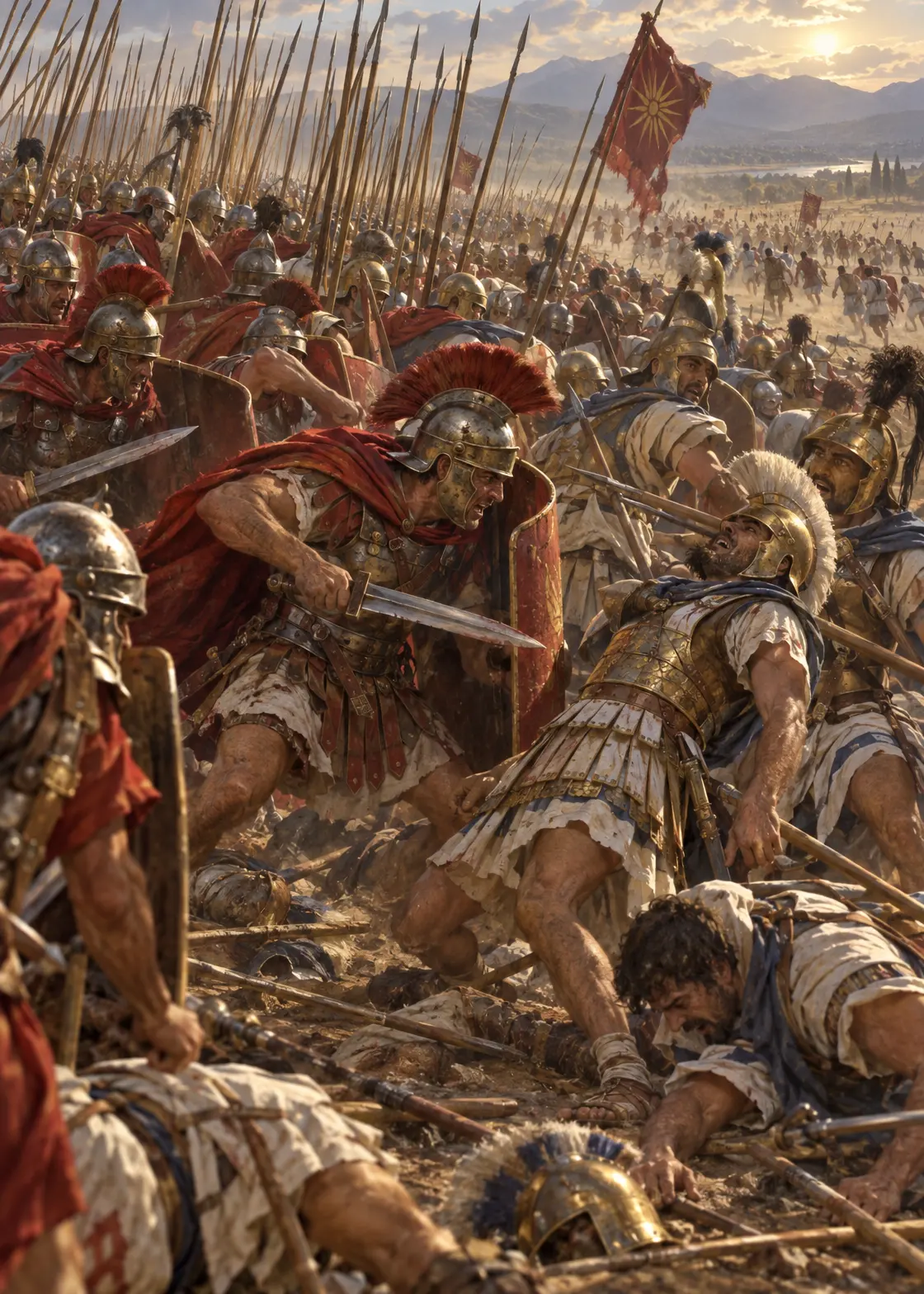
The tactical execution of the maneuver was decisive within approximately an hour. The Roman maniples entered the gaps in the phalanx formation, engaged the phalangites at close quarters where the sarissa was useless and the legionary's gladius was the dominant weapon, and produced what Polybius (29.17) describes as the most one-sided slaughter of any engagement in his historical experience. The phalangites, equipped with the sarissa as their principal weapon and with only a short sword as secondary armament, were structurally inadequate to close-quarter combat against the Roman heavy infantry's gladius-and-scutum equipment; the phalangites, deployed in compact formation with their comrades closely packed around them, could not maneuver individually to compensate for the equipment disadvantage; the phalanx, once its frontage was broken, was reduced from the most formidable formation of Hellenistic warfare to a packed mass of soldiers being killed in detail by Roman troops whose equipment was specifically optimized for the tactical conditions that had now arisen.
The phalanx broke completely within approximately the next hour. The casualties at Pydna are given by Plutarch (Aemilius 21) as approximately 25,000 Macedonian dead with 11,000 captured, against Roman losses of approximately 100. The numerical disparity exceeded even Ilipa and Magnesia and made Pydna one of the most one-sided major battles of ancient military history. Perseus himself escaped from the field with a small body of cavalry, fled to his capital at Pella, and from there to the island of Samothrace where the famous Sanctuary of the Great Gods was located and where he sought temporary refuge under the religious-political protections that the sanctuary traditionally provided. The Macedonian army had ceased to exist as a coherent military force; the strategic-political position of the Macedonian kingdom had been destroyed in a single afternoon.
The Settlement and the End of the Macedonian Kingdom
Perseus's surrender to Aemilius Paullus took place at Samothrace several weeks after the engagement, after negotiations conducted through intermediaries had established the terms of the king's submission. Perseus was brought to Aemilius Paullus's headquarters at Amphipolis in early autumn 168 BC, where the famous scene of the deposed king's reception is preserved by Plutarch (Aemilius 26–27) and by Livy (45.7–8) with the kind of dramatic detail characteristic of Hellenistic-tragic literary tradition. Perseus, accompanied by his young sons, approached Aemilius Paullus in mourning garments; Aemilius rose to meet him with the conventional courtesies appropriate to a defeated monarch; the conversation between the two men, as the sources preserve it, included Aemilius Paullus's observation that Perseus's strategic-political career had been the kind of ambition whose outcome no man could foresee at its beginning, and Perseus's reported response that he was now learning the lesson that the gods reserved for those who attempted what mortal capacity could not sustain. The exchange has the characteristic features of literary reconstruction (the philosophical-moralizing register, the symmetrical question-and-response structure) but the basic situation — the meeting, the formal surrender, the personal dignity of both figures — is firm in outline.
The political settlement that followed was the formal elimination of the Macedonian kingdom as an institutional entity. The Senate at Rome, on receiving Aemilius Paullus's report and after extensive debate, decided not to incorporate Macedonia as a Roman province (which would have required substantial administrative commitment) but to dissolve the kingdom into four small republics, each politically independent and prohibited from forming political-economic relations with the others. The four republics — corresponding approximately to the principal geographic divisions of historical Macedonia — would be governed by their own institutions under loose Roman supervision, would pay tribute to Rome at half the level Perseus had received as king, and would be prohibited from maintaining military forces beyond local police levies. The political-cultural settlement was, in operational terms, the systematic disassembly of the Macedonian kingdom: the institutional structures that had been developed across two centuries of Antigonid rule would be eliminated, the Macedonian aristocratic class would be reduced to local provincial gentry, the strategic-military capacity that had made Macedonia a major Mediterranean power would be permanently destroyed. The four-republic system would prove unstable across the following two decades (the pretender Andriscus's brief revival of monarchic Macedonia in 149 BC would lead to the eventual provincialization of Macedonia in 146 BC), but the immediate post-Pydna settlement represented the definitive end of the independent Macedonian state.
The Roman triumph of Aemilius Paullus on his return to Rome in 167 BC was, by the unanimous testimony of the sources, the most magnificent of the entire Republican period. The triumphal procession extended across three days through the streets of Rome and featured the most extraordinary display of conquered wealth and political-symbolic content that any Roman general had previously assembled. The first day featured 250 wagons laden with the captured statuary and painted panels of the Macedonian royal collection (the artistic-cultural patrimony of the Antigonid dynasty, which Aemilius Paullus had transported wholesale from Pella to Rome); the second day featured the captured armor, weapons, and military equipment of the Macedonian army; the third day featured the captured monetary wealth (3,000 vessels of silver coins, vessels of gold coinage, the royal regalia), the conquered standards and royal symbols, and the principal political prisoners. Perseus himself walked in the procession ahead of Aemilius Paullus's triumphal chariot, accompanied by his sons; the deposed king would die in custody at Alba Fucens approximately two years later, with his sons surviving him under Roman political supervision.
The personal-cultural aspect of Aemilius Paullus's victory had a tragic dimension that the sources record with substantial moral-philosophical reflection. During the period between the triumph and the formal closure of the campaign, Aemilius Paullus lost both his younger sons by his second marriage — one shortly before the triumph, one shortly after — to illness that the contemporary medical understanding could not address. The four sons of his first marriage had previously been transferred by adoption to other senatorial families: the elder two (one adopted into the Fabia family, one into the Cornelia Scipio family — the latter becoming the Scipio Aemilianus Africanus who would dominate the closing chapters of the present volume) survived; the younger two, however, were the sons of his second marriage and constituted his immediate household. Their successive deaths at the moment of his greatest political-strategic achievement was understood by the contemporary Roman tradition as one of the moral-philosophical lessons that the public life of the Republic could deliver: the moment of greatest external success was also the moment of most acute personal grief. Aemilius Paullus's public reflection on the deaths — delivered as a formal address to the Roman people after the funeral of the younger son — was preserved by Plutarch (Aemilius 35–36) and by Polybius (probably; the fragment is not certain) as one of the most morally serious statements of senatorial-aristocratic culture of the entire period. The address combined acknowledgment of the personal grief with reflection on the constitutional-political requirement that the personal and the public must be sustained in proper relation, and concluded with the observation that the gods had perhaps required the personal sacrifice as the appropriate counter-weight to the political-strategic achievement. The address is one of the principal documents of the cultural-political integration that the Hellenistic-cultural faction was constructing within the Roman senatorial tradition, and it captures with unusual clarity the specific kind of moral seriousness that the second-century Roman aristocracy was developing under Hellenistic philosophical influence.
The broader political-cultural consequences of Pydna were the most significant of any single Roman strategic victory between Zama and the destruction of Carthage. The Macedonian royal library — the principal accumulation of Greek manuscripts that had been assembled across the Antigonid period — was transferred to Rome and provided the foundation for the systematic Roman scholarly engagement with Greek philosophy and literature that would proceed across the subsequent generation. The thousand Achaean hostages whose surrender was demanded as part of the post-Pydna political settlement (designed to ensure Achaean political compliance with the new Roman supervisory configuration) included the young Polybius, whose subsequent residence at Rome as the intellectual companion of Scipio Aemilianus would produce the Histories that have served as the principal source for the present compendium. The political-cultural integration between the Roman senatorial-aristocratic class and the Greek philosophical-literary tradition would proceed across the post-Pydna period with the active intellectual leadership of figures like Aemilius Paullus, the developing Scipionic Circle, and the Greek figures who had been incorporated into the Roman cultural environment by the political consequences of the war.
The strategic-military demonstration of Pydna had implications that the Hellenistic political world recognized with substantial clarity. The Macedonian phalanx, which had been the principal tactical instrument of Hellenistic warfare since the time of Philip II of Macedonia and Alexander, had now been definitively demonstrated to be structurally inferior to the Roman manipular legion under any tactical conditions where the phalanx could not maintain its prepared compact frontage. The implications were not merely tactical but strategic-political: any Hellenistic monarchy that attempted to challenge Roman strategic supremacy by conventional military means would face the same structural defeat that Macedonia had now suffered three times (Cynoscephalae in 197, partial defeat at Thermopylae in 191, and now decisive defeat at Pydna in 168). The Hellenistic political-military system that had defined eastern Mediterranean politics since Alexander's death in 323 BC had been definitively superseded by the Roman strategic-military system; the political-cultural integration of the Hellenistic world into the broader Mediterranean political order under Roman strategic supremacy would now proceed on Roman terms.
The Crossroads · 22 June 168 BC · The plain south of Pydna, western Macedonia
The Fractured Phalanx at Pydna
You are Lucius Aemilius Paullus, consul of Rome, commanding the Roman and allied army against King Perseus of Macedon.
An accidental skirmish at a stream between your foragers and Macedonian outposts has escalated into a general battle across the open plain. Perseus has committed his full force of forty thousand infantry, spearheaded by twenty-one thousand phalangites deployed in deep, compact lines, backed by four thousand cavalry. The initial charge of the Macedonian phalanx has driven your first line backward across the plain, its bristling frontage of sarissae and flashing bronze armor presenting a wall that your legionaries cannot penetrate frontally with gladius and scutum. You have watched your men yield ground before the most terrifying sight of your military career. Yet as the phalanx pursues across the undulating terrain cut by minor watercourses, its dense frontage has begun to tear, opening narrow fissures and gaps between sub-units.
How will you commit your legions before your retreating front line collapses entirely?
Weigh each course: open it to hear your own inner voice. Then decide. Nothing is scored.
- Your inner voiceThe course taken
The phalanx is formidable only from the front; its flanks are vulnerable once it pushes past our wings. If our heavy infantry can lock shields, plant their feet, and endure the terrible press of the sarissae, we can send Attalus's Pergamene cavalry and our horsemen around their exposed flanks. Yet our infantry line is already bending; asking legionaries to stand immovable against those pikes risks seeing our entire center cut to ribbons.
- Your inner voiceThe course taken
The sheer weight of twenty-one thousand pikes is driving our front line backward, and attempting to breach that bronze wall frontally will only waste our men. If we hold an unbroken front and draw them further toward the broken ground and our camp, their formation will disintegrate entirely under the terrain. But a withdrawal under pressure easily turns into a rout; our retreating lines may shatter before the ground breaks their advance.
- Your inner voiceThe course taken
If I order the maniples to break our continuous front and plunge into those narrow fractures, I stake everything on close-quarter combat. Inside their pike-points, our legionaries with gladius and scutum can butcher the packed phalangites who carry only short blades. Yet if those gaps snap shut behind them, our isolated maniples will be encircled and crushed. We must strike before the Macedonian officers dress their line.
What was done
Aemilius Paullus ordered the Roman maniples to break from a continuous line and penetrate the gaps in the advancing phalanx (AGrade A). Operating as independent units, the legionaries closed inside the reach of the sarissae, where the Macedonian pikes were useless and the phalangites possessed only short swords. The Roman gladius and scutum dominated the close-quarter fighting, cutting the packed formation to pieces within an hour. Plutarch records approximately 25,000 Macedonian dead and 11,000 captured, against Roman losses of around 100. Perseus fled the field to Pella and then to the sanctuary at Samothrace, where he surrendered weeks later. The Antigonid kingdom was permanently destroyed (BGrade B). The Roman Senate subsequently dissolved Macedonia into four separate, tribute-paying republics barred from political or commercial ties with one another, ending over two centuries of Antigonid monarchy and establishing undisputed Roman supremacy over the Hellenistic world.
The evidence The tactical decision and the engagement at Pydna are attested at AGrade A (with the broader campaign and political settlement at BGrade B). The primary account derives from Polybius (Books 27–29, AGrade A-B, fragmentary), who arrived in Rome in 167 BC as an Achaean hostage and had direct personal access to Aemilius Paullus and surviving Roman officers. Livy (Books 41–45, BGrade B) and Plutarch's Life of Aemilius Paullus (chapters 15–37, AGrade A-B) preserve detailed operational accounts drawing directly on Polybian material and Paullus's personal recollections. Supplementary notices appear in Appian's Macedonica (CGrade C), Diodorus 30 (CGrade C), Cassius Dio via Zonaras 9.22–24 (CGrade C), and Justin 33 (DGrade D). Plutarch fixes the battle date to 22 June 168 BC through an astronomically verified lunar eclipse on the eve of battle, though the casualty figures remain uncorroborated.
If you choose to walk through itAt every scale
- Yourself
When facing an advancing formation whose weapons seem completely impenetrable, how does a commander master fear to recognize the fleeting structural flaws in the enemy line?
- Those beside you
What obligation does a commander owe to front-line soldiers who must endure the initial, deadly shock of an enemy assault while waiting for an opening to appear?
- Rome
How did the senatorial decision to grant extraordinary authority to a single proven commander challenge the Republic's traditional practice of annual consular rotation?
- The wider world
What did the total military disassembly and republican partition of the Macedonian kingdom signal to the remaining monarchies and leagues of the Hellenistic world?
- Our own time
When a long-dominant, highly rigid institution or doctrine is confronted by a more modular and flexible system, why is the rigid system so slow to recognize its fatal vulnerability?
In May 1940, the French military command relied on a continuous, heavily fortified front and centralized methodical battle doctrine, assuming the advance of their massed divisions would hold any frontal assault. When German mechanized units bypassed strongpoints, crossed difficult terrain, and infiltrated the seams between allied armies, the rigid command structure could not maneuver its units individually to counter close-quarter penetrations, leading to the rapid disintegration of the entire defensive system.
Where the comparison fails. The comparison fails because Paullus's tactical maneuver at Pydna was decided in hand-to-hand combat within two hours on an open field, whereas the 1940 campaign was an operational-level collapse across hundreds of kilometers, determined by mechanized logistics, radio communications, and air power rather than the immediate physical clash of infantry weapons.
What does the chapter tell us?
Why did the Roman Senate select Lucius Aemilius Paullus for the Macedonian command in 168 BC instead of following the usual political career rotation?
Between 171 and 169 BC, consuls Licinius Crassus, Hostilius Mancinus, and Marcius Philippus produced stalemates and operational failures. The Senate recognized the limits of annual consular rotation and appointed Paullus specifically for strategic competence to end the war in a single season.
Livy 41–45 (BGrade B) and the chapter's narrative
What structural vulnerability in the Macedonian phalanx enabled the Roman maniples to achieve victory at Pydna?
The phalanx was formidable only while maintaining an unbroken, compact frontage of sarissae. When minor ground undulations and watercourses disrupted its lateral cohesion, Paullus ordered maniples to infiltrate the resulting gaps and butcher the phalangites at close quarters where their pikes were useless.
Polybius 27–29 (AGrade A-B) and Plutarch Aemilius Paullus 15–21 (AGrade A-B)
How did the Roman Senate reorganize Macedonia following Perseus's defeat and surrender?
To avoid the administrative burden of provincialization while permanently destroying Macedonian power, Rome disassembled the kingdom into four autonomous republics. These polities paid half tribute to Rome, could not maintain standing armies, and were strictly forbidden from commercial or political relations with each other.
Livy 45.7–8 (BGrade B) and the chapter's narrative (BGrade B)
What personal tragedy struck Aemilius Paullus during the celebration of his magnificent three-day triumph in Rome?
Having already given his two elder sons up for adoption into the Fabia and Cornelia Scipio families, Paullus lost both young sons of his second marriage to sudden illness around his triumph. His subsequent public address on balancing private grief with public duty became a famous moral text.
Plutarch Aemilius Paullus 35–36 (AGrade A-B)
According to the chapter's Editor's Note, why is the date of the Battle of Pydna (22 June 168 BC) established with unusual historical certainty?
Plutarch records that a lunar eclipse took place the night before the battle. Because lunar eclipses can be precisely verified by modern astronomical calculations, the battle's date of 22 June 168 BC is established with unusual historical certainty compared to most ancient engagements.
Plutarch Aemilius Paullus (AGrade A-B) and Editor's Note (AGrade A)