Book IV · The Wars of Mediterranean Hegemony
Chapter 5
The Third Punic War and the Destruction of Carthage
Carthage in the Half-Century After Zama
The Treaty of Zama of 201 BC had constrained Carthaginian strategic-political autonomy to such a degree that the city's continued existence as an independent political-cultural entity might have appeared, to a contemporary observer, to be the conclusion of the institutional process by which the Mediterranean had been brought under Roman supremacy rather than the prelude to a further confrontation. The terms of the treaty — the surrender of all overseas possessions, the reduction of the fleet, the indemnity payments across fifty years, the prohibition on warfare without Roman permission, the guarantee of Masinissa's Numidian expansion — had been calibrated by Scipio Africanus with the explicit strategic-political intention of producing a Mediterranean configuration in which Carthage would survive but in which her capacity to challenge Roman supremacy would be eliminated. The configuration was, as a matter of strategic engineering, substantially successful for the half-century following Zama. Carthage paid her indemnity installments without serious default; her commercial activity continued and indeed substantially recovered across the post-war generation; her urban-cultural life proceeded with the kind of recovery characteristic of major commercial centers after wartime crisis; her political-cultural institutions adapted to the constrained strategic environment with what the contemporary Roman sources would have recognized, had they been disposed to recognize it, as substantial political-institutional resilience.
The strategic constraint that the treaty imposed, however, contained an institutional time-bomb that would eventually produce the final confrontation between the two states. The provision that Carthage could not undertake warfare in Africa without Roman approval, combined with the provision that Masinissa's Numidian expansion would be guaranteed by Rome as arbitrator of territorial disputes between the two African states, produced a structural-political asymmetry that operated steadily across the post-Zama decades in favor of Numidian expansion at Carthaginian expense. Masinissa — whose reign extended from his establishment as Numidian king after Zama until his death in 148 BC at approximately ninety years of age, one of the longest reigns of any ancient Mediterranean monarch — conducted across the half-century a systematic program of territorial expansion at Carthage's expense, incorporating Carthaginian agricultural and commercial territories into the Numidian kingdom by a combination of military pressure, political infiltration, and the manipulation of Roman arbitration. The Roman arbitration of the disputes between Carthage and Numidia, conducted across the period through repeated senatorial embassies, systematically favored the Numidian position — partly because Masinissa was a personally loyal Roman ally whose strategic value the senatorial leadership recognized, partly because the senatorial conservative faction (under Cato's continued influence) regarded the systematic weakening of Carthage as inherently desirable, and partly because the arbitration procedures themselves provided no institutional remedy for the cumulative territorial damage that the repeated arbitrations effected. The Carthaginian political class, recognizing the systematic strategic-political pressure that the Masinissan expansion represented, was reduced to the political-institutional choice between acquiescence in the steady territorial diminution and military response that would violate the Zama treaty and risk Roman intervention.
The political crisis that produced the war was triggered by the Carthaginian decision, in 150 BC, to undertake military operations against Masinissa without prior Roman authorization. The immediate trigger was a Numidian incursion into Carthaginian territory in the region of Oroscopa (in the modern Tunisian interior); the Carthaginian Senate, after extended internal political debate, voted to undertake military response despite the institutional risk that the response would constitute a treaty violation. A Carthaginian army of approximately 25,000 men was raised under the command of Hasdrubal (a senior Carthaginian officer with the name shared by numerous Carthaginian figures, distinguished from his predecessors by his service in the post-Zama generation), advanced into the disputed territory, and engaged Masinissa's forces in a series of operations across 150 BC. The campaign was operationally unsuccessful: Hasdrubal's army was eventually surrounded by Masinissa's forces, compelled to surrender on terms that included the surrender of all military equipment and the disbanding of the army, and the strategic position of Carthage in the African theater was substantially worse at the end of the operation than at its beginning.
The Roman response to the Carthaginian military action, however, was conducted not on the basis of the operational results (Hasdrubal's army had been defeated by Masinissa and the strategic-political balance had not actually been disturbed) but on the basis of the constitutional principle that the Zama treaty had been violated by the very fact of Carthaginian military action without Roman authorization. The senatorial conservative faction — now led by Cato the Elder in his old age (approximately eighty-four years old in 150 BC, in the final phase of a political career that had spanned almost the entire period of the present volume) — seized upon the treaty violation as the political-rhetorical foundation for the war that they had been agitating for across the previous decade. Cato had been visiting Carthage in 153 BC as a senior member of a diplomatic embassy and had returned to Rome with an assessment of Carthaginian political-economic recovery that he regarded as inconsistent with the continued security of the Roman post-Zama Mediterranean configuration; his subsequent senatorial speeches, delivered with increasing frequency across the late 150s and the 140s BC, had reportedly concluded almost every public address with the famous declaration Praeterea censeo Carthaginem esse delendam — "Moreover I declare that Carthage must be destroyed" — regardless of the topic ostensibly under discussion. The Catonian agitation had been resisted by the senatorial moderates (under the leadership of Publius Cornelius Scipio Nasica Corculum, a younger relative of Africanus who argued that Carthaginian existence was institutionally useful to Rome as a strategic-political counterweight that prevented Roman political-cultural complacency) but had gained progressive senatorial support as the Carthaginian situation provided successive opportunities for the political-rhetorical case.
The Diplomatic Crisis and the Declaration of War149 BC
The declaration of war on Carthage in 149 BC was preceded by a sequence of diplomatic-political maneuvers conducted by the Roman Senate with the systematic intention of constructing a political-strategic situation in which Carthage would have no acceptable alternative to acceptance of terms designed to produce the city's destruction. The Senate's diplomatic procedure, as preserved by Polybius (36.3–7) and by Appian (Libyca 74–82), was conducted in stages: each stage required Carthaginian concessions that the Carthaginian political class regarded as substantial, but each stage was followed by additional demands that the cumulative effect of the previous concessions made progressively more difficult to refuse.
The first stage was the formal Roman embassy to Carthage in 149 BC, delivering the formal declaration of war and demanding (as a precondition for negotiation of terms) the surrender of 300 hostages from the principal senatorial-aristocratic families of the city. The Carthaginian Senate, recognizing the gravity of the political situation and hoping that the surrender of the hostages would prevent the war from proceeding to its further stages, complied: 300 children of the principal families were delivered to the Roman commanders at the port city of Utica (which had detached from the Carthaginian political alliance and aligned with Rome at the opening of the political crisis).
The second stage, conducted after the hostages had been received, was the demand for the surrender of all Carthaginian weapons, military equipment, and warlike materials. The Carthaginian Senate, having committed to the diplomatic process by the surrender of the hostages, complied with this demand as well: an inventory conducted by the Roman commanders at Utica recorded the surrender of approximately 200,000 sets of weapons, 2,000 catapults, and substantial additional military equipment — the accumulated armament of a major commercial city whose military capacity, even under the post-Zama constraints, had been substantial. The disarmament was the most comprehensive ever effected by a major Hellenistic-period city, and reduced Carthage to a military capacity of essentially zero.
The third stage, conducted after the disarmament was complete, was the demand that contained the strategic-political logic of the entire diplomatic sequence: the Carthaginian population was to evacuate the existing urban site, agree to the destruction of the city itself, and relocate to a new settlement at least ten Roman miles inland from the coast. The demand was, in operational substance, the elimination of Carthage as an institutional entity — the destruction of the urban-cultural-economic foundation of the city's existence, with the political community being permitted to survive only as an inland agricultural population whose political-economic functions would bear no continuity with the commercial-maritime civilization that had defined Carthaginian identity for nine centuries.
The Carthaginian political response to the third demand — which had been the Roman strategic intention from the opening of the diplomatic sequence — was the rejection that the senatorial conservative faction at Rome had calculated would produce. The Carthaginian Senate, recognizing that compliance with the demand was incompatible with continued institutional existence, voted to reject the demand and to undertake military resistance despite the absence of military equipment, the loss of the political-aristocratic leadership represented by the surrendered hostages, and the strategic-political isolation that the diplomatic sequence had produced. The Carthaginian population, on receiving the senatorial decision, undertook the most remarkable mobilization of civilian-defensive capacity recorded by any ancient source: the population was systematically organized for military production (women contributed their hair for the manufacture of catapult ropes — the famous detail preserved by Appian Libyca 93 with the kind of cultural-anthropological appreciation that the Hellenistic historiographical tradition specialized in), workshops were established throughout the city for the production of weapons and armor from whatever materials were available, the walls were reinforced and the gates closed, the political-military leadership was reorganized under the command of the senior surviving senatorial figures (Hasdrubal — the same who had been defeated by Masinissa — was rehabilitated and given the principal defensive command), and the city prepared for the siege that the Roman strategic intention required.
The Long Siege149–146 BC
The Roman siege of Carthage was conducted across approximately three years, from the spring of 149 BC through the spring of 146 BC, under successive consular commands that varied substantially in operational competence. The opening commanders (the consuls of 149 BC, Manius Manilius and Lucius Marcius Censorinus) conducted the initial assault operations with conspicuous incompetence, suffering substantial casualties in unsuccessful attacks on the city's walls and producing a strategic-operational stalemate that the senatorial leadership at Rome regarded with increasing political concern. The consul of 148 BC, Lucius Calpurnius Piso Caesoninus, conducted operations of even less distinction, with the campaigning season producing essentially no operational progress. The political crisis at Rome by the end of 148 BC paralleled the earlier crisis surrounding the Numantine campaign: the conventional consular-command system was inadequate to the strategic requirements of the operation, the senatorial selection of provincial commanders was being conducted with substantial difficulty, and the operational reputation of the Roman state was suffering across the broader Mediterranean political environment as the failure to reduce Carthage extended into a third campaigning season.
The Senate's response was the assignment of Scipio Aemilianus to the consulship of 147 BC with explicit assignment to the African command. The constitutional adjustment was substantial: Scipio was, at the time, formally below the legal minimum age for the consulship (he was approximately thirty-eight, with the lex Villia annalis requiring forty-two), had not yet completed the conventional praetorian-aedilician career sequence, and was technically eligible only for the curule aedileship for which he had been a candidate in the 148 BC election. The senatorial action — the suspension of the legal minimum-age requirement and the assignment of the consulship to Scipio over the institutional objections of the senatorial conservatives — required the kind of constitutional manipulation that the Republican system had increasingly to undertake in response to the strategic-military requirements of the Mediterranean position. The political precedent was substantial: the personal authority that Scipio's family connection (through Aemilius Paullus by birth, through the Cornelii Scipiones by adoption) and his personal military reputation conveyed had been recognized as exceeding the conventional career framework, and the constitutional adjustments required were undertaken with what the senatorial process had come to regard as institutional necessity.
Scipio's operational reorganization of the African campaign across 147 BC followed the pattern that would be repeated five years later at Numantia: the army was retrained, discipline was restored, the camp followers and luxury goods were systematically removed, the operational tempo was increased, the strategic focus was concentrated on the reduction of the city by systematic siege rather than by the futile direct-assault attempts that the previous commanders had undertaken. The military operations of 147 BC produced the systematic isolation of Carthage from external support: the Roman fleet under the command of Scipio's senior naval officer Lucius Mummius (who would shortly conduct the destruction of Corinth) blockaded the Carthaginian harbor and prevented external supply; the Roman army constructed a system of fortifications around the landward approaches; the Carthaginian forces under Hasdrubal that had been operating in the African interior were progressively confined to the city itself; Masinissa's Numidian successors (the elderly king had died in 148 BC and had been succeeded by his three sons, with Roman supervision dividing the kingdom among them) provided supporting cavalry and political-strategic cooperation.
The siege intensified across 147 and into 146 BC with the systematic Roman application of Hellenistic siege engineering. The most operationally significant single innovation was the construction of a great mole across the entrance to the Carthaginian outer harbor, conducted under the supervision of Scipio's engineering officers in the autumn of 147 BC and completed across approximately three months. The mole — a stone barrier extending approximately ninety meters from the western shore across the harbor entrance — prevented Carthaginian naval communications with the broader Mediterranean and constituted the operational-strategic transition by which the city was reduced from a maritime-commercial center with continued external connection to a landward-blockaded settlement without external supply. The Carthaginian engineering response was substantial: the besieged population constructed across the winter of 147/146 BC a new harbor entrance at a secondary point on the eastern shore and conducted a brief naval sortie with vessels that had been constructed during the siege itself from materials available within the city — a remarkable demonstration of the engineering capacity that the Carthaginian commercial-maritime tradition could mobilize even under siege conditions. The sortie, however, was operationally unsuccessful: the Carthaginian vessels were defeated by the Roman naval forces in a brief engagement in early spring 146 BC, and the city's strategic-political situation was thereafter without operational option.
The Final Assault and the Destruction of the City
The final Roman assault on Carthage was conducted across approximately six days in the spring of 146 BC, with the operational details preserved by Appian (Libyca 117–135) in unusual narrative depth — drawing apparently on Polybius's now-lost account (Polybius was personally present with Scipio Aemilianus throughout the operation and presumably preserved the engagement in substantial detail in the lost portions of his Histories) and on subsequent Roman sources that had access to the senatorial archive. The assault was conducted in stages: the first stage produced the Roman penetration of the harbor defenses and the establishment of Roman positions inside the city's outer perimeter; the second stage produced the systematic reduction of the city's residential quarters in close-quarter combat that extended across the urban fabric; the third stage produced the reduction of the Byrsa citadel itself — the elevated central position of the city where the principal Carthaginian temple complex and the political-administrative structures were located, and where Hasdrubal and the surviving Carthaginian military leadership had withdrawn for the final defense.
The fighting in the city's residential quarters was conducted, by the unanimous testimony of the sources, with what the Roman tradition itself recognized as exceptional brutality. The Carthaginian population — having been systematically organized for civilian-military defense and having recognized that the destruction of the city was the strategic objective of the Roman operation — resisted house by house with the kind of determination that the Roman military operations had not previously encountered. The Roman troops were compelled to clear each building individually, with the Carthaginian defenders firing missiles from rooftops, conducting close-quarter engagements in the narrow streets, and continuing resistance even after their immediate position was no longer tenable. The Roman response, conducted under Scipio's operational direction but with the cumulative tactical pressure imposed by the casualties the Roman troops were sustaining, was systematic destruction by fire: each building was burned as it was cleared, with the populations within either killed in the immediate combat or forced out into the streets where they were systematically engaged by the Roman troops. The fighting extended across approximately five days through the residential quarters and produced casualties on both sides that were heavy by any normal standard.
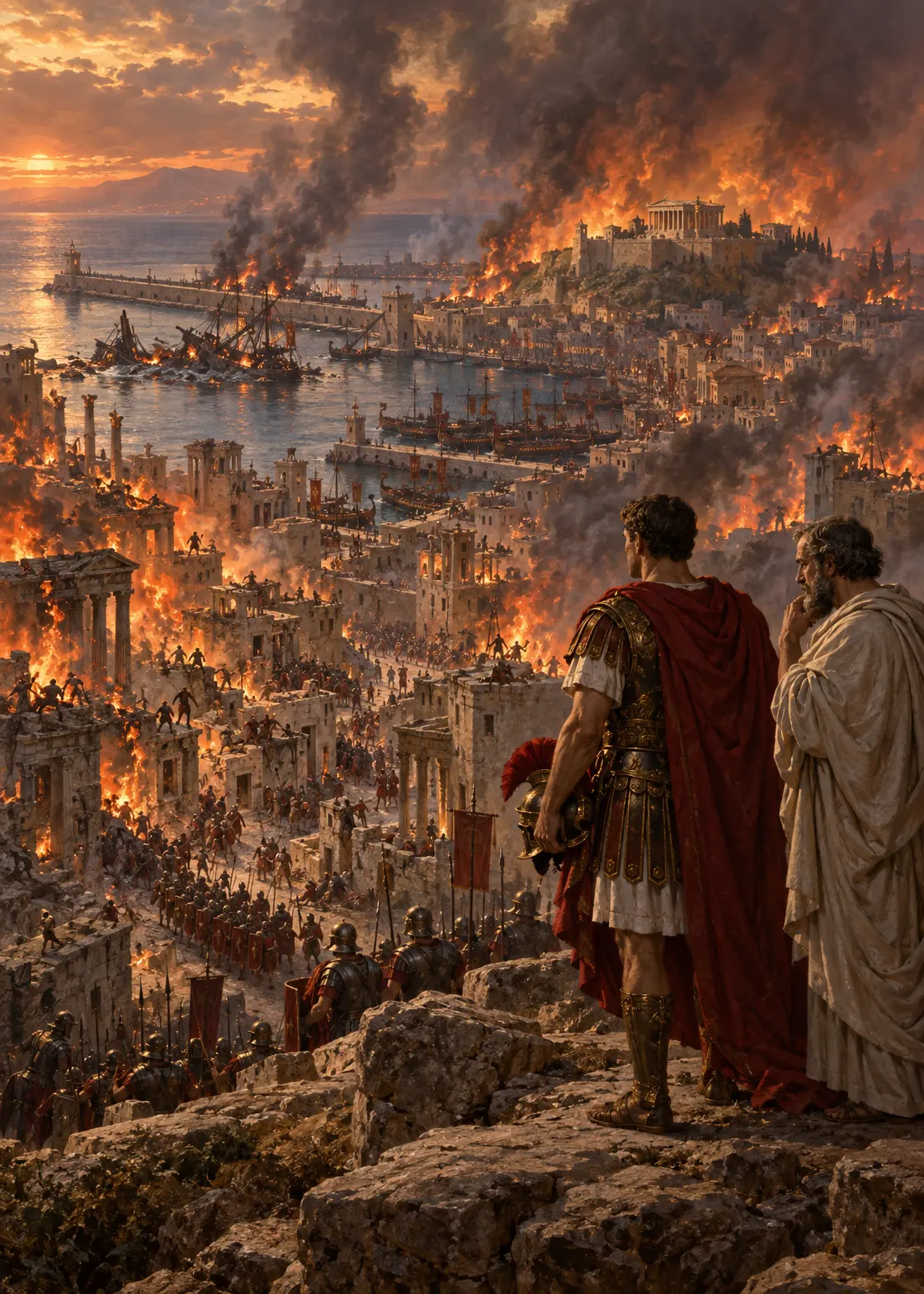
The famous moment preserved by Polybius — through his personal participation in the events — is the conversation between Scipio Aemilianus and Polybius himself as the two observed the burning of Carthage from a vantage point outside the walls. The account, preserved by Appian (Libyca 132) explicitly attributed to Polybius, and partially preserved in the fragments of Polybius's own work (38.21–22), captures with unusual clarity the philosophical-historical reflection that the destruction produced. Scipio, watching the city's destruction, reportedly turned to Polybius and recited the lines from Homer's Iliad (6.448–449) in which Hector predicts the eventual fall of Troy: "There will come a day when sacred Ilium shall perish, and Priam and his people with him." Polybius, recognizing the implication that Scipio was applying to the present moment, asked the consul what he meant by the recitation. Scipio's response, as Polybius preserved it, was the observation that he was reflecting on the universal pattern of historical change — that every great political community eventually meets its end, that Carthage's destruction in this moment was the kind of event that Rome herself would eventually experience at some future moment in the long historical sequence, and that the strategic-political dominance that he was personally enacting was itself subject to the same patterns of historical transformation that had produced the moment he was observing. The exchange is one of the most philosophically reflective moments preserved by any ancient historiographical source and captures with unusual precision the kind of historical-philosophical consciousness that the second-century Roman aristocracy under Hellenistic cultural influence was developing.
The Byrsa citadel itself fell to Roman assault after approximately a day of additional close-quarter fighting. The surviving Carthaginian military leadership under Hasdrubal had taken refuge in the temple complex; Hasdrubal himself, after extended negotiations conducted from the threshold of the temple of Eshmun (the principal Carthaginian deity, whose temple at the summit of the Byrsa was the symbolic-religious center of the city), surrendered to Scipio with what the Roman sources record as conspicuous personal cowardice — he abandoned his wife and children to the temple before surrendering, with his wife (whose name is not preserved) subsequently cursing him publicly from the temple steps and then killing herself and her children in the temple fire that the Roman troops shortly afterward set. The dramatic detail, preserved by Appian and reflecting the Polybian source, is consistent with the kind of dignified-resistance literary tradition that would attach to the Carthaginian-final-defense narrative but has the firm core that Hasdrubal did indeed surrender to Scipio and that the surviving Carthaginian population in the temple complex was destroyed either in the fighting or in the burning that followed.
The destruction of the city was systematic and total. The Roman troops, on Scipio's order and according to the senatorial instructions that had been delivered with the original consular command, set the city ablaze and conducted the systematic destruction of every building that had not been destroyed in the assault itself. The fires burned across approximately seventeen days; the destruction of the urban fabric was conducted with the kind of operational thoroughness that ancient siege practice prescribed for cases of comprehensive elimination; the surviving population (approximately 50,000 of the pre-war population of approximately 200,000) was sold into slavery; the territory of the city was formally cursed by a senatorial-religious ceremony conducted by Scipio at the senatorial direction (the ceremony included the symbolic plowing of a furrow across the city site and the scattering of salt to render the soil agriculturally non-productive, a ritual whose historical authenticity has been debated by modern scholars but whose ceremonial-political content reflects the senatorial intention of preventing institutional revival on the site). The agricultural-economic territory of the Carthaginian state was organized as the new Roman province of Africa, with administrative authority transferred to a Roman praetor and with the territorial-economic resources progressively integrated into the Roman provincial system across the subsequent generation.
The strategic-political consequences of the destruction of Carthage were the elimination of the principal Mediterranean alternative to Roman power and the political-symbolic conclusion of the strategic-historical process that had begun with the First Punic War in 264 BC. The two great commercial-maritime civilizations of the western Mediterranean had been brought into competitive engagement over a period of 118 years (from 264 BC through 146 BC), with three major wars and substantial subsidiary conflict. The strategic-political process had concluded with the comprehensive elimination of one of the two civilizations and the establishment of the other as the unchallenged Mediterranean hegemon. The institutional-cultural consequences of the destruction were less immediately visible than the strategic-political ones but would prove substantial across the long term: the destruction of Carthage as a cultural-civilizational entity eliminated the Punic-Phoenician cultural tradition from continued participation in Mediterranean cultural development, and converted the western Mediterranean from a region of bicultural Greek-Punic civilization to a region of progressively-uniform Roman-Hellenistic civilization that would dominate the subsequent centuries.
The Crossroads · 149 BC · Carthage, the senate house
The Third Demand at Carthage
You are a member of the Carthaginian Senate, listening to the envoys who have just returned from the Roman consular camp at Utica.
After the defeat of Hasdrubal's 25,000 men by King Masinissa of Numidia in 150 BC, Rome declared war, treating the unapproved African campaign as a breach of the 201 BC Treaty of Zama. Seeking to avert destruction, Carthage complied with two successive Roman ultimatums at Utica: first surrendering three hundred children from the leading senatorial families as hostages, then delivering all municipal armaments, including 200,000 sets of weapons and 2,000 catapults. Now the consuls Manius Manilius and Lucius Marcius Censorinus have delivered their third demand: the entire population must evacuate Carthage, permit the physical demolition of the city, and relocate to an inland site at least ten Roman miles from the sea.
Will the Carthaginian Senate accept the forced relocation and the destruction of the city, or refuse the consuls and fight without arms?
Weigh each course: open it to hear your own inner voice. Then decide. Nothing is scored.
- Your inner voiceThe course taken
To tear down our own temples and walk ten miles inland is the death of Carthage in all but name. We gave our sons and our arms, yet each concession only bred a harsher decree. If Rome intends our destruction, let us die behind our own walls. We can bar the gates, forge new weapons in every workshop, summon Hasdrubal from the interior, and make the consuls pay for every street.
- Your inner voiceThe course taken
Our children are hostages at Utica, and every spear and catapult has been delivered to the consuls. If we defy them, their legions will massacre a disarmed populace. Abandoning the sea destroys our ancestral maritime commerce and breaks our spirit, but our people will live. A community can endure in the fields of the interior, whereas choosing war without weapons invites the total annihilation of our race.
- Your inner voiceThe course taken
The consuls Manius Manilius and Lucius Marcius Censorinus seek our absolute ruin, but their Senate is divided. Publius Cornelius Scipio Nasica Corculum has long argued against Cato that our survival serves Rome as a necessary counterweight. If we stall the commanders at Utica and send envoys across the sea, the moderates might restrain the consuls. Defiance without weapons is madness, but submitting immediately condemns our ancient home without an appeal.
What was done
The Carthaginian Senate voted to reject the third demand and undertake military resistance despite disarmament and the loss of the hostages. Mobilizing the entire civilian population, workshops forged weapons from available materials, women cut their hair for catapult ropes (BGrade B), and Hasdrubal was appointed to command the defense. The consuls Manius Manilius and Lucius Marcius Censorinus failed in their assaults, producing a stalemate across 149 and 148 BC under Lucius Calpurnius Piso Caesoninus. In 147 BC, Rome bypassed legal age rules to elect Scipio Aemilianus consul. Scipio restored discipline, sealed the harbor with a ninety-meter mole, and defeated a naval sortie. In 146 BC, Roman troops breached the walls and fought through residential quarters for six days. Hasdrubal surrendered at the temple of Eshmun while his wife threw herself into the flames. Scipio razed Carthage over seventeen days, enslaved approximately 50,000 survivors (BGrade B), and organized the territory as the province of Africa.
The evidence Polybius Books 36, 38, and 39 (AGrade A for surviving personal-witness fragments); Appian Libyca 74–135 (BGrade B, drawing on Polybius); Livy Periochae 47–52 (CGrade C, summary only); Plutarch Cato Major 26–27 (BGrade B); Diodorus 32 (CGrade C, fragmentary); archaeological record at Carthage (AGrade A as material evidence for the destruction). The Editor's Note assigns AGrade A to major events and BGrade B to political-rhetorical details, noting that the precise diplomatic sequence in 149 BC is preserved with some inconsistency across sources.
If you choose to walk through itAt every scale
- Yourself
How do you weigh your own immediate survival against the moral burden of assenting to the erasure of your ancestral city?
- Those beside you
What do you owe to the families whose three hundred children were surrendered as hostages at Utica if your vote guarantees their death?
- Rome
Can a republic maintain its moral and constitutional integrity when its strategic security demands the physical annihilation of an unarmed rival?
- The wider world
How does the total elimination of an ancient maritime civilization alter the autonomy and culture of subject peoples under an unchallenged hegemon?
- Our own time
When a dominant power uses staged diplomatic concessions to engineer unconditional surrender, what realistic choices remain for the weaker state?
Consider an industrial or commercial nation facing incremental, coercive demands from an overwhelming military alliance, such as the gradual disarmament and economic isolation imposed on defeated powers prior to forced partition or regime dismantling in twentieth-century treaties. Step-by-step compliance—surrendering strategic assets, heavy armaments, and economic autonomy to preserve peace—can leave an institution completely vulnerable when the final demand requires the dissolution of its political sovereignty and cultural heartland.
Where the comparison fails. Modern international law and global organizations formally prohibit the total physical annihilation of cities, the mass enslavement of entire civilian populations, and the ritual erasure of sovereign communities, constraints that did not bind ancient Mediterranean powers executing total siege warfare.
What does the chapter tell us?
What structural provision of the 201 BC Treaty of Zama created chronic political friction between Carthage and Numidia?
The treaty forbade Carthage from undertaking warfare without Roman permission and placed territorial disputes under Roman arbitration. This structural asymmetry allowed Masinissa to expand into Carthaginian territory knowing Roman embassies would systematically favor his claims.
the chapter's narrative
What operational event in 150 BC served as the immediate trigger for Rome's declaration of war in 149 BC?
Responding to Numidian incursions near Oroscopa, the Carthaginian Senate dispatched 25,000 men under Hasdrubal without Roman consent. Although Hasdrubal was surrounded and defeated, Roman conservatives used the unauthorized military operation as a casus belli.
the chapter's narrative
Which Roman senator resisted Cato's agitation for the destruction of Carthage by arguing that Carthage remained institutionally useful to Rome?
Publius Cornelius Scipio Nasica Corculum led the senatorial moderates against Cato, arguing that Carthage served as a necessary strategic counterweight that prevented Roman political complacency and cultural decline.
Plutarch Cato Major 26–27 (BGrade B) and the chapter's narrative
What constitutional adjustment did the Roman Senate make to grant Scipio Aemilianus the African command for 147 BC?
Scipio was thirty-eight, below the minimum age of forty-two mandated by the lex Villia annalis, and had only campaigned for the curule aedileship. The Senate suspended the statutory age and career sequence to entrust him with the consular command.
the chapter's narrative
Which Roman engineering work in 147 BC definitively severed Carthage from maritime communications and external supply?
In the autumn of 147 BC, Scipio's engineering officers built a ninety-meter stone mole from the western shore across the outer harbor entrance. This barrier effectively transformed Carthage from a maritime city into a completely isolated, blockaded settlement.
Appian Libyca 74–135 (BGrade B) and the chapter's narrative