Book IV · The Wars of Mediterranean Hegemony
Chapter 6
The Achaean War and the Sack of Corinth
The Achaean League After Pydna
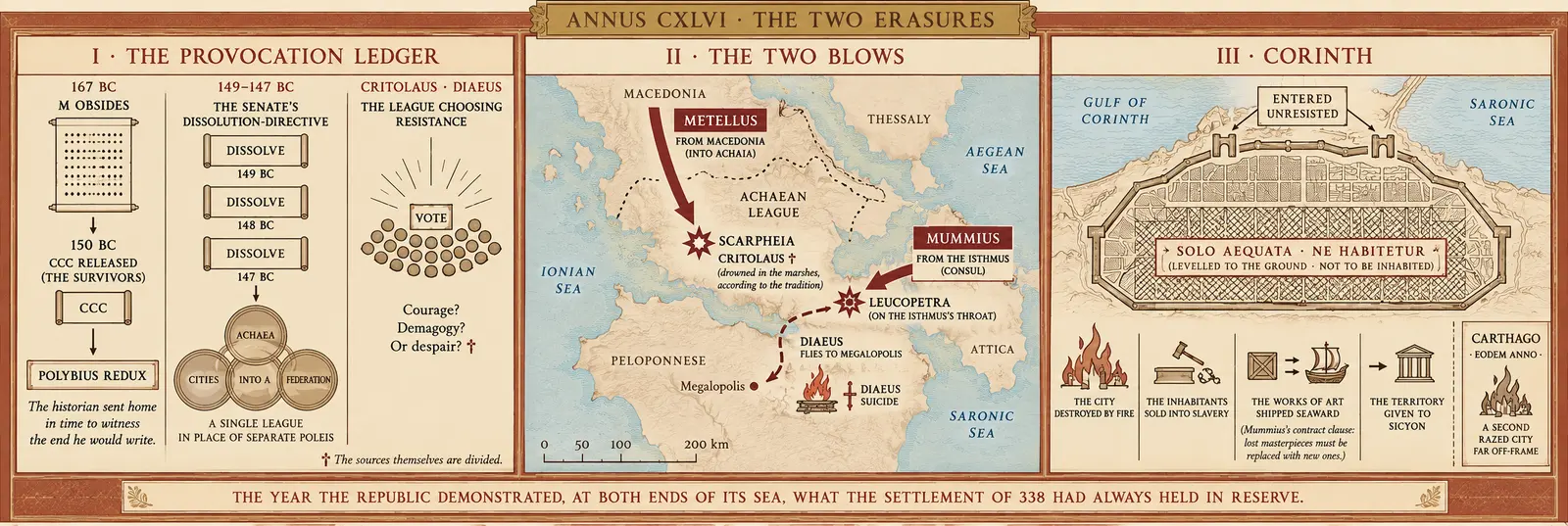
The Achaean League across the post-Pydna period had been the principal Greek political-military confederation under Roman supervisory hegemony. The league's territorial scope at the death of Aemilius Paullus extended across substantially the entire Peloponnese — Corinth and the northern Peloponnesian cities had joined the league across the late Hellenistic period, Sparta had been incorporated after Flamininus's suppression of Nabis in 195 BC, the smaller Peloponnesian communities had progressively associated with the league across the subsequent half-century — and the institutional structures of the league (a federal assembly, magistracies elected annually, a federal military force, common foreign policy) had developed across the period into the most sophisticated Greek federal political organization of the entire Hellenistic period. The league had been Rome's principal Greek strategic partner during the Pydna campaign, providing political-military cooperation and limited contingent forces; the post-Pydna political settlement, however, had imposed substantial costs on the league's institutional standing.
The principal cost was the thousand-hostage requirement that had been imposed on the league in 167 BC as part of the broader political settlement following the Macedonian war. The thousand Achaean hostages — drawn from the principal aristocratic families of the league's member cities, including young men of senior political prominence — had been transferred to Rome for sixteen years of detention, during which their political careers were suspended, their connections with the league's political-institutional development were severed, and (in many cases) their personal-political loyalties were progressively transferred from the Achaean League's federal institutions to the Roman patron-and-client network within which they were embedded during the detention period. The principal example of this political-cultural transfer was Polybius himself, whose intellectual-political residence at Rome as a member of the Aemilian and Scipionic households produced the most sophisticated single Greek perspective on Roman political-cultural development of the entire Republican period — but whose personal-political position when he returned to the Peloponnese in 150 BC was substantially different from what it would have been had his political-personal connections remained continuously oriented toward the Achaean league's institutional framework.
The surviving Achaean hostages were released by Roman senatorial decree in 150 BC after extended political-diplomatic negotiation between the Achaean federal authorities and the Roman Senate, with the senatorial faction associated with the Scipionic family — including Scipio Aemilianus and Cato Maior, who reportedly delivered a remark in the senatorial debate that the question of hostage release had detained too much of the Senate's attention and should be resolved in whatever direction would prevent further wasted senatorial time — supporting the release decision. Of the original thousand hostages, approximately three hundred had survived the sixteen-year detention to return to the Peloponnese; the returning population entered an Achaean political environment substantially transformed from the one they had left, with the political-institutional dynamics they had been familiar with as young men replaced by new political configurations they had to navigate without the political-personal connections they had failed to develop during their absence. The cultural-political dislocation produced by the hostage release was, accordingly, substantial — and combined with the broader political-institutional developments of the post-Pydna period to produce the political crisis that the present chapter describes.
The Political Crisis and the Outbreak of War149–146 BC
The political crisis that produced the Achaean War of 146 BC arose from the cumulative tension between the institutional autonomy that the Flamininan supervisory framework had promised the Greek political communities and the practical-administrative reality that the post-Pydna Roman political-strategic position had progressively imposed. The principal proximate trigger was the political conflict between the Achaean League and Sparta — which had been incorporated into the league after Flamininus's settlement of 195 BC but whose political-cultural autonomy the Spartan political class had never fully accepted, and which conducted across the late 150s and the 140s BC a sustained political-diplomatic campaign to recover independent status from the league. The Roman senatorial response to the Spartan diplomatic appeals was, in the years 149 through 147 BC, the dispatch of senatorial commissioners (Lucius Aurelius Orestes in 147 BC, with subsequent embassies) to the league with directives that several smaller cities — including Sparta itself, Corinth, Argos, Orchomenus, and Heraclea — were to be detached from the league and restored to independent status under Roman supervisory direction.
The senatorial directives, as preserved by Pausanias (Description of Greece 7.14) and by the fragments of Polybius's now-lost Book 38, were strategically calibrated to test whether the league would accept what was, in operational substance, the political-institutional dissolution of the federal structure. The Achaean political class recognized the strategic-political implication of the directives: if the league could be progressively reduced by selective Roman extraction of member cities, the federal institution itself would lose institutional coherence and would eventually be dissolved into a constellation of small dependent communities under direct Roman supervision. The political-cultural decision facing the league was, accordingly, between acquiescence in the institutional dissolution that the directives implied and resistance that would produce military confrontation with Rome on terms that no Greek political community had the strategic-military capacity to sustain.
The decision of the Achaean federal assembly in early 146 BC was for resistance. The decision was conducted under the leadership of two principal political figures — Critolaus (the league's principal political-rhetorical figure of the period) and Diaeus (his political-strategic partner and successor as league strategos) — whose political-rhetorical framework presented the resistance as the defense of Greek political-cultural autonomy against the institutional dissolution that the Roman directives represented. The political-rhetorical content of the decision, as preserved through Polybius's fragmentary remarks and through later anti-Achaean accounts (Pausanias's source, drawing on senatorial-Roman tradition, was hostile to the Achaean leadership and presents the decision as the product of political-rhetorical demagoguery rather than as the serious political-strategic calculation that the contemporary sources suggest), reflected the genuine institutional-political crisis: the Achaean League was being asked to consent to its own dissolution, and the resistance — however operationally hopeless — represented the only available political-institutional alternative.
The military-strategic content of the resistance, however, was substantially inadequate to the strategic-political situation. The league's federal military force was approximately 14,000 infantry and 600 cavalry, of variable quality and without major recent combat experience; the Roman military forces in Greece at the time (under the praetor Metellus Macedonicus, who had been conducting concurrent operations against the Macedonian pretender Andriscus and was completing the suppression of that revolt) were approximately 20,000 men, supplemented by the forces that would shortly arrive under Lucius Mummius, the consul of 146 BC assigned to the Greek command. The qualitative balance was overwhelmingly in Roman favor; the geographic-strategic position of the league was indefensible against a major Roman expeditionary force; the diplomatic-political support that the league might have obtained from other Greek communities was conspicuously absent (the principal Greek communities outside the Peloponnese — Athens, Thebes, Boeotia — declined to join the resistance, recognizing the strategic-political hopelessness of the position).
The Engagement at ScarpheiaSummer 146 BC
The opening Roman military operations against the Achaean League were conducted by Metellus Macedonicus in his secondary capacity as the proconsular commander in Greece, while the principal consular command was being organized under Mummius. Metellus's forces engaged the Achaean army under Critolaus at Scarpheia in central Greece (near the modern Thermopylae) in mid-summer 146 BC, in an engagement that was operationally less consequential than the political-symbolic significance the contemporary sources attached to it. Critolaus's army, attempting to defend the central Greek approaches to the Peloponnese, was defeated by Metellus's forces in a brief engagement; Critolaus himself was killed in the engagement (the circumstances of his death are not preserved with certainty — some sources report battle casualty, others suicide after the defeat, others disappearance into the surrounding country); the Achaean federal forces retreated into the Peloponnese, with the remaining political-military leadership transferred to Diaeus, who attempted to organize the final defense around the strategic position of Corinth itself.
The transition to Mummius's command across the late summer of 146 BC was, by contemporary standards, an institutional formality conducted without operational disruption. Mummius had arrived in Greece in mid-summer with the consular reinforcements (approximately two legions and the corresponding allied contingents) and had assumed overall command from Metellus, who returned to Macedonia to complete the suppression of the Andriscan revolt. Mummius's combined force for the campaign against the surviving Achaean resistance was approximately 23,000 infantry and 3,500 cavalry, with substantial siege equipment and naval support. The Achaean federal forces under Diaeus were approximately 14,000 — substantially reduced by the Scarpheia engagement and the political-military disorganization that followed — and were attempting the defense of Corinth and the surrounding Peloponnesian-northern territories under conditions that no realistic operational analysis could have regarded as sustainable.
The Engagement at Leucopetra and the Fall of Corinth
The decisive engagement of the Achaean War was fought at Leucopetra on the Isthmus of Corinth in early autumn 146 BC, with Mummius's army engaging Diaeus's federal forces in what was, in operational terms, less a battle than a one-sided military demonstration. The Achaean infantry was deployed in conventional phalanx formation; the Roman heavy infantry engaged frontally with the operational competence that the post-Pydna Roman army had refined; the Achaean cavalry on the wings was outnumbered and outclassed by the Roman and allied cavalry; the engagement was substantially decided within approximately two hours of its opening, with the Achaean infantry broken and the cavalry destroyed in detail. Diaeus himself escaped from the field, fled to his native city of Megalopolis (the same city of Polybius's birth), killed his wife and family to prevent their capture, set fire to his house, and committed suicide in the burning building; the dramatic detail, preserved by Pausanias with substantial moral-philosophical commentary, captures the political-personal collapse of the Achaean resistance leadership at the moment of military defeat.
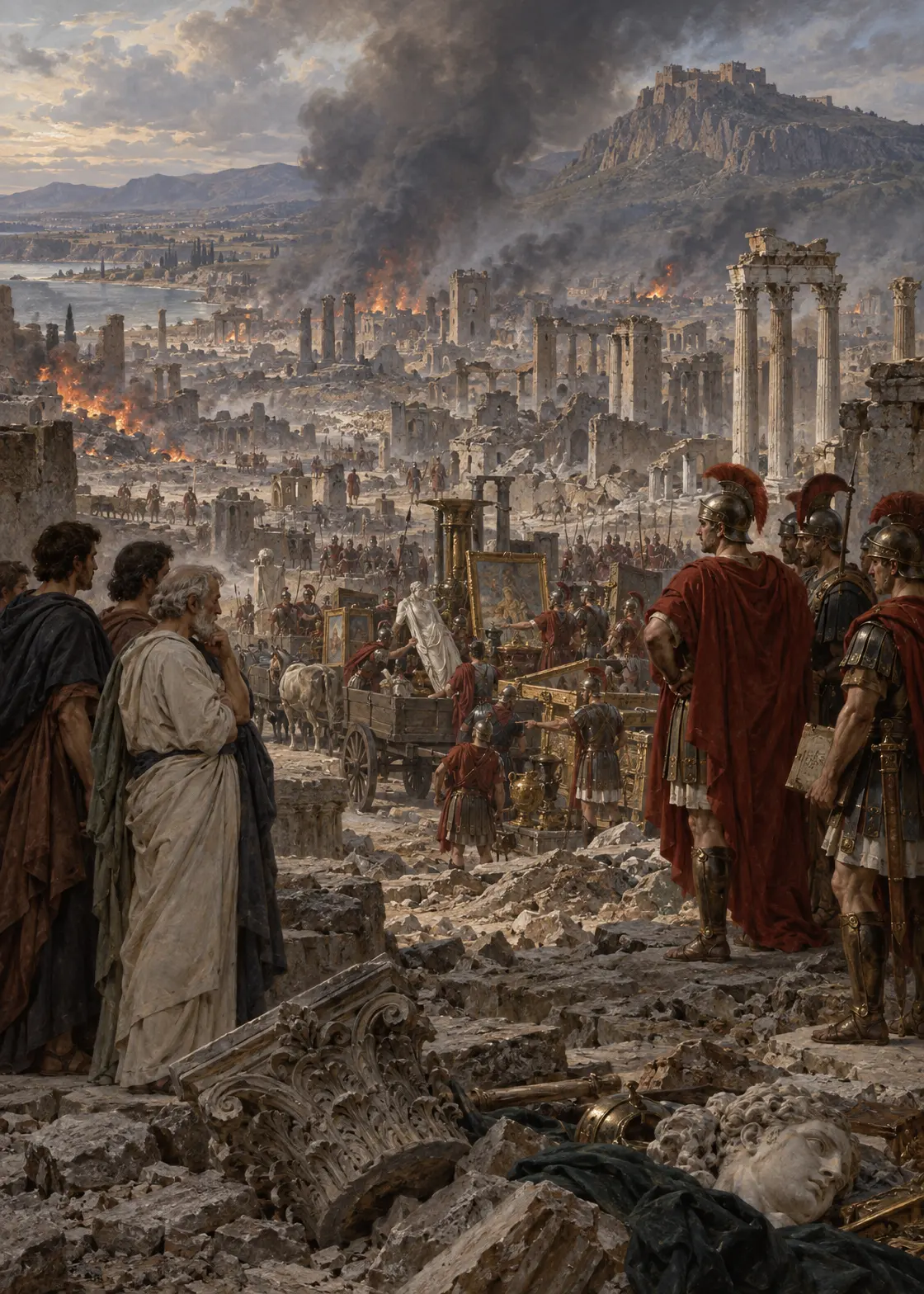
Mummius's army advanced from Leucopetra into Corinth without significant resistance. The city's surviving population — those who had not fled to the surrounding country or escaped by sea during the period between Leucopetra and the Roman entry — was systematically dealt with according to the institutional patterns that the senatorial directives had specified. The adult male population was killed; the women and children were sold into slavery; the city's accumulated artistic and material wealth — the principal commercial-cultural center of the Greek world for over half a millennium, with substantial accumulated artistic, sculptural, and material patrimony — was systematically removed for transport to Rome.
The treatment of Corinth was, in its strategic-political content, parallel to the destruction of Carthage that had been conducted earlier in the same year. The senatorial directives had specified that the city was to be destroyed as an institutional entity, with the urban fabric burned and the territorial-economic resources confiscated for Roman or Roman-allied use. The operational execution of the destruction occupied approximately several days, with the city's residential quarters burned systematically and the principal public buildings destroyed; the agricultural-territorial hinterland was confiscated, with substantial portions distributed to allied Greek communities (Sicyon, in particular, received substantial territorial gains from the Corinthian distribution) and the remainder organized under Roman administrative supervision.
Mummius and the Cultural Catastrophe
The Roman commander Lucius Mummius, who would shortly receive the cognomen Achaicus from the campaign, has occupied a particular position in the historical-cultural reception of the destruction of Corinth, owing principally to a series of anecdotes preserved by Velleius Paterculus (1.13) and by other late-Republican and imperial-period sources that capture, with varying degrees of historicity, the cultural-historical disjunction between the Roman senatorial-aristocratic class of the mid-second century BC and the Greek cultural patrimony that the destruction of Corinth brought wholesale into Roman possession. Mummius was, by the unanimous testimony of the sources, a senatorial figure of conspicuous personal integrity and operational competence but of substantially limited Hellenistic cultural-aesthetic sophistication. The famous anecdote — Velleius preserves it most directly — concerns Mummius's instructions to the contractors responsible for transporting the captured Corinthian artworks to Rome: he reportedly told them that if any of the works were damaged in transit, the contractors would be required to replace them with new productions of equivalent value. The remark, however historically authentic in its specific form, captured with unusual clarity the cultural-historical disjunction: Mummius had not recognized that the captured works were unreproducible artistic productions of Hellenistic culture's high classical period (Praxitelean and post-Praxitelean sculpture, painted panels by classical Greek masters, ceremonial objects of unique artistic provenance) and was treating them as commercial-material goods whose replacement was the kind of business arrangement that conventional Roman commerce could effect.
The historical-cultural significance of the anecdote, however, exceeds its specific authenticity. The destruction of Corinth produced the most substantial single transfer of Greek cultural patrimony to Rome of any single Roman strategic event of the entire Republican period — exceeding even Marcellus's transfer from Syracuse in 211 BC, exceeding Aemilius Paullus's transfer from Pella in 167 BC, exceeding the cumulative imports of Hellenistic cultural material that the post-Pydna generation had effected. The transferred works would shape the developing Roman aesthetic-cultural environment across the subsequent generation; the Roman aristocratic-collecting class that would emerge in the late second and early first centuries BC (figures like Lucullus, Hortensius, Cicero, Atticus) would build their collections substantially on the foundation that the post-Corinth transfer had established; the cultural-aesthetic vocabulary of Roman aristocratic civilization in the late Republic would be substantially shaped by the works that had been removed from Corinth in 146 BC.
The cultural-historical irony, captured in the Mummius anecdote, is that the Roman strategic-political process that brought these works to Rome was conducted under the operational direction of a senatorial figure whose personal cultural-aesthetic understanding was substantially inferior to the cultural-historical significance of the materials he was transferring. The institutional transfer of Hellenistic cultural patrimony to Rome was, in this specific sense, conducted by Roman political-military figures whose individual cultural-aesthetic understanding was substantially less sophisticated than the cultural patrimony they were transferring; the cultural-aesthetic absorption of the transferred materials would be the work of subsequent generations whose individual cultural-aesthetic understanding had developed under the influence of the materials themselves and of the broader Hellenistic-cultural educational tradition that was now being progressively integrated into Roman aristocratic education. Mummius was, in this institutional-historical sense, the figure who effected the cultural transfer without the cultural-personal capacity to recognize what he was effecting; the recognition would come later, in the generation that grew up surrounded by the materials his campaign had transferred.
Polybius's Mediation and the Political-Cultural Settlement
A figure who occupied a particular position in the political-cultural reception of the destruction of Corinth was Polybius himself, who returned to the Peloponnese in 150 BC after the senatorial release of the Achaean hostages and who was present in mainland Greece during the political crisis of 149 through 146 BC. His personal-political position was complex: he was the principal Greek intellectual figure of his generation, with the deepest understanding of Roman political-cultural development of any contemporary observer; he was personally allied with the Scipionic family and was the intellectual companion of Scipio Aemilianus, whose African command had concluded earlier in 146; he was also a Greek of the Achaean League's principal political-aristocratic class, with personal-political connections to the league's institutional structure and to the political-cultural framework that the destruction of Corinth was eliminating.
Polybius's role in the post-destruction settlement of Greece was, accordingly, that of intermediary between the Roman political-military authorities and the surviving Greek political communities. He returned to Greece shortly after the destruction of Corinth (he had been with Scipio Aemilianus at Carthage during the principal events) and conducted, in cooperation with the Roman senatorial commissioners who were organizing the post-war political settlement, the implementation of the political-administrative arrangements for the Greek mainland. The settlement that was implemented — dissolution of the Achaean federal institutions, restoration of substantial autonomy to the individual Greek city-states (which were now to function as direct dependents of Roman senatorial supervision rather than as members of the federal league), confirmation of the territorial and political privileges of the Greek communities that had not joined the resistance, and the integration of the Greek mainland into the broader Mediterranean supervisory framework that the Roman post-war political configuration was constructing — was implemented with Polybius's personal intermediation in many of the specific local applications. Pausanias preserves (Description of Greece 8.30) the substantial cultural-political memorial that the Greek communities of the surviving cities erected to Polybius in recognition of his role in the post-war settlement: a series of statues across the principal Peloponnesian centers depicting Polybius in the conventional Hellenistic philosophical-statesman portrait style, with inscriptions recording his service in the political-cultural mediation of the post-Corinthian transition. The memorial tradition reflects the broader political-cultural recognition that the Roman supervisory hegemony, however brutal in its proximate institutional consequences, was being implemented by figures who included Greeks of substantial intellectual-political distinction whose personal-cultural integration with the Roman political-military system had developed across the post-Pydna generation.
The political-cultural significance of the simultaneous destructions of Carthage and Corinth in 146 BC has been recognized by the Roman tradition itself as the institutional-political watershed of the second century BC. The two cities had constituted, in the Mediterranean political-cultural configuration of the early second century, the principal centers of non-Roman civilizational tradition: Carthage as the principal Phoenician-Punic urban-commercial center of the western Mediterranean, Corinth as the principal Greek commercial-political center of the central Mediterranean. The simultaneous destruction of both — within months of each other in the same campaigning season, conducted under coordinated senatorial direction with the explicit strategic-political objective of eliminating the principal alternative civilizational centers — was the institutional event by which the Mediterranean basin was reduced to a single political-cultural framework under Roman supervisory hegemony. The institutional consequence was the strategic-political configuration that the late-Republican phrase mare nostrum would eventually describe; the political-cultural consequence was the progressive elimination across the subsequent centuries of the non-Roman civilizational alternatives that had defined the Mediterranean for the previous millennium.
The Crossroads · Early 146 BC · The Peloponnese
The Choice at the Achaean Assembly
You are a voting delegate in the Achaean federal assembly, listening to Critolaus and Diaeus after Roman senatorial envoys have delivered directives ordering the dismemberment of the league.
Following decades of Roman supervisory hegemony and the return of three hundred surviving hostages from sixteen years of detention in Italy, the Peloponnese faces an ultimatum. The Roman Senate, responding to Spartan appeals, has dispatched commissioners under Lucius Aurelius Orestes demanding that Sparta, Corinth, Argos, Orchomenus, and Heraclea be detached from the league and restored to independent status under Roman direction. The federal leadership recognizes that selective extraction of member cities means the functional dissolution of the Hellenistic world's most sophisticated federal structure. Critolaus and Diaeus urge defiance to defend Greek political-cultural autonomy. Yet the league can field only fourteen thousand infantry and six hundred cavalry against the twenty thousand Roman legionaries under the praetor Metellus Macedonicus already in Greece, with consular reinforcements preparing to arrive under Lucius Mummius.
How should the federal assembly respond to the Roman senatorial directives?
Weigh each course: open it to hear your own inner voice. Then decide. Nothing is scored.
- Your inner voiceThe course taken
We cannot accept our dismemberment, yet we cannot march out alone with fourteen thousand men against Rome's legions. Let us reject the detachment of Corinth and Argos, but avoid provoking immediate battle with Metellus. Envoys must ride at once to Athens, Thebes, and Boeotia. If the Greek cities unite our spears and treasuries, Rome may pause before pressing her demands; if they refuse us, we will at least know our true strength before risking all.
- Your inner voiceThe course taken
If we submit to the Senate's envoys, our confederation will be stripped of its greatest cities and left a scattered remnant under Roman supervision. Yet what army do we possess? Metellus holds twenty thousand men, and a consular force approaches under Mummius. To bow is bitter and shatters our federal strength, but our walls will stand, our citizens will live, and our cities will not be put to fire and the sword.
- Your inner voiceThe course taken
Rome asks us to vote our own extinction. If we surrender Sparta, Corinth, and Argos at Orestes' command, the league ceases to exist in all but name, reduced to helpless fragments awaiting Roman orders. Critolaus and Diaeus speak the truth: without autonomy, peace is merely servitude. Even if the military odds are desperate, we must draw the sword for Greek freedom. Better to fall defending our federal laws than to consent to our own destruction.
What was done
The assembly voted for resistance, rallying behind Critolaus and Diaeus. Neighboring cities like Athens, Thebes, and Boeotia refused to join the hopeless cause. In summer 146 BC, Metellus Macedonicus defeated the federal army at Scarpheia, where Critolaus fell. Diaeus assumed command at Corinth with fourteen thousand men, but consul Lucius Mummius arrived with twenty-three thousand infantry and thirty-five hundred cavalry. At Leucopetra, Roman heavy infantry and cavalry routed the Achaean phalanx within two hours. Diaeus fled to Megalopolis, killed his family, and died by suicide in his burning house. Mummius entered Corinth without resistance: adult males were slaughtered, women and children enslaved, and the city's vast artistic treasures shipped to Rome before the urban fabric was burned. Polybius returned to mediate a settlement that dissolved the league's federal institutions into separate Roman protectorates (BGrade B for major events; CGrade C for Mummius's transport anecdotes).
The evidence Polybius Books 38–39 (AGrade A as personal witness for surviving fragments, BGrade B for the narrative overall due to loss); Pausanias, Description of Greece 7.14–16 (BGrade B, with documentary-research basis); Livy, Periochae 52 (CGrade C); Strabo 8.6.23 (CGrade C); Velleius Paterculus 1.13 (CGrade C); Cicero, various passages (CGrade C); Florus 1.32 (DGrade D); Cassius Dio frag. via Zonaras 9.31 (CGrade C); Orosius 5.3 (DGrade D). Modern analyses include Gruen (1984), Ferrary (1988), and Kallet-Marx (1995). Attestation is BGrade B for major events and CGrade C for anecdotes regarding Mummius.
If you choose to walk through itAt every scale
- Yourself
How do you weigh personal survival against the moral imperative to defend your community's freedom when defeat is virtually certain?
- Those beside you
What responsibility do leaders bear toward their families and fellow citizens when choosing a principle that invites catastrophic reprisal?
- Rome
How does an imperial power maintain supervisory hegemony without ultimately reducing allied confederations to direct administrative subjection?
- The wider world
Can a federation of smaller states preserve genuine political independence when overshadowed by a singular, overwhelming military superpower?
- Our own time
When an international order demands concessions that threaten a weaker nation's sovereign identity, where does the boundary lie between prudent compromise and fatal capitulation?
Consider a regional economic or political federation presented with non-negotiable demands by an overwhelming superpower to dissolve its regulatory unions, detach key members, and accept bilateral oversight. Member states must decide whether to acquiesce to structural dismemberment to preserve immediate economic stability, or reject the ultimatums on sovereign principle despite lacking the financial or institutional strength to withstand coercive sanctions or intervention.
Where the comparison fails. Modern international law, multilateral assemblies, and global trade networks offer arbitration mechanisms and diplomatic appeals absent in 146 BC. Furthermore, modern coercive leverage typically relies on economic sanctions rather than total physical annihilation, city-wide massacres, and the wholesale enslavement of populations.
What does the chapter tell us?
Why did the Roman Senate dispatch commissioners like Lucius Aurelius Orestes to the Achaean League between 149 and 147 BC?
Prompted by Spartan appeals to recover independent status, Roman senatorial directives ordered several cities detached from the league, effectively testing whether the Achaeans would accept the dissolution of their federal structure.
Pausanias Description of Greece 7.14 and Polybius Book 38 (BGrade B)
What was the primary effect of the sixteen-year Roman detention on the surviving Achaean hostages released in 150 BC?
The detention suspended their local careers, broke their domestic political ties, and transferred loyalties to Roman patron networks like the Scipionic circle, creating profound cultural and political dislocation when the three hundred survivors returned.
the chapter's narrative (BGrade B)
How did neighboring Greek communities outside the Peloponnese respond to the Achaean League's call to resist Rome in 146 BC?
The chapter notes that diplomatic-political support was conspicuously absent; major communities outside the Peloponnese, recognizing the military hopelessness of confronting Rome's legions, declined to join the Achaean resistance.
the chapter's narrative (BGrade B)
What famous cultural anecdote is attributed to the consul Lucius Mummius during the sack of Corinth?
Velleius Paterculus records that Mummius warned contractors to replace damaged artworks with equivalent new productions, illustrating his lack of aesthetic understanding regarding irreplaceable classical Hellenistic masterpieces.
Velleius Paterculus 1.13 (CGrade C)
What role did the historian Polybius play in the aftermath of Corinth's destruction?
Returning from Carthage, Polybius acted as intermediary with Roman senatorial commissioners, helping establish local autonomy for individual city-states under Roman supervision, for which Peloponnesian cities erected memorial statues in his honor.
Pausanias Description of Greece 8.30 and Polybius Book 39 (BGrade B)