Book V · The Crisis of the Republic
Chapter 1
The Gracchan Crisis: The Return of Political Violence
The Agrarian Question
The political crisis that opened the century of Republican self-destruction arose from a problem that the strategic successes of the previous volumes had themselves created. The Roman military system of the middle Republic had rested, institutionally and demographically, on the assidui — the propertied smallholding citizens who qualified for legionary service by the census and who constituted, in the traditional understanding, both the agricultural and the military backbone of the state. The wars of the second century had subjected this class to a compound pressure. Prolonged overseas service removed the smallholder from his land for years at a stretch; the influx of slave labor from the great conquests (150,000 Epirotes enslaved after Pydna alone, comparable masses from Carthage, Corinth, Spain, and Sardinia) provided the capital-owning class with an agricultural workforce against which the free smallholder could not compete; and the ager publicus — the public land confiscated from defeated Italian communities across the previous two centuries, which was legally subject to occupation limits of five hundred iugera per holder — had been progressively engrossed by large possessors in open defiance of the statutory limits, which had gone unenforced for generations. The result, as the reforming tradition understood it, was the visible transformation of the Italian countryside: the smallholding assiduus displaced by the slave-worked latifundium, the recruiting base of the legions narrowing census by census, and a growing landless urban population that was, in the traditional constitutional understanding, neither economically productive nor militarily useful.
The modern scholarly literature has complicated every element of this traditional picture — the demographic evidence for smallholder decline is ambiguous, the census figures admit multiple interpretations, and the archaeological record of the Italian countryside shows more continuity of small-farm occupation than the literary tradition suggests. But the political fact is not in dispute: the Roman reforming faction of the 130s BC believed the traditional picture, articulated it as the justification for the most consequential legislative initiative of the century, and acted on it. Tiberius Sempronius Gracchus, tribune of the plebs for 133 BC, was the bearer of that initiative, and his personal formation explains much of its character. He was the son of the censor of 169 and the grandson, through his mother Cornelia, of Scipio Africanus; he had served with distinction at Carthage in 146 under his cousin-by-adoption Scipio Aemilianus; and he had been the quaestor whose personal credit with the Celtiberians had extracted the Roman army from the Numantine disaster of 137 — only to see the treaty he had negotiated repudiated by the Senate and his own good faith publicly consumed in the repudiation, an episode treated in the previous volume and universally recognized, by ancient and modern observers alike, as one of the personal springs of his subsequent political course. Plutarch adds the detail, which he attributes to Gaius Gracchus's own memoir, that Tiberius's convictions crystallized as he traveled through Etruria on the road to Spain and observed the countryside worked everywhere by imported barbarian slaves, with the free citizens who should have been farming it nowhere to be seen.
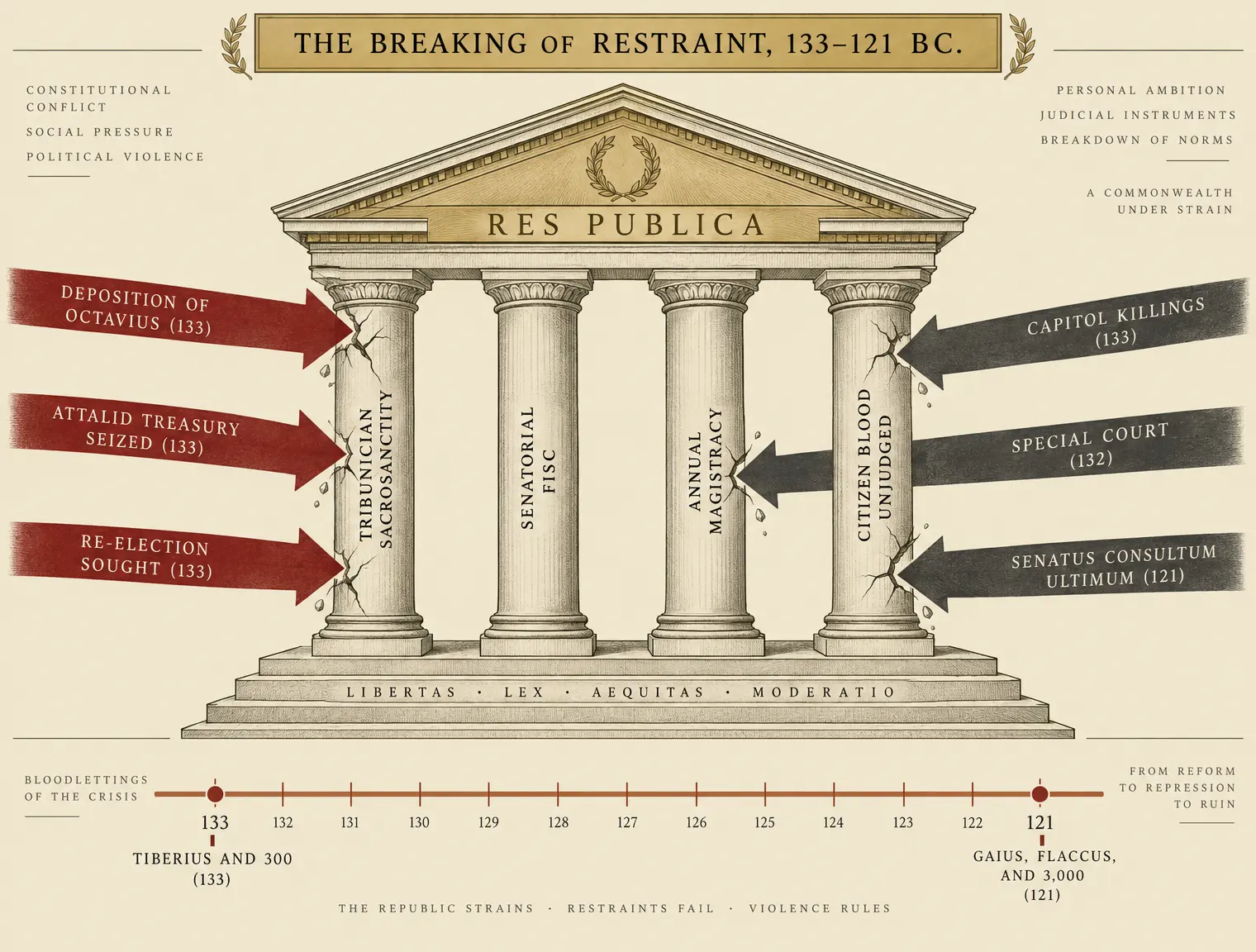
The lex agraria that Tiberius carried in 133 BC was, in its substance, conservative: it reasserted the ancient occupation limit of five hundred iugera of public land (with an additional allowance per son), guaranteed the possessors secure title to their permitted holdings, and established a standing commission of three men — Tiberius himself, his younger brother Gaius, and his father-in-law Appius Claudius Pulcher, the princeps senatus — to recover the excess and distribute it to landless citizens in small inalienable allotments. The substance was less revolutionary than the method. When his fellow tribune Marcus Octavius, acting in the interest of the possessing class, interposed his veto against the bill, Tiberius took the step for which no constitutional precedent existed: he carried a vote in the plebeian assembly deposing Octavius from the tribunate itself, on the argument that a tribune who acted against the interest of the plebs had forfeited the office that existed to protect them. The argument had a demagogic logic and no constitutional foundation whatever; the sacrosanctity of the tribunate was the oldest fixed point of the plebeian constitution, and Tiberius had abolished it in order to save it. The bill then passed, and the commission began its work — hampered at once by the Senate's refusal to vote it an operating budget, a stroke Tiberius answered with a second unprecedented step: when the news arrived that Attalus III of Pergamum had died and bequeathed his kingdom to the Roman people, Tiberius proposed that the Attalid treasury be applied directly by the assembly to fund the land commission, invading the Senate's immemorial control of finance and foreign policy in a single motion.
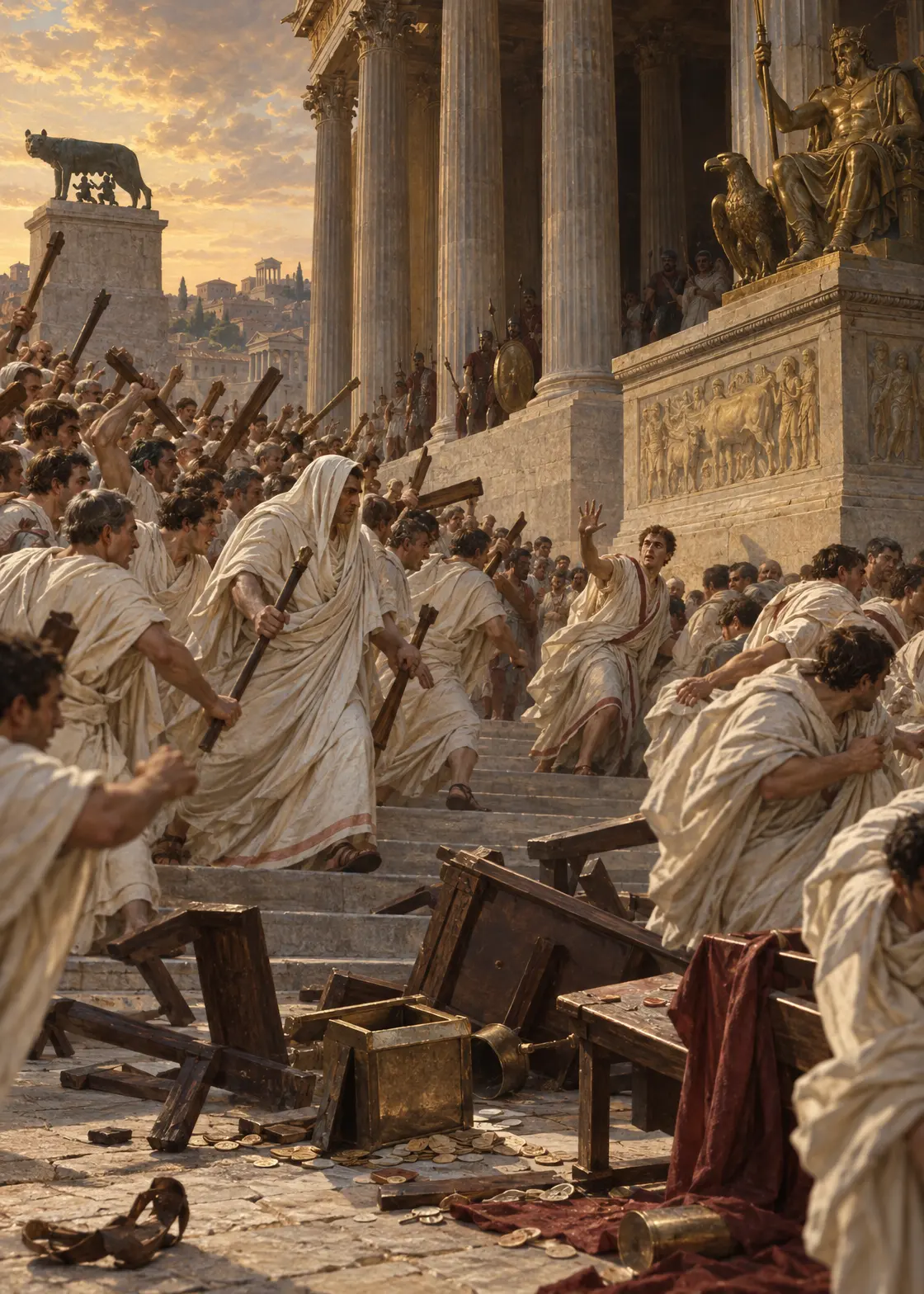
By the summer of 133 Tiberius had thus made himself intolerable to the senatorial majority on three separate grounds — the substance of the land law, the deposition of Octavius, and the invasion of senatorial fiscal prerogative — and had made himself, in the process, dependent for his personal safety on continuation in office, since the sacrosanctity of the tribunate was now the only shield between himself and prosecution. He accordingly stood for immediate re-election, which was itself of contested legality. On the day of the electoral assembly on the Capitol, amid escalating scuffles between his supporters and his opponents, the report reached the Senate, meeting nearby in the Temple of Fides, that Tiberius was demanding a crown — the report was almost certainly a misconstruction of a gesture, Tiberius touching his head to signal that his life was in danger, but it was the construction the moment required. The pontifex maximus Publius Cornelius Scipio Nasica Serapio, Tiberius's own cousin, demanded that the consul Scaevola suppress the tyrant by force; Scaevola refused to be the first to shed unjudged citizen blood; and Nasica, drawing his toga over his head in the manner of a priest at sacrifice, called on those who would save the state to follow him, and led the senators and their clients up the Capitol armed with clubs and the broken legs of the assembly benches. Tiberius Gracchus was beaten to death at the door of the Temple of Jupiter, along with some three hundred of his supporters, and the bodies were thrown that night into the Tiber — his brother's request for the corpse for burial refused. It was the first political bloodshed at Rome, as the ancient tradition itself observed with careful horror, since the expulsion of the kings nearly four centuries before.
Gaius Gracchus and the Widening of the Breach123–121 BC
The decade following Tiberius's death demonstrated that the killing had resolved nothing. The land commission itself survived — the Senate, with instructive cynicism, allowed the popular measure to proceed once its author was dead, and the surviving boundary stones (cippi) of the Gracchan commissioners, several of which have been recovered by modern archaeology bearing the names of the commissioners, attest that substantial distribution actually occurred through the 120s. The judicial pursuit of Tiberius's surviving supporters proceeded in parallel under a special senatorial court of ugly reputation; Scipio Nasica, the killer, was decently removed to an honorific mission in Asia, where he shortly died; and Scipio Aemilianus, returning from Numantia to find his cousin killed and half-approving the killing — his quotation of Homer, "so perish all who do the like again," was remembered against him — spent the remainder of the decade as the principal senatorial counterweight to the Gracchan faction, until his own sudden death in his bed in 129 BC, on the morning of a major speech, with marks (the tradition insisted) upon his throat. No inquest was held. The ancient sources canvass his wife Sempronia — sister of the Gracchi — and Cornelia their mother among the suspects, along with natural death; the modern reader should register the case as the sources leave it, unresolved, and register also what it signifies that within four years of the Capitol killing the death of Rome's greatest living soldier in his own bedroom could be plausibly attributed, by contemporaries, to political murder.
Gaius Sempronius Gracchus, nine years younger than his brother, reached the tribunate for 123 BC and held it — the constitutional barrier having been legislated away in the interval — for two successive years. He was, by the unanimous testimony of the tradition, the superior of his brother in every instrument of politics: the greatest orator Rome had yet produced (fragments of his speeches were studied in the schools for centuries; Cicero's generation still knew them), an administrator of ferocious capacity, and a strategist who understood what Tiberius had not — that a reforming tribune could survive only by assembling a coalition of interests broad enough to overmatch the senatorial establishment. His legislative program was accordingly comprehensive where his brother's had been single: renewal and extension of the agrarian distributions; a grain law establishing the subsidized public sale of corn to the urban populace, the foundation-stone of the Roman annona for the following six centuries; a law transferring the juries of the extortion court — the standing court before which provincial governors answered for their administration — from senators to the equestrian order, thereby handing the business class a standing weapon against the governing class and institutionalizing a rivalry that would poison provincial administration for a century; public works and road-building on a scale that put thousands of contracts into equestrian hands; the founding of citizen colonies in Italy and, in the boldest single stroke, overseas — the colony of Junonia, to be planted on the cursed and vacant site of Carthage itself; and, in his second year, the proposal on which his coalition finally broke: the extension of Roman citizenship to the Latin allies and Latin rights to the Italians, the first major attempt to resolve the question that would, thirty years later, detonate the Social War.
The citizenship proposal cost Gaius the Roman plebs, who had no wish to share their privileges, and the senatorial counterattack was conducted through a rival tribune, Marcus Livius Drusus, who simply outbid him — proposing colonies more numerous and terms more generous, with no intention of enactment, until the Gracchan coalition dissolved into the constituencies from which it had been assembled. Gaius failed of election to a third tribunate for 121; and when, in that year, the consul Lucius Opimius moved the repeal of the Junonia colony law, the final act was staged with a stateliness that suggests both sides understood what was coming. A scuffle at the repeal assembly, in which an attendant of the consul was killed; the Senate's passage, on Opimius's motion, of the decree that history knows as the senatus consultum ultimum — the first in Roman history — advising the consuls "to see to it that the state take no harm," a formula of studied vagueness that Opimius chose to read as the suspension of all law; the arming of the senatorial party and a contingent of Cretan archers; the Gracchans' occupation of the Aventine, the ancient hill of plebeian secession, in a gesture whose symbolism no Roman could miss; the rejection of their embassies; and the storm. Flaccus, Gaius's consular ally, was killed with his elder son; Gaius himself, unwounded but pursued, crossed the Tiber by the Pons Sublicius — two friends dying to hold the bridgehead behind him in a grim citation of Horatius — and died in the grove of Furrina by the hand of his single remaining slave, Philocrates, who then killed himself over the body. Opimius had placed a bounty on the head equal to its weight in gold; the tradition preserves, with disgust, the name of the man who carried it in on a spear having first filled the skull with molten lead. Some three thousand of the Gracchan party were subsequently killed or executed under Opimius's emergency powers, the bodies again given to the Tiber and the widows forbidden to mourn; and Opimius, acquitted on trial for the killings, was commissioned to build a temple — to Concord — overlooking the Forum in which the reckoning had occurred. The Roman talent for institutional irony has no darker exhibit.
The Constitutional Meaning
The Editor may be permitted, at the close of the opening chapter, to fix the constitutional accounting that the remainder of the volume will repeatedly draw upon, for the Gracchan decade established every precedent of the coming catastrophe in miniature. It established that the tribunate — designed as the shield of the citizen — could be wielded as the sword of a faction, and that the plebeian assembly could be used to legislate over the Senate's head on any subject whatever. It established, in the deposition of Octavius, that constitutional restraints bound only those who chose to be bound. It established, in the killing of Tiberius, that the possessing class would answer an intolerable law with unjudged violence; and in the senatus consultum ultimum of 121, it clothed that violence in a form of legality that would be invoked against Saturninus in 100, against Lepidus in 77, against Catiline in 63, and against Caesar himself in 49 — on which last occasion the intended victim would decline, at the head of a veteran army, to submit to it. And it established — the deepest lesson, learned by every subsequent actor — that reform and reformer alike could be destroyed if the reformer had no force behind him but the assembly's vote. Marius would supply the missing element. The Gracchi died because they were tribunes without legions; the century that followed belongs to the men who understood the corollary.
The Crossroads · 133 BC · Rome, the plebeian assembly
Deposing Marcus Octavius
You are Tiberius Sempronius Gracchus, tribune of the plebs for 133 BC, son of the censor of 169 and grandson of Scipio Africanus.
You brought forward a lex agraria to enforce the ancient limit of five hundred iugera on public land and settle displaced, landless citizens. Your fellow tribune Marcus Octavius, acting in the interest of the wealthy possessors, has interposed his sacrosanct veto against the bill. The assembly is paralyzed, and your reform cannot proceed so long as his obstruction stands.
How will you respond to your colleague's veto to save the agrarian law?
Weigh each course: open it to hear your own inner voice. Then decide. Nothing is scored.
- Your inner voiceThe course taken
I can pause the assembly and appeal directly to the senators, seeking terms that the possessors might accept. Perhaps broadening the allowance for their sons or deferring the recovery of excess land will coax Octavius into withdrawing his obstruction. But the Senate repudiated my good faith after Numantia, and the great possessors have flouted the five hundred iugera law for generations. To plead before them now is to surrender our initiative to men determined to yield nothing.
- Your inner voiceThe course taken
If the office was created to shield the plebs, a tribune who wields it to starve them has unmade his own authority. I can summon the tribes and bid the citizens strip Octavius of his magistracy. It breaks an ancient, unbroken boundary: the sacrosanctity of the tribunes has shielded us for centuries. If I shatter that protection today, our enemies will learn that no constitutional wall is sacred when faction demands its breach.
- Your inner voiceThe course taken
The tribunician veto is the oldest foundation of plebeian liberty. If I yield to Octavius, the lex agraria falls, the large possessors keep their vast tracts of ager publicus, and our landless assidui are left to drift without hope. Yet our ancestral order remains intact, and my own standing is unblemished. We preserve the sacrosanctity of the office for another year, even if the Italian countryside remains worked only by gangs of imported slaves.
What was done
Tiberius put the deposition of Marcus Octavius to the assembly, arguing that a tribune who obstructed the plebs forfeited his office. The tribes voted Octavius out, the lex agraria passed, and a land commission was established comprising Tiberius, his brother Gaius, and Appius Claudius Pulcher. When the Senate refused operating funds, Tiberius claimed the treasury bequeathed by Attalus III of Pergamum through an assembly vote, invading senatorial prerogative. Facing imminent prosecution once out of office, he stood for immediate re-election in the summer of 133 BC. Amid assembly scuffles on the Capitol, Scipio Nasica branded him an aspiring tyrant and led armed senators wielding clubs and bench legs (B–C). Tiberius was beaten to death at the Temple of Jupiter with some three hundred followers, their bodies cast into the Tiber. It was the first political bloodshed at Rome since the expulsion of the kings.
The evidence The narrative of the deposition and its aftermath survives in Appian (Civil Wars 1.7–26, BGrade B) and Plutarch's Life of Tiberius Gracchus (BGrade B, incorporating AGrade A Gracchan family memoir material). Cicero provides contemporary-generation reflection (BGrade B). Later summaries include Livy's Periochae 58 (CGrade C) and Velleius Paterculus 2.2–7 (CGrade C). Recovered boundary stones (cippi, AGrade A) corroborate the commission's work. The Editor's Note observes that the precise legal terms of Octavius's deposition are not preserved verbatim, and the Capitol death-scenes carry dramatic elaboration (BGrade B–C).
If you choose to walk through itAt every scale
- Yourself
Does personal conscience and the memory of broken public faith justify sweeping away constitutional restraints to enact an urgent reform?
- Those beside you
When a reformer exposes his family, political allies, and commissioners to senatorial vengeance, where do his obligations to them begin and end?
- Rome
Can a constitutional republic endure once its sacred procedural protections are treated as binding only on those who choose to respect them?
- The wider world
What happens to the military power of an imperial state when the smallholding citizens who fill its armies are displaced by captive slave labor?
- Our own time
How should constitutional democracies respond when entrenched elites employ established procedural checks to paralyze redistributive reform?
Modern constitutional republics periodically experience acute crises when a minority faction exercises a traditional procedural veto—such as a legislative filibuster, a judicial block, or an entrenched upper chamber—to halt redistributive economic measures or urgent land reforms. When executive or legislative majorities respond by unilaterally sweeping away customary checks or changing procedural rules mid-session, they overcome the immediate obstruction but permanently weaken the institutional restraint that protects subsequent minorities.
Where the comparison fails. Ancient Roman tribunes were sacrosanct individuals wielding absolute personal religious taboos, not modern political parties debating parliamentary rules. Moreover, modern deadlocks rarely culminate in rival factions arming themselves with improvised clubs to slaughter magistrates in the legislative hall itself.
What does the chapter tell us?
What institutional argument did Tiberius Gracchus advance to justify deposing Marcus Octavius from the tribunate?
Tiberius argued that the tribunate existed solely to champion the plebs; therefore, a tribune who used his powers against their interests annulled his own office, an argument with demagogic appeal but no constitutional foundation.
Appian BC 1.12 (BGrade B) and Plutarch Ti. Gracchus 11–12 (BGrade B)
According to the reforming tradition, what compound pressures had degraded the position of the Roman assidui in the second century BC?
Long overseas campaigns took smallholders away from their farms, while vast inflows of enslaved war captives allowed wealthy possessors to build large estates on public land that pushed free citizens into landless poverty.
Appian BC 1.7–9 (BGrade B) and the chapter's narrative
How did Tiberius Gracchus secure an operating budget for his land commission after the Senate refused to grant one?
When Attalus III died and bequeathed his kingdom to Rome, Tiberius bypassed senatorial control over finance and foreign policy by having the plebeian assembly vote the royal treasury directly to his commission.
Plutarch Ti. Gracchus 14 (BGrade B) and the chapter's narrative
What primary documentary evidence confirms that the Gracchan land commission successfully distributed holdings in the Italian countryside?
Archaeologists have recovered physical boundary stones (cippi) in Italy bearing the names of Gracchan commissioners, providing AGrade A documentary confirmation that substantial land distribution took place.
CIL I² 639–645 (AGrade A)
What was the purpose and practical effect of the senatus consultum ultimum first passed during the consulship of Lucius Opimius in 121 BC?
The decree advised consuls to ensure the state took no harm; Opimius used its studied vagueness to suspend normal legal rights, attack the Gracchan party on the Aventine, and execute thousands without trial.
Appian BC 1.25–26 (BGrade B) and the chapter's narrative