Book V · The Crisis of the Republic
Chapter 3
The Northern Peril: The Cimbri, the Teutones, and the Marian Army
Arausio
While the African war was consuming Roman political attention, a demographic event of an entirely different order was in motion beyond the Alps. The Cimbri and the Teutones — Germanic peoples from the Jutland peninsula, migrating southward with their families, wagons, and herds in a moving nation that the ancient sources number, with whatever exaggeration, in the many hundreds of thousands — had entered the middle Danube lands in the 110s and collided with the Roman sphere for the first time in 113 BC, when the consul Gnaeus Papirius Carbo attempted to ambush them in the eastern Alps near Noreia and was routed for his treachery, his army saved from annihilation only by a thunderstorm that broke off the pursuit. The wanderers turned west rather than south, spent years traversing Gaul, and reappeared on the Rhône in 109, requesting land for settlement from the Roman province and defeating the consul Marcus Junius Silanus when it was refused. In 107 the Tigurini — a Helvetian people drawn into the migration's wake — destroyed the army of the consul Lucius Cassius Longinus near the Garonne, killed the consul, and sent the survivors under the yoke. And in October of 105, at Arausio on the lower Rhône, the compounding negligence of a decade reached its arithmetic conclusion.
Two full Roman armies stood on the Rhône that autumn — the consular army of Gnaeus Mallius Maximus, a novus homo, and the proconsular army of Quintus Servilius Caepio, an aristocrat of the bluest descent who had the previous year, in a transaction that became proverbial, appropriated the enormous sacred treasure of Tolosa (the "gold of Tolosa," which vanished en route to Massilia under an escort that was itself massacred; the phrase became a Latin byword for cursed wealth). Caepio would neither combine camps with the new man nor coordinate with him; when Mallius opened negotiations with the approaching Cimbri, Caepio, fearing a settlement that would rob him of a triumph, attacked alone rather than share one. His army was destroyed against the river; the Cimbri then stormed Mallius's camp and destroyed the second army against the same river; and the Roman dead of the sixth of October — the sources' figure is eighty thousand soldiers with the servants and camp-followers besides, and even the most severe modern discounting leaves Arausio the bloodiest Roman day since Cannae — were not ransomed or enslaved, for the victors, in fulfillment of a vow, sacrificed everything: the prisoners hanged, the horses drowned, the gold and silver cut to pieces and thrown into the Rhône, the armor rent. Italy lay open, defended by nothing; and the fact that the Cimbri then turned aside into Spain for three years, for their own inscrutable reasons, was understood by the Romans themselves as an unearned reprieve granted by fortune to a state that had deserved destruction.
The political consequences were immediate and structural. Caepio was stripped of his proconsulate and eventually of his citizenship, prosecuted, and exiled — the gold of Tolosa unrecovered and his name accursed; the assembly carried a law barring iteration of commands by the incapable nobility; and Marius, still in Africa with the only victorious army Rome possessed, was elected consul for 104 in absentia and then — against every constitutional convention of the annual magistracy — re-elected continuously for 103, 102, 101, and 100: five successive consulships, an accumulation without precedent in the Republic's history, granted by a citizenry that had concluded, correctly, that the constitution's rotational principle was a luxury the emergency could not afford. The novus homo of Arpinum spent the reprieve rebuilding the northern armies around the professional model forged in Africa: the capite censi cohorts, the standardized equipment, the eagle standards, the mules of Marius — and the training regime, borrowed from the gladiatorial schools through his colleague Rutilius Rufus, that made the new legions the most drilled soldiery Rome had ever fielded. He also, in the waiting years, cut the canal — the fossae Marianae — through the silting mouths of the Rhône to secure his supply line from the sea, a piece of engineering patience that tells more about the man than his enemies' portrait of the rustic demagogue would suggest.
Aquae Sextiae and Vercellae102–101 BC
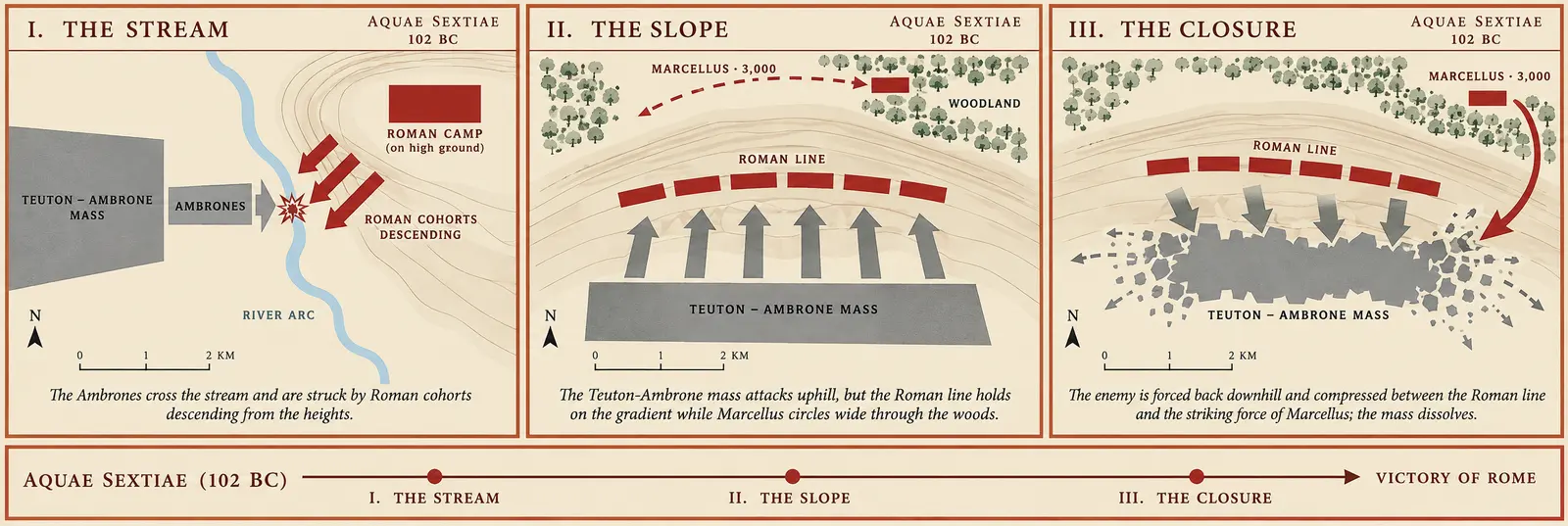
The migrating nations returned from Spain in 103, reunited in Gaul, and resolved — with the fatal deliberateness of a people who did not understand what had been rebuilt to meet them — on a converging invasion of Italy for 102: the Teutones and Ambrones to advance along the Mediterranean coast into Liguria, the Cimbri to cross the eastern Alps by the Brenner, the Tigurini to demonstrate through the Julian passes. The division was the Romans' salvation, for it allowed the two consular armies to meet the columns in sequence. Marius, waiting behind entrenchments at the junction of the Isère and the Rhône, let the Teutonic host flow past his camp — six days, the tradition says, the wagons took to pass, the warriors shouting up at the palisades asking whether the Romans had messages for their wives — and then followed, choosing his ground at Aquae Sextiae (Aix-en-Provence) in the dry hills where Sextius had planted the province's first colony. The battle was opened by accident — a brawl of water-carriers at the stream between the camps drew in the Ambrones, who were cut to pieces crossing the water — and consummated two days later by design: Marius drew the Teutonic mass uphill against his legions posted on the slope, the disciplined line holding and then pressing the enemy back down onto the plain, where the ambush he had laid the night before — three thousand men under Claudius Marcellus, circling through the woods to the enemy rear — struck the reversing mass from behind at the moment of maximum compression. The Teutones and Ambrones ceased to exist as peoples: the sources speak of one hundred thousand killed or taken, of the fields of Massilia fenced with bones, of vineyards fattened for a generation on the dead; King Teutobod was taken in the pursuit. Marius was burning the trophy-pyre of captured arms when the riders reached him with his fifth consulship — and with the news that the other jaw of the invasion had broken through.
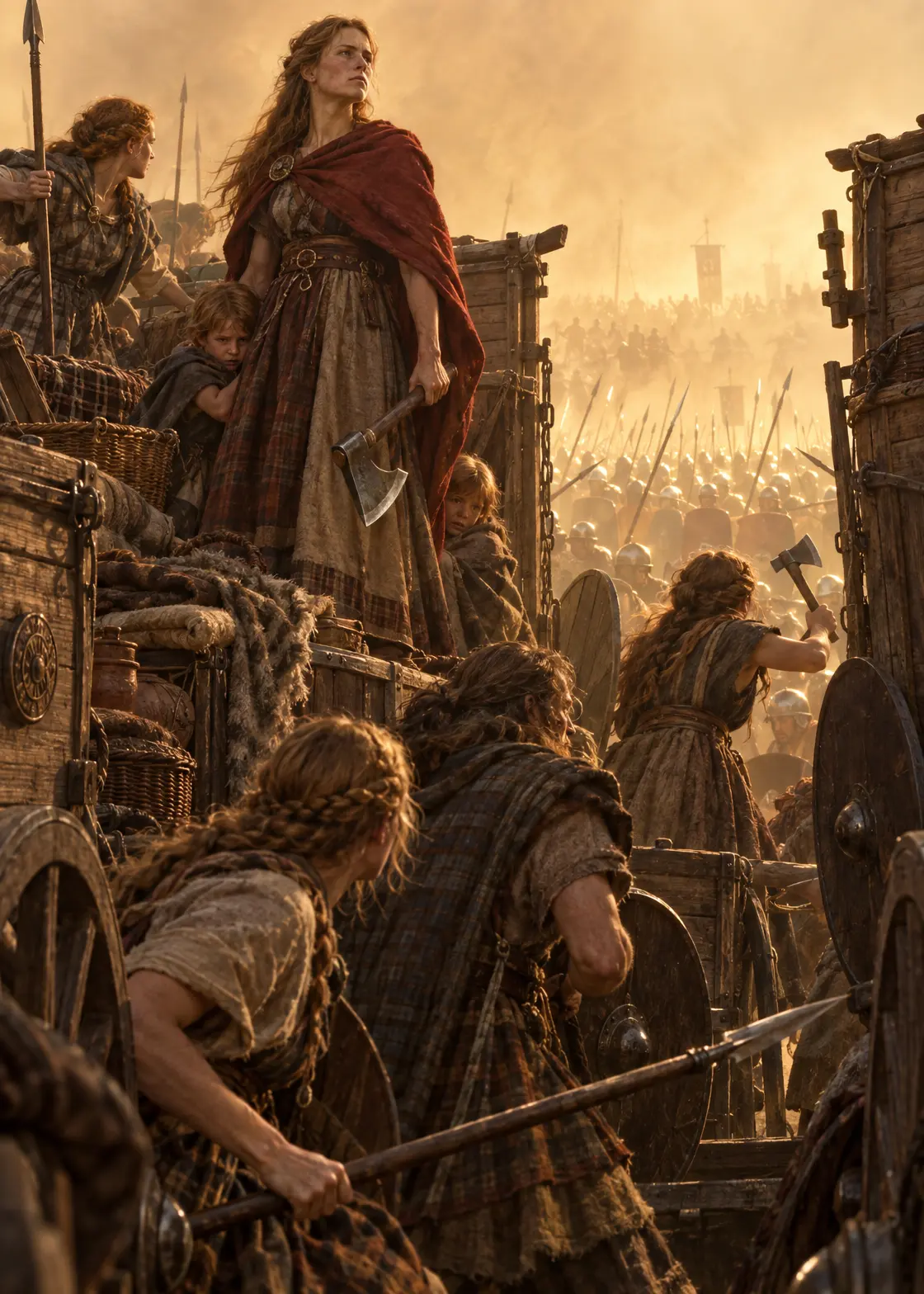
The Cimbri had crossed the Brenner in the same season, brushing aside the army of the proconsul Quintus Lutatius Catulus, which had attempted to hold the Adige gorges and had been saved from disintegration only by the self-possession of its military tribunes — among them Sulla, transferred from Marius's staff to Catulus's in the deepening chill between the two men. Northern Italy east of the Po wintered under the Cimbri, who — the detail is Plutarch's, and it fixed itself in the Roman imagination — slid the Alpine snowfields naked on their shields for sport. In the summer of 101 Marius brought the army of Gaul over to join Catulus, and the combined force of some fifty-two thousand met the entire Cimbric nation on the plain called the Raudine Field near Vercellae, west of Milan, on the thirtieth of July. The battle was fought in heat and blinding dust — conditions the Romans, trained in the African and Provençal sun, endured and the northern warriors could not; the Cimbric infantry, chained together in its front ranks by the sources' account, was enveloped and destroyed against its own wagon-laager, where the final horror was enacted by the Cimbric women, who killed their children and themselves rather than accept slavery, and whose defense of the wagons the sources describe with an awe that has nothing conventional in it. King Boiorix died fighting; the numbers given are one hundred twenty thousand dead and sixty thousand taken; the Tigurini, hearing, melted back through the passes; and the migration that had destroyed five consular armies in twelve years was gone from history. Marius was hailed by the acclamation of the whole state as the third founder of Rome, after Romulus and Camillus; his colleague Catulus, whose army claimed with some justice the decisive envelopment at Vercellae and whose memoir pressed the claim, was granted a share in a joint triumph and nursed the grievance; and Sulla, who had served Catulus through the campaign, filed the whole accounting away.
Saturninus, and the Sixth Consulship100 BC
The sequel demonstrated with cruel economy that the new army had solved Rome's foreign problem and created its domestic one. Marius's veterans of Africa and the north required land; land required legislation; legislation required tribunes; and the tribune to hand was Lucius Appuleius Saturninus — a demagogue of genuine ferocity, twice tribune, who in 103 had carried allotments for the African veterans and who in 100, allied with the praetor Servilius Glaucia and operating in open partnership with the sixth-time consul Marius, carried a program of colonial settlements for the northern veterans through assemblies that his organized gangs controlled by riot, appending to the law an oath of compliance that every senator was required to swear on pain of exile. Metellus Numidicus, Marius's old commander and enemy, alone refused the oath and went into exile with an epigram; and the Marian coalition, having broken the opposition, proceeded to break itself. At the consular elections for 99, Saturninus's men clubbed a rival candidate to death in the open comitium; the Senate passed the senatus consultum ultimum — its second deployment — and called upon the consul Marius to suppress his own confederates; and Marius, caught at last in the closing scissors of his double role as popular champion and chief magistrate, obeyed. Saturninus and Glaucia, besieged on the Capitol and surrendering on the consul's pledge of protection, were lodged in the Curia Hostilia; the mob — with what degree of senatorial orchestration the sources dispute — stripped the roof and stoned the prisoners to death with the tiles. Marius's pledge died with them. The greatest soldier of the age spent the following decade in eclipse — his eastern travels, his sixth-consulship prestige inverted into embarrassment, the nobility he had saved despising him with restored confidence — waiting, with a patience that would prove the most destructive force of the next chapter but one, for the state to need him again.
The Crossroads · Late 100 BC · Rome, at the Senate and the Capitol
The Consul's Dilemma: Marius and the Crisis of 100 BC
You are Gaius Marius, novus homo of Arpinum, hailed as the third founder of Rome after your victories at Aquae Sextiae and Vercellae, now serving your sixth consulship.
Your partnership with the tribune Lucius Appuleius Saturninus and the praetor Servilius Glaucia secured colonial land settlements for your veterans of Africa and the north, backed by an oath that drove your enemy Metellus Numidicus into exile. But during the consular elections for 99 BC, Saturninus's gangs clubbed a rival candidate to death in the comitium. The Senate has responded by deploying the senatus consultum ultimum for only the second time in history, commanding you as consul to suppress your confederates, who have seized the Capitol.
How do you respond to the Senate's decree commanding you to put down Saturninus and Glaucia?
Weigh each course: open it to hear your own inner voice. Then decide. Nothing is scored.
- Your inner voiceThe course taken
The consular magistracy is the pillar of my life and the Republic. If I defy the senatus consultum ultimum, I become a mere rebel, discarding the dignity of six consulships. Saturninus has crossed into murder, which no lawful state can overlook. I must summon the force to secure the Capitol, receive their surrender upon my consular word of safety, and protect both constitutional order and the lives of the men who gave my soldiers their land.
- Your inner voiceThe course taken
The patrician nobility has despised me from the day I rose from Arpinum, conceding commands only when barbarian terror left them no choice. Saturninus secured the land allotments my veterans bled for; without him, the Senate will repudiate those laws and leave my soldiers destitute. If I turn my veterans against the curia, I finish what the Gracchi could not, cementing popular rule upon the strength of the new legions that saved Italy.
- Your inner voiceThe course taken
I was acclaimed by the entire state as Rome's third founder after Vercellae. I must not lead citizens to butcher citizens on our sacred hills. If I refuse to lead troops against the Capitol and place my consular person between the factions, I can force the armed bands to disperse while compelling the Senate to respect the veterans' agrarian laws. Neutrality preserves my honor and prevents an irreparable fracture in the state.
What was done
Marius obeyed the senatus consultum ultimum, cut the Capitol's water pipes, and besieged Saturninus and Glaucia. When they surrendered upon his consular pledge of protection, Marius placed them inside the Curia Hostilia to await trial. But a mob—its degree of senatorial orchestration disputed in the tradition (BGrade B)—stripped the building's roof and stoned the prisoners to death with tiles. Marius's pledge died with them, shattering his standing. The Marian coalition broke itself; the nobility he had saved despised him with restored confidence, while the popular faction saw him as a traitor. The greatest commander of Rome spent the following decade in eclipse, departing on eastern travels and waiting with bitter patience for the Republic to need his sword again.
The evidence The crisis of 100 BC and the suppression of Saturninus rest on Appian Civil Wars 1.28–33 (BGrade B), which serves as the narrative spine for these events. The episode is supported by the Livian tradition in epitome (Periochae 69, CGrade C) and Plutarch's Marius (BGrade B), alongside constitutional analysis in modern scholarship by Lintott.
If you choose to walk through itAt every scale
- Yourself
Can personal honor survive when an office of state compels the destruction of the political allies who secured it?
- Those beside you
What duty does a commander owe to veteran soldiers and radical organizers whose violent measures won those soldiers their livelihood?
- Rome
Can constitutional emergency decrees restore civic peace, or do they merely sanitize factional violence and erode republican norms?
- The wider world
How does sudden domestic paralysis inside an imperial capital affect subject peoples and unsettled provincial frontiers?
- Our own time
When political polarization turns to factional street violence, how can constitutional authorities enforce the law without fatally dividing civic trust?
In troubled constitutional republics, a popular reformist executive or former military hero is often elevated to restore stability, only to watch radical factional partners deploy militia violence or intimidation to bypass legislative blockades. When the judicial or legislative establishment demands emergency measures against those partners, the leader faces an acute trap: enforce the law and destroy the movement that elected them, or tolerate lawlessness and wreck the constitutional order.
Where the comparison fails. Modern constitutional republics possess professional civilian police forces, statutory due process, and standing courts, whereas the late Roman Republic lacked a municipal police force, leaving magistrates dependent on armed citizens, personal clients, and ad hoc violence to suppress urban unrest.
What does the chapter tell us?
What primary operational failure caused the catastrophic Roman defeat at Arausio in 105 BC?
The aristocrat Caepio refused to cooperate with or combine camps alongside the new man Mallius. Fearing that Mallius's negotiations would deprive him of a triumph, Caepio attacked independently, resulting in both Roman armies being destroyed against the Rhône.
Rutilius Rufus via Granius Licinianus (CGrade C) and the chapter's narrative
Which constitutional precedent was broken in the immediate aftermath of the disaster at Arausio?
To confront the northern migration after five consular armies were lost, the assembly suspended the traditional rotational principle of the annual magistracy, electing Marius consul for 104 BC in absentia and repeatedly re-electing him through 100 BC.
Plutarch Marius (BGrade B) and the chapter's narrative
What tactical combination enabled Marius to destroy the Teutones and Ambrones at Aquae Sextiae?
Marius posted his disciplined legions on a slope, drawing the Teutones uphill, and then struck their compressing rear with three thousand men hidden in the woods under Claudius Marcellus.
Plutarch Marius (BGrade B) and Frontinus Stratagems (CGrade C)
Why must Plutarch's account of the Cimbric campaigns be evaluated with critical caution?
Plutarch's Marius and Sulla rely substantially on the partisan memoirs of Catulus—who disputed credit for the victory at Vercellae—and Sulla, both of whom became Marius's bitter rivals.
The chapter's Editor's Note (BGrade B)
What event provoked the Senate to pass the senatus consultum ultimum in late 100 BC?
During the consular elections for 99 BC, partisans of the tribune Saturninus and the praetor Glaucia murdered a competing candidate in the open comitium, prompting the Senate to order Marius to suppress them.
Appian BC 1.28–33 (BGrade B)