Book V · The Crisis of the Republic
Chapter 4
The Social War and the Civil Wars of Marius and Sulla
The Italian Question and the Social War91–88 BC
The question that detonated the first general war on Italian soil since Hannibal was the one Gaius Gracchus had raised and Rome had refused for thirty years: the citizenship of the allies. The Italian socii — the confederated peoples whose manpower had won every war in this compendium, who supplied by the late second century perhaps two-thirds of every Roman army, who bled at Arausio and Vercellae in Roman quarrels under Roman discipline — remained excluded from the citizenship whose burdens they carried: without vote, without appeal against the rod and axe of Roman magistrates, without share in the land distributions their service underwrote, and increasingly, as the Gracchan land commissions had shown, liable to have their own occupied lands resumed for the benefit of Roman settlers. The tribune Marcus Livius Drusus — son of the Drusus who had outbid Gaius Gracchus, and a reforming conservative of the paradoxical kind the late Republic occasionally produced — made the last constitutional attempt in 91 BC: a grand compromise of land and grain laws for the plebs, jury reform splitting the courts between Senate and equestrians, and enfranchisement for the Italians. Every interest he balanced turned against the balancer; his laws were annulled on a religious technicality; and in the autumn of 91 he was struck down in the evening crowd at his own doorway by an assassin's knife that was never officially traced — dying, Velleius reports, with the question whether the Republic would ever have a citizen like himself again. The Italians, who had bound themselves to Drusus by secret oath and whose hopes died with him, went to war within weeks; the spark was struck at Asculum in Picenum, where the town rose and massacred every Roman resident within its walls.
The war that followed — the bellum sociale, the war of the allies — was the strangest and among the deadliest Rome ever fought: a war against her own army, in effect, for the enemy was organized, equipped, drilled, and officered on the Roman model by men who had learned war in Roman service. The insurgent confederacy — its core the Marsi of the central Apennines under Quintus Poppaedius Silo and the Samnites under Gaius Papius Mutilus, with the Paeligni, Vestini, Marrucini, Frentani, Picentes, Lucanians, and Apulians in association — established a capital at Corfinium, renamed Italica, with a senate of five hundred, consuls, praetors, and a coinage whose types declared the program: the Italian bull goring the Roman wolf. The fighting of 90 BC went heavily against Rome on both fronts — the consul Rutilius Lupus killed in a river ambush in the Marsic north, his colleague repeatedly mauled in Campania, where Mutilus's Samnites took Nola and the coastal cities; the state put out its full strength, recalling every commander of capacity including the aging Marius, who handled the northern front with a steadiness his enemies called sluggishness, and the legate Sulla, whose service in the south began his ascent to independent fame. But the war was decided as much by statute as by steel. The lex Julia of late 90, carried by the consul Lucius Julius Caesar, granted citizenship to every allied community that had not revolted or would lay down arms; the lex Plautia Papiria of 89 extended it to individuals of the insurgent peoples presenting themselves within sixty days; and the confederacy, its grievance conceded in principle, fought on only where hatred outran calculation. In 89 the northern front collapsed after Asculum fell to Gnaeus Pompeius Strabo — father of Pompey the Great, a commander of glacial cruelty who triumphed over the ruins — while Sulla in the south retook Campania and broke the Samnites in the field, winning the consulship for 88 on the credit. Silo died in a last battle in 88; the Samnites and Lucanians smoldered unreconciled, awaiting the occasion they would find four years later; and Italy south of the Po emerged from three years of war and perhaps three hundred thousand dead as, in law, a single citizen state — the new citizens carefully registered, in a final Roman meanness that would furnish the next decade's politics, into a minority of the voting tribes so that their numbers could never control an assembly.
The March on Rome88 BC
The transformation of the citizen question into the first Roman civil war required only the collision of the new army with the old politics, and the collision came in the first year of the peace. The great eastern crisis had broken: Mithridates VI of Pontus — of whom the next chapter will treat at length — had overrun Asia and ordered the massacre in a single prearranged day of the Roman and Italian residents of the province, eighty thousand dead by the ancient count; and the command against him, the richest prize the Republic had ever offered, was assigned by the Senate to the consul Sulla, who stood with the army of the Social War still embodied at Nola. At Rome the tribune Publius Sulpicius Rufus — a Drusan reformer turned radical, carrying laws to distribute the new Italian citizens through all the tribes against furious senatorial resistance — struck his bargain with the one man whose name could counterweight a consul: the tribal-distribution laws would pass under the protection of Marian veterans, and the Mithridatic command would be transferred by plebiscite from Sulla to the sixty-nine-year-old Marius. It was the Numidian precedent of 107 replayed; but the army had changed since 107, and Sulla understood the change as no man yet had. When the tribunes' officers reached Nola to take over the legions, the soldiers — whose stake in the eastern war was the plunder of the richest kingdom in the world, and whose loyalty ran to the commander who would lead them to it — stoned them to death; and Sulla, putting the question to the army in assembly, marched six legions on Rome. Every senior officer but one — his quaestor, Lucius Licinius Lucullus — refused to accompany the march; the city, defenseless, was taken after hours of street-fighting against improvised barricades and roof-tiles, the first armed capture of Rome in its history by its own army; Sulpicius was betrayed by a slave and killed, his head displayed in the Forum on Sulla's order (the slave freed for the service, then flung from the Tarpeian rock for the treachery); and Marius, hunted through the coastal marshes of Latium, was taken at Minturnae — where the sequence that became one of antiquity's most retold tableaux unfolded: the Gallic or Cimbric trooper sent into the darkened room to kill him recoiling from the old man's eyes and the growl "Man, do you dare to kill Gaius Marius?"; the magistrates, ashamed, shipping him instead to Africa; the Roman governor's officer there forbidding him to land; and the answer sent back from the small boat off the shore of the province he had conquered — "Tell the praetor you have seen Gaius Marius a fugitive, sitting amid the ruins of Carthage." The tableau's polish is the tradition's, but its currency began at once, and its meaning was not lost on contemporaries: the Republic now did these things to its own.
Sulla, having passed laws to shackle the assemblies, took his legions east in 87 to the war the whole convulsion had been about — and the settlement collapsed behind him within months. The consul Cinna, reviving the Sulpician program, was driven from the city by his colleague Octavius in rioting that killed thousands, declared deposed, and did what deposed men with the new army's example before them now did: raised the Campanian legions, recalled Marius from Africa, and besieged Rome. The city fell in late 87 through famine and defection; and the five days that followed gave the language its first taste of what the word "Marian" would thereafter carry. The consul Octavius, refusing flight, was killed in his curule chair and his head — a consul's head, the first — nailed to the Rostra; the orator Marcus Antonius, grandfather of the triumvir and the greatest speaker of the age, was hunted to a safe-house and killed mid-persuasion, the soldiers' commander weeping as he carried the head away; Catulus of Vercellae, prosecuted toward certain death, suffocated himself with charcoal fumes; the slave-bodyguard Marius enrolled — the Bardyaei — killed on a nod or a refused greeting until Cinna and Sertorius, a Marian officer with a conscience the age had not yet worn out of him, surrounded and butchered the butchers in their sleep. Marius entered upon the seventh consulship the prophecy of his youth had promised on the first of January 86, and died on the seventeenth day of it, aged seventy, of pleurisy and, the tradition insists, of drink and raving; the sequel belonged to Cinna, who ruled by continuous consulship — the dominatio Cinnae — for three years of ominous, administrative quiet, while in the East the outlaw proconsul (Sulla had been declared a public enemy, his laws annulled, his house razed) fought the Mithridatic war on his own credit, and in 84 Cinna, embarking troops to confront him, was stoned to death by his own mutinous soldiers on the Ancona shore. The Republic's constitutional history in these years reduces to a single sentence: every armed man had learned that the state was whoever held Rome, and Rome was whoever held an army.
Sulla's Return and the Colline Gate83–82 BC
Sulla landed at Brundisium in the spring of 83 with forty thousand veterans of the eastern war — the Mithridatic campaign itself, with its sieges and set-pieces, is treated in the following chapter, but its political product landed here: an army five years bound to its imperator by oath, plunder, and outlawry — and the last civil war of the cycle unfolded across eighteen months of Italy. The young men came to him: Marcus Licinius Crassus, whose father and brother had died in the Marian terror, out of Spain with a private force; and Gnaeus Pompeius, twenty-three years old, who raised three legions from his father Strabo's veterans in Picenum on his own authority and presented himself with them — saluted, to the scandal of every constitutionalist and the delight of the army, as imperator by Sulla, who understood exactly what he was buying and what precedent he was setting. The government's new-citizen levies fought better than the government: the consul Norbanus was beaten at Canusium; the army of his colleague Scipio Asiaticus was talked out from under him at Teanum, deserting entire during a parley-truce; but the campaign of 82 in the north between Pompey, Metellus Pius, and the younger Marius's partisans, and in the center between Sulla and the consul Carbo, was hard and bloody through the summer — the younger Marius, defeated at Sacriportus, penned in Praeneste with the treasury; the Marian government, before abandoning Rome, perpetrating its final atrocity in the murder of the pontifex maximus Scaevola in the temple of Vesta itself; Carbo losing heart and sailing for Africa, leaving his armies to dissolve. What remained was the unreconciled remnant of the Social War: the Samnite and Lucanian armies under Pontius Telesinus, seventy thousand strong, who having failed to relieve Praeneste turned on Rome itself with the declared program — the phrase was reported from Telesinus's harangue — of demolishing the wolf's den outright, since Italy would never be free while the wolf lived in it. Sulla's army, force-marching, reached the city hours ahead of the storm, and the battle was joined against the northern walls, before the Colline Gate, on the afternoon of the first of November 82: the last pitched battle of the Italic peoples against Rome, and Rome's nearest approach to extinction since the Gauls. Sulla's own left, which he commanded, was broken and driven against the walls — the fugitives trampled at the gates, which the veterans of the garrison slammed against friend and enemy alike; Sulla, by his own memoirs' account, prayed aloud to his Apollo amid the wreck; and the battle was retrieved from the other wing, where Crassus shattered the Samnite right and rolled up the line in a night of killing that ran on into the following day. Telesinus was found dying on the field with the expression, witnesses said, of the victor he had nearly been; the Samnite prisoners, some thousands, were penned in the Villa Publica on the Campus Martius; and two days later, while Sulla addressed the Senate in the temple of Bellona nearby, the prisoners were slaughtered to a man on his order, the screams filling the pauses of the speech — the senators starting to their feet, and Sulla, not raising his voice, instructing them to attend to what he was saying: it was merely some criminals being corrected.
The sentence stood for the regime. Within days the first proscription lists went up in the Forum — the innovation that gave the language a word: names published, the named stripped of law, their killers rewarded from the estate, their sons and grandsons barred from office, informers enriched, the heads receipted and displayed. Forty senators and sixteen hundred equestrians stood on the first lists; the final toll ran far higher, swollen by the entrepreneurial murders the mechanism invited — men proscribed because they were rich, one victim famously reading his own name and observing that his Alban villa had killed him. Crassus built the foundations of the greatest fortune in Rome buying proscribed estates at auction; the young Julius Caesar, nephew by marriage of Marius and son-in-law of Cinna, refused Sulla's order to divorce, went into hiding in the Sabine hills, and was spared at last on the intercession of his connections — with the warning, which every ancient biographer records and no modern one can resist, that in that boy were many Mariuses. The constitutional settlement followed on the terror's foundation: Sulla revived, for the first time in a hundred and twenty years, the dictatorship — held without time limit, legibus scribundis et rei publicae constituendae, for the writing of laws and the ordering of the state — and legislated the senatorial republic back into a fortress: the tribunate stripped of legislative initiative and veto and made a career dead-end, the courts restored to senatorial juries, the cursus honorum fixed in law with minimum ages and mandatory intervals, the provincial commands bounded by treason law, the Senate doubled to six hundred with his partisans, three hundred thousand acres of Italy planted with a hundred thousand of his veterans — a standing army of the settlement, quartered on the confiscated lands of Samnium and Etruria, whose ruined prior owners would furnish every insurrection of the following generation. And then, in 79, the act that Caesar alone in the next generation professed himself unable to understand: Sulla resigned the dictatorship, dismissed his lictors, and walked the Forum as a private citizen, offering — the gesture was the message — to render account to any man who asked. None asked. He retired to Campania, to the memoirs, the hunting, and the actors of his raffish youth, and died within the year of a hemorrhagic disease the tradition rendered loathsome; the epitaph he composed for himself said that no friend had ever outdone him in kindness, nor any enemy in harm. The state gave him the grandest funeral in its history, the legions marching, the matrons contributing spice by the hundredweight — and the settlement he had built to last forever began to be dismantled, by his own lieutenants, within two years.
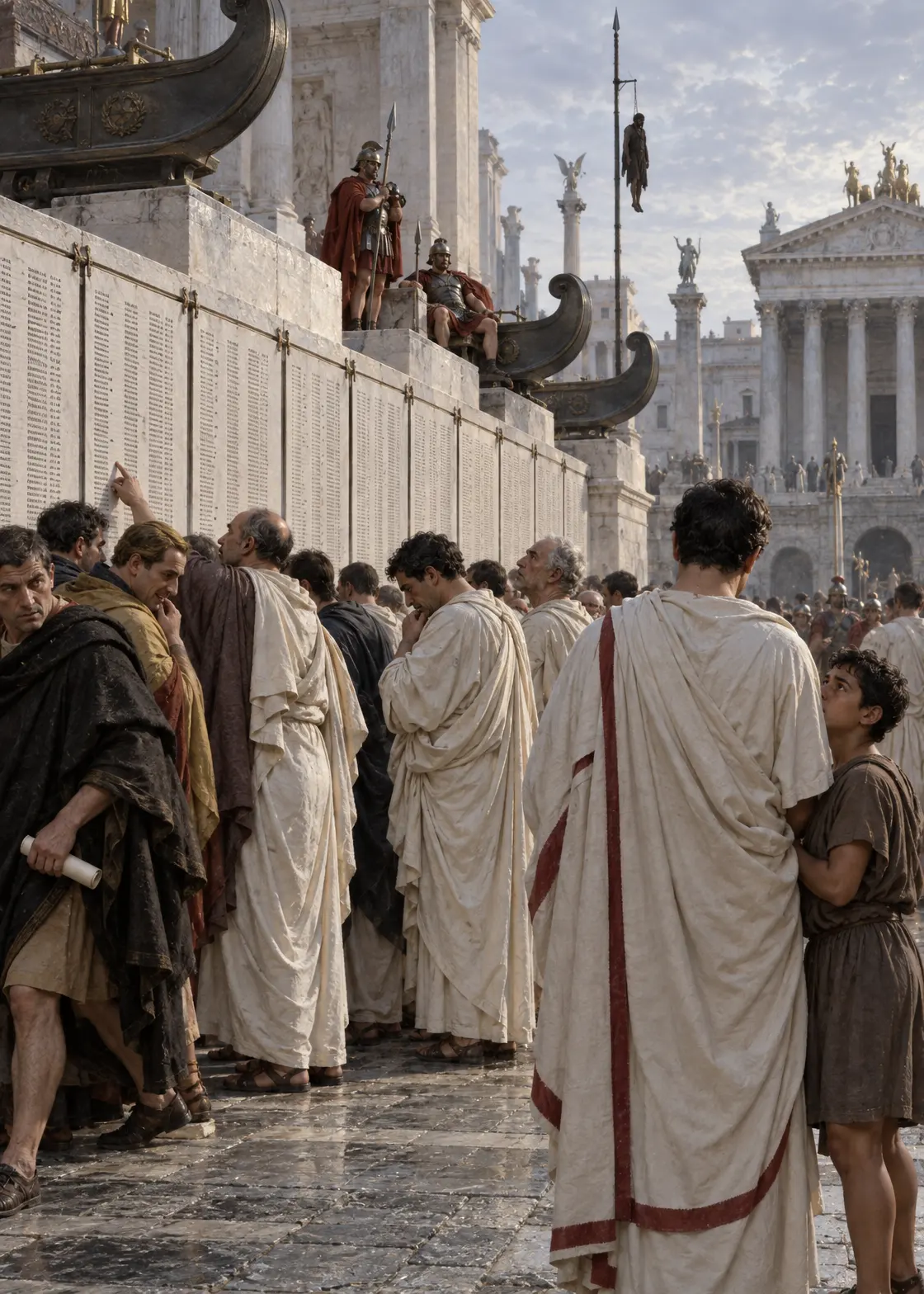
The Crossroads · 88 BC · The Roman camp outside Nola, Campania
The March on Rome
You are the consul Lucius Cornelius Sulla, standing before your six veteran legions outside Nola.
Having broken the Samnites in the Social War and won the consulship, the Senate assigned you the command against Mithridates VI of Pontus, who has overrun Asia and massacred eighty thousand Roman and Italian residents. But at Rome, the tribune Publius Sulpicius Rufus struck a bargain with the aging Gaius Marius: passing laws to distribute the new Italian citizens through all thirty-five tribes in exchange for transferring your eastern command to Marius by plebiscite. When Sulpicius's military tribunes arrived at your camp at Nola to take over the army, your soldiers—eager for eastern plunder and loyal to the general who led them—stoned the tribunes' officers to death. Marius and Sulpicius control the city through armed mobs; your officers hesitate; and blood has already been spilled.
How will you respond to the assembly's revocation of your command?
Weigh each course: open it to hear your own inner voice. Then decide. Nothing is scored.
- Your inner voiceThe course taken
If I yield the Mithridatic command to Marius, I preserve the sacred laws of the Republic. No consul has ever led Roman legions against Rome itself. Yet Sulpicius has used Marian veterans to intimidate the Forum, and my soldiers have already stoned the tribunes' messengers to death. If I lay down my imperium, I face certain trial, exile, or death at the hands of Marius, leaving my men defenseless and my name utterly ruined.
- Your inner voiceThe course taken
I could bypass Rome entirely and embark these legions from Brundisium for Asia. Mithridates has butchered eighty thousand Romans and Italians; our duty lies against the foreign king, not against our countrymen. Yet sailing as a stripped commander leaves our rear open to declared outlawry. Marius will seize our estates, raise new legions to follow us, and label every veteran under my standard an armed rebel wandering the eastern provinces without authority.
- Your inner voiceThe course taken
I must put the question directly to the soldiers and lead these six legions straight to Rome. Sulpicius and Marius have subverted the Senate by mob violence and plebiscite. The men know the eastern plunder belongs to them, not to Marius's recruits. Rome has never fallen to its own legions, and nearly all my senior officers will recoil, but the Republic now belongs to whoever has the courage to wield the army to restore order.
What was done
Sulla put the question to his army in assembly and marched six legions on Rome. Every senior officer except his quaestor, Lucius Licinius Lucullus, refused to accompany the march. Rome fell after hours of street-fighting against improvised barricades and roof-tiles—the first armed capture of the city by its own army in history. Sulpicius was betrayed by a slave and killed, his head displayed on the Rostra in the Forum, while the slave was freed and then flung from the Tarpeian rock. Marius escaped through the coastal marshes to Minturnae and fled to Africa (BGrade B–C). Having passed laws to shackle the assemblies, Sulla embarked his legions east in 87 BC for the Mithridatic war. Yet the constitutional precedent proved fatal: within months, the consul Cinna raised legions, recalled Marius, and besieged Rome anew, unleashing a bloody terror that consumed consuls, orators, and the Republic's remaining peace.
The evidence Appian's Civil Wars (1.34–107, BGrade B) provides the continuous narrative of the march on Nola and Rome. Plutarch's Sulla and Marius (BGrade B) furnish biographical detail, drawing directly on Sulla's twenty-two-book Memoirs (AGrade A substrate, completed just before his death) and supplemented by Plutarch's Lucullus. The lost contemporary Historiae of Sisenna (CGrade C fragment) forms the missing annalistic control. Livy's Periochae (Books 71–90, CGrade C) records the march in epitome, while the tableau of Marius at Minturnae reflects rhetorical traditions rated BGrade B–C.
If you choose to walk through itAt every scale
- Yourself
When personal survival and rightful political honor are stripped away by legal maneuver, at what point does obedience to constitutional forms become political suicide?
- Those beside you
How does a commander weigh the moral refusal of his fellow aristocratic officers against the fierce, self-interested devotion of the ordinary soldiers under his command?
- Rome
Can an armed breach of constitutional norms ever truly preserve the institutions it violates, or does the first march on the capital inevitably destroy the civic peace?
- The wider world
How does an empire's internal factional collapse alter its ability to defend allied provincial populations against ambitious foreign powers?
- Our own time
When professional armed forces develop material loyalties to individual leaders rather than the state, what checks remain to keep military power subordinate to civil authority?
In nineteenth-century Latin America and Spain, regular armed forces repeatedly intervened in domestic politics through military pronunciamientos. Underfunded armies frequently showed greater loyalty to charismatic field commanders who guaranteed their pay, promotions, and land grants than to civilian assemblies in the capital. When legislative factions attempted to dismiss popular generals or strip their commands, commanders routinely mobilized their garrisons to march on the seat of government, claiming they were acting solely to restore constitutional order and purge corrupt politicians.
Where the comparison fails. Unlike late Republican Rome, modern states possess formalized bureaucracies, professional civil services, and standing legal frameworks independent of individual magistrates. Furthermore, Sulla's soldiers were recruited from landless citizens whose entire post-service livelihoods depended personally on eastern plunder and commander-administered allotments, creating an absolute personal dependency rarely matched in institutional modern militaries.
What does the chapter tell us?
What immediate event triggered the outbreak of the Social War across central and southern Italy in 91 BC?
The tribune Marcus Livius Drusus attempted a grand compromise that included enfranchising the Italian allies. When his laws were annulled and he was murdered at his doorway in the autumn of 91 BC, the allies went to war within weeks, beginning with a massacre of Romans at Asculum.
Appian BC 1.34–107 (BGrade B) and Velleius 2.15–28 (CGrade C)
How did Rome primarily break the political cohesion and military momentum of the Italian insurgent confederacy?
The war was decided as much by statute as by steel. The lex Julia of 90 BC conceded citizenship to allied communities that had not revolted or laid down arms, and the lex Plautia Papiria extended it to individuals, causing the rebel coalition to unravel.
Appian BC 1.34–107 (BGrade B)
When Sulla resolved to march on Rome in 88 BC, how did his senior officer corps respond to the order?
While the ordinary legionaries followed Sulla eagerly to protect their prospective eastern plunder, his aristocratic officers recoiled from the sacrilege: every senior officer except his quaestor, Lucius Licinius Lucullus, refused to take part in marching against the city.
the chapter's narrative (drawing on Plutarch Sulla, BGrade B)
What was the declared objective of the Samnite and Lucanian commander Pontius Telesinus at the Colline Gate in 82 BC?
Having failed to relieve Praeneste, Telesinus turned seventy thousand Samnites and Lucanians directly upon Rome, declaring in his harangue that the wolf's den must be demolished outright, because Italy would never be free as long as the Roman wolf lived.
the chapter's narrative (drawing on Sulla's Memoirs, AGrade A substrate, and Plutarch Sulla, BGrade B)
Which set of measures characterized Sulla's dictatorship following his victory in the civil wars?
Sulla introduced published proscription lists to eliminate enemies and enrich partisans, revived an open-ended dictatorship, stripped the tribunate of legislative initiative and veto power, restored juries to senators, doubled the Senate to six hundred, and planted a hundred thousand veterans on confiscated Italian land.
Appian BC 1.34–107 (BGrade B) and Cicero Pro Roscio Amerino (AGrade A)