Book V · The Crisis of the Republic
Chapter 5
Wars in the Shadow of the Settlement: Mithridates, Sertorius, Spartacus
The First War Against Mithridates88–85 BC
The eastern war whose command had broken the constitution in 88 deserves the fuller treatment deferred from the preceding chapter, for its antagonist was the most formidable foreign enemy Rome faced between Hannibal and the Parthian ascendancy. Mithridates VI Eupator, king of Pontus — the Hellenized Iranian realm along the Black Sea's southern shore — had come to his throne as a boy amid court murder, survived (the tradition says) by years of self-imposed exile in the wild and by the systematic self-administration of graduated poisons that made his immunity proverbial, and built across four decades a Black Sea empire embracing the Crimea, Colchis, and the Anatolian interior. He was a figure calculated to seize the Greek imagination and the Roman nightmare alike: speaking, the tradition claimed, the languages of all twenty-two nations he ruled; a giant in body; a collector of antidotes, concubines, and grievances; and the first eastern monarch since Hannibal to understand that Rome's empire was most vulnerable in the hatred of its own subjects. When the collision came in 89–88 — provoked by Roman commissioners goading Bithynia into raiding Pontic territory, with the province of Asia stripped of troops for the Social War — Mithridates swept the peninsula in a single campaign, and then transformed invasion into revolution with the order already noticed: the coordinated massacre, on a single day of 88, of the Roman and Italian residents of Asia — merchants, tax-farmers, families; the ancient figures run from eighty to one hundred fifty thousand — carried out by the Greek cities with an enthusiasm that measured, better than any speech, what a generation of the publicani had made of Roman rule. Greece itself then rose to him; Athens, under the philosopher-tyrant Aristion, declared for the king; and it was against this position — the Aegean world in arms, Italy barely out of the Social War, Rome descending into the Marian terror behind him — that Sulla crossed with five legions in 87.
The campaign that followed made the army that would conquer Rome. Sulla besieged Athens and the Piraeus through the winter of 87–86 with a thoroughness that consumed the sacred groves of the Academy and the Lyceum, felled for siege timber, and the treasuries of Olympia and Delphi, borrowed against with a soldier's piety; the city starved until men boiled hides in the Ceramicus, and fell by night assault on the first of March 86, the breach carried at the Heptachalcum, the slaughter running until — the phrase is preserved as his — Sulla declared that he spared the living for the sake of the dead, forgiving the few Athenians for the sake of their ancestors. Aristion, taken later on the Acropolis, was poisoned; the Piraeus, Themistocles's harbor-fortress, was burnt to its foundations and never in antiquity recovered its rank. In Boeotia that summer the king's grand army under Archelaus — the sources give it one hundred twenty thousand, against Sulla's perhaps forty — met the legions at Chaeronea, where Greece's battles went to die; the scythed chariots that opened the Pontic attack were received by the veterans with opened lanes and derisive applause, as at a circus, and the phalanx of freed slaves behind them, pinned by pila and the entrenchments Sulla had dug across the plain, was enveloped and destroyed — the Roman casualty return, as Sulla's memoirs preserved it with a straight face, being twelve men missing, of whom two returned by evening. The following year at Orchomenus, on the drained lakebed of the Copais, Archelaus's rebuilt army caught the Romans entrenching and broke the line — the day retrieved by Sulla himself on foot among the fugitives with a standard, shouting that when men asked where they had abandoned their imperator, they should answer: at Orchomenus; the line turned, the trenches were carried, and the marsh finished what the sword began. With Asia in revolt against the king's increasingly Oriental severities, with a rival Roman army — the Marian government's, its commander Flaccus murdered by his own legate Fimbria, who then campaigned with cheerful savagery across the straits — burning Ilium itself, Mithridates treated. At Dardanus in 85, king and proconsul met: the terms — evacuation of all conquests, seventy warships, two thousand talents, the status of Roman ally restored — were of a mildness that scandalized the army until Sulla explained it with his usual candor: he could not fight Mithridates and Rome at once, and Rome came first. Fimbria's army, confronted, deserted its commander, who fell on his sword at Pergamum; the province of Asia was fined twenty thousand talents and quartered upon by the legions in a winter that broke its economy for a generation; and Sulla turned west, to the war this compendium has already followed to the Colline Gate, leaving Mithridates diminished, instructed, and alive — a deferral of account that a second, trivial war (81–80, the freelance aggressions of the legate Murena, checked by the king and disowned by Sulla) did nothing to settle, and that would cost Rome twenty further years.
Sertorius: The Republic in Exile80–72 BC
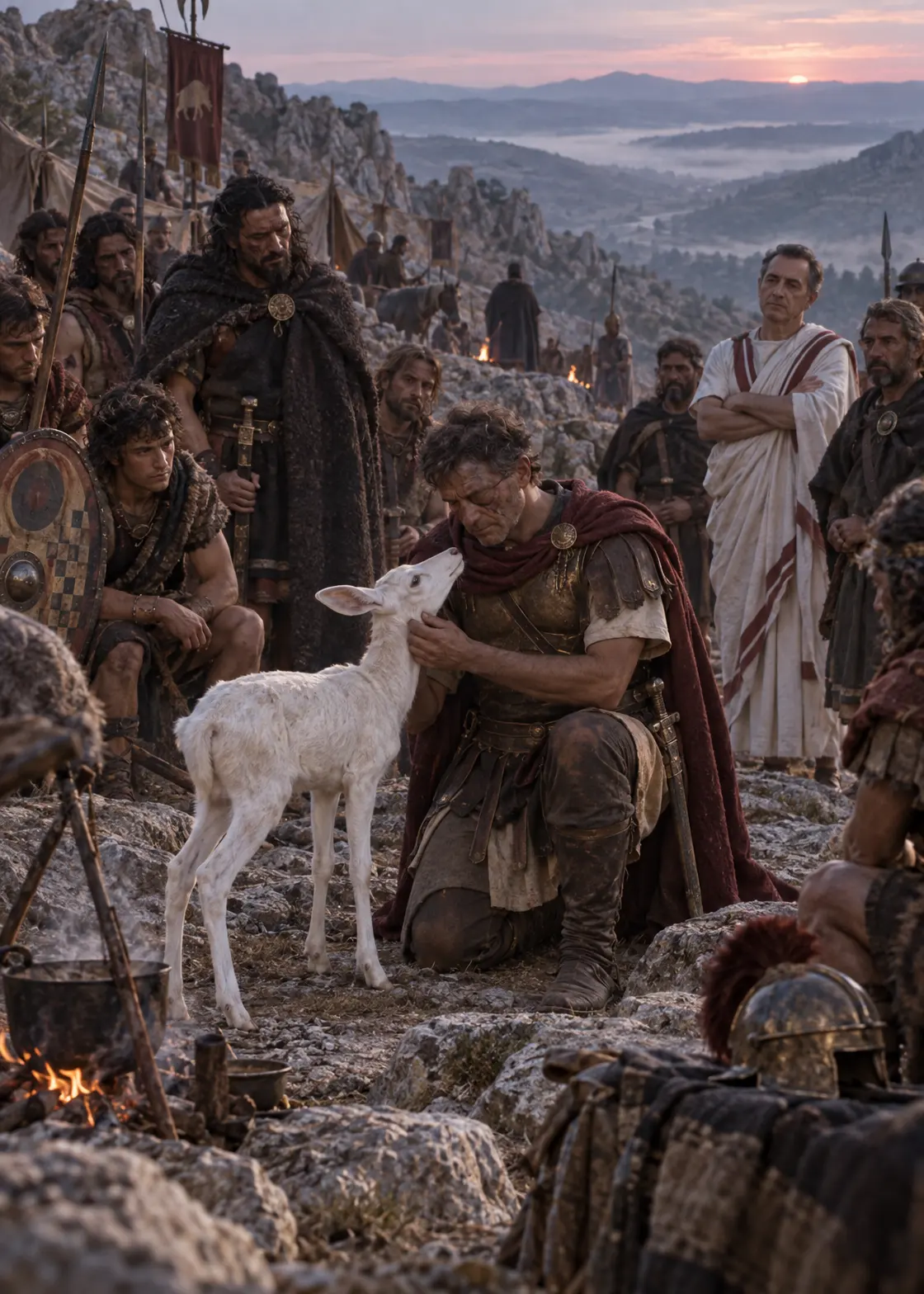
The Sullan settlement's first great war was fought against the best soldier the Marian cause ever produced. Quintus Sertorius — Sabine, novus homo, the officer whose conscience had ended the Bardyaei and whose eye had been lost in the Cimbric war (he alone of Roman commanders, Plutarch notes, wore his mutilation as an ornament) — had taken the praetorian province of Nearer Spain in 83, been proscribed and driven out in 81, and returned in 80 at the invitation of the Lusitanians to become, for eight years, the most dangerous man in the Roman world: an outlaw proconsul governing half the peninsula through a counter-state of his own construction. He gave the exiled Marians a senate of three hundred; he gave the Spanish nobility a school at Osca where their sons learned Latin and the toga — education and hostageship in one institution, the boys' fate a lever he would eventually, in his decline, use with a cruelty that stained him; he gave the tribes his justice, his charisma, and the white fawn of Diana that followed him like a dog and through which, he let it be believed, the goddess whispered intelligence — the fawn's disappearances and returns stage-managed, Plutarch says frankly, to schedule revelations whose real sources were his scouts. And he gave the Roman government a military education. Metellus Pius, the ponderous and competent proconsul sent against him, was run ragged for years by a war of ambush, feint, and vanished columns — Sertorius lecturing his Spanish levies, in the parable the tradition loved, with the two horses: the strong man exhausting himself tearing at the sound horse's tail, the weak man plucking the feeble horse's hairs one by one until the tail was gone. When the government reinforced with Pompey in 77 — twenty-nine years old, never a magistrate, granted proconsular imperium by a Senate that swallowed the irregularity with the epigram of the consul-elect Philippus, that he went out not in place of a consul but in place of both of them — Sertorius handed the young conqueror his tuition at Lauron, luring him to spectate the town's siege and then revealing, once Pompey stood committed before the walls, the six thousand men posted behind him, so that Pompey watched the town burn — the phrase went around — as an audience rather than an army. The campaigns of 76 and 75 in the eastern river valleys were the war's hard center: at the Sucro Pompey, attacking without waiting for Metellus, was beaten on his own wing and escaped capture only by abandoning to the Spaniards a horse caparisoned in gold, which they paused to fight over; at Saguntum the allied armies bled each other through a drawn day; and in the winter of 75–74 Pompey's dispatch to the Senate — preserved in substance by Sallust — announced that his unpaid, unfed army had conquered the passes and the coast, and that if the treasury did not act, the war and the army would come home to Italy together: the client-army logic of the age, stated for the first time as fiscal policy.
Rome paid; the attrition told; the Roman exiles around Sertorius, despising the Spanish war they could not win and the Spanish loyalty they could not command, curdled into conspiracy under Marcus Perperna, the well-born mediocrity whose army had joined Sertorius over his objection in 77; and the guerrilla king's last years darkened — the hostage-school's pupils punished for their fathers' defections, the drinking noted by a tradition hostile enough to invent it, the fawn's oracles wearing thin. In 73 Perperna's faction murdered Sertorius at a banquet staged for the purpose, the assassins' signal a dropped cup, the one-eyed man dying under the couches where he had been invited as a guest. The sequel was brief and instructive: Perperna, inheriting the war, was out-generaled by Pompey within weeks, taken in ambush, and — playing his last card — offered up Sertorius's captured correspondence, letters from named men of consular rank in Rome inviting the outlaw to Italy. Pompey had Perperna executed without an interview and burned the letters unread; and the Editor, who will have occasion in later chapters to weigh this man's vanities, records that no act of his long career better served the Republic, for the names in that correspondence, published, would have furnished the next civil war a decade early.
Spartacus73–71 BC
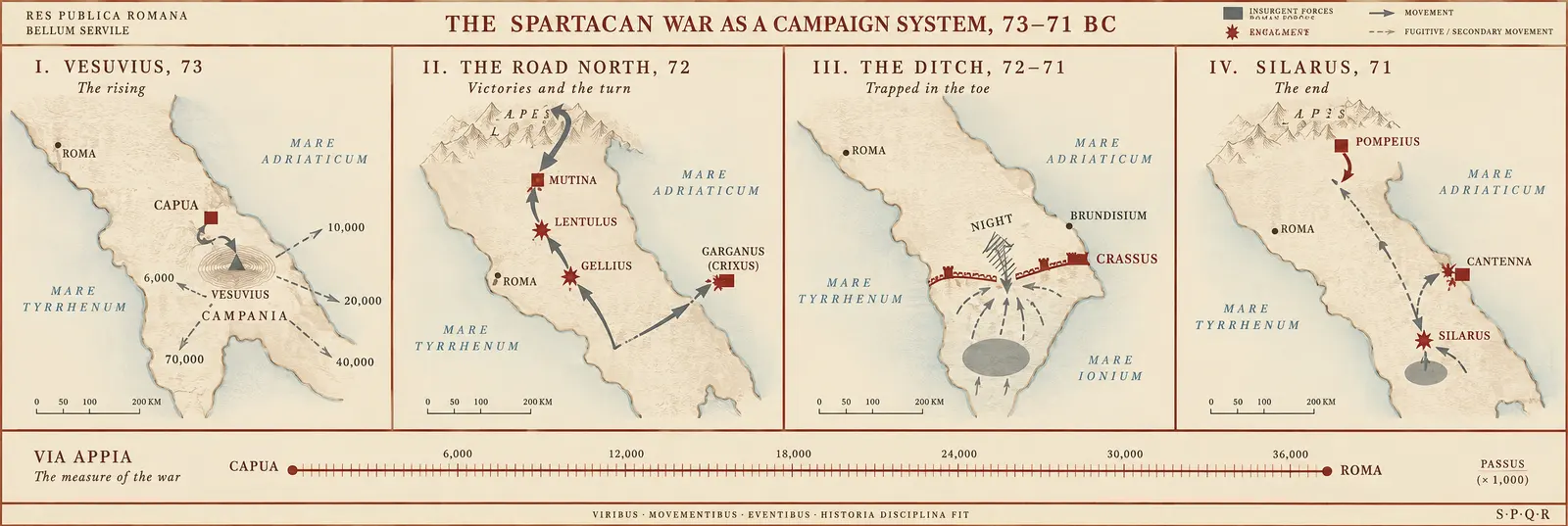
The servile war that terrified Italy while Sertorius died in Spain began with perhaps seventy men and kitchen knives. In 73 BC a group of gladiators broke out of the training-school of Lentulus Batiatus at Capua — Thracians, Celts, and Germans of the categories the schools bought in bulk — seized a wagonload of gladiatorial weapons on the road, and fortified themselves on Vesuvius, in the crater country then wild and unregarded. Their elected leaders were the Celts Crixus and Oenomaus and the Thracian Spartacus — a man, the sources agree across their hostility, of un-slavelike stamp: he had served Rome as an auxiliary before enslavement, and Plutarch adds both the Greek judgment that he was more Hellene than his fortune and the wife's prophecy, the serpent found coiled about his sleeping face and read as a sign of great and terrible power. The first force sent against the mountain — three thousand hasty levies under the praetor Claudius Glaber, who sealed the single descending path and proposed to starve the runaways out — was destroyed by the war's signature stroke: the gladiators plaited ladders from the wild vines of the crater, descended the sheer face Glaber had not troubled to watch, and took the siege camp from behind at night. The arsenal thus won armed the countryside; the latifundia of Campania and Lucania — the slave-barracks Italy had stocked from the conquests of the previous volume — emptied into the rebellion by tens of thousands; a second praetorian army under Varinius was defeated in detail through the autumn, its commander's own horse and lictors' fasces taken; and by the spring of 72 the servile army stood at figures the sources give between seventy and one hundred twenty thousand, drilling with Roman method under a leadership that forbade — the notice is Appian's, and it distinguishes this war from every prior servile outbreak — the possession of gold and silver in the camp.
The campaign of 72 broke the Republic's complacency in a single season. The insurgent leadership split along its permanent fault: Crixus with the Celto-Germanic contingent, intent on plunder and Italy, was caught and destroyed at Monte Gargano by the consul Gellius; Spartacus, whose consistent strategy — the sources are unanimous on the intent while marveling at it — was escape northward over the Alps to disperse his people to their homelands, defeated first Lentulus's consular army in the Apennines, then Gellius's, then the proconsul of Cisalpine Gaul at Mutina with ten fresh legions' worth of provincial troops; and at some point in this sequence he honored Crixus's shade with funeral games in the Roman manner, compelling three hundred Roman prisoners to fight as gladiators about the pyre — the war's mirror held up to its makers. And then, with the passes open before him, he turned back into Italy: the sources offer motives — the army's refusal to leave a peninsula it was stripping, the intoxication of victory, hopes of the discontented Italian poor — and the Editor offers, with them, only the observation that a general who could win every battle could not make seventy thousand freed slaves want to walk home. Rome, both consuls beaten in one year, suspended the consular command and conferred the war by extraordinary appointment on Marcus Licinius Crassus, praetorian, proscription-rich, and possessed of the one qualification the emergency wanted: he would spend. He raised six new legions on his own credit to add to the consular remnants; and he opened his command by reviving, upon the first cohorts that broke and ran, the punishment of decimation — the beaten unit divided into tens, the lots drawn, the tenth man clubbed to death by his nine messmates before the assembled army — administered, Appian's figure, upon some four thousand men, with the result the tradition records in a sentence: Crassus's soldiers came to fear their general more than the enemy.
The war's last winter compressed into the toe of Italy. Spartacus, marching south with a design on Sicily — where the embers of the previous servile wars still smoked, and whose seizure would have transformed the rebellion — was cheated by the Cilician pirates who took his fee for a crossing and sailed; and Crassus sealed the Bregantine peninsula behind him with the engineering stroke of the war: a ditch and wall across the entire isthmus, sea to sea — three hundred stadia, some thirty-five Roman miles, fifteen feet of depth and breadth with the rampart above — garrisoned along its length. The blockade winter starved the servile army until, in a night of snow and storm, Spartacus filled a section of the ditch with earth, brush, and — Appian adds — the bodies of prisoners and cattle, and threw a third of his force across before the line could close; the remainder followed in the confusion, and the war was loose again in Lucania. But it was now a pursuit. Rome, with the fine impartiality of its ruling class toward its commanders, had summoned Pompey home from Spain and Lucullus's brother from Macedonia to finish the war Crassus had paid for — news that drove both armies, hunter and hunted alike, toward immediate decision: the insurgent detachment under Castus and Cannicus was annihilated at Cantenna in the war's second-bloodiest field (the eagle-standards and fasces of five defeated Roman armies were recovered in their camp); and in the spring of 71, on the upper Silarus, Spartacus turned his last army about and gave Crassus the pitched battle both required. Before it, brought his horse, he killed it before the standards — saying, in the tradition's unimprovable sentence, that if he won he would have his pick of horses from the enemy, and if he lost he would need none — and died attempting to cut his way to Crassus himself, taking two centurions with him, unyielding, in Appian's words, and surrounded; his body was never identified among the field's tens of thousands. Crassus crucified six thousand prisoners along the Via Appia from Capua to the gates of Rome, one cross every forty yards or so of the hundred and twenty miles, and left them; and Pompey, arriving from Spain in time to destroy five thousand fugitives of the breakout in the north, wrote to the Senate the letter Crassus never forgave — that Crassus had beaten the slaves in open battle, but he, Pompey, had ended the war by the roots. The two rivals, each declining to disband his army, camped outside the city through the elections and took the joint consulship of 70 BC as the price of demobilization — and spent it, these two heirs of Sulla, dismantling their patron's constitution: the tribunate restored to full power, the censorship revived to purge the Senate, the juries split three ways among the orders. The Sullan fortress had stood, in the end, eight years; and the wars of this chapter had taught the generation now rising — Pompey, Crassus, and the young men watching them — every lesson the next thirty years would apply.
The Crossroads · 85 BC · Dardanus, on the Hellespont
Dardanus: The King or the City
You are Sulla, proconsul of Rome, commanding five veteran legions on the straits.
You have starved Athens, destroyed the Pontic armies of Archelaus at Chaeronea and Orchomenus, and forced King Mithridates VI Eupator to seek terms at Dardanus. Yet your position is precarious. Across the straits, a rival Roman army under Fimbria—having murdered the consul Flaccus—has sacked Ilium and campaigns independently. In Rome, the Marian regime has declared you an outlaw, and their terror rules Italy. Your soldiers demand the utter destruction of the Pontic monarch who orchestrated the massacre of eighty to one hundred fifty thousand Roman and Italian residents in Asia. Mithridates now offers to evacuate all Roman territory, deliver seventy warships, and pay two thousand talents, provided he is restored as a recognized ally of Rome.
What terms will you grant King Mithridates at Dardanus?
Weigh each course: open it to hear your own inner voice. Then decide. Nothing is scored.
- Your inner voiceThe course taken
Rome cannot leave this monarch alive. Eighty thousand of our people lie unavenged in the soil of Asia, and granting this eastern king the title of Roman ally makes a mockery of Chaeronea and Orchomenus. If I turn back now, he will rebuild his armies the moment my back is turned. Let Fimbria rage and let the Marian usurpers hold the city a little longer; I must eradicate Pontus completely before I look west.
- Your inner voiceThe course taken
A proconsul of Rome does not barter with a defeated king. I hold the field and his armies are shattered; I should demand his surrender in chains, the confiscation of his royal treasury, and the reduction of Pontus to a tributary province. If he refuses, the war continues. It risks a protracted campaign while Italy remains in hostile hands, but it spares Rome from ever having to fight this formidable monarch a second time.
- Your inner voiceThe course taken
I cannot fight Mithridates and Rome at once, and Rome must come first. My men will murmur at the king escaping with his life and realm, but seventy warships and two thousand talents give me the fleet and treasure needed to cross the sea. If I remain trapped in Pontus, the Marian faction cements its tyranny over Italy while Fimbria ravages Asia. I must take the king's submission, isolate Fimbria, and reclaim the Republic.
What was done
Sulla chose peace. At Dardanus in 85 BC, he accepted Mithridates's terms: the king evacuated all conquests, provided seventy warships, paid two thousand talents, and received restoration as an ally of Rome. Though the leniency scandalized his five legions, Sulla's rationale was unsparing: he could not fight Mithridates and Rome simultaneously, and Rome came first. Confronted across the straits, Fimbria's rival army deserted to Sulla, driving Fimbria to fall upon his sword at Pergamum. Sulla then punished the province of Asia, fining it twenty thousand talents and quartering his legions there for a winter that broke its economy for a generation. Having secured his rear, Sulla sailed west toward Italy and the Colline Gate, leaving Mithridates diminished, instructed, and alive. This deferral of account—which a second, trivial war (81–80 BC) under Murena did nothing to resolve—would ultimately cost Rome twenty further years of eastern warfare (BGrade B).
The evidence Appian's Mithridatica (BGrade B) provides the continuous narrative spine for the First Mithridatic War and the negotiations at Dardanus. Plutarch's Sulla (BGrade B) preserves Sulla's strategic rationale on the direct authority of Sulla's lost Memoirs (AGrade A-substrate). Memnon of Heraclea (BGrade B–C) offers an independent Anatolian-Greek perspective on the conflict, supplemented by the epitomes of Livy (Per. 76–83) and Licinianus (CGrade C). The chapter's Editor's Note observes that the Dardanus terms are variously reported across traditions and that the treaty was never officially ratified by the Senate in Rome.
If you choose to walk through itAt every scale
- Yourself
When personal survival and the recovery of domestic power require compromising with an enemy of the state, does political necessity eclipse personal honour and justice?
- Those beside you
How do commanders maintain the loyalty of soldiers when strategic compromises deprive the army of the punitive vengeance and plunder it was promised?
- Rome
Can a constitutional republic endure when rival military commanders subordinate foreign national security to their domestic civil conflicts for control of the capital?
- The wider world
What are the long-term consequences for provincial subjects and allied nations when an imperial power settles a war based on domestic expedience rather than a durable peace?
- Our own time
In modern warfare, how should leaders weigh the immediate benefit of an imperfect armistice against the peril of leaving an aggressive adversary intact to rebuild?
In 1991, during the Persian Gulf War, the United States-led coalition halted military operations after expelling Iraqi forces from Kuwait rather than advancing to overthrow the regime in Baghdad. Coalition leadership prioritized limited United Nations mandate objectives, regional stability, and preserving their international alliance over a costly, open-ended occupation. The armistice neutralized immediate territorial aggression but left the hostile regime intact, resulting in a decade of containment, ongoing air skirmishes, and renewed invasion twelve years later.
Where the comparison fails. Unlike Sulla, the 1991 coalition commanders operated under a clear international legal framework and faced no domestic civil war or rival general seizing their home capital. Furthermore, Sulla made a unilateral, unratified deal as an outlawed proconsul, whereas the Gulf War ceasefire was enacted by sovereign governments in concert.
What does the chapter tell us?
What immediate strategic crisis prompted Sulla to grant King Mithridates mild peace terms at Dardanus in 85 BC?
Sulla candidly told his grumbling soldiers that he could not fight Mithridates and Rome simultaneously, and Rome came first. Fimbria's Marian army was operating across the straits, while the Marian terror held Rome, requiring Sulla's return.
Plutarch Sulla 11–25 (BGrade B) / Appian Mithridatica 10–63 (BGrade B)
How did the Greek cities of the province of Asia initially react to Mithridates's invasion in 88 BC?
Mithridates transformed invasion into revolution by ordering the coordinated massacre of Roman and Italian merchants, tax-farmers, and families on a single day. The Greek cities executed the order enthusiastically, reflecting their hatred of the Roman publicani.
Appian Mithridatica 10–63 (BGrade B)
Why did Pompey burn Quintus Sertorius's captured correspondence without reading it after Perperna's defeat?
Perperna sought to trade Sertorius's correspondence—letters from named men of consular rank inviting the outlaw to Italy—for his life. Pompey executed Perperna and burned the letters unread, preventing the next civil war a decade early.
Plutarch Pompey 17–21 (BGrade B) / Sallust Historiae fragments (AGrade A)
What extreme disciplinary measure did Marcus Licinius Crassus revive upon his defeated legions during the war against Spartacus?
After cohorts broke and ran, Crassus revived the ancient punishment of decimation upon some four thousand men. Units were divided into tens, lots were drawn, and the tenth man was clubbed to death by his nine messmates.
Appian BC 1.116–121 (BGrade B)
According to the chapter's Editor's Note, what is the primary historiographical limitation regarding the narrative of the servile war led by Spartacus?
The Editor's Note points out that no ancient monograph was ever written on the servile war, reflecting how Rome classified it. The perspective of the insurgents is entirely unpreserved, surviving exclusively in Roman records.
the chapter's Editor's Note (BGrade B)