Book V · The Crisis of the Republic
Chapter 6
Pompey and the Conquest of the East
Lucullus74–66 BC
The final reckoning with Mithridates opened in 74 BC, when the childless king of Bithynia died and willed his realm to Rome in the Attalid manner, planting a Roman province on the Pontic doorstep. Mithridates — who had spent the peace rebuilding his army on Roman lines, re-equipping the phalanx-mass of the first war as legionary-style cohorts, and negotiating with Sertorius, whose renegade officers now drilled Pontic infantry — struck first, overran Bithynia, and penned the consul Cotta in Chalcedon with the loss of the Roman fleet. His army then fixed itself upon the great Propontic city of Cyzicus, loyal to Rome, and the war's shape was set by the response of the other consul of 74: Lucius Licinius Lucullus — Sulla's old quaestor, the only officer who had marched on Rome with him, now a commander of consummate patience in his mid-forties — who declined battle against the king's enormous host, seized instead the single ridge commanding its supply roads, and announced to his impatient officers that he would defeat Mithridates without fighting him. He did. The winter of 74–73 before Cyzicus consumed the royal army — which ate its baggage animals, then its dead — while the city's defenders held every assault from sea and mole; the spring breakout was harried into the flooding rivers with losses the sources put near two hundred thousand men from all causes; and Lucullus, following the wreck eastward, spent 72 and 71 dismantling the Pontic heartland, destroying the king's last field army at Cabira in a campaign of maneuver among the river gorges, until Mithridates — his baggage-train's gold scattered behind him to slow the pursuit, his sisters and wives sent the executioner's order that royal households might not fall to the enemy — crossed the mountains a fugitive, to the court of his son-in-law Tigranes of Armenia.
Tigranes, styled King of Kings, ruled at that hour the greatest power in western Asia — an Armenia swollen by the Seleucid collapse to reach from the Caspian to the Levant, its captive populations concentrated in the new royal city of Tigranocerta — and he kept the Roman envoy waiting while declining, with imperial languor, to surrender his guest. Lucullus's answer was the boldest march in Republican history: in 69, with two legions and change — perhaps fifteen thousand men, unauthorized by any senatorial vote — he crossed the Euphrates and the Tigris and appeared before Tigranocerta. The king, returning with a relief host the sources number at over two hundred thousand and delivering upon the small Roman force the most quoted sneer of the age — too many for an embassy, too few for an army — was destroyed on the sixth of October in the battle that stands as the tactical masterpiece of the period: Lucullus, refusing the numbers a static defense, led his cohorts personally through a ford and up an unregarded hill onto the plateau behind the Armenian cataphract wing, took the armored cavalry in the rear before it could wheel, and drove it through its own unformed infantry masses, which dissolved without ever engaging; the Roman casualty return — five dead, a hundred wounded, against uncounted tens of thousands — belongs with Sulla's at Chaeronea in the museum of victors' arithmetic, but the disproportion of the field is not in doubt. Tigranocerta's captive Greeks opened the gates; the city was given over and its assembled treasure paid the army; and the Editor pauses to note what Lucullus did next, because it explains the two decades that follow: he spent the winter reorganizing the finances of Roman Asia — capping the compound interest under which the province still labored from Sulla's fine, striking off accumulated usury, breaking the tax-farmers' hold — an act of administrative justice that saved the province and destroyed the proconsul, for the equestrian financiers of Rome, their Asian revenues halved, joined the popular politicians in a sustained campaign against his command. The instrument of his fall, though, was his own army: unpaid in the spectacular manner of the age, marched beyond the maps, wintered in Armenian snows, and worked upon by the young aristocrat Publius Clodius — Lucullus's own brother-in-law, calling himself the soldiers' friend — the legions refused, after one further victory at Artaxata and the hardest marching of the war, to go further; the mutinies of 68–67 dissolved the conquest; Mithridates re-entered Pontus over the ruin of a Roman detachment at Zela; and Lucullus, superseded piecemeal by the Manilian arrangements below, went home to his gardens, his library, his fishponds, and his cherry trees — he had brought the cherry from Pontus to Europe — to become, in retirement, the proverb of luxury the tradition prefers to the general who had broken two empires with five legions.
The Pirate Command and the Lex Manilia67–66 BC
The instrument that replaced him was forged in a different emergency. Mediterranean piracy — swollen for fifty years in the wreckage of Seleucid sea-power, organized from the Cilician coast into confederated fleets that the sources credit with a thousand ships, sackers of four hundred towns, plunderers of Delos and Ostia itself, kidnappers of two praetors with their lictors and of the young Julius Caesar (who, ransomed, returned with a scratch squadron and crucified his hosts, mitigating the sentence, by his own account of his own clemency, to prior throat-cutting) — had by 67 priced grain at Rome toward famine. The tribune Aulus Gabinius carried, over the Senate's near-unanimous horror, a law creating a command without precedent: the entire sea and every coast to fifty miles inland, five hundred ships, up to twenty legates of praetorian rank, and treasury access unlimited, for three years — and everyone knew for whom. Pompey took the pirate command and extinguished in ninety days a plague the Republic had failed against for two generations — the sea swept west to east by squadroned zones in forty days, Cilicia stormed in another fifty, the corsair fortresses of the Coracesium coast reduced — and then, in the act that distinguishes him in this volume, declined the crucifixions the age expected: the surrendered pirate populations, twenty thousand and more, were resettled as farmers in the emptied towns of Cilicia and Achaea, at Soli renamed Pompeiopolis, on the theory — his own, and it worked — that piracy was an economics before it was a crime. Rome, presented with competence on this scale, concluded the obvious: the tribune Manilius carried in 66 the transfer to Pompey of the entire eastern war — Bithynia, Cilicia, Pontus, the armies of Lucullus and Glabrio, and discretion over war and peace with every king in Asia. The young Cicero, praetor that year, made the law's case in his first political oration (Pro Lege Manilia, extant, a monument of studied usefulness); Caesar supported it; the constitutionalists — Catulus's son, Hortensius — objected that the Republic was creating a monarch, were answered that it was creating a conquest, and were, both sides, correct.
Pompey's Settlement of the East66–62 BC
The war itself, against an enemy Lucullus had twice broken, was brief. Pompey — commanding, with the combined authorizations, the largest force Rome had ever deployed in Asia — refused the aging king's negotiations (the terms demanded were surrender entire), maneuvered him out of successive river-lines in Lesser Armenia, and in a night action along the Lycus in 66, near the site where the city of victory, Nicopolis, would rise, caught the Pontic army by moonlight in a defile with the moon at the Roman backs — the lengthened shadows drawing the enemy's missile-aim short, the sources say — and annihilated it. Mithridates escaped the field with a bodyguard, was refused by Tigranes (who set a price on his head, having his own peace to make), and performed then the last astonishment of his life: a fugitive march around the eastern Black Sea, through the Caucasus, to his Crimean kingdom, where the old king — now past sixty-five — set about levying Scythian armies for a descent on Italy by the Danube, an Alexander-project in a mirror, until his own cities and his own son Pharnaces revolted at the prospect. Besieged by his child in his own palace at Panticapaeum in 63, Mithridates took the poison that had been his life's study and found himself — the tradition's irony is too apt to be safe, and too early to dismiss — proof against it; the sword of a Gallic officer of his guard, Bituitus, finished what forty years of antidotes prevented. Pompey, receiving the news amid his Judaean operations, granted the body royal burial in the Pontic tombs at Sinope. Tigranes had already made his peace — riding into the Roman camp, dismounting, and laying his diadem at the proconsul's feet, to receive it back with Armenia proper and the title of friend, minus the empire and six thousand talents; his heir, who had guided the Romans in, objected to the arithmetic and adorned the triumph instead.
What occupied Pompey thereafter was not war but architecture. The campaigns of 65–63 — the Caucasian expeditions against Iberi and Albani to the edge of the Caspian; the descent into a Syria vacant of Seleucids, annexed by a sentence; the intervention in the Hasmonean civil war that ended with the three-month siege of Jerusalem's Temple mount and the storm of it on a Sabbath, ten thousand defenders dying and Pompey walking — the act echoed for a century in Jewish memory — into the Holy of Holies, where he touched, with deliberate publicity, nothing — were the punctuation of an administrative reconstruction of half the ancient world. Four new provinces (Bithynia-Pontus, Cilicia enlarged, Syria, Crete from the parallel war of Metellus); a client periphery ordered in depth — Armenia, Cappadocia, Galatia, Judaea under the high priest Hyrcanus, the Bosporan kingdom under the parricide Pharnaces, a dozen lesser tetrarchies — each dynast graded, taxed, and bound to Rome by the person of Pompey; thirty-nine cities founded or refounded; and the Roman public revenue raised, Plutarch's figures, from fifty million denarii to eighty-five, with twenty thousand talents brought to the treasury besides the donatives that made his veterans small gentry. He had done it all — the constitutional point was not missed at Rome — by his own discretion, without a senatorial commission, treating with kings as a king; and in December 62 he landed at Brundisium, the most powerful Roman who had ever lived, master of an army that worshiped him and an East that obeyed him — and disbanded the army at the dock, asking of the Republic only ratification of his acts in gross and land for his soldiers. The Senate of Cato and Lucullus, in the most consequential act of small-mindedness in this compendium, spent the following three years refusing both. The refusal built the coalition of the next chapter.
The third triumph, celebrated over two days of September 61 on his forty-fifth birthday, closed the arc this chapter has traced: the placards proclaimed twelve million people subjected, fifteen hundred towns and forts taken, nine hundred cities, and the treasury doubled; the procession displayed the children of Mithridates and Tigranes, the throne and scepter of the Pontic king, and a trophy of the inhabited world; and Pompey the Great — the cognomen granted mockingly by Sulla now cashed in full — rode as the conqueror, the placard said, of the three continents: Africa in his first triumph, Europe in his second, now Asia. Behind the chariot, unadvertised, rode the facts of the new age: that Rome's East was one man's clientele; that six eastern legions' worth of veterans awaited their farms upon his word; and that the constitution possessed no category for what Pompeius Magnus now was, except the one nobody would yet speak.
Of the domestic convulsion that filled the interval of his absence — the debt-crisis conspiracy of the ruined patrician Lucius Sergius Catilina in 63, detected and denounced in Cicero's consulship through the four extant Catilinarian orations; the executions without trial of the arrested conspirators under the senatus consultum ultimum, carried in the Senate against the argued opposition of the praetor-elect Julius Caesar by the intervention of Marcus Porcius Cato, in the paired speeches Sallust made the moral centerpiece of Roman historiography; and the end of Catiline himself in January 62 at Pistoria, dying far forward among the enemy dead with his wounds in front, the one Roman battle of these years fought entirely between Romans — the compendium takes note here principally for its sequels: the execution vote would follow Cicero into exile a decade later; the clemency argument would follow Caesar to the Ides; and the ultimum decree had now killed citizens under four different constitutions, and had one deployment left.
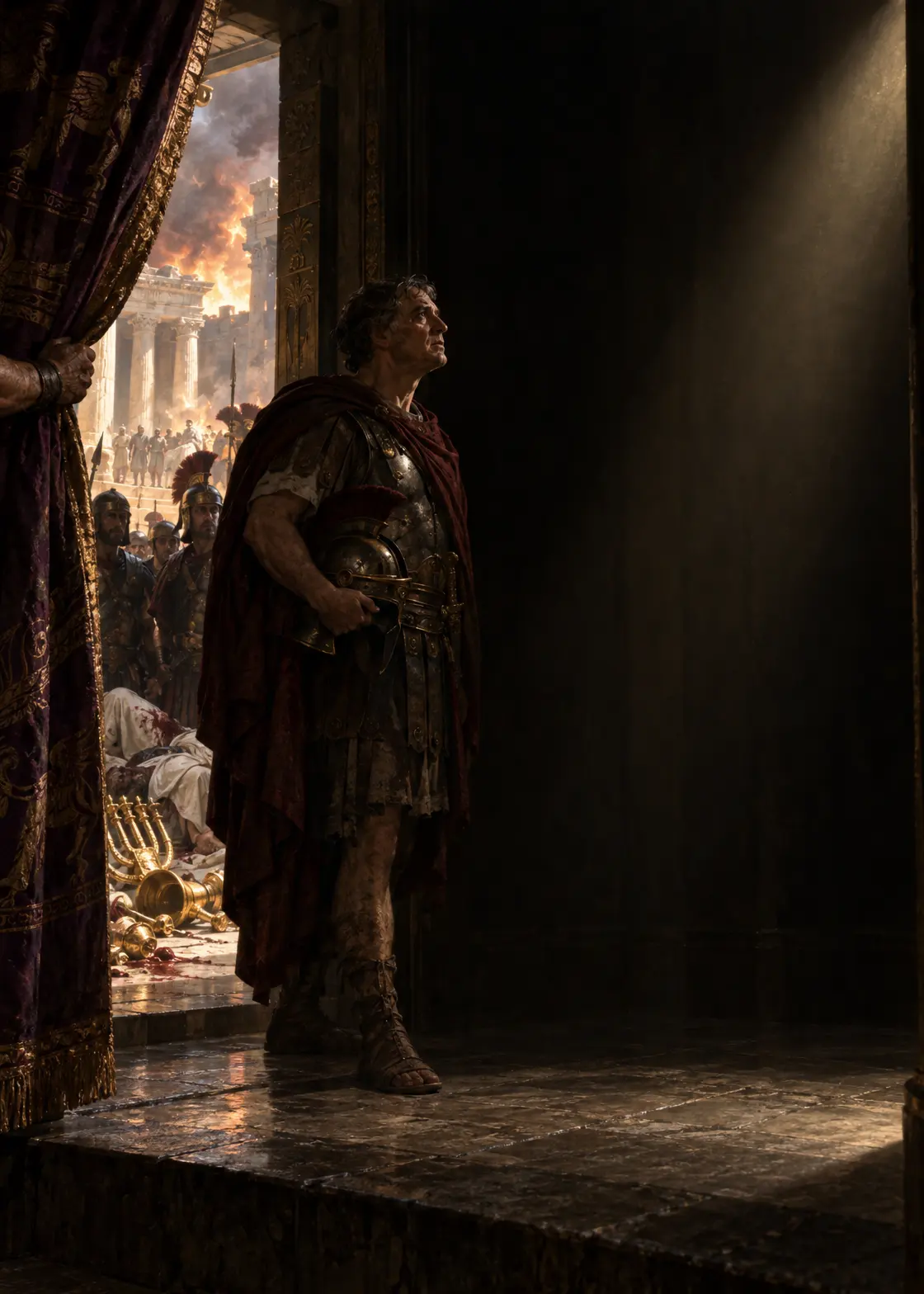
The Crossroads · December 62 BC · Brundisium, Italy
The Disarming at Brundisium
You are Gnaeus Pompeius Magnus, conqueror of the East, standing on the docks of Brundisium beside your disembarking legions.
You return from Asia having crushed Mithridates, forced Tigranes of Armenia to yield his empire, organized four new provinces, founded thirty-nine cities, and raised the Republic's revenues from fifty million denarii to eighty-five million. Six legions of devoted veterans have crossed the Adriatic with you, expecting the farms you promised them. Sulla marched on Rome with his army; Lucius Licinius Lucullus and Marcus Porcius Cato now watch from the Senate, deeply suspicious of your power and eager to humiliate you. You require senatorial ratification of your eastern settlement in gross and land for your soldiers.
What will you do with your six victorious legions now that you have landed on Italian soil?
Weigh each course: open it to hear your own inner voice. Then decide. Nothing is scored.
- Your inner voiceThe course taken
Sulla showed that the Senate yields only to force. My veterans worship me; they broke Mithridates and Tigranes, and they will follow me anywhere. If I lead them armed toward Rome, Cato and Lucullus cannot refuse our demands. The eastern treaties will be ratified in an hour and land given to every soldier. But the cost is dreadful: I would govern only as an autocrat and break the constitution of the Republic.
- Your inner voiceThe course taken
If I dismiss the legions here at the water's edge, I prove to the Republic that I am no Sulla. I will enter Rome as a private citizen, relying upon the glory of three continents and the wealth brought to the treasury. Yet without my soldiers, I place the settlement of Asia and my veterans' farms entirely at the mercy of the Senate, where Lucullus and Cato nurse their bitter grievances against my commands.
- Your inner voiceThe course taken
I need not march on the city to make my power felt. By keeping the six legions assembled under my eagles in camp here at Brundisium, the Senate will negotiate under the visible shadow of force. I avoid an open march, while Cato and Lucullus are reminded what defiance costs. Yet maintaining such a host feeds terror in the capital and allows my enemies to treat me as an armed menace.
What was done
Pompey disbanded his army immediately at the docks of Brundisium in December 62 BC, asking the Republic only for the ratification of his eastern settlement in gross and land for his veterans. The gesture astonished Rome, which had feared another Sullan march, but it stripped him of leverage. The Senate, led by Marcus Porcius Cato and Lucullus, spent the following three years refusing both requests. Although Pompey celebrated a magnificent third triumph in September 61 BC—displaying the doubled revenues (BGrade B), royal captives, and placards boasting twelve million people subjected—his political isolation deepened. By denying farms to six legions' worth of veterans, the Senate's consequential refusal built the coalition of the next chapter.
The evidence Plutarch's Pompey (BGrade B, resting on the AGrade A eyewitness substrate of Pompey's camp-historian Theophanes of Mytilene) provides the narrative of the landing at Brundisium, the disbanding of the legions, and the third triumph. Cassius Dio 37 (BGrade B) supplies the annalistic frame for the Senate's resistance under Cato and Lucullus, while Appian's Mithridatica (BGrade B) covers the eastern settlement. Cicero's contemporary correspondence (AGrade A) reflects the domestic political atmosphere. The financial totals and triumph placards descend from Pompeian documentation preserved through Plutarch and cannot be independently audited.
If you choose to walk through itAt every scale
- Yourself
Does a commander who willingly relinquishes supreme armed power demonstrate true civic virtue, or does he merely reveal a failure of political nerve?
- Those beside you
What obligation does a general owe to the soldiers who bled for his glory when their livelihood depends upon his willingness to intimidate the civilian government?
- Rome
Can a republican constitution survive when its security depends entirely on the voluntary restraint of victorious commanders rather than institutional force?
- The wider world
How should subject peoples and client kings view treaties granted by an imperator if domestic senatorial factions can repudiate them at will?
- Our own time
When democratic institutions obstruct the reasonable claims of returning veterans or public servants, does the danger to the state come from the institution's stubbornness or from the leaders who step outside the law to satisfy them?
In 1783, at the conclusion of the American Revolutionary War, the Continental Army faced the dilemma of demobilizing without back pay or secure pensions from a bankrupt Confederation Congress. Rumors of an armed coup at Newburgh circulated among officers who urged the army to remain assembled until their financial demands were guaranteed. The army chose instead to disband peacefully and submit to civilian authority, entrusting their claims to an uncooperative legislature.
Where the comparison fails. The Continental Army was an impoverished revolutionary force confronting a newly formed, destitute confederation, whereas Pompey led six victorious, loot-laden legions returning to an ancient, wealthy empire that had already seen Sulla's troops march on the capital to seize power.
What does the chapter tell us?
What caused the equestrian financiers and popular politicians at Rome to unite in a campaign against Lucullus's command?
The chapter explains that Lucullus spent the winter of 69 BC reforming the finances of Roman Asia, capping compound usury and breaking the tax-farmers' hold. Because this halved the equestrian financiers' revenues, they allied with popular politicians to strip him of his command.
Plutarch Lucullus (BGrade B)
Why did Pompey decline to crucify the more than twenty thousand pirates who surrendered to him in 67 BC?
Pompey resettled the twenty thousand surrendered pirates in depopulated cities such as Soli (renamed Pompeiopolis) and Achaea. The chapter notes his personal theory that piracy was an economic condition before it was a crime, and his resettlement strategy succeeded where executions had failed.
Appian Mithridatica (BGrade B) and the chapter's narrative
According to the Editor's Note, what caution applies to the financial figures and triumph placards of Pompey's eastern settlement?
The Editor's Note explicitly observes that the settlement's financial figures—such as raising revenue from fifty to eighty-five million denarii—originate in Pompey's own camp documentation (partly through Theophanes of Mytilene) and are transmitted through Plutarch, making independent auditing impossible.
Editor's Note (BGrade B; T1 substrate)
How did Lucullus achieve his tactical victory over Tigranes's vastly superior army at Tigranocerta in 69 BC?
Rejecting a static defense against Tigranes's host, Lucullus personally led his cohorts through a river ford and up an unregarded hill, striking the armored cataphracts in the rear before they could wheel and driving them back through their own unformed infantry.
the chapter's narrative
What was the Senate's response when Pompey disbanded his legions at Brundisium and requested land for his veterans and ratification of his eastern settlement?
The chapter describes the Senate under Cato and Lucullus engaging in 'the most consequential act of small-mindedness in this compendium' by spending three years refusing both the ratification of Pompey's eastern acts in gross and the land allocations for his six legions' worth of veterans.
the chapter's narrative