Book V · The Crisis of the Republic
Chapter 7
Caesar in Gaul
The Coalition and the Command
The command that made Caesar was manufactured by the senatorial obstruction described at the last chapter's close. By 60 BC three men held grievances the Senate would not compose: Pompey, his eastern acts unratified and his veterans unlanded, thanks to three years of Catonian filibuster; Crassus, whose equestrian clients had overbid the Asian tax-contracts and been refused relief; and Gaius Julius Caesar, returning from a propraetorship in Spain with a triumph earned and the consulship due, forced by Cato's procedure to choose between them — he chose the office, waiving the triumph, a trade whose meaning his enemies grasped too late. The coalition of the three — the "three-headed monster" of Varro's pamphlet, the First Triumvirate of the moderns, an alliance of convenience sealed by the marriage of Caesar's daughter Julia to Pompey, and a marriage that became, to the surprise of everyone including the principals, a love-match on which the Republic's peace would hang — delivered the consulship of 59 as a demonstration of what the constitution was worth against organized force: the agrarian law for Pompey's veterans carried through the assembly over the physical obstruction of the consul Bibulus, who was pelted with filth, his fasces broken, and who retired to his house for the remaining eight months to "watch the sky" for omens and issue edicts nobody obeyed — the wits dated documents that year to the consulship of Julius and Caesar. Among the year's transactions was the tribune Vatinius's law conferring on Caesar, for five years, the provinces of Cisalpine Gaul and Illyricum with three legions, to which the Senate — on Pompey's motion, preferring to grant what the assembly would otherwise seize — added Transalpine Gaul and a fourth legion. Caesar was forty-one, a politician of the first rank with a soldier's reputation still to make, and in debt beyond arithmetic. Gaul paid every account.
The Conquest58–53 BC
The pretext arrived before the proconsul did. The Helvetii of the Swiss plateau — 368,000 souls by the census tablets in Greek later taken in their camp, Caesar reports, of whom a quarter were fighting men — had resolved on a national migration to the Atlantic coast, burned their twelve towns and four hundred villages to foreclose return, and requested passage through the Roman province. Caesar, holding the Rhône crossing with one legion while raising five more on credit and his own authority, refused, wore out their embassies with engineered delay while he fortified nineteen miles of the river line, then followed their alternative route north, caught the nation astride the Saône — annihilating the rearguard canton on the east bank, the Tigurini who had yoked a Roman army in his grandfather-in-law's day, a debt he notes discharging — and brought the remainder to battle at Bibracte: the legions on the hillside, their general's own horse sent to the rear with all the officers' ("that the danger might be equal"), the Helvetian mass attacking uphill, wheeling with unexpected discipline when their allies struck the Roman flank, the fight lasting from midday to nightfall with, Caesar observes, no man of the enemy seen to turn his back; the survivors were sent home to rebuild their burned country as a buffer against the Germans, 110,000 of the 368,000. The same season he answered the appeal of the Aeduan faction against Ariovistus, the Suebian king established west of the Rhine — a "friend of the Roman people" by the Senate's own recent vote, which made the diplomacy delicate and the war, once the king's ambitions were displayed, indispensable; the campaign is remembered for its crisis before it began, the panic that swept the officer corps at Vesontio on tavern reports of German immensity, met by the address in which Caesar declared he would march with the Tenth Legion alone if the rest preferred safety — the Tenth's soldiers thanking him, the shamed remainder competing thereafter for his opinion; the battle in the Alsatian plain broke the Suebian line at the run, and Ariovistus crossed the Rhine in a skiff, to die obscurely within the year. In one season the proconsul of the Gallic frontier had made himself arbiter of Gaul; the Belgae of the north, reading the future correctly, confederated against him over the winter, and 57 carried the eagles to the Channel: the Belgic mass — 300,000 by the allied intelligence Caesar transmits — dissolved at the Aisne for want of a commissariat, its cantons submitted in sequence, until the Nervii, fiercest of the north, who admitted no traders in wine and mocked their neighbors' surrenders, caught the army entrenching camp on the Sambre in the concealed rush that produced the nearest-run engagement of the whole war: the right wing's two legions cut off, every centurion of one cohort down, the general himself snatching a shield from a rear-ranker and going into the first line calling centurions by name — the Tenth's arrival from across the river, and the veteran instinct of soldiers who formed square without orders, converted massacre into a victory that, Caesar writes, brought the name and nation of the Nervii almost to extinction; their neighbors the Atuatuci, storm-taken after a false surrender, went to the auction-block in one lot of fifty-three thousand. The maritime Veneti of Brittany rose in 56 and were finished at sea, their leather-sailed oaken ships — unrammable, unboardable, tide-masters — becalmed off Quiberon and taken one by one with long-handled hooks that sheared their halyards, the fleet of the ocean watching its own dismasting from the cliffs; Caesar executed their council for the detention of envoys and sold the nation. Rome voted fifteen days of thanksgiving, five more than Pompey had ever received; and at Luca in the spring of 56, two hundred senators attending like clients, the coalition renewed itself: Pompey and Crassus to be consuls again in 55, with Spain and Syria for provinces, Caesar's command extended five years more.
The years 55 and 54 were the years of spectacle, and the Editor grades them accordingly. The Germanic Usipetes and Tencteri, pushed over the lower Rhine by Suebian pressure, were destroyed in 55 during a truce — their chiefs held at a parley while the legions stormed the unwarned camp, the fugitive mass driven into the river-junction; 430,000 souls, Caesar's own figure, with Roman losses of none — an act Cato proposed in the Senate to expiate by delivering Caesar bound to the survivors, and which this compendium records in the terms its own author supplies, there being no others: the Commentarii's serene accounting of a truce-time extermination is the most instructive page in them. The Rhine bridge followed within days — forty feet of river depth, the piles rammed aslant against the current, the whole span thrown in ten days and demolished after eighteen days of demonstrative burning beyond it — engineering as rhetoric, addressed to Germany; and the two British expeditions (a late-season reconnaissance-in-force of 55 that nearly drowned in the Channel storms, the invasion of 54 with five legions that crossed the Thames, took the submission of Cassivellaunus and the Trinovantes, and withdrew with hostages, a nominal tribute, and no garrison) added an ocean and an island of legend to the Roman imagination at trivial strategic yield — the dividend was paid entirely at Rome, where the sky, Cicero's letters attest, was scanned for news of Britain as for a moon-landing. The reckoning came with the winter of 54. The harvest had failed; the legions dispersed into separated winter camps among the Belgae; and Ambiorix of the Eburones, having stormed nothing, talked one garrison out of its walls — the legate Sabinus accepting safe-conduct against his colleague Cotta's furious protest, the column ambushed in a defile two miles out, Cotta dying in the fighting line, Sabinus at a parley, the eagle-bearer hurling his standard back over the rampart of the doomed camp, the survivors' night suicide upon each other's swords: fifteen cohorts erased — while the same rising flung the Nervii upon the camp of Quintus Cicero, the orator's brother, whose siege is the Commentarii's set-piece of the other Roman virtues: the towers outbuilt, the fire-storm endured, the letter in Greek characters lofted in on a javelin and lodged unnoticed two days in the tower fabric, the relief column of seven thousand drawing sixty thousand onto ground of its own choosing. Caesar wintered in Gaul entire, raised his establishment to ten legions — borrowing one from Pompey — and spent 53 in punitive demonstration, crossing the Rhine a second time and hunting the Eburones to national extinction by invitation, the neighboring peoples licensed to the plunder; Ambiorix was never taken, a loose thread the Commentarii cannot quite stop fingering.
In the same summer, far to the east, the coalition's third head fell. Crassus, sixty years old and rich past counting, had taken the Syrian command in pursuit of the one currency he lacked, and led seven legions across the Euphrates against Parthia without pretext beyond the wanting; near Carrhae in the Mesopotamian steppe, in June of 53, the Roman square spent a day under the arrow-storm of Surena's ten thousand horse-archers — the camel-trains reloading their quivers, the proverb-making discovery that the shafts nailed shields to arms and feet to earth — while the cataphracts waited; the breakout attempt of the general's son Publius, Caesar's own decorated cavalry officer from Gaul, was swallowed whole, his head raised on a lance before his father's lines; the night retreat abandoned four thousand wounded; and Crassus, compelled by his mutinous remnant to accept Surena's parley, was cut down in the scuffle at the horses. His head reached the Parthian court during a performance of the Bacchae and was carried on as Pentheus's, to applause; twenty thousand Romans died, ten thousand marched into Margian captivity, and seven eagles went into Parthian temples, a debt of standards that would run sixty years. Julia had died in childbirth the autumn before, and Pompey, refusing every offered re-knitting of the marriage alliance, drifted where his new father-in-law Scipio and the Catonians beckoned. Between Caesar and the constitution there now stood no third force and no shared blood.
Vercingetorix (52 BC), and the Verdict on the Commentarii
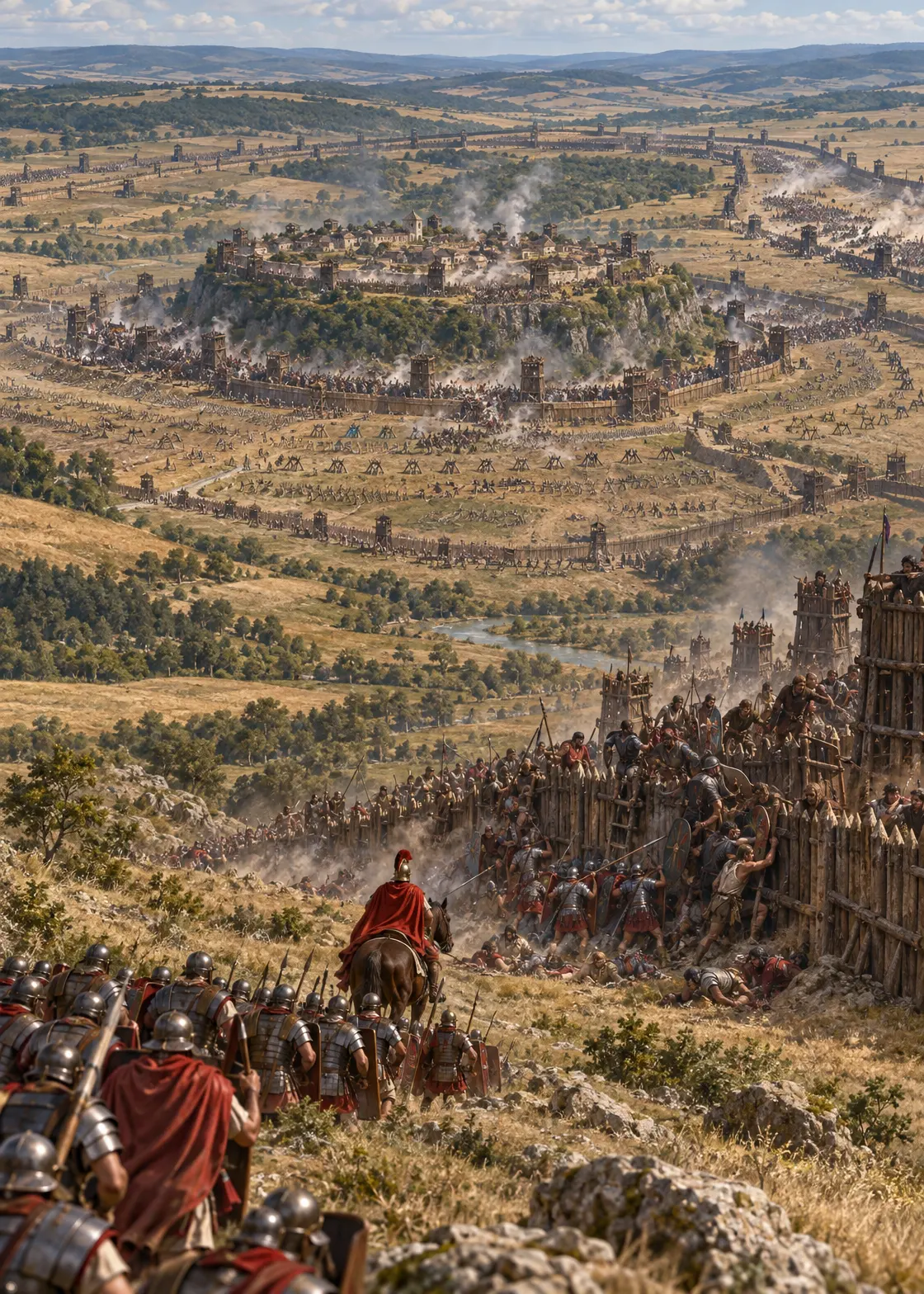
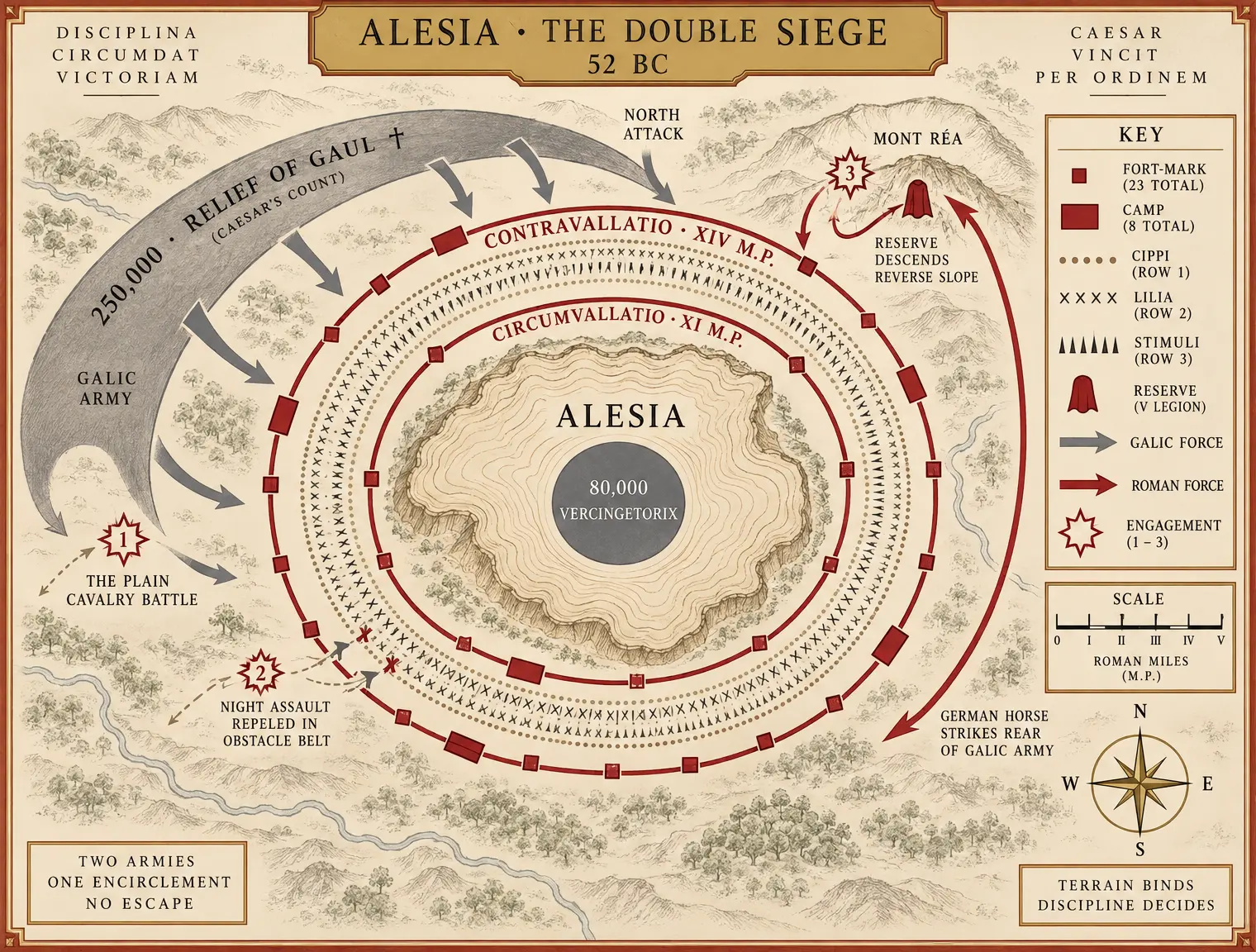
The general rising came in 52, when Gaul had learned everything Rome could teach it. Its architect, Vercingetorix, son of an Arvernian noble executed for aiming at kingship, imposed on the coalition of the peoples the one strategy that could win — scorched earth, the war carried against Roman supply, twenty towns of the Bituriges burned in a day by their own hands — and was broken by the one town spared: Avaricum, loveliest of Gaul, which begged itself an exception, held the Romans' colossal siege-ramp twenty-five days of counter-mine and sortie, and yielded to a storm delivered out of a rainstorm; of forty thousand within, the Commentarii count eight hundred out. At Gergovia, the Arvernian hill-capital, Caesar took his first unambiguous defeat — an assault that outran its recall, seven hundred legionaries and forty-six centurions dead under the walls — and the Aedui, Rome's oldest allied name in Gaul, went over to the rising with the central depot and the cavalry. What followed was the campaign by which the age judged him: the retreat that was not one, the improvised German horse, the interception on the Vingeanne, and Vercingetorix's withdrawal into Alesia with eighty thousand men — the fortress on its plateau judged impregnable to assault and therefore, in the Caesarian grammar, to be taken by mathematics. The double siege of Alesia is the engineering summit of ancient warfare and the Editor will spend the space its numbers demand: an inner circumvallation of eleven Roman miles facing the town, an outer contravallation of fourteen facing Gaul, twenty-three forts, eight camps, the twenty-foot trench, the double ditches one flooded, the palisade with antler-work, and before it the sown horrors the soldiers named like garden plants — the cippi of sharpened boughs in five interlaced rows, the lilia of fire-hardened stakes in quincunx pits, the iron-hooked stimuli — the whole double world built in a month by men fighting off sorties as they dug, provisioned for thirty days against the relief of all Gaul, which came two hundred and fifty thousand strong (the figure is the victor's; the Editor flags it and moves on, the tactical reality being indifferent to a factor of two). The crisis ran three days: the cavalry battle lost by Gaul in the plain; the night assault that died among the lilies; and the combined storm at noon of the third day, Vercassivellaunus's sixty thousand against the cursed camp on the north slope where the lines could not follow the ground, the town's whole strength against the inner works simultaneously — the sequence in which the Commentarii's cold third person admits its author to the narrative in the only costume the army needed, the color of the cloak he was accustomed to wear in action: the scarlet paludamentum coming down the reverse slope with the last four cohorts and the German horse loosed around the outside, the relief army's collapse propagating from that point outward until the plain emptied and Gaul, in the persons of its hostage-chiefs, came over the wall as prisoners. Vercingetorix rode out the next day, circled the tribunal where Caesar sat — the caparisoned horse, the armor cast down piece by piece, the seated silence at the conqueror's feet: the tableau is Plutarch's and Dio's; Caesar's own sentence is nine words of administration — and went to the Tullianum for six years, to walk in the quadruple triumph of 46 and be strangled in the pit where Jugurtha starved. The embers of 51 — the year of Uxellodunum, whose garrison's sword-hands Caesar struck off and whose survivors he dispersed as a public text, the clemency of the coming civil war being a currency he minted only for Romans — completed a conquest whose price Plutarch renders in round figures from the tradition Caesar's enemies kept: a million Gauls dead, a million enslaved, of three million under arms across the eight years; modern demography distrusts every term of the ratio and disputes none of its order of magnitude. Gaul entire, Rhine to Pyrenees to Ocean, was Roman, and would stay so for five hundred years, the deepest single addition any one man made to the empire.
The source-verdict belongs here rather than in the apparatus, because in this chapter the source is the subject. The Commentarii de Bello Gallico — seven books by the proconsul, the eighth supplied after his death by his officer Hirtius — are AGrade A by every formal test this compendium applies: the author is the commander, the eyewitness, the sole possessor of the documents; the Greek and Roman critics united on the perfection of the prose, Cicero pronouncing them nudi, recti et venusti, naked and straight and graceful, written to forestall historians and succeeding. And they are, simultaneously and by design, the century's supreme instrument of self-presentation: dispatches composed for annual publication to a home audience, the third person a device of manufactured objectivity, the disasters audited (Gergovia's arithmetic wobbles; the Usipetes truce is narrated with a clear conscience the reader must supply for himself), the enemy's numbers elastic wherever glory is the quotient. The Editor's rule for the whole Caesarian corpus is therefore stated once: trust the topography, the engineering, the sequence, and the army; audit the motives, the numbers, and the innocence. It is the rule for the next chapter as well, where the same pen narrates the killing of Romans.
The Crossroads · 52 BC · Alesia, central Gaul
The Lines at Alesia
You are Gaius Julius Caesar, proconsul of Gaul, standing before the plateau fortress of Alesia.
Following your defeat at Gergovia and the defection of your oldest Gallic allies, the Aedui, you have trapped Vercingetorix and eighty thousand warriors inside the plateau fortress of Alesia. The stronghold sits on an elevated hill and is judged impregnable to direct assault. You command ten legions and improvised German cavalry, but the loss of your central depot leaves barely thirty days of rations. Outside these heights, the general rising of Gaul is gathering a vast relief army to envelop you.
How will you reduce Alesia and break the Gallic coalition before your army is starved or overwhelmed?
Weigh each course: open it to hear your own inner voice. Then decide. Nothing is scored.
- Your inner voiceThe course taken
I could fling all ten legions up the slopes at once. At Gergovia our assault outran its recall, costing seven hundred legionaries and forty-six centurions, yet waiting here invites eighty thousand defenders to entrench while all Gaul mobilizes behind us. If my men carry the heights by audacity before the coalition gathers, the war ends where Vercingetorix stands. But if the ascent fails against these cliffs, the army will break, and Gaul will swallow what remains.
- Your inner voiceThe course taken
We must settle this by mathematics. If the plateau cannot be stormed, eighty thousand men inside cannot be fed for long. I will dig an inner line of eleven miles to seal Vercingetorix within, and an outer ring of fourteen miles to bar the rest of Gaul. My soldiers must build trenches, ramparts, and traps while fighting off sorties. It traps my ten legions between two armies, but engineering will master both.
- Your inner voiceThe course taken
I could lead the army south toward the safety of the Roman province. With the Aedui in open revolt, our central grain depot is gone, and thirty days of food cannot sustain a protracted contest. Reaching the province would preserve my veteran legions, re-establish secure supply lines, and deny Vercingetorix the chance to pin us against these hills. Yet retreat would surrender everything won across seven years, leaving all Gaul united under an Arvernian king.
What was done
Caesar committed his ten legions to the double siege (AGrade A). Over a single month, the legionaries constructed an inner circumvallation of eleven Roman miles and an outer contravallation of fourteen miles, complete with twenty-three forts, eight camps, a twenty-foot trench, double ditches, palisades with antler-work, and sown obstacle fields of cippi, lilia, and iron stimuli. When the Gallic relief army arrived—reported at two hundred and fifty thousand men (BGrade B–C)—Caesar was besieged while besieging. The crisis culminated on the third day of battle: sixty thousand Gauls under Vercassivellaunus attacked the northern camp while Vercingetorix assaulted the inner works. Caesar intervened in person, recognized across the field by his scarlet cloak, committing his final four cohorts and German cavalry to break the relief army. On the following day, Vercingetorix surrendered his arms before Caesar's tribunal (BGrade B), sealing the conquest of Gaul.
The evidence The principal source is Caesar's Commentarii de Bello Gallico Book 7 (AGrade A, audited author-is-subject). The siege works, lines of circumvallation, and obstacle systems are confirmed directly by archaeology at Alise-Sainte-Reine through the nineteenth-century excavations under Napoleon III and the Reddé–von Schnurbein excavations of 1991–97 (AGrade A, material). Independent narratives and the surrender tableau derive from Plutarch's Caesar and Cassius Dio Books 38–40 (BGrade B), with hostile contemporary traditions and the lost critique of Asinius Pollio reflected in Suetonius's Divus Julius (BGrade B). Gallic numbers and casualty figures remain BGrade B–C estimates originating from the conqueror.
If you choose to walk through itAt every scale
- Yourself
How far does the choice to risk ten legions between two converging armies reflect strategic necessity rather than your personal dread of prosecution and political ruin at Rome?
- Those beside you
What moral debt does a commander owe to the veteran legionaries and centurions who must dig double ramparts and fight starving in trenches to redeem an operational miscalculation?
- Rome
Can republican institutions survive when the state grants extraordinary long-term commands that bind the legions exclusively to the fortunes of their general?
- The wider world
When a conquering empire secures peace through scorched earth, mass enslavement, and calculated sieges, what legitimate recourse remains for tribal confederations defending their independence?
- Our own time
In modern asymmetric warfare, how should military planners weigh the decisive tactical power of superior engineering and containment against the prolonged human cost of encircling populated strongholds?
During the 1863 Siege of Vicksburg, Union forces surrounded an entrenched Confederate army occupying formidable river bluffs. After bloody frontal assaults failed, the besieging army turned to engineering, digging extensive trenches to starve the garrison while simultaneously constructing fortified exterior lines to block a Confederate relief army operating in their rear. The double-front siege forced the garrison to capitulate once provisions were exhausted, cutting the Confederacy in two and permanently altering the course of the war.
Where the comparison fails. Unlike Caesar at Alesia, the Union command possessed secure steamship supply lines along the Mississippi and overwhelming industrial superiority, never facing the total logistical isolation or near-parity in troop numbers that threatened the Roman double circumvallation.
What does the chapter tell us?
Why did Pompey, Crassus, and Caesar form their informal coalition in 60 BC?
Senatorial obstruction, spearheaded by Cato, refused to ratify Pompey's eastern settlements, denied financial relief to Crassus's equestrian tax-farming clients, and forced Caesar to surrender his triumph to declare his consular candidacy.
the chapter's narrative
Why did Cato propose in the Senate that Caesar should be handed over bound to the Usipetes and Tencteri?
Caesar detained the Germanic chiefs while they met under a parley and immediately ordered the legions to storm their unwarned camp, annihilating the tribes. Cato viewed this breach of a sacred truce as a religious and moral violation requiring Caesar's surrender.
Caesar BG 4 and Plutarch Cato Minor 51 (BGrade B)
How did Ambiorix of the Eburones succeed in destroying fifteen Roman cohorts during the winter of 54 BC?
Ambiorix talked the Roman command out of its defenses. Over Cotta's furious opposition, Sabinus trusted Ambiorix's safe-conduct. When the Roman column entered a defile two miles out, the Eburones ambushed and annihilated the force.
Caesar BG 5 (AGrade A, audited)
What major flaw compromised Vercingetorix's scorched-earth strategy against Caesar in 52 BC?
Vercingetorix aimed to starve the Roman army by burning Gallic settlements, but he relented when Avaricum begged to be spared. Caesar successfully assaulted the town after twenty-five days, replenishing his supplies and breaking the scorched-earth cordon.
Caesar BG 7 (AGrade A, audited)
How do modern archaeological excavations at Alise-Sainte-Reine evaluate Caesar's written account of the siege of Alesia?
Excavations initiated under Napoleon III and verified by Reddé and von Schnurbein in 1991–1997 confirmed the double lines, forts, camps, and intricate obstacle fields in plan and detail, corroborating Caesar's operational and engineering claims.
Alise-Sainte-Reine siege-works excavation (AGrade A, material)