Book V · The Crisis of the Republic
Chapter 8
The Civil Wars and the End of the Republic
The Rubicon and the Sixty Days49 BC
The mechanics of the final breach can be stated with the brevity the participants denied it. Caesar's command expired; his enemies intended his prosecution the hour he became a private citizen — for the acts of 59, for anything, the charge being the pretext and the destruction the object, as Cato did not trouble to conceal; his protection was to pass from proconsulship to a second consulship without the gap in which the courts could seize him, and the "ratchet of 50" was the closing, one by one, of every legal path to that continuity. The tribune Curio, Caesar's purchased genius of that year, forced the Senate in December to divide on the naked question — that both Caesar and Pompey lay down their commands together — and it carried three hundred and seventy to twenty-two: the Republic's governing class, offered peace by supermajority, was then overridden within days by the twenty-two, the consul Marcellus riding unauthorized to Pompey's villa to place a sword in his hand and the defense of the state upon him. On the seventh of January 49 the Senate passed the senatus consultum ultimum — its final deployment in this compendium — and the tribunes of the year, Antony and Cassius Longinus, vetoing on Caesar's behalf, fled the city to him in hired carts and slaves' clothing: the constitutional grievance, tribunician sacrosanctity violated, in which the coming war was dressed. On the night of the tenth of January Caesar, with the Thirteenth Legion — five thousand men against the Republic — halted at the provincial boundary stream south of Ravenna, spoke to his officers of what the crossing meant (Asinius Pollio was present, and the tradition descends from him), quoted his Menander in Greek — let the die be flown — and crossed the Rubicon. Suetonius adds the apparition with the trumpet on the bank; the Editor records it as the first deposit in the mythology and moves with the army, which moved very fast. Italy fell in sixty days, mostly by embrace: the towns opened, the levies changed sides, and at Corfinium, where Domitius Ahenobarbus — Caesar's designated successor in Gaul — was surrendered by his own garrison after three days, the war revealed its new weapon: the captured senators dismissed unharmed with their money, the soldiers enrolled, and the policy stated in Caesar's extant letter to his agents as a conscious doctrine — let this be the new method of conquering, to fortify ourselves with mercy and generosity. The clementia Caesaris was strategy before it was virtue, an instrument aimed at Sulla's memory; it emptied Pompey's Italian position within weeks. Pompey, who had boasted he need only stamp his foot for legions and now declined to defend Rome, Italy, or a treasury he forgot in his haste, executed the one maneuver of genius left to him — the evacuation of the government, the Senate, and his army from Brundisium to Greece under Caesar's siege, trading the peninsula for the sea, the East that was his clientele, and time; Caesar, shipless, entered a Rome emptied of legitimacy, broke the tribune Metellus from the treasury door with the observation that killing him would be easier than saying so, took the reserve, and marched — characteristically — away from his enemy, west against the enemy's army: the seven legions of Pompeian Spain. The campaign of Ilerda that summer was won, after a flood-crisis that nearly starved the besieger, almost without a battle: out-entrenched, out-marched, and cut from water on the arid plateau above the Ebro, the armies of Afranius and Petreius were surrounded, fraternized with, and dissolved — the soldiers discharged or enrolled, the generals dismissed to fight again, no man executed; Massilia fell to Trebonius and the young Decimus Brutus's improvised fleet after a siege the city's Greek dignity adorned; and the year's ledger carried one Caesarian catastrophe, in Africa, where Curio — the tribune of 50, now commanding two legions of former Pompeians — was lured by feigned retreat into the Bagradas plain, enveloped by King Juba's Numidian horse, and died refusing rescue, saying he could not face Caesar having lost the army Caesar gave him; the legions were butchered or executed by the king, the worst Caesarian field-loss of the entire war, and the account against Numidia was opened that Thapsus would close.
Pharsalus, and the Death of Pompey48 BC
The eastern campaign began with the war's greatest gamble: Caesar in January 48 threw seven under-strength legions across a winter sea held by Bibulus's five hundred ships — the blockader dying at his post of the exposure — and, when the transports could not return for the rest, was penned for months on the barren Epirote coast, the famous night-attempt to recross alone in a fishing smack (you carry Caesar and his fortune) belonging to the tradition here, until Antony forced the second convoy over. What followed at Dyrrachium was Alesia inverted and instructive: Caesar, besieging a larger army with a smaller — seventeen miles of contravallation against Pompey's fifteen, the counter-fortification duel running months — was breached at the sea-flank in July, lost a thousand veterans in the panic, and was saved by his opponent's caution from losing the war; his own verdict, preserved by Plutarch, closed the episode: today the victory was the enemy's, if the enemy had possessed a victor. The retreat into Thessaly that should have been a death-march became instead the war's decision, because Pompey's camp — the senators auditing their general, quarreling over Caesar's priesthood and the proscription-lists to come, Domitius proposing the trial, after victory, of every senator who had stayed neutral — required a battle their commander's whole strategy of attrition forbade, and required it of him daily until he yielded. On the ninth of August 48, in the plain of Pharsalus, some twenty-two thousand Caesarian legionaries stood against forty-five thousand, and Pompey's tactical conception was entirely sound: his infantry to hold, his seven-thousand-strong cavalry under Labienus — Caesar's own great marshal of Gaul, the one senior officer who had gone over, and gone over from conviction — to sweep Caesar's thousand horse and take the veteran line in flank and rear. Caesar read the field's asymmetry the evening before and hid his answer behind his right: a fourth line, six cohorts drawn off obliquely, with the instruction that became doctrine — not to throw the pila but to keep and thrust them upward, at the faces, at the eyes, the young cavalry of the nobility, he is reported saying, being unwilling to be ugly; whether the psychology or merely the reach decided it, Labienus's mass, having swept the Caesarian horse exactly as designed, struck the standing hedge of points, recoiled, and disintegrated, and the six cohorts wheeled through the vacated space onto the naked flank of Pompey's infantry as the third Caesarian line went in fresh. Pompey the Great left the field before his army finished dying — back to the camp, the tradition's details of the prepared victory-banquet and the laurelled tents supplied by the victors who ate it — and Caesar, walking the fifteen thousand enemy dead, spoke the sentence Pollio heard and Suetonius kept: They would have it so; I, Gaius Caesar, after such deeds, should have been condemned, had I not sought help from my army. The clemency processed the twenty-four thousand prisoners — among them a bookish thirty-four-year-old named Marcus Junius Brutus, whose pardon Caesar had ordered sought out particularly — and the pursuit followed the fugitive by Lesbos, where Cornelia joined him, toward the client-East that had been his making: to Egypt, where the counselors of the boy-king Ptolemy XIII, weighing the suppliant against the pursuer, produced the eunuch-court's syllogism — the theme is Theodotus the rhetorician's, dead men do not bite — and sent a small boat to the roadstead off Pelusium. In it sat Septimius, a Roman who had been Pompey's own centurion in the pirate war; Pompey, reading the silence in the boat, went over the side with a Sophoclean tag about entering a tyrant's doors, and was stabbed from behind as he studied his landing-speech, his wife and son watching from the ship's rail — killed on the day after his fifty-eighth birthday, beheaded on the sand, the trunk left for his freedman to burn on a fisherman's pyre of wreckage. When the head and the signet were presented at Alexandria, Caesar wept, turned away, and had the presenters — Pothinus at least — executed in due course; the Editor, bound by his own rule to audit the innocence, notes merely that the grief and the convenience were both real, and that no account exists that Caesar did not license.
The Egyptian interlude that followed — nine months that nearly ended everything — belongs to this compendium for its battles and to every other kind of book for its politics. Cleopatra VII, the deposed elder sister, twenty-one, had herself carried through the palace blockade to Caesar rolled in a bedding-sack (Plutarch's stromatodesmon; the carpet is the tradition's upholstery); Caesar, enchanted and outnumbered, restored her to the joint throne; the court answered with the Alexandrian War — the palace quarter besieged all winter by the royal army and the most dangerous urban mob in the Mediterranean, the harbor fought over ship by ship, the Egyptian fleet burned at its moorings in a fire that took the dockside book-depots (the death of the great Library itself is a longstanding over-claim the Editor declines to repeat), the causeway battle at the Pharos where Caesar's overloaded skiff sank under him and the general swam for it under missile-fire, by one tradition towing his cloak in his teeth and holding his papers dry above the water with one hand — until the relief army of Mithridates of Pergamum came down through Syria, and the Nile-delta battle of March 47 destroyed the royal cause, the boy-king drowning in his golden armor. Caesar lingered two months more on the river with the queen — the son born that summer was called, by the Alexandrians and the problem itself, Caesarion — then moved with five years' compressed velocity: through Syria and Pontus, where Pharnaces, the parricide of Chapter 6, had used the civil war to retake his father's kingdom and maul a Roman army at Nicopolis, and was extinguished at Zela on the second of August 47 in a five-day campaign and four-hour battle uphill against scythed chariots, reported to Rome in the three words that are the period's most perfect document of self-knowledge — veni, vidi, vici; through an Italy where his unpaid veteran legions, the Tenth at their head, had marched on Rome demanding discharge, and were broken to obedience by a single word of address — Quirites, "citizens," civilians — the master of the client-army demonstrating that its bond ran person-to-person and could be severed by grammar; and into the African campaign of 46 against the re-formed republican center: Scipio, Cato governing Utica, Juba, and Labienus, fourteen legions against his ten. It ended on the sixth of April at Thapsus, where the army — the sources say the veterans forced the signal before Caesar gave it — stormed the double Pompeian position against a backdrop of panicking war-elephants and then, deaf for once to the clemency-trumpet, massacred the surrendering: ten thousand killed asking quarter, the one great stain on the clementia, senators dying under the swords of soldiers who had decided the policy of mercy merely recycled enemies. Cato, holding Utica with the war lost, spent his last evening arguing the Phaedo at dinner, twice reading the dialogue through in the night, and fell on his sword toward dawn; the wound failing — the hand was injured, the thrust went awry — he tore it open against his physician's stitches and died refusing the survival his friends were forcing on him, at forty-eight. Caesar's reported words — Cato, I begrudge you your death, as you begrudged me the sparing of your life — opened instead of closing the account: the pamphlet war of Cato and Anticato that followed fixed the Stoic suicide as the Republic's patron martyr, a defeat administered to the dictator by a corpse. The quadruple triumph of 46 — Gaul, Egypt, Pontus, Africa, the civil victories decently costumed as foreign ones, Vercingetorix strangled at the culminating hour, the soldiers chanting their license-songs at the chariot wheels warning the citizens to lock up their wives; and one year later the last army of the name of Pompey, under the sons Gnaeus and Sextus with the unkillable Labienus, was destroyed at Munda in Spain on the seventeenth of March 45 in the one battle Caesar called a fight for his life rather than for victory — the veteran lines locked shield-to-shield on the hillside until the commander dismounted into the first rank asking his men whether they proposed to hand him to boys; thirty thousand fell including Labienus, Gnaeus was hunted down and beheaded, and Sextus vanished into the hills to become, in the next decade, the sea-king of the age.
The Ides, the Proscription, and Philippi44–42 BC
What Rome could not classify it killed. The honors avalanche of 45–44 — the perpetual dictatorship voted in February 44, the month renamed, the statue among the kings', the temple to his Clemency, the person declared sacrosanct with the tribunes' own inviolability — assembled around Caesar every ornament of monarchy except the name, and the name was tested too, at the Lupercalia of the fifteenth of February, when Antony three times offered the diadem and Caesar, reading the crowd's groan against its scattered claque, three times refused it to applause and ordered the crown inscribed to Jupiter: whether rehearsal, trial-balloon, or renunciation, no source knew then and none knows now. The conspiracy that answered numbered above sixty — Cassius the organizing hatred, Brutus the legitimating name, descendant of the Brutus who expelled the kings, Caesar's pardoned favorite and, the gossip insisted, more; Decimus Brutus the trusted intimate; the mass a compound of pardoned Pompeians and disappointed Caesarians — and it fixed on the Senate's meeting of the fifteenth of March, three days before the dictator's departure for the Parthian war that would have put him beyond reach at the head of sixteen legions. The omens the tradition demands were all supplied and all overridden: Spurinna's warning of the Ides, Calpurnia's dream of the collapsing pediment, the sacrifices without heart, and Decimus in the doorway at the last, laughing his friend past his wife's terror to the Senate's own business. In the portico of Pompey's theater — the Senate met that day, the coincidence beyond any dramatist's nerve, in the hall Pompey built, beneath Pompey's statue — Tillius Cimber gave the signal by dragging the toga from Caesar's neck; Casca struck first and badly; and the pack closed, twenty-three wounds, the victim fighting with his stylus until, seeing Brutus's blade among the rest, he spoke — if he spoke; Suetonius and Dio transmit it as what some reported — the Greek that has outlived the Latin the stage later gave him, kai su, teknon: you too, child; then drew the toga over his face and fell, with whatever the universe intended by it, at the base of Pompey's statue, which was wet with him. The liberators, marching to the Capitol with their caps of liberty, discovered within days that they had freed nothing: the constitution they had killed for had no army, and the dead man had two — his veterans, and his will. The testament read at Antony's instance gave the people Caesar's gardens and three hundred sesterces a man, and adopted as son and principal heir the sickly eighteen-year-old grand-nephew Gaius Octavius, studying at Apollonia; the funeral in the Forum, worked by Antony's oration and the mechanical wax effigy rotated above the bier displaying the twenty-three wounds, became a riot that cremated the dictator on an improvised pyre of benches and drove the liberators from Rome within the month. The boy landed in Italy against all advice, took the name — Caesar, the only weapon he needed for the first year, and the games he financed for his father's victory obligingly produced a comet — and began the demonstration, which occupies the rest of this volume, that the coldest intelligence of the age had been born in 63 BC.
The two years that followed defy compression and receive it. Antony and the young Caesar collided first as rivals for the Caesarian inheritance — the war of Mutina in April 43, where the Senate under Cicero's Philippic leadership yoked Octavian to both consuls against Antony and won two battles at the cost of both consuls, leaving the nineteen-year-old in sole command of the victorious armies precisely as Cicero's epigram had proposed to prevent — the young man is to be praised, honored, and removed; the pun (tollendum: exalted, or eliminated) was reported to its subject, and answered in August when Octavian marched his eight legions on Rome and took the consulship at nineteen with a kinsman as colleague. In November 43, on an island in a river near Bononia, Antony, Octavian, and Lepidus merged their armies and their proscription lists into the Triumvirate for the Constitution of the State — the Sullan instrument revived as a board, established by the lex Titia as a magistracy: terror was now constitutional. The lists ran to some three hundred senators and two thousand equestrians, each dynast selling kin to buy enemies — Lepidus his brother, Antony his uncle — and the estates funding the forty-three legions the eastern war required; the most famous name was purely Antony's price. Cicero, who had aimed the Philippics at his head knowing the stake, was overtaken in his litter near his Formian villa on the seventh of December 43, and forbade his slaves the fight they offered: he put his head out of the litter to the sword of the tribune Herennius with — the detail the tradition would not surrender — the request that he do it properly. The head and the hands that wrote the Philippics went to Rome, where Antony had them nailed to the Rostra — the platform of forty years of the greatest oratory in the Latin language — and where, Dio records, Fulvia took the head first upon her knees and drove her hairpins through the tongue. The Editor sets the scene down without ornament, because none is possible, and passes to the war for which it paid: Philippi, in Macedonia, October and November of 42, the largest engagement Romans ever fought against Romans — the liberators Brutus and Cassius, holding the East with some eighty thousand foot astride the Via Egnatia on impregnable ground with the sea at their backs, against the triumviral hundred thousand under Antony (Octavian present and ill, commanding chiefly a litter). Strategy again forbade the stronger position to fight, and politics again overrode strategy. In the first battle of the third of October, Brutus's wing stormed Octavian's camp — the young Caesar absent from his own tent, warned, he later wrote, by a friend's dream, and hiding three days in the marshes by one account he never quite suppressed — while Antony stormed Cassius's; and Cassius, myopic on his hill, mistaking Brutus's victorious cavalry in the dust for enemy and his sent rider Titinius's welcoming captors for capture, retired into his tent with his freedman Pindarus and the sword — the tradition remembered it as the one he had used on the Ides — and was found beheaded; Titinius, riding back with the good news to the body, killed himself over it. Brutus buried "the last of the Romans" secretly, held the ground three weeks against every logic of his advantage while blockade did his work, and was compelled — the sources agree his own officers and the ghost-fearing rankers forced it — to the second battle of the twenty-third of October, which was pure attrition and broke his line by mid-afternoon. He withdrew with four legions to the hills, tested his friends' willingness one by one through the night — the quotation Dio preserves, the tragedian's couplet on Virtue, wretched Virtue, thou wert but a name, and I served thee as real — clasped the sword with Strato of Epirus at dawn and ran upon it. Antony covered the body with his own scarlet cloak; the head, shipped for the base of Caesar's statue, went down — Dio's justice — in a storm at sea. The Republic had no third army. What remained was the division of the world among its executors, and the ten years it took the world to discover that it could have only one.
Actium (32–31 BC), and the Last Day of Alexandria30 BC
The decade of the divided world the Editor compresses to its military ledger. In the West: the Perusine war of 41–40 — Antony's brother and the widow Fulvia raising Italy against Octavian's veteran-settlement confiscations, starved out in Perusia, the town burned, the tradition of three hundred captives slaughtered at the altar of the Divine Julius on the Ides of March anniversary transmitted by Suetonius and Dio and flagged by both as partisan atrocity-arithmetic; the pacts of Brundisium and Misenum patching the Triumvirate with marriages and maps — Antony taking the widowed Octavia, sister of his colleague, the Mediterranean divided at Scodra; then the Sicilian war against Sextus Pompeius, master of the grain-lanes, whose blockade brought famine riots that nearly stoned Octavian in the Forum, and whose sea-power was broken not by Octavian — twice wrecked, once nearly drowned — but by Marcus Agrippa, the low-born coeval who now enters this compendium as the finest admiral-engineer Rome ever produced: the harbor-works of the Portus Julius carved from the Lucrine lakes as a training-sea, the boarding-grapnel harpax shot from catapults to end the age of the ram, and the battle of Naulochus on the third of September 36 — three hundred ships a side, twenty-eight escaping — that erased Sextus (executed in Asia the next year by Antony's officer, the last son of Pompey) and, in the same season, erased Lepidus, who bid for Sicily with twenty legions and watched them walk across to Octavian's raised standard, to live out thirty years as history's most durable cautionary tale, pontifex maximus under house arrest. In the East: Antony's Parthian war of 36, the revenge for Carrhae mounted with a hundred thousand men and ruined by its own siege-train's loss and the Median winter — the retreat's twenty-seven days of testudo-marches, poisoned roots, and eighteen engagements costing, Plutarch's figures, thirty-two thousand men without a battle lost, the commander at his human best amid the wreck and calling into his tent for the sword before each new crisis passed; and the Armenian face-saving campaign of 34 that furnished the Donations of Alexandria — the ceremony in the Gymnasium enthroning Cleopatra as Queen of Kings with Caesarion beside her proclaimed Caesar's true son, and Antony's children by her invested with kingdoms from Armenia to Cyrene. With that ceremony the war of weapons was preceded, for three years, by the greatest propaganda war of antiquity, and Octavian won it before a ship sailed: Antony's Roman marriage discarded by letter, Octavia's public dignity turned into a weapon her brother wielded weekly; the defectors Plancus and Titius guiding Octavian to the Vestals' custody of Antony's will, seized and read to the Senate — the bequests to Cleopatra's children, the burial clause beside her in Alexandria — its authenticity doubted then and now and its effect total; the consecrated fetial spear thrown at last, in the archaic rite revived by the master of new forms, against Cleopatra alone: Rome's war would be foreign, and Antony merely the queen's lost Roman.
The campaign itself Agrippa decided before the fleets met. Antony wintered 32–31 at Actium on the Ambracian Gulf with five hundred ships and the East's treasury embarked; Agrippa took Methone behind him, cut the Peloponnesian supply-chain port by port, and let the malarial summer, desertion (the consular Ahenobarbus rowing over to die of fever in Octavian's camp; Dellius, the historian of the Parthian retreat, carrying the battle-plans across at the last), and the crews' famine reduce the Antonian fleet to perhaps two hundred and thirty effective hulls. The council's alternatives — Canidius urging the army's retreat into Macedonia to fight on land, the queen's party the fleet's breakout for Egypt — were resolved by the detail the old soldiers read like an omen: the order to embark the sails, never carried into a fight a commander meant to finish. On the second of September 31 the fleets engaged outside the straits through a long becalmed morning, Antony's great deck-castled hulls against Agrippa's more numerous, nimbler squadrons declining the ram for missile-fight and wing-stretch; and in the early afternoon, as the sea-breeze rose on schedule, Cleopatra's reserve squadron of sixty made sail through the loosening center and ran south with the treasure, and Antony — the act contemporaries could not explain and this compendium will not explain for them — transferred from his flagship to a quinquereme and followed, leaving fleet and cause fighting under a commander who had left. The fleet burned or struck by evening; the nineteen legions ashore, abandoned by Canidius in the night, negotiated a week and then marched over entire; and the victor of the last battle of the Roman Republic was, as at Naulochus, Agrippa — the dedication at Nicopolis, the victory-city above the straits, naming nonetheless the man for whom the age would be named. Antony ran the ship south in a three-day silence at the prow, head in his hands; Egypt gave him a year of theatrical despair — the Timoneum hermitage on the Alexandrian mole, the drinking-society rechristened from the Inimitable Livers to the Partners in Death — while the queen tested poisons on prisoners, Plutarch reports, in search of the painless one, and both negotiated secretly with the approaching conqueror, who wanted the treasure intact, the queen for the triumph, and nothing else. On the first of August 30, at the gates of Alexandria, the fleet and cavalry went over in an hour and the last battle of the last civil war was a skirmish already decided; Antony, on the false report of Cleopatra's death — sent, the tradition says, from the mausoleum where she had barricaded with the treasure and the combustibles — called on his slave Eros for the sword and received instead the slave's own suicide, botched his stroke into his belly, and, learning the report false, was hauled dying by ropes through the mausoleum's upper window by the queen and her two women, to die in her arms with a soldier's last advice about trusting Procleius. The queen outlived him nine days of negotiation, inventory, and one audience with Octavian in which each performed for the other; warned by a sympathizer of the triumph-date, she visited the tomb, dined, and was found on the golden couch in royal dress, dead, her women dying at her feet — the asp in the fig-basket the version Plutarch reports while admitting no one knows the truth of it, two faint marks on the arm, the hollow hairpin the rival tradition, Octavian's snake-charming Psylli summoned too late either way, and the serpent, whatever the fact, awarded the official verdict by the victor, whose triumph carried her effigy with the coiled asp. She was thirty-nine, the last of the Ptolemies, and buried — the one clause of Antony's scandalous will its destroyer honored — beside him. Caesarion, seventeen, caught fleeing toward India, was killed on the advice of the philosopher Areius, who amended Homer for the occasion: no good thing is a multitude of Caesars; Antony's eldest son was dragged from sanctuary and killed; the remaining children walked in the triumph and were raised, in the age's strangest domestic arrangement, by Octavia. Egypt became the conqueror's personal estate, its treasure dropping Roman interest rates by two-thirds on arrival; and in January of 29 the doors of the temple of Janus, open through ninety-two years of this volume's subject matter save one, were closed by senatorial decree, for war — the formula ran — was ended by land and sea. What was actually ended, and what was founded, the Epilogue must weigh.
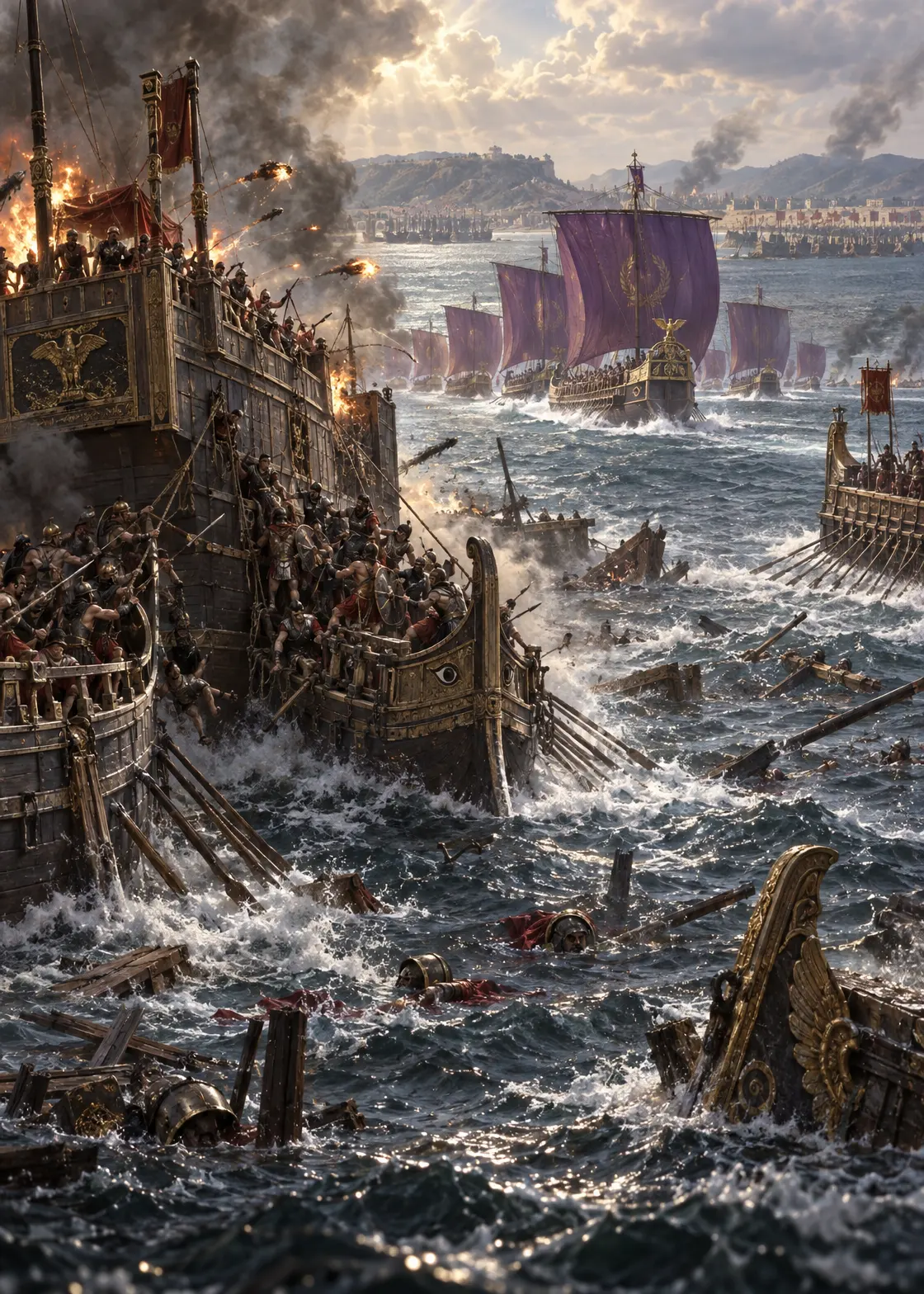
The Crossroads · The night of January 10, 49 BC · The provincial boundary stream south of Ravenna
The Crossing of the Rubicon
You are Caesar, proconsul of Gaul, halted with your officers and the five thousand men of the Thirteenth Legion on the northern bank of the boundary stream.
Your Gallic command has expired, and the legal paths to pass directly from proconsulship to a second consulship without returning to private life have been closed one by one. In December, Curio carried a division in the Senate by three hundred and seventy votes to twenty-two for both you and Pompey to lay down your arms together, but the consul Marcellus overrode the supermajority by placing a sword in Pompey's hand. On the seventh of January, the Senate passed the senatus consultum ultimum. The tribunes Antony and Cassius Longinus, their vetoes ignored and their sacrosanctity violated, have fled Rome to your camp in hired carts and slaves' clothing. Cato and your enemies intend your prosecution the hour you become a private citizen. You stand at the boundary with a single legion: five thousand men against the Republic.
Do you lead the Thirteenth Legion across the boundary stream into Italy, or submit to the decree of the Senate?
Weigh each course: open it to hear your own inner voice. Then decide. Nothing is scored.
- Your inner voiceThe course taken
If I dismiss my five thousand veterans and return to Rome alone, I submit to the ancient laws of the Republic. Yet Cato and my enemies do not conceal their purpose: the moment I am stripped of my command, the courts will seize me for the acts of 59. I would avoid civil war, but I would abandon Antony and Cassius Longinus, offering my life to the twenty-two who placed a sword in Pompey's hand.
- Your inner voiceThe course taken
The tribunes fled in slaves' clothing, their vetoes overridden; the defense of their violated sacrosanctity is the grievance in which this war must be dressed. Five thousand men are few against the Republic, but speed is everything. If I cross this stream, I make myself an enemy of Rome, but I protect my soldiers, my dignity, and the tribunes who risked their lives for me. Let the die be flown: there is no safety in delay.
- Your inner voiceThe course taken
Curio carried the division of three hundred and seventy senators against twenty-two; the governing class wanted peace, not Marcellus's unauthorized sword. If I remain on this side of the boundary stream, I do not commit the crime of invading Italy, giving moderate men time to assert their will. Yet the senatus consultum ultimum has already passed. If I wait idly while my command expires, my enemies will assemble their levies and declare me a public enemy.
What was done
Quoting Menander, Caesar crossed the Rubicon on the night of the tenth of January 49 BC with the Thirteenth Legion, initiating the civil war (AGrade A). Italy fell in sixty days, largely by embrace as towns opened and levies changed sides. At Corfinium, his designated successor Domitius Ahenobarbus was surrendered by his garrison after three days; Caesar dismissed the captured senators unharmed with their money and enrolled the soldiers, inaugurating clementia Caesaris as a conscious strategy to dispel the memory of Sulla. Pompey abandoned Rome and its treasury to execute an evacuation from Brundisium to Greece, trading Italy for time and the client-East. Caesar broke the tribune Metellus from the treasury door in Rome, secured the reserve funds, and immediately marched west to Spain, where at Ilerda he compelled the Pompeian legions under Afranius and Petreius to dissolve without a slaughter, securing the western provinces before turning toward Greece.
The evidence The crossing is documented by Caesar's own Bellum Civile (AGrade A/A-), Cicero's letters (AGrade A), and the lost Historiae of Asinius Pollio, who was physically present at the Rubicon. Pollio's eyewitness account forms the primary substrate for Appian's Bellum Civile 2–5 (BGrade B) and Plutarch's Caesar and Pompey (BGrade B). Suetonius's Divus Julius (BGrade B narrative, AGrade A for documentary quotations) records the scene while adding the trumpet apparition, which the Editor treats as mythology. Overall attestation for the sequence and chronology is AGrade A.
If you choose to walk through itAt every scale
- Yourself
Does a commander who believes his prosecution and political destruction are preordained have a moral right to preserve his dignity by turning his army against the state?
- Those beside you
What obligation does a general owe to the five thousand soldiers and loyal tribunes who tied their fortunes to his, against the certainty of leading them into civil slaughter?
- Rome
Can a constitutional order survive when its legal processes are weaponized by factions to eliminate rivals, leaving no middle ground between capitulation and rebellion?
- The wider world
When the central government of an empire fractures into armed factions, to what extent do subject provinces and client kingdoms bear the real burden of the struggle?
- Our own time
When political factions come to regard the legal survival of their rivals as an existential threat, can institutional norms alone prevent an escalation into political violence?
In 1932, during the final crisis of the Weimar Republic, the national government invoked emergency presidential decrees to depose the elected administration of Prussia, subordinating regional police power to federal military oversight. As constitutional checks disintegrated, opposing political movements concluded that control over state institutions and armed factions was the only guarantee against being prosecuted or crushed by their enemies, accelerating the complete breakdown of democratic legitimacy.
Where the comparison fails. The Weimar breakdown occurred within a modern industrial state governed by mass political movements and civil bureaucracies, rather than a personal clientelist republic where private legions answered directly to aristocratic dynasts. Furthermore, the German collapse enabled an ideological totalitarian dictatorship, whereas Caesar's initial aim was personal security and aristocratic primacy within traditional Roman magistracies.
What does the chapter tell us?
What constitutional pretext did Caesar use to justify crossing the Rubicon with the Thirteenth Legion?
Caesar justified his military advance by highlighting that the Senate had passed the senatus consultum ultimum against the veto of the tribunes Antony and Cassius Longinus, who were forced to flee the city disguised as slaves, thereby violating their ancient tribunician sacrosanctity.
the chapter's narrative
Why did Curio's compromise proposal in December 50 BC fail to prevent the outbreak of civil war?
The Senate voted overwhelmingly by 370 to 22 for both Caesar and Pompey to lay down their commands simultaneously. However, the minority faction immediately overrode this supermajority when the consul Marcellus rode to Pompey's villa and commissioned him to defend the state.
the chapter's narrative
How was Caesar's policy of clementia practically demonstrated at Corfinium and Ilerda?
Caesar deployed clemency as a deliberate strategic instrument designed to counteract the memory of Sulla's proscriptions. At Corfinium and Ilerda, captured senators and hostile generals such as Domitius, Afranius, and Petreius were released unharmed with their property, while their soldiers were peacefully discharged or enrolled.
Caesar's letter cited in the chapter's narrative
How did Caesar counter Labienus's cavalry superiority at the Battle of Pharsalus?
Anticipating that Labienus's seven thousand cavalry would overpower his own horsemen, Caesar concealed a fourth line of six cohorts behind his right wing. He ordered them to hold their javelins and thrust directly at the riders' faces, breaking the charge and exposing Pompey's infantry flank.
the chapter's narrative
Why does the Editor's Note caution that ancient accounts of the war from Philippi onward require critical scrutiny?
The Editor points out that from Philippi forward, the surviving historical narrative was largely preserved by Octavian, whose official memoirs and Res Gestae presented partisan accounts (DGrade D interpretation) that framed proscriptions as legitimate tribunals and foreign campaigns as personal triumphs.
Editor's Note (DGrade D for Augustan tradition standing alone)