Book V · The Crisis of the Republic
Epilogue
Rome in 31/30 BC
The Accounting of a Century
The Republic whose wars this volume has narrated did not fall; it was dismantled, component by component, across the century between the Capitol killings and the Actian breakout, by men who at every stage believed themselves — most of them sincerely — to be saving it. The Epilogue's first task is the institutional accounting, and it can be run as a ledger of the precedents this volume has watched being set. The tribunate, forged as the citizen's shield, was converted by Tiberius Gracchus into a faction's sword and then, by the Sullan and post-Sullan generations, into the standard siege-engine of ambitious politics — until Octavian's eventual settlement would absorb its powers whole into the person of the princeps, the shield restored by being nationalized. The senatus consultum ultimum, invented in 121 to kill Gaius Gracchus lawfully, was deployed against Saturninus in 100, Lepidus in 77, Catiline's men in 63, and Caesar in 49, on which final occasion the weapon met a target armed with thirteen legions and discharged, instead of a riot's suppression, the war that ended the state that wielded it. The extraordinary command, pioneered for Marius by plebiscite in 107, was normalized by the Gabinian and Manilian laws into the standing practice of handing whole theaters and treasuries to individuals — the Republic training its citizens, decade by decade, to understand that emergencies were solved not by institutions but by a man. And beneath all of these ran the master-transformation on which the Proem staked the volume's thesis: the army of 107, recruited from men with nothing, bound to commanders who alone could reward them, had made every subsequent convulsion structurally possible and most of them structurally likely. Sulla's march, Cinna's siege, the armies that Pompey raised privately at twenty-three and Octavian raised privately at nineteen, the legions that changed sides at Teanum and Brundisium and Alexandria for donatives and land — these are a single phenomenon observed at intervals: the client army seeking its patron, and the state reduced to whichever patron currently held it. The Republic's constitutional history from 133 to 31 is the history of that army looking for its final employer; at Actium it found him.
The human accounting resists the ledger form, and the Editor will not pretend otherwise. The century's internal wars — Italian, Sullan, Sertorian, servile, Caesarian, Philippic, Sicilian, Actian — killed Romans and Italians on a scale no external enemy had ever approached: the Social War's three hundred thousand; the Sullan wars and proscription; Pharsalus's and Philippi's legions of citizens; Perusia; the crosses of the Via Appia. The senatorial order was harvested three times over — by Marius's terror, Sulla's lists, and the Triumvirs' — with the result, visible in the prosopography, that the governing class of the new age was substantially a new class: the old names extinguished or ornamental, the consulships of the coming regime filled with Italian municipal gentry of the very stock the Social War had enfranchised, men whose grandfathers had fought Rome and whose grandsons would govern it. Italy itself, unified in law by the war of 91–88, was unified in fact by the century's shared catastrophe and by the veteran colonies studded across it — Sulla's, Caesar's, the Triumvirs' — which planted the legions' discharged generations in a hundred towns and made the peninsula, for the first time, a single political nation: the tota Italia whose oath of personal allegiance to Octavian in 32 was the plebiscite of the new order, extorted and real in the proportions such instruments always are.
The paradox the Editor has deferred to this page is that the century of the Republic's destruction is simultaneously the summit of its civilization, and that the two facts are one fact. The pressure that broke the state made the literature: Cicero's oratory and correspondence exist because words were, for one last generation, still contending with armies for the direction of events; Caesar's prose exists as a weapon of the contention; Sallust's history exists as the loser's autopsy of it; Lucretius and Catullus wrote in the eye of the storm, and the generation of Virgil and Horace — both of them losers of confiscated farms in the veteran-settlements this volume has described, one of them a defeated officer of Philippi — was already composing, as the doors of Janus closed, the poetry in which the whole catastrophe would be transmuted into the founding myth of the peace. The compendium's attestation apparatus registered the same paradox as a source-state: the century that destroyed the Republic documented itself as no ancient society ever had, and the destruction is the reason — every dynast a publicist, every faction a historiography, every proscription a memoir-crop. The reader who has followed the Editor's Notes from the Gracchan chapters' epitome-fragments to the civil-war chapters' embarrassment of AGrade A riches has watched the Roman revolution happen in the evidence itself.
What was founded at Actium the next volume must treat, but its shape can be sketched in the terms this volume has earned. The victor — Caesar Divi Filius, holding in 30 BC every army, every province, and every treasury in the Roman world — faced precisely the problem that had killed his father: Rome would not tolerate a king, and could no longer function without one. His solution, elaborated across the following decade and formalized in the settlement of January 27 BC, was the masterpiece of institutional camouflage the age's hard schooling had prepared him to build: the res publica restored — Senate, magistracies, elections, laws, all resumed in form — with the military monopoly quietly retained, the frontier provinces and their legions held by the princeps as a single perpetual proconsulship, the client army's patronage nationalized at last into fixed terms of service, fixed pay, and a military treasury that made the soldier the pensioner of the state in the person of its first citizen. The name the Senate voted him that January — Augustus, a word from the vocabulary of consecration rather than constitution — completed the design: not king, not dictator (the title was abolished, with studied piety, forever), but the revered one, first among restored equals, holding the Republic in trust. It was a fiction, and it was functional, and the distinction between those two things — which the Republic's last century had erased and the Principate's first would master — is the hinge on which this compendium now turns. The wars that follow are of a new kind: frontier wars of a world-state, fought by a professional standing army under a single patron, their triumphs a dynastic monopoly, their disasters — the reader will meet three legions in a German forest before the next volume is old — absorbed by an order that no defeat could any longer unseat. The Republic's wars were arguments about who Rome would be; the Empire's wars would be arguments only about where Rome would end. This volume closes at the moment of the exchange: the doors of Janus shut on a silence ninety-two years of this book's subject matter had made unimaginable, and the Roman world, having tried every alternative to the rule of one man, resting at last — exhausted, diminished, relieved, and about to be told by its poets that this was what it had wanted all along.
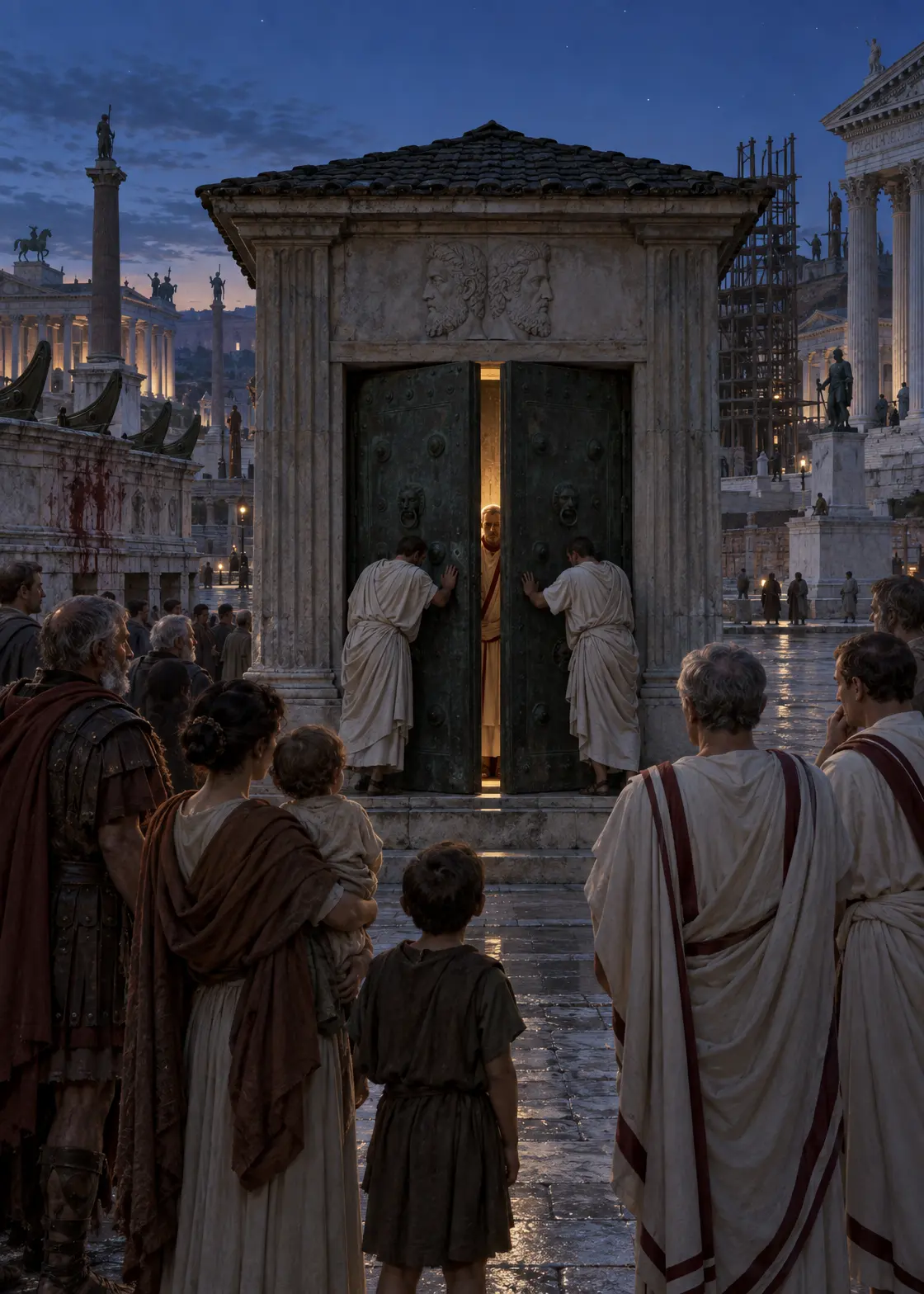
Here ends Book V of Imperium Romanum: the Crisis of the Republic, from the tribunate of Tiberius Gracchus to the battle of Actium. Book VI will treat the wars of the early Principate: the Augustan conquests and the German catastrophe, the Julio-Claudian frontiers, the year of the four emperors, and the Flavian consolidation — the wars of the world-state whose construction this volume has witnessed, on the long road that ends, four hundred and seventy-six years and three volumes hence, at the last emperor of the West.