Book VI · The Wars of the Early Principate
Chapter 1
The Augustan Conquests
The Edges of the Inheritance
The first campaigns of the Principate were conducted at the empire's two oldest edges — the Nile and Spain — and they announced the new age's grammar. In Egypt, held by the princeps as a personal domain no senator might even visit without leave, the first prefect Cornelius Gallus — poet, friend of Virgil, conqueror of the Thebaid — carved his deeds on the pyramids and obelisks in three languages, was disgraced for exactly that species of self-advertisement, and opened his veins in 26 BC: the first lesson of the reign, that glory now had a sole proprietor. His successors fought the new state's first foreign wars: Aelius Gallus's expedition of 26–25 BC down the Red Sea coast toward the incense kingdoms of Arabia Felix, a fiasco of thirst, disease, and a treacherous Nabataean guide that reached the walls of Marib and staggered back with the army's bones strewn across six months of desert — the campaign is preserved by Strabo, the prefect's friend, with the guide bearing all blame the friendship required; and the Kushite war of 25–22 BC, when the one-eyed candace Amanirenas of Meroë sacked Syene and Philae and carried off the emperor's statues, and the prefect Petronius stormed south past the cataracts to Napata in reprisal. The peace that followed fixed the Nile frontier for three centuries at Hiera Sykaminos; and the war's true monument was recovered by archaeology at Meroë itself in 1910: the bronze head of Augustus, hacked from its statue in the raid of 25, buried beneath the threshold of a Kushite victory temple so that every worshipper for generations trod on the neck of the master of the world — the single most eloquent object the empire's enemies ever left behind, and AGrade A testimony that the view from beyond the frontier existed, though almost nowhere else does it survive.
Spain was graver. The Cantabri and Astures of the northern mountains — the last unconquered peoples of a peninsula Rome had been fighting over since the Scipios — were the object of the new regime's first full war, and Augustus took the field himself in 26 BC, the last reigning princeps for a century to campaign in person against a foreign enemy. The war was the Numantine problem multiplied by geography: a mountain enemy of hill-forts and ambush who would not stand, columns converging through the passes from Segisama, a fleet landing marines on the Biscay coast behind the tribes, the emperor invalided to Tarraco with the illness that nearly ended the reign in 25, and the premature triumph-closing of Janus's doors that the mountains twice reopened. The rebellions of 24, 22, and 20–19 BC were answered with escalating severity — crucified prisoners singing their defiance from the crosses, mothers killing children in the sieges, captives sold on condition of removal, and finally Agrippa, summoned in 19 to end it, breaking the Cantabri with a thoroughness he declined to advertise: the military-age population largely destroyed or deported to the plains, the hill-forts razed, and the triumph the Senate voted him refused — the second lesson of the reign, taught by its second man, that even earned glory was now best worn invisibly. Two of the war's legions were settled at the new colony of Emerita Augusta; the northwest's gold, worked thereafter by imperial engineers on a scale Pliny describes with awe, repaid the war within a generation; and the Spanish provinces, garrisoned down the century from three legions to one, produced within eighty years the first emperor born outside Italy — the long Romanization this compendium will watch mature into the age of Trajan.
The Alps followed, in the swift campaigns that closed the gap between Italy and the northern rivers: the Salassi of the Aosta valley extirpated in 25 BC, forty-four thousand sold at Eporedia and the colony of Augusta Praetoria planted in their chief valley; and in 15 BC the great pincer of the emperor's stepsons — Tiberius striking east from Gaul, Drusus north from Italy through the Brenner — that subjugated the Raeti and Vindelici in a single summer and carried the frontier to the Danube's headwaters. The trophy of the Alpine wars still stands above Monaco at La Turbie, and its dedication, preserved complete by the elder Pliny, lists by name the forty-five Alpine peoples brought under the imperium of the Roman people — a document, the Editor notes, of the new age's characteristic form: total, administrative, and in the dative case, conquest recorded as a filing.
The eastern edge, in the same decade, was settled without a battle — and advertised as though by one. In 20 BC, under the pressure of Tiberius's army posted in Armenia and a diplomacy of exquisite patience, Phraates IV of Parthia returned the eagles of Carrhae and the survivors of Crassus's and Antony's armies; Armenia received a Roman-crowned king; and the standards' recovery was celebrated at Rome with a temple, an arch, the closing of Janus, and the cuirass of the Prima Porta statue, on which a Parthian hands back the eagle beneath a personified sky — the reign's masterpiece of converting a negotiated settlement into an iconography of surrender. The Editor grades the images accordingly, and notes the substance beneath them: the Euphrates line and the Armenian buffer, established here without a legionary casualty, would remain the architecture of Rome's eastern security, and the theater of its recurring crises, for the whole remaining span of this compendium.
The German Project12 BC–AD 6
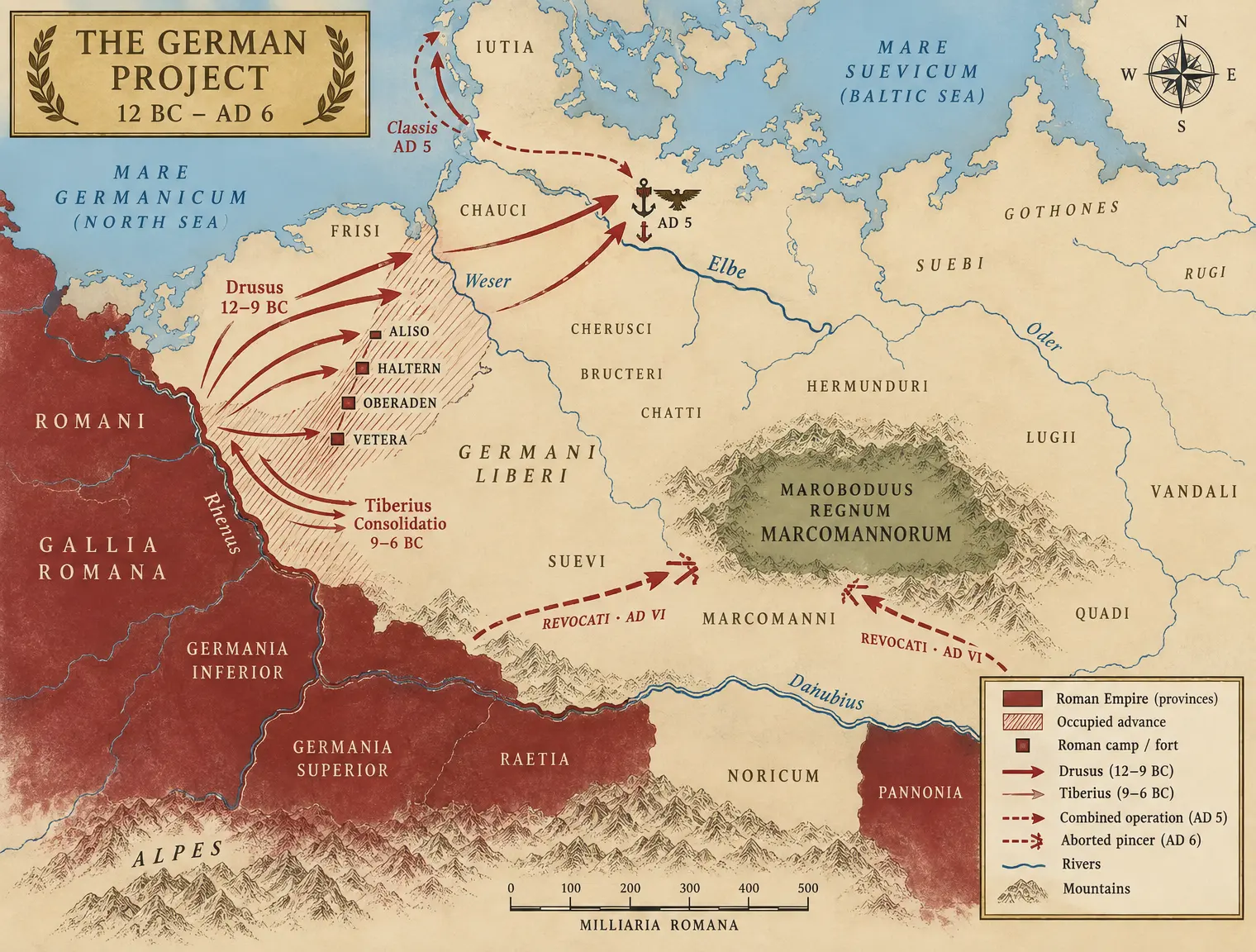
The great exception to the reign's economy of force was Germany, and the volume must treat the project on the scale its ambition and its catastrophe deserve. The occasion was supplied in 16 BC, when the Sugambri and their allies crossed the Rhine, mauled the Fifth Legion's cavalry, and took its eagle from the proconsul Marcus Lollius — a defeat trivial in losses and intolerable in symbolism, the clades Lolliana that brought Augustus himself to Gaul for three years and converted the Rhine from a guarded river into a start-line. The instrument of the advance was the emperor's younger stepson, Nero Claudius Drusus, twenty-five years old at his first command and, by the unanimous testimony of a tradition that loved him, the most brilliant and most Republican-mannered prince the dynasty produced. His four campaigns of 12–9 BC were a compound of engineering and audacity that redrew the map: the fifty-mile canal — the fossa Drusiana — cut from Rhine to Zuiderzee to let the fleet into the North Sea; the ocean coast brought over, the Frisii made allies, the Chauci reached across tidal flats that nearly drowned an army learning what the ocean did twice a day; the Lippe corridor fortified — the great base at Oberaden, dated by its timbers' tree-rings to the autumn of 11 BC, the depot at Haltern, the road-forts that archaeology has strung like beads along the river — and the campaigns driven deeper each year: the Sugambri, the Cherusci across the Weser, and in 9 BC the Marcomanni and the long march that touched, first of Roman armies, the bank of the Elbe. There the tradition placed the omen — the giant barbarian woman who barred the crossing and told the young general in Latin to turn back, for his end was near — and there, on the return march, his horse fell on him; he died thirty days later in the summer camp, his brother Tiberius, riding two hundred miles in a day and a night from the Alps, arriving in time to close his eyes, and walking before the body every step to the Rhine. Rome gave him the posthumous name Germanicus for himself and his line; the army built him a cenotaph at Mogontiacum and mourned him for a generation; and the Editor, obliged to grade as well as mourn, notes that the sources' unanimous portrait of the beloved prince descends substantially through his son's partisans and his family's grief, and that what is certain is the work: when Drusus died, Roman arms had reached the Elbe, and Roman timber stood in garrison a hundred and fifty miles beyond the Rhine.
Tiberius took up the command and the method changed to his: the campaigns of 8–7 BC that brought the Sugambri to terms and then transplanted forty thousand of them to the Gallic bank — the tribe that had taken Lollius's eagle dissolved by administrative act; the slow conversion of the Lippe and Main corridors into governed space, with winter camps deep in the interior, assizes held, tribute assessed, and the first altar of the imperial cult among the Germans rising at the Ubian city that would one day be Cologne. After the decade's dynastic interruption — Tiberius's self-exile to Rhodes, the deaths of the emperor's grandsons, the adoption of 4 AD that made the Claudian the heir — he returned to the German command and completed, in the campaigns of AD 4–5 that Velleius Paterculus rode in and wrote up, the project's apparent triumph: the interior peoples sworn, the army wintering on the upper Lippe, and in 5 the combined operation that stands as the logistical summit of the ancient world's northern warfare — the fleet sailing from the Rhine mouths around the Jutland peninsula while the legions marched inland, army and navy meeting on the lower Elbe, the ocean squadron pushing on into waters no Mediterranean keel had cut. One power remained on the map between the Elbe and the Danube: Maroboduus, king of the Marcomanni, who had led his people out of the Main valley into the mountain-ringed basin of Bohemia and built there, with Roman deserters and Roman methods, a drilled army the sources put at seventy thousand foot — the first German state, created by the pressure of the advance and targeted for destruction by the plan of AD 6: twelve legions in two army groups, Tiberius from the Danube, Saturninus from the Rhine, the greatest converging operation Rome had ever mounted, five days' march from contact when the couriers reached the columns with the news that Illyricum, behind them, had risen entire.
The chapter halts at that courier, as the empire did. The German project's reckoning belongs to the next chapter; its design belongs here, and the Editor closes with the question the design has posed ever since: whether the Elbe frontier was strategic wisdom interrupted, or overextension reprieved. The ancient verdict was written afterward by the man who inherited the ruins, in the state-paper Tacitus summarizes as the advice of Augustus — consilium coercendi intra terminos imperii, the counsel of keeping the empire within its bounds — and the modern literature still divides. The compendium's own ledger records what the spade has certified: that for one generation, from the tree-ring dated timbers of Oberaden to the coin-dated ovens of Haltern, Rome governed to the Weser and marched to the Elbe; and that everything east of the Rhine which the next chapter does not destroy, the one after it will formally renounce.
The Crossroads · 16 BC · Gaul
The Rhine Start-Line
You are Augustus, princeps of Rome, arrived in Gaul following a military disaster on the northern frontier.
In 16 BC, the Sugambri and their allies crossed the Rhine, mauled the cavalry of the Fifth Legion, and took its eagle from the proconsul Marcus Lollius. Though losses in men were trivial, the loss of a legionary standard in the clades Lolliana is an intolerable public humiliation. You have come to Gaul yourself for three years to restore order. Until now, the regime has practiced an economy of force, establishing an eastern buffer on the Euphrates through diplomacy and subduing Spain and the Alps. You must now determine whether to restore the Rhine as a guarded boundary or carry Roman arms deep into Germany.
How will you answer the defeat of Marcus Lollius and secure the frontier across the Rhine?
Weigh each course: open it to hear your own inner voice. Then decide. Nothing is scored.
- Your inner voiceThe course taken
Lollius has made the river look frail. If I leave the Rhine as a guarded river, the Sugambri will cross again whenever Rome looks away. I must make the river a start-line instead. My stepson Drusus has the audacity to lead the legions inland, build road-forts, and drive Roman arms past the Weser to the Elbe. It will demand fleets, canals, and years of blood, but it will permanently secure Gaul.
- Your inner voiceThe course taken
The loss of the Fifth Legion's eagle is an insult, not a disaster of arms. A swift reprisal across the water will punish the Sugambri, recover the lost standard, and teach the tribes respect. Then the Rhine can remain a guarded boundary, sparing the treasury and preserving our economy of force. If I commit my legions into the dense forests beyond, I risk endless ambushes and overextension far from Italy.
- Your inner voiceThe course taken
Our conquests in Spain and the Alps have already strained the legions. Gaul is wealthy and pacified; we need only defend the Gallic bank, rebuild the river forts, and let the German peoples beyond exhaust themselves in their own wars. As we saw in Armenia against Parthia, patience and diplomacy can gain more than open battle. Marching into trackless territory across the Rhine will only unite the tribes against us.
What was done
Augustus stayed three years in Gaul and converted the Rhine from a guarded river into an offensive start-line. Nero Claudius Drusus took command at age twenty-five (12–9 BC), cutting a fifty-mile canal from the Rhine to the Zuiderzee, allying with the Frisii, fortifying the Lippe with bases at Oberaden (dated by tree-rings to 11 BC, AGrade A) and Haltern, and driving past the Weser to the Elbe before dying on his return march. Tiberius continued the conquest (8–7 BC), transplanting forty thousand Sugambri to the Gallic bank, and in AD 4–5 led a joint army and fleet operation to the lower Elbe (AGrade A/D). By AD 6, twelve legions converged in two army groups against Maroboduus in Bohemia—until couriers arrived reporting that Illyricum had risen entire behind them. For a generation, Rome governed to the Weser and marched to the Elbe, until the empire later renounced what it could not hold.
The evidence Cassius Dio 51–55 (BGrade B) provides the continuous narrative spine; Velleius Paterculus 2.90–110 offers eyewitness observation as an officer with courtier bias (AGrade A observation, DGrade D judgment); Suetonius (Augustus, Tiberius) preserves archival fragments (BGrade B); Florus and Orosius epitomize lost Livy (CGrade C–D). The documentary and material record provides AGrade A control: the Res Gestae 26–33 (AGrade A text, DGrade D victor's arithmetic) and the dendro- and coin-dated Lippe fortifications at Oberaden and Haltern.
If you choose to walk through itAt every scale
- Yourself
How far does a ruler's dread of personal disgrace and the loss of dynastic prestige compel wars that calm calculation would avoid?
- Those beside you
What does it mean to entrust the bloodiest enterprise of a reign to young stepsons whose glory may eclipse your own or cost them their lives?
- Rome
Can an empire founded on the promise of peace and restored order justify endless offensive expansion into uncharted territory?
- The wider world
How does an imperial power distinguish between securing its frontiers and creating the very unified coalitions of enemies that will threaten its survival?
- Our own time
When modern powers encounter frontier crises, what determines whether forward military intervention stabilizes a border or produces unsustainable overreach?
In the nineteenth century, imperial powers frequently turned punitive border skirmishes into permanent forward policies. Following minor cross-border raids by indigenous forces along the Northwest Frontier of British India, authorities debated whether to maintain the Indus River line or push forward through the mountain passes into the interior of Afghanistan to preempt rival empires. Forward policies promised permanent pacification through roads and forts, but consistently demanded escalating troop commitments and entanglements in territory resistant to foreign administration.
Where the comparison fails. The British possessed industrial transport, telegraphs, and global steam supply lines unavailable to ancient armies marching through trackless forests. Moreover, Rome sought to incorporate conquered tribal territory directly into provincial civic administration, whereas modern forward policies often aimed at establishing indirect buffer protectorates rather than total civic assimilation.
What does the chapter tell us?
Why was the defeat of Marcus Lollius in 16 BC (clades Lolliana) significant enough to bring Augustus to Gaul for three years?
The chapter states that the defeat of Marcus Lollius was trivial in actual casualties but intolerable in symbolism because the Sugambri captured the eagle of the Fifth Legion. This political humiliation prompted Augustus to travel to Gaul and convert the Rhine into an offensive start-line.
the chapter's narrative
What primary AGrade A material evidence confirms the scale and reality of the early Roman military occupation deep in Germany?
The chapter highlights tree-ring dated timbers from the autumn of 11 BC at the base of Oberaden and coin-dated occupation horizons at Haltern as AGrade A material control, proving that Rome maintained fortified garrisons and governed space far beyond the Rhine.
Lippe-fort archaeology (AGrade A)
How did the Augustan regime resolve its conflict with Parthia in 20 BC, and how did it choose to present that outcome?
Under diplomatic pressure and the presence of Tiberius's army in Armenia, Phraates IV returned the eagles of Carrhae and surviving prisoners without a battle. The regime converted this negotiated compromise into an iconography of total surrender through temples, arches, and the Prima Porta cuirass.
the chapter's narrative
According to the chapter, why must the eyewitness history of Velleius Paterculus be used with particular caution?
The Editor's Note describes Velleius Paterculus as a precious anomaly: an eyewitness cavalry officer present during the German and Illyrian commands whose factual observations earn AGrade A, but whose courtier bias degrades his historical judgment to DGrade D.
Velleius 2.90–110 (AGrade A/D)
What sudden development halted the massive converging Roman campaign against Maroboduus in AD 6?
Tiberius and Saturninus were leading twelve legions in two converging army groups, just five days' march from Maroboduus's forces in Bohemia, when couriers arrived bearing news that Illyricum had risen in total revolt, forcing the empire to halt the campaign.
the chapter's narrative