Book VI · The Wars of the Early Principate
Chapter 2
The Great Illyrian Revolt and the Varian Disaster
The Bellum BatonianumAD 6–9
The rising that saved Maroboduus began, with the bitterest of the period's ironies, in a levy: Illyrian auxiliaries mustering for Tiberius's Bohemian war looked at their own assembled strength, weighed the taxes and the recruiting officers and the publicani against it, and concluded — their leader's words were remembered and are given below — that Rome had taught them her language of war too well to go on speaking her language of obedience. The revolt of the two Batos — Bato the Daesitiate in the Bosnian mountains, Bato the Breucian in the Save valley, with the Pannonian Pinnes beside them — ran through the whole tract between Italy and Macedonia within weeks: garrisons and citizen traders massacred, the coast raided, Macedonia invaded, and Italy itself, as the panic in the capital measured it, ten days' march from an enemy who was said to put two hundred thousand foot and nine thousand horse under arms. Augustus told the Senate the war was the gravest since Carthage — Suetonius preserves the estimate, and the mobilization certifies it as more than rhetoric: the Bohemian operation cancelled and a face-saving treaty thrown to Maroboduus; ten legions concentrated with above seventy auxiliary cohorts and ten thousand recalled veterans; freedmen conscripted into cohorts for the first time since the Hannibalic emergencies; and the emergency taxes and slave-levies at Rome accompanied by grain rationing and the muttering, which Dio records, that the city itself was one bad harvest from joining the provinces in revolt.
The war Tiberius then conducted for three years is the least narrated great war of the ancient world — its only continuous account is Dio's compressed annalistic, with Velleius riding in it and gilding it — and the most instructive, because it is the Principate's military system operating exactly as designed against the worst case: no battles of annals, but a strangulation. The armies converged and declined combat except on their own terms; the country was eaten systematically, valley by valley, the population driven from the lowlands, the fortified refuges reduced one by one; Germanicus, the dead Drusus's son, was blooded here in independent command; and the coalition was disassembled politically as it was starved militarily — the Breucian Bato bought in AD 8 with recognition as client-prince, then seized and executed by his Daesitiate namesake when the Save valley's surrender exposed the mountains; the Pannonians beaten at the Bathinus river on the third of August 8; the last campaign of 9 a mountain man-hunt through the karst, ending at the siege of Andetrium above Salona, where the final assault up the cliff-terraces was delivered under the eyes of Tiberius enthroned before the camp, and the war's end was transacted in the exchange the compendium has carried from Dio as one of its permanent texts. The surrendered Bato, brought before the tribunal and asked why his people had rebelled, answered: You are to blame for this; for you send as guardians of your flocks neither dogs nor shepherds, but wolves. Tiberius — the detail completes the exchange — kept him honorably interned at Ravenna for life: the one commander of the age who never pretended the answer was false. Three days after the news of the Illyrian peace reached Rome, the couriers from the Rhine arrived.
The TeutoburgSeptember, AD 9
Publius Quinctilius Varus was not the fool the tradition required. Consular, husband of the emperor's grand-niece, former governor of Africa and of Syria — where he had marched on Jerusalem to crucify two thousand rebels after Herod's death, efficiently — he was appointed to the Rhine command about AD 7 as precisely what the German project now seemed to need: an administrator, to convert Drusus's and Tiberius's conquest into a tax-paying province. Velleius, who knew him, fixed his epitaph in an epigram — that he entered rich Syria poor and left poor Syria rich — and fixed the deeper failure in a sentence: he imagined the Germans could be tamed by law. Through the summer of 9 he held assizes east of the Weser as though in Umbria, his three legions dispersed on requisition and escort duties, while around him the conspiracy assembled itself inside his own headquarters. Its architect, Arminius of the Cherusci, was twenty-five or six: a chief's son raised as a hostage-soldier in the Roman auxilia, decorated in the Illyrian war, enrolled in the equestrian order, commander of the Cheruscan contingent at Varus's own table — the client-army system's finished product, turning the entire apparatus of his formation against its makers. The warnings were delivered and declined: Segestes, a rival Cheruscan loyal to Rome and Arminius's unwilling father-in-law, denounced the plot at dinner and urged Varus to arrest the conspirators on the spot; Varus, weighing a family feud against his own judgment of men, declined. In late September the army — the Seventeenth, Eighteenth, and Nineteenth legions, six auxiliary cohorts, three cavalry alae, with the baggage, the families, and the law-courts of a governor's progress — broke camp for the Rhine by the northern route, and turned aside, on Arminius's intelligence, to suppress a rising that Arminius had arranged; his auxiliaries rode ahead, he said, to gather the loyal tribes, and gathered them.
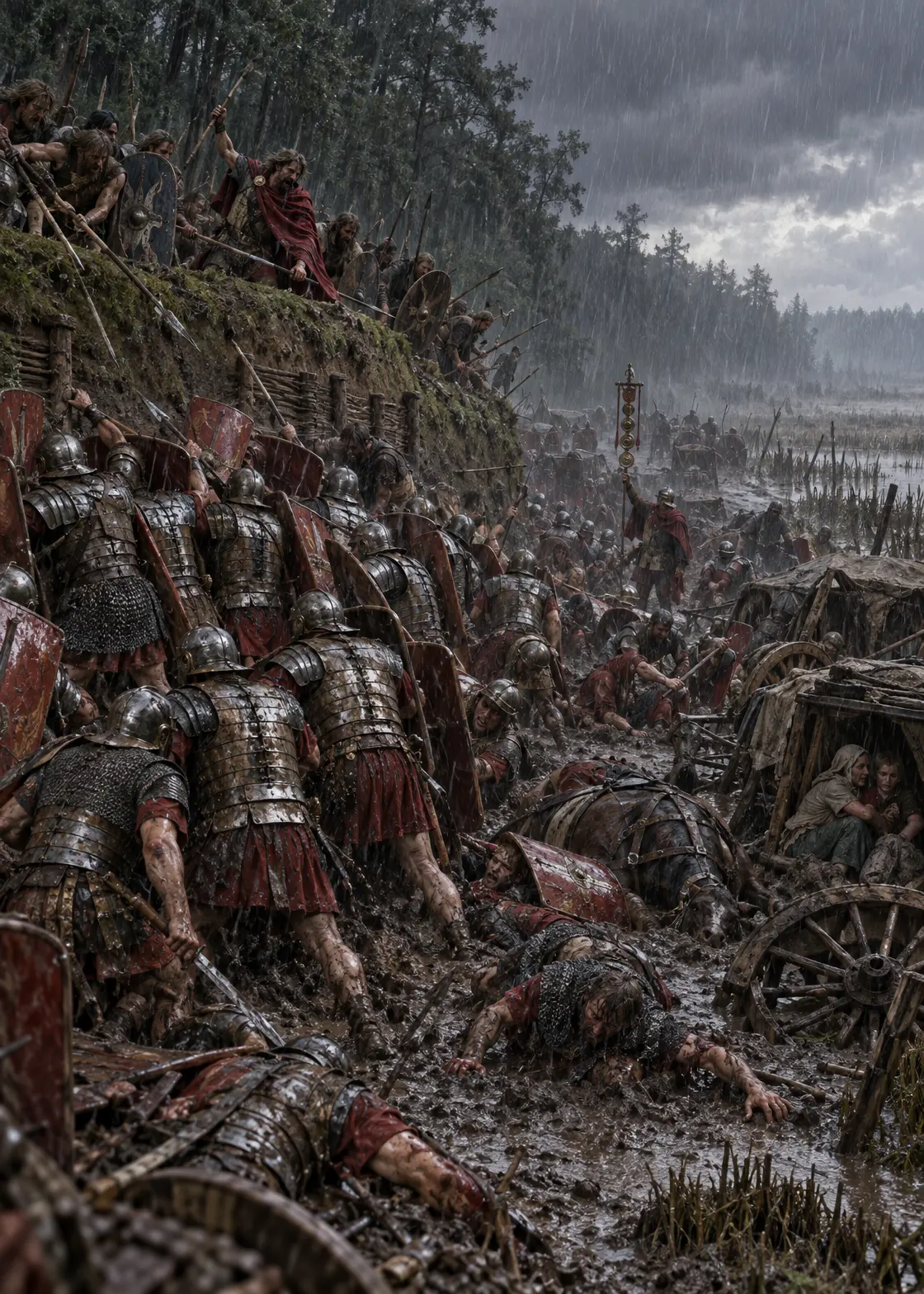
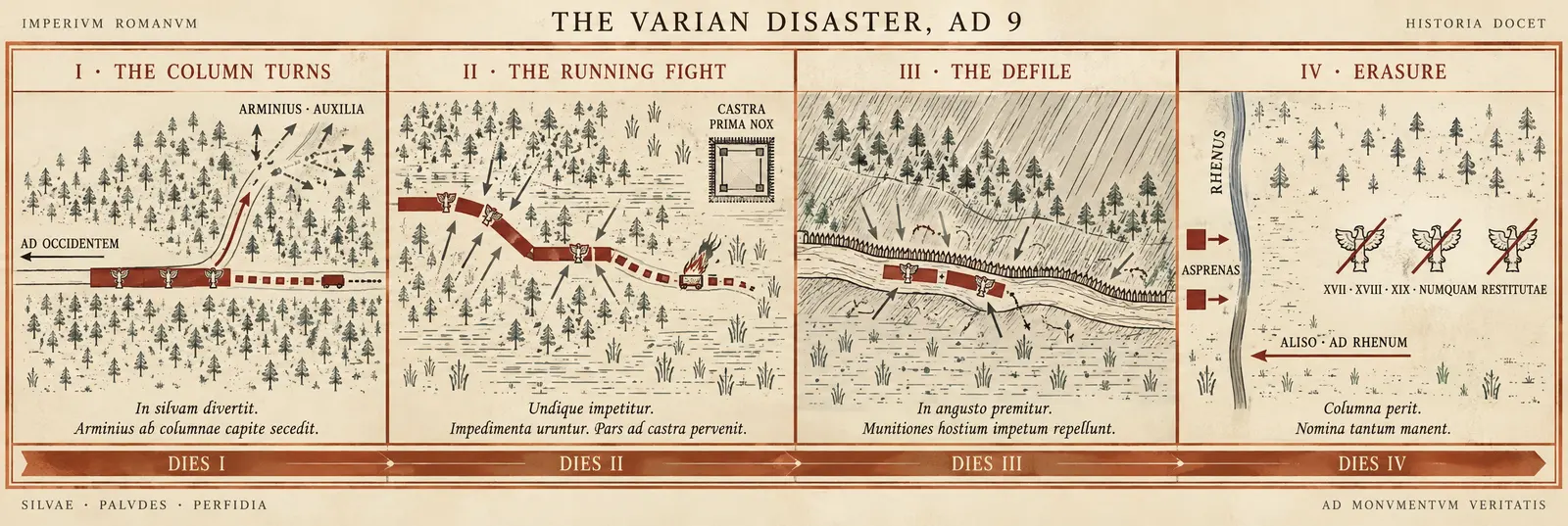
What followed, across four days of the Kalkriese corridor where the great bog comes down to meet the Wiehen hills, the compendium reconstructs from Dio's narrative and the ground's own testimony, which since 1987 has been excavated into the best-attested battlefield of antiquity. The column, ten miles of soldiers, wagons, and civilians on a forest track in breaking autumn weather, was bled first at range — the trees felled ahead, the javelins from the slopes, the rain that soaked the shields heavy and the bowstrings slack; the first night's camp was entrenched in full order, the second, after a day of running fight and the baggage burned by its own escort, barely at all. On the third or fourth day the survivors entered the killing ground the archaeology has mapped: the narrow passage between hill and bog at Kalkriese, where the Germans had built along the slope's foot a turf-and-sand rampart, sod-faced, with sally gaps — a Roman field-fortification, built by men Rome trained, to murder a Roman army in — and the column, assaulting it under the storm, broke against it. The finds speak with terrible particularity: the rampart's collapsed face lying over Roman ordnance where the countercharges failed; the coin-horizon sealed at 9, the legionary mint-marks of the lost numbers; the iron catapult bolts, the officer's silvered parade-mask torn from its helmet, the surgeon's instruments, the women's hairpins among the military bronze; the mule-skeletons still harnessed, one with its neck-bell stuffed with straw — the column's last night-move, muffling the animals in the dark, preserved in a handful of oat-stems and forever. Varus, wounded, fell on his sword with his senior officers in the tradition of Cannae's consul rather than Carrhae's proconsul; one camp prefect died fighting, the other negotiated a surrender that delivered the remnant to the altars — the groves where, when Germanicus's men came six years later, the skulls were still nailed to the trees and the survivors could point out the pits, and the gibbets, and where each tribune had been butchered. Perhaps fifteen to twenty thousand soldiers died with the uncounted civilians; a few prisoners were ransomed decades later, forbidden by their own families' settlements to enter Italy; the three eagles went to the tribes, and the legionary numbers XVII, XVIII, and XIX were never borne by any Roman unit again — the only such erasure in the army's history, a mourning written into the order of battle for as long as the army lasted.
The strategic sequel was decided in a fortnight and ratified for four hundred years. Lucius Asprenas brought the two Mainz legions down the river and held the crossings; the fort of Aliso on the Lippe, besieged, broke out by night behind its archers and reached the Rhine — the one clean feat of arms the disaster's tradition preserved; Arminius, who understood everything about Roman armies except their depth, sent Varus's head to Maroboduus, soliciting the alliance of the two Germanies against the wounded empire, and Maroboduus, who had watched twelve legions turn back from his mountains three years before, sent the head on to Augustus for burial and stayed neutral. At Rome the emperor, seventy-one years old, dismissed his German bodyguard, posted watches against a rising that never came, and was seen for months, Suetonius records, unbarbered and beating his head against the doors with the cry the tradition made the epitaph of the entire project: Quinctili Vare, legiones redde — Quinctilius Varus, give back the legions. The army establishment absorbed the amputation — twenty-five legions now, the Rhine command rebuilt to eight — and the policy conclusion, drafted in the state-paper already cited and executed by Tiberius against every provocation of the following decade, renounced the Elbe: Germany would be punished, demonstratively and repeatedly, and never again governed. The Editor defers the punishment to the next chapter and closes this one on the graded verdict the evidence sustains: the Teutoburg was not the defeat of an army by a wilderness, as the Roman imagination preferred to remember it, but the defeat of an occupation by its own graduates — the client-military system's masterpiece and its warning, delivered in the same instrument; and the frontier it fixed at the Rhine became, across the centuries this compendium has still to travel, the deepest single line in the history of Europe.
The Crossroads · September, AD 9 · East of the Weser, Germania
The Denunciation at the Weser
You are Publius Quinctilius Varus, consular, former governor of Syria and Africa, and commander of the Rhine army: the Seventeenth, Eighteenth, and Nineteenth legions, with their auxiliary cohorts, cavalry alae, and civilian trains.
Your summer assizes east of the Weser have concluded. As the army prepares to march back toward winter quarters on the Rhine, a Cheruscan nobleman loyal to Rome, Segestes, brings a startling accusation to your dinner table: Arminius, the Romanized Cheruscan equestrian who commands your native auxiliary cavalry and sits beside you as a guest, is leading a conspiracy to destroy your army. Segestes urges you to seize Arminius and the tribal chiefs on the spot. Arminius denies any plot, reporting instead an urgent tribal rising off your route of march, and offers to ride ahead with his auxiliary horse to gather loyal forces to help you suppress it.
Do you heed Segestes and arrest Arminius at dinner, march directly for the Rhine while refusing the detour, or trust Arminius and turn your column aside to put down the reported rising?
Weigh each course: open it to hear your own inner voice. Then decide. Nothing is scored.
- Your inner voiceThe course taken
Segestes despises Arminius for taking his daughter against his consent; I cannot overturn imperial policy over a barbarian family quarrel. Arminius was trained in our auxiliary cohorts, holds the equestrian gold ring, and sits at my table. To arrest him without evidence would destroy the trust that underpins provincial governance. Let him ride ahead to gather the loyal tribes, while our legions turn aside to suppress this minor disturbance.
- Your inner voiceThe course taken
Segestes demands instant chains before the trap springs. If I strike now, I violate hospitality and insult an equestrian officer decorated in the Illyrian war, risking an immediate tribal explosion across the Weser. Yet if Segestes speaks truth rather than malice, my three legions, their baggage, and hundreds of civilians face mortal peril. Better to bear the political outcry of an unlawful arrest than march blindly into an engineered forest ambush.
- Your inner voiceThe course taken
I need not choose between an unproven arrest and an unverified detour. Segestes may lie, but narrow forest tracks in breaking autumn rain invite disaster. I can refuse the diversion, order the Seventeenth, Eighteenth, and Nineteenth to keep tight marching order, and keep Arminius and his Cheruscan horse under my personal eye until we reach the river. Treason cannot strike an intact, watchful army on an open road.
What was done
Varus dismissed Segestes's warning as a domestic feud and trusted his auxiliary commander. In late September AD 9, the three legions, six auxiliary cohorts, three cavalry alae, and extensive civilian trains broke camp and turned aside on Arminius's intelligence. Arminius and his Cheruscan horse rode ahead, ostensibly to rally loyal tribes, but instead mobilized the conspirators. Trapped across four days of autumn storms along the Kalkriese corridor between bog and hills, the ten-mile column was methodically bled and channeled into a prepared killing ground. Against a sod-faced turf rampart built by Roman-trained Germans, the Roman counterattacks collapsed. Varus fell on his sword with his senior officers; fifteen to twenty thousand Romans died, and the eagles of XVII, XVIII, and XIX were lost forever. The disaster forced Augustus and Tiberius to abandon the Elbe and fix the imperial boundary at the Rhine (AGrade A material testimony, BGrade B operational narrative).
The evidence The disaster has no surviving eyewitness accounts. The earliest connected narratives are Velleius Paterculus 2.117–120 (AGrade A presence, DGrade D proportion, writing as a contemporary courtier blaming Varus) and Cassius Dio 56.18–24 (BGrade B, the fullest tactical sequence, drawing on lost intermediaries). Tacitus provides retrospective autopsy at Annals 1.60–62 (AGrade A for the physical remains found six years later). The Kalkriese excavation assemblage provides AGrade A material testimony for the multi-day running fight, the turf-and-sand rampart, the sealed coin-horizon of AD 9, and the straw-stuffed mule-bells.
If you choose to walk through itAt every scale
- Yourself
How does your confidence as an experienced consular administrator who governed Syria and Africa lead you to mistake a volatile frontier for a pacified province?
- Those beside you
How do you evaluate conflicting counsel when the warning comes from a suspicious father-in-law and the reassurance comes from a decorated comrade dining at your table?
- Rome
When an empire incorporates foreign warriors into its regular military structures, how can its institutions guard against that tactical training being turned against the state?
- The wider world
What happens to subject populations when provincial administration relies on tax-gatherers and military levies that native elites perceive as intolerable exploitation?
- Our own time
How should modern institutions distinguish between credible whistleblower intelligence and accusations born of personal malice or factional rivalry?
Modern counterinsurgency and stabilization campaigns frequently train, equip, and rely upon indigenous security forces. Coalition commanders often form close working relationships with local officers who have graduated from Western academies and adopted Western military practices. When intelligence warnings suggest that allied local commanders are secretly coordinating with insurgent networks, headquarters often dismisses the warnings as the product of ethnic or factional rivalry, only to suffer devastating insider attacks.
Where the comparison fails. Modern military headquarters possess electronic surveillance, intercepted telecommunications, biometric databases, and specialized counterintelligence units to verify loyalties. Varus operated entirely without technical intelligence, relying only on unverified oral testimony, personal rapport, and tribal intermediaries across an unmapped forested frontier.
What does the chapter tell us?
What immediate event triggered the outbreak of the Great Illyrian Revolt (Bellum Batonianum) in AD 6?
The chapter states the revolt began in a levy, when Illyrian auxiliaries mustering for Tiberius's campaign against Maroboduus weighed their assembled strength against Roman taxes and recruitment, concluding they should no longer obey.
Cassius Dio 55.29–34 / the chapter's narrative (BGrade B)
Why did Augustus appoint Publius Quinctilius Varus to the Rhine command around AD 7?
The chapter explains that Varus was consular, former governor of Africa and Syria, and appointed precisely as an administrator to organize the German conquest into a regular, tax-paying Roman province.
Velleius Paterculus 2.117–120 / the chapter's narrative
What archaeological find at the Kalkriese site confirmed that the Roman column attempted a silent nighttime withdrawal during the battle?
Excavations at Kalkriese uncovered harnessed mule-skeletons, including one with its bronze neck-bell stuffed with oat-stems to silence it during the army's desperate final night movements.
Kalkriese assemblage (AGrade A)
When Bato the Daesitiate was asked by Tiberius after his surrender why his people had rebelled, what was his recorded response?
Cassius Dio records that Bato told Tiberius Rome was to blame for the war because she sent wolves rather than shepherds or dogs to protect her provincial flocks; Tiberius kept him interned at Ravenna.
Cassius Dio 56.16 (BGrade B)
What long-term strategic policy resulted from the destruction of Varus's three legions?
Following the disaster, imperial policy renounced the Elbe; Germany was to be punished by punitive expeditions but never governed, fixing the Rhine frontier for four centuries and retiring the lost legionary numbers forever.
the chapter's narrative