Book VI · The Wars of the Early Principate
Chapter 3
Germanicus and the Julio-Claudian North
The Mutinies of AD 14
The first succession of the Principate was ratified not in the Senate but in the camps, and nearly refused there. Within days of Augustus's death in August 14, the two great army groups of the north — three legions in summer camp in Pannonia, eight on the Rhine — rose in the mutiny that stands as the professional army's first collective bargaining and the reign's first lesson to its new master. The grievances, which Tacitus reconstructs through the camp-orator Percennius with a sympathy his politics elsewhere forbids, were the terms of service themselves: men held to the standards twenty, thirty, forty years by recall and stoppages, flogged by centurions whose nicknames — one was called Cedo Alteram, "Fetch-Another," for the vine-staves he broke on soldiers' backs — the mutineers now repaid with interest, discharged when at all to bounty-land that was marsh or mountainside. Pannonia was settled by Tiberius's son Drusus with an eclipse of the moon, judicious executions, and concessions later withdrawn; the Rhine was graver, because the Rhine had a candidate. Germanicus — Drusus's son, Tiberius's adopted heir, twenty-eight years old and commanding the whole Gallic-German provincia — was hailed by the mutinous legions of the lower army, who offered to march on Rome and make him emperor; and the crisis's resolution fixed his legend and his problem in a single scene-sequence that Tacitus renders as theater because it was theater: the offered empire refused with a drawn sword and the cry that he would die rather than betray his father — a soldier calling out that his own blade was sharper; the forged letter and the shaming departure of the pregnant Agrippina and the toddler Gaius, the camp's mascot in his miniature soldier's boots — Caligula — through the gate; the surrender of the ringleaders to their own comrades' improvised court, butchered along the rampart in an expiation Tacitus grades exactly as the Editor must, cruelty accounted as catharsis. The pacified legions then demanded, and their general granted, the therapy the mutiny's psychology required: an immediate crossing of the Rhine against the enemy, and the autumn massacre of the Marsi — a tribe surprised at a festival, cut down drunken and sleeping through a fifty-mile radius of systematic killing, the grove-sanctuary of Tanfana razed — opened the campaigns that the next section must weigh as war, expiation, and dynastic argument at once.
The German Campaigns of Germanicus15–16
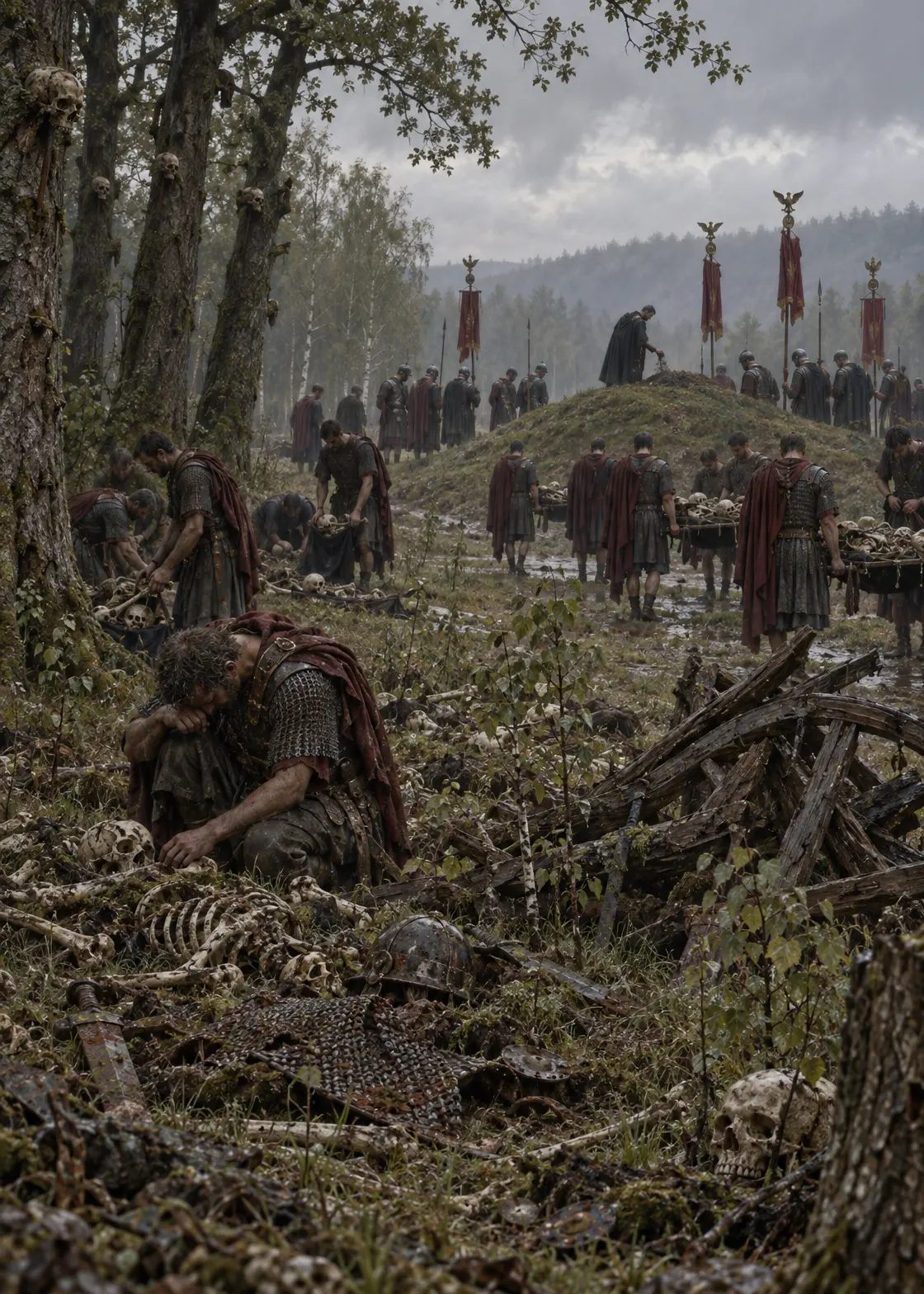
The three campaigning seasons that followed were the empire's revenge upon the Teutoburg and the empire's last argument with itself about Germany. In 15 Germanicus struck the Chatti and burned their capital; answered the appeal of the loyalist Segestes, besieged by his own tribe, and carried off in the rescue the war's great trophy and its great wound — Arminius's wife Thusnelda, Segestes's daughter, pregnant, marching into captivity with her eyes, Tacitus says, not on her father's Roman protectors but her own clasped hands; her husband, raptor of her and now raging at the theft in return, raised free Germany with the cry that Rome now warred on wombs. The summer's second operation was the pilgrimage this compendium has already drawn upon: the army brought to the Teutoburg field six years after, the bleaching bone-drifts where the lines had stood, the skulls on the tree-trunks, the altars of the tribunes' sacrifice — and the burial, the whole army raising the mound, Germanicus laying the first turf, against the pontifical law that forbade an augur the dead and against, Tacitus intimates, the emperor's cooler judgment that soldiers shown the price of Germany fight it worse. The season closed with the disaster deferred: the retreat of Caecina Severus's four legions by the causeway of the pontes longi, Arminius closing on the drowning track through the bogs, the camp half-flooded and the night alive with German fires — and the old general (forty years' service, the detail is the point) holding his shaking legions through a dawn breakout that turned ambush into counter-ambush; behind them, at the Rhine, the panic proposal to demolish the bridge was faced down by Agrippina herself, who stood at the bridgehead with praise and clothing and dressings as the survivors came over — a femina ingens animi doing a general's office, in words Tacitus lifts toward her and lets fall, with their shadow, toward the emperor reading of it.
The campaign of 16 was the maximum effort: a purpose-built fleet of a thousand hulls down Drusus's canal and along the ocean to the Ems, the army landed dry and deep, and the war Arminius could not refuse brought to the Weser plain at Idistaviso. There, and at the Angrivarian wall weeks later — a tribal boundary-rampart between river and forest, stormed frontally under the sling-and-artillery preparation of a commander who had learned the Kalkriese lesson in reverse — the Cheruscan coalition was broken in open field twice over, with slaughter the sources render immense and the Editor renders unaudited; Arminius, wounded, smearing his face with his own blood to pass unknown, was carried clear by his horse; the trophy of the second field bore the boast that the army of Tiberius Caesar had conquered the peoples between Rhine and Elbe. The ocean then delivered its verdict on the year: the fleet, standing home late in the season, was scattered by the equinoctial storm down the whole amber coast, hulls swallowed, cohorts drowned, survivors trickling back for months from the islands and the amber-marts — some ransomed out of inner Germany — with tales of monsters that Tacitus records as the sea's own propaganda. Two of the lost eagles had been recovered in the campaigns — the Nineteenth's from the Bructeri, a second from the Marsi; the third would come home a generation later, in 41, taken from the Chauci by Gabinius under Claudius, closing the account at last — and on that arithmetic the emperor closed the war. The recall of 16, wrapped in a second triumph and a second consulship, was justified in the sentence of Tiberian statecraft Tacitus preserves and the whole subsequent frontier history ratified: enough had been achieved, and more would be, by leaving the Germans to their own quarrels.
The quarrels obliged. Within two years Arminius and Maroboduus — liberator and king, the two Germanies the Roman advance had called into being — fought their own great war on the Weser, indecisive in the field and decided by desertion; Maroboduus, abandoned, begged asylum and got Ravenna, eighteen years of comfortable exhibition, Tiberius pointing him out to the Senate as once more dangerous than Pyrrhus and now more instructive; his kingdom passed to adventurers Rome licensed and taxed. Arminius, reaching after the kingship himself, was killed in 21 by his own kin — dolo propinquorum, by the treachery of his relatives, the fate his compendium-cousin Sertorius had met — at thirty-seven, and Tacitus closed his account of him with the obituary this compendium sets beside the Bato exchange as the tradition's rare justice to the other side: liberator haud dubie Germaniae — beyond doubt the liberator of Germany, who challenged Rome not in her infancy but at the height of her power; unconquered in the war, though beaten in battles; still sung among the barbarian nations, unknown to the annals of Greece, and less than his due among us Romans, who praise the old days and neglect the recent. Germanicus himself predeceased his enemy: dead at Antioch in October 19, aged thirty-three, amid accusations of poison against the governor Piso that became the treason-trial of the age — and the compendium notes, as the age's documentary landmark, that the Senate's own verdict survives: the senatus consultum de Cn. Pisone patre, recovered from Spanish bronze copies in the 1980s, six hundred lines of the official truth, AGrade A evidence of what the regime said had happened and a standing seminar, set against Tacitus's account of the same affair, in the distance between record and history.
The Long Frontier17–43
The quarter-century between the German recall and the invasion of Britain the compendium compresses to its wars, which were the new system's maintenance schedule. In Africa, the deserter Tacfarinas — another auxiliary graduate — ran a raiding war through Numidia for seven years (17–24), outlasting three proconsuls and the temporary transfer of the Ninth legion from Pannonia, until Dolabella's converging columns caught and killed him at Auzea; the war's texture, small war of razzia and waterhole, was the African frontier's permanent grammar learning itself. In Gaul in 21, the debt-revolt of Florus and Sacrovir — Romanized nobles, one commanding his own trained gladiators — flared and died at Augustodunum in a single charge, notable chiefly for Tiberius's refusal to interrupt his routine for it. In Thrace, the client-kingdom's levies mutinied rather than serve abroad; in 26 the mountain tribes stood a siege of their crag and broke; the kingdom itself would be a province by 46. On the lower Rhine in 28, the Frisii — Drusus's model allies — rose against a requisition of ox-hides assessed, with the immortal stupidity of middle management, by the standard of the aurochs rather than their own small cattle; they hanged the tax-soldiers, mauled the punitive expedition at the wood of Baduhenna with nine hundred Roman dead, and were — the sequel is the policy — written off: Tiberius suppressed the reverse and declined the war, and Frisia stayed loose until Corbulo's day. The reign of Gaius the compendium treats at the length its wars deserve, which is brief: the bridge of boats at Baiae, the northern expedition of 39–40 that broke a real conspiracy (Gaetulicus, the lower Rhine's over-mighty legate, executed) and then dissolved into the theater the hostile tradition preserved — the staged captures, the surrender of the British exile Adminius inflated into the ocean's submission, and on the Channel beach the order that the legions gather seashells, spolia Oceani for the Capitol; the Editor grades the shells as he graded Caligula's horse-consulship, hostile tradition delivering a truth by caricature — the army knew the difference between war and its impersonation, and the knowledge was itself a political fact. The reign's one durable acquisition was administrative murder: Ptolemy of Mauretania, Juba's son and Antony's grandson, summoned and killed in 40, his kingdom detonating into the revolt of his freedman Aedemon, so that the new reign of Claudius opened with real fighting in the Atlas — Suetonius Paulinus and Hosidius Geta crossing the mountains into the desert's edge in 41–42, names the reader will meet again on a British battlefield — and closed it as two provinces. By 43 the system stood ready for its one great remaining adventure: a new emperor, lame, stammering, bookish, derided by the army he had never served with, needed what every ruler of this volume's dynasty needed and only conquest could mint; and across the Ocean lay the island Caesar had twice invaded and no Roman had governed, its exiled princes at the imperial doorstep, its harvests and metals in the merchants' ledgers, its conquest — as the next chapter opens — the last unfinished sentence of the dynasty's founder.
The Crossroads · Autumn, AD 16 · Rome
The Recall of Germanicus
You are Tiberius Caesar, Augustus's successor and princeps, reviewing dispatches from the northern front.
Three campaigning seasons under your adopted son Germanicus have avenged the Teutoburg. The Cheruscan coalition has broken at Idistaviso and the Angrivarian wall, and two lost legionary eagles are recovered. Yet the cost has been terrible: equinoctial storms on the Ocean have swallowed a purpose-built fleet of a thousand hulls, scattering drowned cohorts across the amber coast. Germanicus believes one final campaign will secure Germany to the Elbe, but eight legions revere him and the treasury feels the strain.
Will you permit Germanicus another season of offensive war across the Rhine, or bring the northern campaigns to an end?
Weigh each course: open it to hear your own inner voice. Then decide. Nothing is scored.
- Your inner voiceThe course taken
Halting now leaves Rome's vengeance half-accomplished. Arminius fled Idistaviso wounded, his warriors are shaken, and our trophy already proclaims the lands between Rhine and Elbe conquered. With fresh transports and levies, one more season could break barbarian resistance forever. If I recall my brother's son now, men will whisper that I envied his glory and lacked the resolve to fulfill the grand frontier design that Augustus bequeathed to the empire.
- Your inner voiceThe course taken
We cannot risk the Ocean's hazards again, yet an abrupt retreat invites German incursions into Gaul. Keep Germanicus at the frontier with strict limits. Let him strike the Chatti or Marsi when provoked, maintaining the terror of Roman arms without venturing past the Weser. Yet holding eight restive legions in winter quarters without grand campaigns risks reviving the mutinous fury that shook the Rhine camps when Augustus died.
- Your inner voiceThe course taken
Enough blood has been poured into German marshes. Two lost eagles have returned, the fields of Idistaviso are won, and Roman honor stands vindicated. If Germanicus remains, another storm or another treacherous bog could swallow four legions, as nearly befell Caecina Severus. Let the prince receive his second consulship and a triumph in Rome. The Cheruscan coalition and Maroboduus will turn upon each other soon enough without Roman soldiers paying the butcher's bill.
What was done
Tiberius recalled Germanicus late in 16, sweetening the recall with a second triumph and a second consulship. The emperor justified the decision with a maxim of statecraft: enough had been achieved, and more would be accomplished by leaving the Germans to their own quarrels. The aftermath ratified his judgment. Within two years, Arminius and Maroboduus clashed in an indecisive, desertion-ridden war; Maroboduus fled to Roman asylum and spent eighteen years exhibited at Ravenna, while Arminius was assassinated by his own relatives in 21. Germanicus did not long survive his victories, dying at Antioch in 19 amid poison allegations that produced the senatus consultum de Cn. Pisone patre (AGrade A). The Rhine settled into a permanent defensive frontier, confirming the narrative of Tacitus (AGrade A–B) that Rome's aggressive advance beyond the river had reached its definitive end.
The evidence Tacitus Annals 1–6 (AGrade A/B for campaign narratives of 14–16); senatus consultum de Cn. Pisone patre (AGrade A, documentary); Cassius Dio 57–60 (BGrade B); Suetonius Tiberius (BGrade B); Velleius Paterculus 2.123–131 (CGrade C for judgment); lost strata including the elder Pliny's Bella Germaniae and the younger Agrippina's memoirs.
If you choose to walk through itAt every scale
- Yourself
How do you separate your duty to imperial security from personal resentment toward a glamorous, celebrated adopted son?
- Those beside you
How do the dynastic prospects of Germanicus, Agrippina, and their children balance against the standing of your own biological son Drusus?
- Rome
Can the imperial treasury and legionary manpower sustain continuous punitive offensives beyond the frontier without inviting fresh mutinies?
- The wider world
Does imperial withdrawal abandon frontier peoples to unending civil conflict, or grant them freedom from foreign subjugation?
- Our own time
When should the leadership of a major power recognize that the strategic cost of maintaining a distant military commitment exceeds any benefit?
A global power concludes a costly military expedition in an inhospitable territory after inflicting punitive defeats upon hostile coalitions. Rather than pouring infinite blood and resources into indefinite territorial occupation, national leaders withdraw conventional ground forces behind secure border perimeters, calculating that local adversaries will exhaust their strength fighting neighboring rivals rather than threatening external interests.
Where the comparison fails. Modern withdrawals are subject to continuous real-time public scrutiny, electoral accountability, and sudden geopolitical vacuums, whereas Tiberius directed dynastic statecraft under monarchical authority, insulated his border behind wide river systems, and faced no media pressure.
What does the chapter tell us?
What primary grievances sparked the Rhine legionary mutinies in AD 14 following the death of Augustus?
Tacitus records through Percennius that legionaries were retained under the standards for thirty or forty years, endured beatings from centurions like Fetch-Another, and received discharge land consisting of rocks or marsh.
Tacitus Annals (AGrade A/B)
On what strategic basis did Tiberius justify his recall of Germanicus from Germany in AD 16?
Tiberius maintained that Roman honor and vengeance were satisfied by the campaigns, and that future stability across the Rhine would be achieved more effectively by allowing the Germans to exhaust themselves in internal tribal wars.
Tacitus Annals (AGrade A/B)
What was the ultimate fate of Arminius following the cessation of major Roman campaigns?
After waging an indecisive civil war against Maroboduus on the Weser, Arminius reached for royal power among his people and was murdered by his own kin (dolo propinquorum) at the age of thirty-seven.
the chapter's narrative
Why is the senatus consultum de Cn. Pisone patre considered a landmark historical document for the period?
Recovered from Spanish bronze inscriptions, the decree provides six hundred lines of official state truth concerning the treason trial following Germanicus's death, offering a direct documentary counterweight to literary accounts.
SC de Pisone patre (AGrade A)
What administrative demand provoked the Frisii along the lower Rhine to revolt in AD 28?
Roman administrators assessed the Frisian hide tribute using the standard of the wild aurochs. When their small domestic cattle failed to meet the measure, the Frisii revolted, hanged tax collectors, and routed a Roman force at Baduhenna.
the chapter's narrative