Book VI · The Wars of the Early Principate
Chapter 4
Britain: Conquest and Revolt
The Claudian Invasion43–47
The invasion of 43 was assembled from the standard imperial kit: a dynastic need (Claudius, raised by the Praetorians over the Senate's protests after Gaius's murder, required a conquest as a coronation requires a crown), a legal pretext (the exiled king Verica of the Atrebates, suppliant at Rome against the expanding sons of Cunobelinus), and an economic brief the merchants had been writing for a century. Four legions were committed — II Augusta from Strasbourg under the future emperor Vespasian, IX Hispana from Pannonia, XIV Gemina and XX from the Rhine — with auxilia to match, some forty thousand men under Aulus Plautius; and the expedition began with the age's characteristic mutiny, the troops refusing the Ocean as a boundary of the human world until Claudius's freedman Narcissus, mounting the tribunal, was shouted down with the Saturnalian jeer Io Saturnalia — slaves playing master — and the army, having laughed itself out of its terror, embarked. The landing (Richborough by the consensus the archaeology of the Claudian base there sustains, against a minority case for the Solent) was unopposed, the Britons having stood down a coastal levy the delayed crossing outwaited; the campaign's decision came on the Medway, a two-day battle — a rarity in ancient warfare the sources mark as such — where the Batavian cohorts swam the river in armor to hamstring the chariot-teams, Hosidius Geta's division was cut off and nearly lost before winning the ornamenta triumphalia, and the brothers Togodumnus and Caratacus were broken westward. Plautius halted at the Thames per his instructions, and the emperor came out for the finale as the script required: Claudius crossed with the reinforcements and the elephant corps, presided sixteen days, received Camulodunum and the surrender or alliance of eleven kings — the arch at Rome would count them — and returned to celebrate the conquest of Ocean; the Senate gave him the name Britannicus for his son, and the reign its foundation myth. The real war then ran west and north for four years: Vespasian's II Augusta grinding down the Durotrigan hill-country — thirty battles, twenty oppida, and the Isle of Wight, says Suetonius; the war-cemetery and sling-arsenals of Maiden Castle and Hod Hill supplying the archaeology, with the Editor noting that the dramatic 'massacre' reading of the former has been tempered by re-excavation; the Fosse Way diagonal — Exeter to Lincoln — settling by the later 40s into the first frontier, a corridor of forts that said, prematurely, thus far.
Caratacus47–51
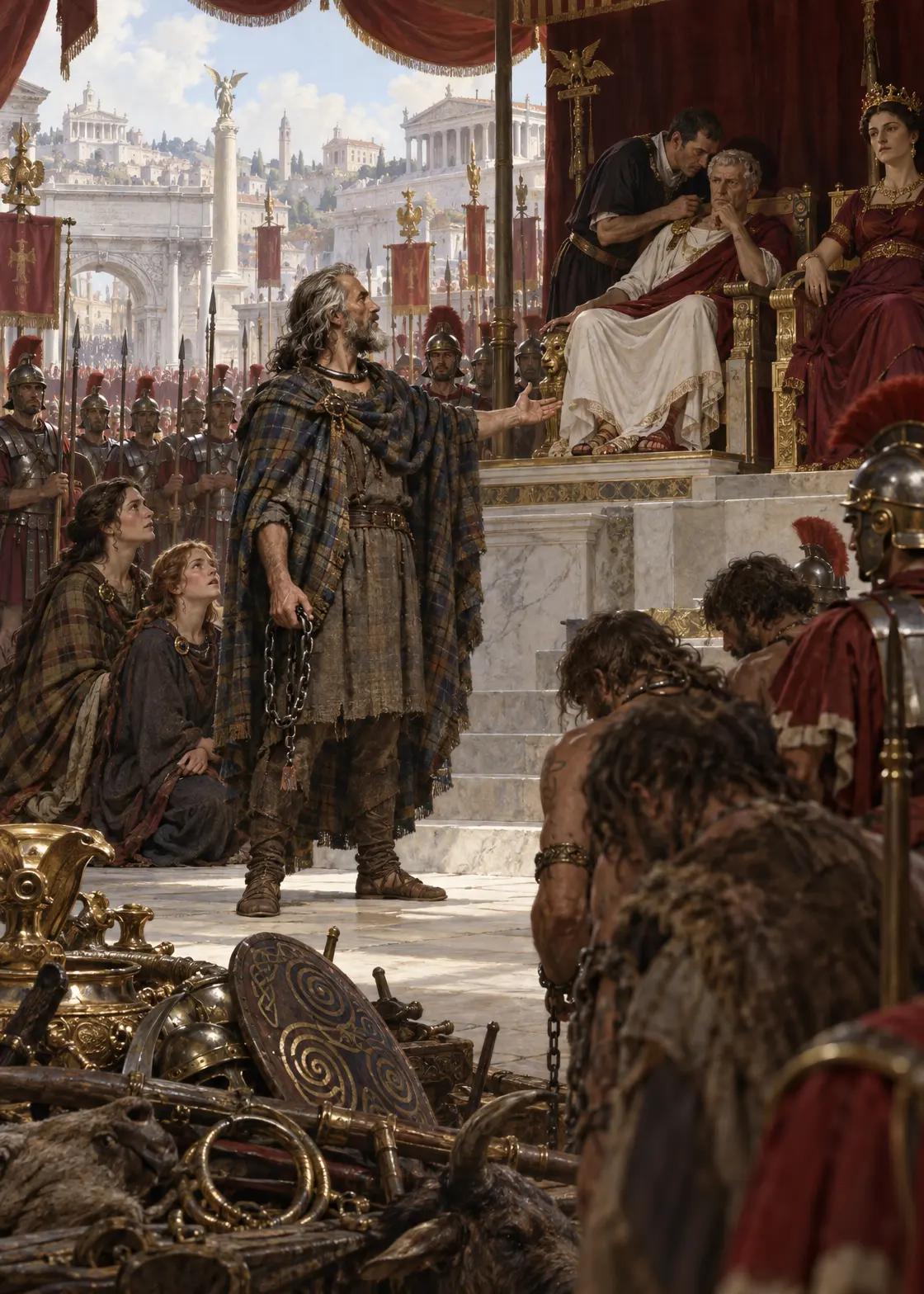
The son of Cunobelinus, twice beaten in the southeast, executed the strategic withdrawal that made him: westward, out of his own lost kingdom, into the hills of the Silures and Ordovices, where for eight years he ran the war Rome could least afford — the Sertorian war of ambush and weather, the legions' roads lengthening behind them, a governor (Ostorius Scapula) dying in harness of the strain. Brought to bay at last in 51 on a prepared position in the Ordovician hills — river in front, slopes stone-walled, the sources' description generic enough that no modern candidate site commands assent — he lost the set-piece battle to the escalade he could not prevent, lost wife and daughter to the camp's capture, and, fleeing north to the Brigantes, was delivered in chains by their queen Cartimandua, Rome's client, whose reward and whose consequent domestic history — the consort Venutius twice raised the north against her, the second time, in the year of the four emperors, for keeps — the chapter will meet again. The captive's Roman finale Tacitus stages as the dynasty's best theater and the tradition's best speech: the parade of the Claudian guard, the trophies, the kneeling family — and Caratacus upright, asking the emperor from the tribunal why a possessor of such marble should covet British tents, and closing on the hinge the historian built for him: kill me, and both the war and your glory die with me; spare me, and I am forever the proof of your clemency. Claudius spared him — the family lived out their days in Italy, and the Editor grades the speech as he graded Calgacus's to come: a Roman composition in a Briton's mouth, AGrade A evidence for what Rome wished its conquests said of it, ungradeable as transcript. The captor-queen's reward, and the Silurian war grinding on regardless — a legionary camp stormed, a governor's ashes, the Senate hearing the war-word deleri, extermination, entered into policy against the Silures — carried the province to the reign of Nero, the appointment of Suetonius Paulinus, the Atlas veteran, and the operation with which the next section opens: the reduction of the druids' island, Mona, in 60 — the shore-line of black-robed women with torches among the warriors, the soldiers frozen until shame moved them, the sacred groves cut — at the precise moment when, at the province's other end, a client-king's will came due.
Boudica60–61
Prasutagus of the Iceni had died leaving half to his daughters and half to the emperor, the standard actuarial flattery of a client court; the procurator Catus Decianus foreclosed on the whole as on a defaulted estate. What followed at the royal seat — the widow Boudica flogged, the daughters raped, the nobility's lands called in, the Claudian temple at Camulodunum meanwhile taxing the province to deify its conqueror — assembled in one season every grievance the compendium's provincial wars have catalogued, and the rising, Iceni and Trinovantes together with the harvest left standing, fell first on the colony itself: Camulodunum, unwalled, its veterans' appeals answered by the procurator with two hundred men, held the temple podium two days and was erased — the archaeological signature, the burnt destruction horizon of 60/61, red between the Claudian and Flavian layers under three modern cities like a page of the annals fired into the ground. The Ninth legion's relief column under Cerialis was ambushed and its infantry annihilated; Catus fled to Gaul; Paulinus, force-marching ahead of his army down Watling Street, reached Londinium first, judged it — undefended, unwalled, strategically nothing, humanly everything — and made the decision Tacitus grants him without softening: the town was abandoned to the enemy, with all who could not march; Verulamium after it; and in the three sackings the tradition's count is seventy thousand citizens and allies killed, the killing garnished in Dio's rhetoric with atrocities the Editor grades D and declines to transcribe. Paulinus, with XIV Gemina, detachments of XX, and auxilia — perhaps ten thousand — accepted battle where the ground was his: a defile fronting open plain, forest at the back, the site unlocated to this day though the search parties of scholarship have never disbanded. The disposition Tacitus gives is the manual's: legions in close order at the defile's throat, auxilia on the flanks, cavalry at the wings; the British mass — the figures run to the hundreds of thousands, with the wagon-laager of families drawn up at the field's rear to watch the victory — attacking up the funnel into the volleyed pila and then the wedge; the rout jamming against its own wagon-wall as at Vercellae; the killing running through baggage, beasts, and the audience alike, eighty thousand Britons to four hundred Romans by the tradition's arithmetic, which the Editor prints as the tradition's. Boudica ended by poison in Tacitus's account, by illness in Dio's — the divergence itself the measure of how quickly the queen passed from intelligence into legend; Poenius Postumus, camp prefect of II Augusta, who had refused Paulinus's summons and kept his legion in the west, fell on his sword when the news came. The sequel was the more consequential battle: Paulinus's reprisals — fire and sword through the rebel cantons, the famine of the unsown year — against the new procurator Julius Classicianus, whose report to Rome argued that vengeance was not a fiscal policy; the freedman Polyclitus's commission of inquiry; and Paulinus's supersession under cover of a lost fleet detachment. Classicianus's verdict on the war survives in the medium the age reserved for its most durable statements: his tombstone, raised by his widow — Julia Pacata, daughter of Indus, a Gaulish noble's daughter, wife of the Gaulish-descended knight who took the province's side against its conqueror — recovered piecemeal from a bastion of London's later wall and standing now in the British Museum, AGrade A testimony that the argument between the sword and the ledger was real, and that the ledger, for once, won.
Agricola and the Far North77–84
The Flavian governors resumed the advance the crisis had suspended: Cerialis (the Ninth's unlucky legate of 60, now consular) breaking the Brigantian north in the early 70s, Frontinus — the same whose Stratagems this compendium has cited throughout — solving the Silures at last with the fortress-and-road grid of Wales; and from 77, for seven years, Gnaeus Julius Agricola, whose governorship is the best-documented provincial command in Roman history for the sufficient and compromising reason that his son-in-law wrote it. Through the Agricola — biography, ethnography, and opposition pamphlet in one — the compendium receives the northern conquest whole: Mona finished in the first season; the Brigantian and lowland consolidations; the Forth–Clyde line garrisoned and judged, for one paragraph of the historian's regret, a sufficient terminus; then the estuary-hopping advance beyond it, the fleet feeling ahead of the army, the ninth legion's camp surprised by night and saved by the general's own column striking the attackers' rear at dawn; and in the seventh summer, at the mountain the sources call Graupius — unlocated; the northeast's candidates from Bennachie northward each keep their partisans — the massed Caledonian confederacy under Calgacus, thirty thousand by the account, standing at last. Tacitus built the battle as a diptych of speeches, and gave the Caledonian the greatest anti-imperial oration in the Latin language — the terrible sentences that have outlived every battlefield in this volume: auferre trucidare rapere falsis nominibus imperium, atque ubi solitudinem faciunt, pacem appellant — robbery, butchery, rapine they call by the lying name of empire; they make a desert, and they call it peace. The Editor's grading of the speech was fixed in the Caratacus section and stands: the conqueror's own conscience, ventriloquized through the conquered, AGrade A for Rome's self-knowledge, nothing for Calgacus, who may not have existed. The battle beneath the speeches Agricola won without committing a legion: the auxilia — eight thousand foot, Batavian and Tungrian cohorts leading — carried the slope sword-to-buckler, the cavalry broke the flanking masses, and the pursuit ran to nightfall with the tradition's arithmetic at ten thousand Caledonians against three hundred and sixty auxiliaries; the fleet was then sent north about, took the surrender of Orkney, sighted Thule, and proved Britain an island — the campaign's real strategic yield, the Ocean's circumnavigation, worth more at Rome than the moor it garlanded. The sequel is the volume's recurring lesson in imperial arithmetic: Agricola was recalled with ornamenta and no successor-in-advance; the fortress rising at Inchtuthil to hold the Highland gates was dismantled unfinished within three years — its garrison needed on the Danube, where the next chapter but one is already burning — and abandoned so deliberately that its builders buried what they could not carry: the hoard of three-quarters of a million unused iron nails, ten tons of them, interred against enemy salvage and recovered by the excavators of the 1950s, the most eloquent quartermaster's document in the empire — conquest itself, crated and written off. Tacitus closed the account with the epigram the whole British book of this volume argues: perdomita Britannia et statim missa — Britain was thoroughly conquered, and immediately let go.
The Crossroads · AD 60 · Londinium
The Abandonment of Londinium
You are Suetonius Paulinus, consular governor of Britain, conqueror of Mona, and commander of the legions in the west.
You have force-marched down Watling Street ahead of your main column after reducing the druid sanctuaries on the island of Mona. Word has arrived that the province is collapsing behind you: the veteran colony at Camulodunum has been razed, its temple burned, the procurator Catus Decianus has fled to Gaul, and the infantry of Petillius Cerialis's Ninth Legion has been cut to pieces. Queen Boudica's allied Iceni and Trinovantes are sweeping south toward the Thames. You reach Londinium to find a wealthy, crowded trade settlement devoid of walls or military defenses, its citizens and merchants pleading for protection, while your own force consists only of an advance guard.
Do you commit your vanguard to defend the unwalled settlement of Londinium, or abandon its population to unite your legions?
Weigh each course: open it to hear your own inner voice. Then decide. Nothing is scored.
- Your inner voiceThe course taken
To abandon Londinium is to condemn thousands of Roman citizens and allies to fire and slaughter. If I turn my back now, the prestige of Rome falls with this trading post, and our name will stink of cowardice from here to the Rhine. We could dig trenches, throw up earthworks, and muster the merchants to hold the line until my legions arrive. Can an imperial governor surrender his own people without striking a blow?
- Your inner voiceThe course taken
The town is unwalled, undefended, and strategically nothing, though humanly everything. I have only an advance guard here; the Ninth is already broken, and Catus has fled. If I attempt to defend these open streets, my remaining men will be swallowed whole by Boudica's overwhelming numbers. We must abandon the settlement, take those who can keep pace, join the Fourteenth and Twentieth, and find ground where Roman discipline can master barbarian numbers.
- Your inner voiceThe course taken
The province is in flames, the Ninth Legion is annihilated, and Poenius Postumus has refused to bring up the Second. Catus Decianus has already escaped across the water. If I lead my column straight to the coast, we can preserve the core of the army and save the survivors of the administration. Yet to cross the sea is to concede Britain entirely, throwing away every fort and road Claudius won.
What was done
Paulinus made the decision Tacitus records without softening: Londinium was abandoned to the rebel army, with all who could not march, and Verulamium was evacuated after it. In the three sackings of Camulodunum, Londinium, and Verulamium, the tradition counts seventy thousand citizens and allies killed, a slaughter Dio decorates with atrocities the Editor grades D. Paulinus gathered the Fourteenth Gemina, detachments of the Twentieth, and auxiliary cohorts—roughly ten thousand men—while Poenius Postumus kept the Second Legion in the west. Paulinus offered battle in a narrow defile fronting an open plain with forest at his rear. When the British wagons jammed the rebel retreat, the legions and auxiliaries cut down eighty thousand Britons against four hundred Romans by the tradition's arithmetic. Boudica died by poison or illness, and the burnt destruction layer of 60/61 (AGrade A) remains sealed under three modern cities.
The evidence The surviving Annals of Tacitus (14.29–39) provide AGrade A narrative based on named contemporary strata from inside Paulinus's headquarters, though audited for headquarters interest. Dio (62.1–12, BGrade B/C) gives an independent, rhetorically inflamed parallel, while the burnt destruction horizons of 60/61 at Colchester, London, and St Albans supply AGrade A material confirmation.
If you choose to walk through itAt every scale
- Yourself
How does a commander bear the personal ignominy of deliberately abandoning unarmed civilians who look to him for protection?
- Those beside you
What obligation does a general owe to the soldiers in his immediate ranks, whose lives would be spent in a hopeless urban defense?
- Rome
Can an empire maintain its political authority over conquered territory when its representative sacrifices thousands of citizens to preserve military assets?
- The wider world
How does imperial administrative violence—such as the flogging of a client queen and the foreclosure of a royal estate—determine whether subject peoples submit or fight to the death?
- Our own time
Under what ethical frameworks, if any, can modern leaders justify sacrificing civilian enclaves to keep strategic military units intact during an invasion?
During the 1940 withdrawal to Dunkirk, Allied military commanders elected to pull back defensive divisions toward the coast rather than commit them to stand in open French towns against advancing armored columns. Leaders recognized that attempting to shield civilian population centers would result in the encirclement and destruction of their armies, choosing instead to preserve a trained core of troops for future campaigns, even though it left vulnerable non-combatants behind to face military occupation.
Where the comparison fails. Unlike Londinium, which possessed no fortifications or garrison and received no formal truce terms, the Dunkirk withdrawal occurred under international conventions of war, across a modern communication network, and within an established evacuation corridor, whereas the British rebels engaged in total eradication of the abandoned settlements.
What does the chapter tell us?
What immediate fiscal and administrative abuses triggered the joint rebellion of the Iceni and Trinovantes in 60 AD?
Prasutagus willed half his estate to the emperor and half to his daughters, but the procurator Catus Decianus foreclosed on the whole, flogged Boudica, raped her daughters, and called in royal lands, sparking immediate revolt.
the chapter's narrative (referencing Tacitus Ann. 14.29–39)
How does the compendium evaluate the famous speeches attributed to Caratacus and Calgacus?
The Editor notes that Caratacus's Claudian speech and Calgacus's Graupian address are literary compositions representing AGrade A evidence for Rome's critique of its own imperialism, but they cannot be treated as actual historical transcripts.
the Editor's Note (citing Tacitus Ann. 12.31–40 and Agricola)
What material archaeological find provides AGrade A evidence for the geographic scale and violence of the Boudican revolt?
A distinct burnt destruction horizon of 60/61 lies red between the Claudian and Flavian archaeological layers beneath Colchester, London, and St Albans, serving as AGrade A proof of the devastation described in the literary tradition.
the Editor's Note (AGrade A material)
Why was Suetonius Paulinus superseded as governor following his decisive military victory over Boudica?
Julius Classicianus reported that vengeance was not a fiscal policy, arguing that Paulinus's widespread burnings and subsequent famine would prevent economic recovery, leading the freedman Polyclitus to conduct an inquiry that replaced Paulinus.
the chapter's narrative and Editor's Note (RIB 12, AGrade A)
What did the deliberate burial of ten tons of iron nails at the Inchtuthil fortress demonstrate about imperial strategy?
The hoard of three-quarters of a million unused nails at Inchtuthil shows that Rome deliberately dismantled the unfinished base to prevent salvage when its legion was recalled to meet military crises on the Danube frontier.
the chapter's narrative and Editor's Note (AGrade A material)