Book VI · The Wars of the Early Principate
Chapter 5
The Eastern Question: Corbulo, Armenia, and Parthia
The Discipline of Corbulo
The commander who dominates this chapter enters it on the wrong frontier, in the vignette that fixed both his character and his predicament. Gnaeus Domitius Corbulo — half-brother by marriage to Caligula's empress, consular, a giant in body with a gift for the theatrical severity the age called old-Roman — took the lower Rhine command in 47 and conducted, against the Chaucian sea-raids of the deserter Gannascus and the loosened Frisii, a campaign of textbook restoration: the raiders hunted down, the Frisii resettled and garrisoned, the legions retaught the entrenching-tool by a general who executed one soldier for digging unbelted of his sword and another for digging armed with dagger alone — the anecdote's point, as Tacitus frames it, being not the cruelty but the appetite of an army for a master. On the brink of finishing the Chauci, he received Claudius's order — the post-Varian standing policy asserting itself against the man most likely to test it — to withdraw every garrison west of the Rhine; and his reply, spoken as he obeyed, became the epigraph of the whole Principate's command-problem: beatos quondam duces Romanos — happy the Roman generals of old. Denied his war, he set the legions to peace-work on the scale of one: the twenty-three-mile canal between Meuse and Rhine that drained the flood-country and still runs — the fossa Corbulonis, traced by Dutch archaeology through the peat with its timber revetments dendro-dated to the very years — so that the chapter's protagonist enters the eastern crisis already complete: the empire's best soldier, trusted absolutely with armies and never quite with victory, digging canals to spend an aggression the system could employ but not afford.
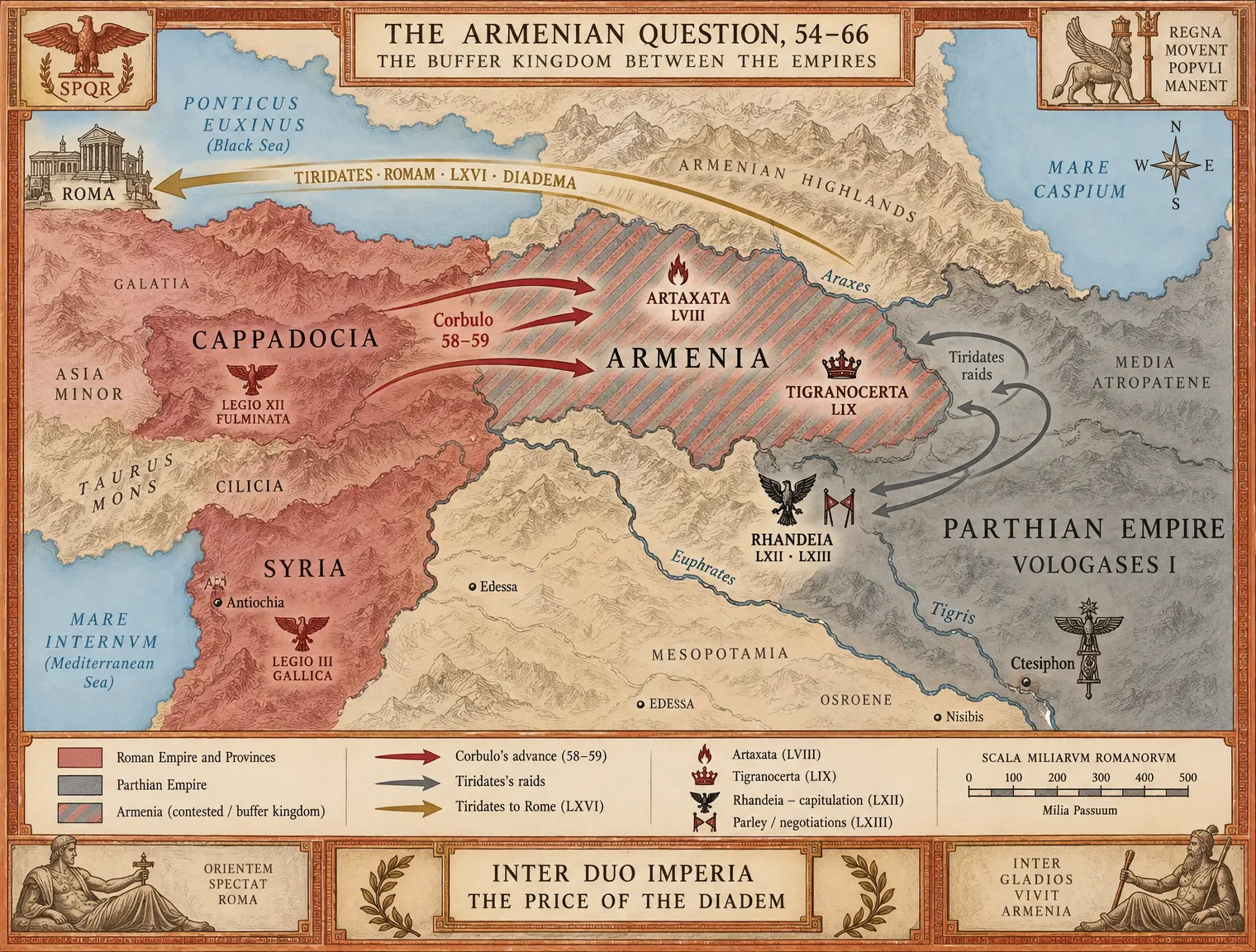
The crisis that summoned him east was the oldest file in Roman diplomacy. Armenia — the mountain kingdom the reader has watched since Lucullus and Pompey, wedged between the empires, Roman by investiture and Parthian by geography, religion, and half its aristocracy's kinships — had been managed since the settlement of 20 BC by crowned nominees; in 52/53 the new and able Arsacid king of Parthia, Vologases I, resolved the question in the dynastic style by conquering the kingdom for his own younger brother Tiridates. Rome's answer waited on a reign-change: among the first acts of Nero's new government in 54 — the government of Seneca and Burrus, advertising merit — was Corbulo's appointment to Cappadocia and the Armenian commission, and the East revealed to him what four decades of the standing peace had made of its garrison: legions, Tacitus reports from what must be Corbulo's own dispatches, containing veterans who had never stood a watch nor dug a rampart, without helmets or breastplates sold long since, soldiers of the towns and the trade-fairs. The reconstruction consumed three years and became the army's legend of itself: the winter training-camps pitched deliberately in the Armenian highland frost where sentries froze at their posts and the general, cloakless and bare-headed, walked the works praising and burying; discharges purged the unfit, Galatian and Cappadocian levies filled the files, desertion was answered by execution on the first offense rather than the third; and when the army moved at last in 58, it moved as the instrument the chapter's battles will assume without further comment.
Artaxata and Tigranocerta58–60
Corbulo's Armenian war was a masterpiece of the indirect, and the Editor narrates it as the counter-case to every battle-seeking campaign in this compendium. Against Tiridates's horse-archer strategy — raid the pro-Roman districts, refuse the legions' embrace — Corbulo divided into mutually supporting columns, fortified as he went, brought the Moschian hill-tribes and the client-kings of Commagene and Iberia in upon the kingdom's flanks, and struck not at the king but at his roofs: the storm of the fortress of Volandum in a morning, the systematic reduction of the strongholds, and in the campaign's crisis the running fight before Artaxata, where Tiridates's encircling archery broke against a marching-square that declined pursuit into the dusk — and the capital, watching, opened its gates next dawn. Artaxata was burned regardless — the city was ungarrisonable at that season and clemency, Corbulo judged, must not look like inability — and the omen-tradition supplied the thunderclap that divided the sky as the army entered. The next season delivered the strategic geometry's second point: the march on Tigranocerta across the waterless Taurus country, the army eating its baggage-animals, the punitive columns fanning through Tauraunitis after an assassination-attempt on the general by a captured noble's hired hand; and the second capital, weighing Artaxata's ashes against Volandum's, sent out its golden crown ahead of the siege — one recalcitrant fortress, Legerda, stormed to keep the arithmetic honest. By 60 the kingdom was swept, Tiridates's Median invasion-attempt was parried by the fortified passes, and Rome installed its nominee: Tigranes VI, a Cappadocian-Herodian princeling from the hostage-nursery at Rome — the client-system's pure product, set on the client-system's most breakable throne — while Corbulo, promoted to the vacant governorship of Syria, handed Armenia to the settlement's guarantee and the guarantee, within a year, to its test.
Rhandeia (62), and the Peace of the Diadem63–66
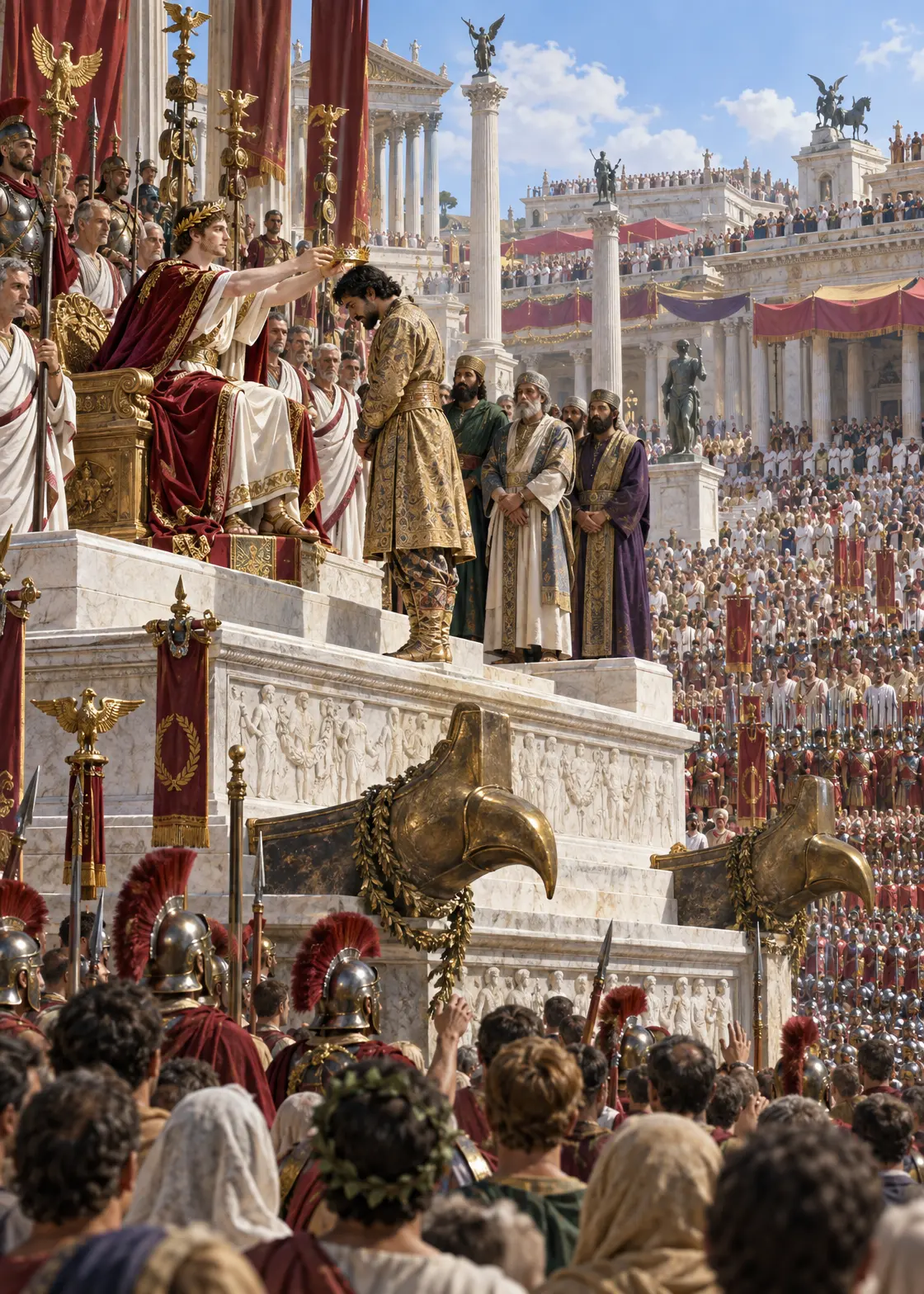
The test came from both directions at once. Tigranes, misreading investiture as license, raided Adiabene — a Parthian vassal — and gave Vologases the casus his nobility demanded; the Parthian king crowned Tiridates afresh before his court, sent his grand vizier Monaeses against Tigranocerta, and turned the Armenian question, for the first time since Antony, into the prospect of open war between the empires. Rome's response divided the command and doubled the risk: Corbulo, holding Syria and the Euphrates with his veteran legions, requested a separate general for the Armenian theater, and received Lucius Caesennius Paetus — consular, connected, and convinced, the sources agree, that Corbulo's methods were slow theater and Armenia a province waiting for its census. Paetus wintered his two under-strength legions at Rhandeia on the Arsanias in careless dispersal, furloughs liberal and entrenchments nominal; Vologases came over the Taurus with the royal army in the winter of 62, penned him, and administered upon a Roman consular army the capitulation this compendium has not had to record since the Caudine and Numantine pages of its earliest volumes: the camp surrendered by negotiation while Corbulo's relief column — summoned late by a commander ashamed to summon it, and marching, Tacitus's narrative implies with studied fairness to both readings, at a pace that would arrive to rescue the situation rather than the credit of Paetus — was three days off; the terms evacuated Armenia entire, surrendered the forts and stores, and bridged the Arsanias for the king's elephant to parade across; and the tradition Tacitus reports while declining to certify — that the legions passed under a yoke of spears — was believed at Rome, which for the purposes of the disgrace was the operative fact. Paetus's dispatches had meanwhile announced a war proceeding favorably; Nero learned the truth from the Parthian embassy's terms; and the empire's answer restored the chapter's protagonist to the whole theater with imperium maius — the greatest delegated command since the civil wars, the system's post-Varian caution overridden by the system's need — and Corbulo, rebuilding Paetus's shaken legions with drafts and shame, crossed the Euphrates at Melitene in 63 in a strength no Parthian field-army would test. No battle followed, because none was required and neither professional wanted one: at Rhandeia itself — the site chosen by both sides for the symmetry, disgrace to be annulled where incurred — Tiridates met Corbulo in conference, and before the assembled legions and the images of Nero laid his diadem at the emperor's feet, to be resumed only from the emperor's hand at Rome. The Editor pauses on the settlement's architecture, because it governed the East for fifty years and is the compendium's best specimen of war as the pricing-mechanism of diplomacy: Parthia conceded the form — an Arsacid kneeling to a Julio-Claudian image, the investiture Roman forever after in law; Rome conceded the substance — Armenia's kings henceforth Arsacid princes, the geography acknowledged; and both empires bought, at the cost of one wintered army's honor and three burned campaigns, the longest eastern peace in their shared history. The coronation-journey of 66 sealed it as spectacle: Tiridates overland nine months with three thousand horse — the daily cost to the fiscus eight hundred thousand sesterces in Dio's figure, entered here as tradition's arithmetic — the magi in his train, the Naples preliminaries, and the golden day in the Forum: the king ascending the rostra to the seated emperor before the drawn-up Guard and the city on the rooftops, the diadem set on his head at the point of a century of contention, the Janus doors closed, the day named golden by decree. Nero, the tradition's monster, had presided over the Principate's subtlest foreign-policy success; the Editor enters the credit where the evidence puts it, while noting for the pattern-book that the success was manufactured by the general and worn by the patron — the division of labor on which the whole system ran, and on which the chapter must close.
For the system now completed the pattern this volume has traced since Agrippa declined his triumph. Corbulo — the empire's most famous soldier, its eastern armies' oath-personified, his daughter married into the senatorial opposition's orbit, his name (the sources let us see the regime seeing it) canvassed by every conspirator sounding the East — was summoned in 67 to Greece, where the emperor was touring his other victories; at Cenchreae, disembarking to the arrest-order, he ran himself through with the one word the tradition preserves, the Greek acclamation of the games: Axios — Worthy. Whether the worthiness meant the emperor's sentence, his own career, or the bitter symmetry of the two, the sources do not resolve and the Editor does not presume; the structural reading requires no resolution. The Principate had solved the Republic's dilemma of the over-mighty commander not by abolishing him — the frontiers required him — but by owning him absolutely and terminating him at will; Corbulo, who had spent the Rhine command envying the generals of old and the eastern command proving he was one, obeyed the summons as he had obeyed the recall of 47, and his death, eighteen months before the eastern legions he had built began making emperors themselves, stands as the last demonstration of the loyalty whose withdrawal, in the chapter after next, ends the dynasty. His trained legions, his officer-school of legates, and his Armenian settlement passed intact to the Flavians — Vespasian's Jewish-war army and Trajan's eastern establishment alike were Corbulo's issue — and his daughter Domitia Longina ended an empress, wife to the Domitian of this volume's close, so that the house of the general who died on the acclamation Worthy outlasted, in the palace, the house that required the dying.
The Crossroads · AD 63 · Rhandeia on the Arsanias River, Armenia
The Peace of the Diadem
Gnaeus Domitius Corbulo, consular commander invested with imperium maius across the eastern theater
Following Lucius Caesennius Paetus's capitulation at Rhandeia in 62, where Roman legions surrendered their camp and stores to King Vologases I of Parthia, Rome granted you imperium maius. You have reorganized Paetus's shaken forces, combined them with your veteran Syrian legions, and crossed the Euphrates at Melitene in overwhelming strength. Neither Vologases nor his brother Tiridates will risk an open field engagement against your marching squares. Tiridates has requested a personal conference at Rhandeia—the very ground of Rome's recent disgrace—to settle the kingdom's fate.
On what terms will you resolve the Armenian war and address the humiliation of Rome's arms?
Weigh each course: open it to hear your own inner voice. Then decide. Nothing is scored.
- Your inner voiceThe course taken
Paetus claimed Armenia was merely a province waiting for its census, and with my imperium maius I possess the force to impose direct Roman rule. Yet garrisoning this vast, mountainous kingdom between the Euphrates and Artaxata would swallow legions we cannot spare from Syria and the Danube. The local nobility shares kinship and religion with Parthia; an imperial governor would face unending insurrection, tying our eagles to an ungovernable highland frontier.
- Your inner voiceThe course taken
We can offer Tiridates the Armenian throne if he surrenders the diadem before the images of Nero, pledging to travel to Rome to receive it anew from the emperor. Parthia yields the sacred legal form of Roman investiture, while Rome concedes the highland reality to an Arsacid prince. This spares my men another brutal winter campaign across the Taurus and secures the frontier, even if strict traditionalists condemn treating with the Arsacids.
- Your inner voiceThe course taken
Rome's honor lies in the peat and dust of the Arsanias, where Paetus's men surrendered their swords. My reinforced legions could hunt Tiridates and Vologases across the highlands and force an open field action. Yet winter in these mountains eats baggage-animals and freezes sentries, while Parthian horse-archers refuse pitched battle. Restoring another Roman client like Tigranes invites the same border raids on Adiabene and leaves our eastern garrisons bleeding indefinitely.
What was done
Corbulo chose to negotiate the Peace of the Diadem (AGrade A). At Rhandeia, the very site of Paetus's capitulation, Tiridates met Corbulo before the assembled legions and the imperial standards. The Arsacid prince removed his diadem and placed it at the feet of Nero's statue, binding himself to resume it only in Rome from the emperor's own hand (AGrade A). In exchange, Rome acknowledged an Arsacid prince upon the Armenian throne. Neither commander sought a bloody, unnecessary battle. The settlement purchased fifty years of eastern peace by balancing form and substance: Parthia conceded Roman investiture in law, while Rome acknowledged geographic reality. In 66, after an overland journey costing eight hundred thousand sesterces daily in tradition's arithmetic (CGrade C), Tiridates was crowned by Nero in the Roman Forum on the decree's golden day, allowing the Janus doors to close upon the empire's subtlest diplomatic success.
The evidence Tacitus, Annals 15.24–31 provides the controlling AGrade A account, drawn from Corbulo's lost campaign memoirs (commentarii). Cassius Dio 62.19–23 and 63.1–7 (BGrade B, epitomated) preserves the conference choreography and the subsequent coronation journey. Suetonius, Nero 13 (BGrade B) describes the ceremony on the Forum rostra, while Neronian closure-of-Janus coinages provide AGrade A material corroboration for the resulting peace.
If you choose to walk through itAt every scale
- Yourself
How does a commander who prizes theatrical severity and old-Roman discipline weigh a diplomatic compromise against the glory of a battlefield victory?
- Those beside you
What do veteran legionaries, trained in frozen winter camps and forced to witness their comrades disgraced, expect from a general holding supreme command?
- Rome
How can an imperial administration balance the political demand to avenge military humiliation against the immense logistical costs of an indefinite highland war?
- The wider world
Can a buffer kingdom situated between rival empires ever maintain genuine autonomy when geography, religion, and dynastic kinships pull in opposite directions?
- Our own time
When major powers negotiate regional settlements, under what circumstances does preserving the symbolic prestige of sovereignty matter more than dictating local governance?
In Cold War accords concerning contested border states, such as the 1955 Austrian State Treaty or the 1962 Geneva Accords on Laos, rival superpowers avoided armed confrontation by trading formal guarantees for regional realities. Both blocs accepted that an indigenous government could rule, provided strict diplomatic neutrality and external recognition were maintained to satisfy the prestige of both empires without sparking general war.
Where the comparison fails. Modern multilateral diplomacy relies on written international treaties, multilateral organizations, and global media scrutiny rather than the personal fealty of dynasts, religious oaths before an emperor's physical effigy, or the public submission of crowns before drawn-up legions.
What does the chapter tell us?
Why did Corbulo order the destruction of the Armenian capital of Artaxata in 58 after its citizens voluntarily opened their gates?
The chapter notes that Artaxata was ungarrisonable at that season, and Corbulo judged that sparing the city might look like Roman inability to hold it. The thunderclap dividing the sky was merely an omen-tradition that accompanied the entry.
the chapter's narrative
What was the fundamental compromise that defined the Peace of the Diadem negotiated at Rhandeia in 63?
The settlement balanced form and substance: Parthia accepted that Armenia's kingship must be conferred in law by Roman investiture before Nero's image, while Rome conceded the geopolitical reality that the ruling monarch would be an Arsacid prince.
Tacitus, Annals 15.24–31 (AGrade A)
What operational failure directly enabled King Vologases I to force the capitulation of Paetus's army at Rhandeia in 62?
Convinced that Armenia was merely a province awaiting its census, Paetus wintered two under-strength legions at Rhandeia with nominal entrenchments and widespread furloughs, leaving his dispersed force vulnerable when Vologases crossed the Taurus.
Tacitus, Annals 15.1–17 (AGrade A)
Why does the Editor describe the surviving account of Paetus's defeat and Corbulo's relief march as structurally biased?
Tacitus built his account on Corbulo's published campaign memoirs (commentarii). This creates an inherent pro-Corbulo slant regarding Paetus's incompetence and leaves open whether Corbulo marched deliberately slowly to rescue the situation rather than Paetus's credit.
Tacitus, Annals 15.1–17 audited through Corbulo's commentarii (AGrade A)
How did Emperor Claudius respond to Corbulo's aggressive campaigns against the Chauci on the Lower Rhine in 47?
Reasserting the post-Varian policy of frontier caution, Claudius ordered all garrisons withdrawn west of the Rhine. Denied his war, Corbulo obeyed and employed the idle legions constructing the twenty-three-mile fossa Corbulonis.
Tacitus, Annals 11.18–20 (AGrade A) and archaeological dendro-dating (AGrade A)