Book VI · The Wars of the Early Principate
Chapter 6
The Jewish War
The Road to Revolt
The war that destroyed Jerusalem was the compendium's most heavily foretold catastrophe, a generation of warnings filed and ignored. Judaea after the client-kings was governed by procurators of the second administrative rank, from a coastal capital, with auxiliaries recruited from the province's own Greek cities — Samaritans and Caesareans policing Jews, an arrangement with the stability of a lit fuse; the province's grievances ran from the fiscal (the census that had raised Judas the Galilean's rising at the annexation itself) through the calendrical (Gaius's order, deflected only by his murder, to install his statue in the Temple) to the daily frictions of garrison and festival — a soldier's obscene gesture from the Antonia's roof at Passover had cost, under Cumanus, a stampede's worth of dead measured in tens of thousands by Josephus's arithmetic. The last procurator, Gessius Florus, converted friction to policy: when Caesarea's synagogue dispute was settled for cash and then betrayed, he took seventeen talents from the Temple treasury "for Caesar's needs," answered the mockery of Jerusalem's alms-baskets ("for poor Florus") with a punitive market-sack and the crucifixion of Jews of Roman equestrian rank, and departed leaving the city to choose, in the summer of 66, between submission proved by greeting his cohorts and the refusal the priests' faction then made irreversible: the captain of the Temple, Eleazar son of Ananias, ceased the daily sacrifice offered for Rome and the emperor. That liturgical act was the declaration of war. The Roman garrison of the upper city, surrendering on terms, was massacred to a man save its commander, who promised circumcision; the same hour, Josephus notes with his historian's ear for the age's symmetries, the Greeks of Caesarea slaughtered their Jewish neighbors — twenty thousand in a day — and the whole Levant followed, city by city, into reciprocal pogrom; and in the autumn Cestius Gallus, legate of Syria, came south with the Twelfth legion reinforced, took the suburbs, assaulted the Temple wall's approaches — and then, for reasons no source makes intelligible and his death the following year left forever unexplained, broke off and retreated. The withdrawal through the Beth-Horon defiles — the road where Judas Maccabaeus had destroyed Seleucid columns two centuries before, a resonance no one in either army missed — became a running massacre: five thousand three hundred infantry and near five hundred horse lost, the artillery train captured entire and mounted thereafter on Jerusalem's walls, and the column's eagle, by the tradition Suetonius transmits, taken — the Twelfth Fulminata's disgrace, which Titus would let the legion redeem at the same walls four years later. The revolt, given an army's spoils and a victory over a consular legate, organized itself as a state: the Temple aristocracy assumed the war it had failed to prevent, minted the silver shekels of Year One — Jerusalem the Holy, the coinage's AGrade A witness that this was a war of liberation with a treasury — and commissioned regional commanders, among them, for Galilee, a twenty-nine-year-old priest of the first course named Joseph son of Matthias, whom this compendium, like history, must now call by the name his captors gave him: Josephus.
Vespasian in Galilee (67–68), and the Historian at Jotapata
Nero, receiving the news in Greece between festival victories, appointed to the war the empire's available specialist in difficult terrain: Titus Flavius Vespasianus, the Britain veteran, out of favor for sleeping at the imperial recitals and therefore safely employable — with his son Titus as legate, three legions (V Macedonica, X Fretensis, XV Apollinaris), and the client-kings' auxiliaries: some sixty thousand men mustered at Ptolemais in the spring of 67 against a Galilee whose commander had spent the winter fortifying towns and drilling levies in the Roman manner he admired and describes. The campaign was methodical erasure: Gabara stormed and burned; then Jotapata, the crag-fortress where Josephus himself took command of the defense, and where for forty-seven days the war's whole texture was rehearsed — the ramp raised and the wall raised faster atop it, ox-hides against the rams, boiling oil and the boiled-fenugreek stratagem greasing the assault-planks, the water rationed and the defenders' wrung garments hung dripping from the battlements in ostentatious waste, until a deserter sold the sentries' exhaustion and the dawn escalade took the town asleep; forty thousand dead across the siege by the account, the survivors enslaved. The commander's own survival became antiquity's most examined self-exculpation, because he wrote it: the cave with forty notables sworn to mutual death, Josephus's argued theology of surrender voted down, the lots drawn for the order of killing — by chance or by God's providence, his own phrasing, he drew last but one, and persuaded his final companion to live; then the surrender, and before Vespasian the prophecy that converted a prisoner into a client: that the general and his son would wear the purple, Nero's fall being at hand. Vespasian kept him in fetters and in mind; two years later the prophecy paid out, the fetters were struck, and the compendium acquires the source-situation the Proem flagged: the war's one great narrative written by a commander of the losing side, in the victor's household, on the victor's pension — AGrade A eyewitness of both camps, auditing himself. Galilee was finished by winter — Taricheae's lake-battle staining Gennesaret red, the Gamala escarpment stormed twice with the town's population ending in the ravines, Gischala abandoned by night by the faction-chief John, who reached Jerusalem to become half its ruin; and through 68 Vespasian methodically shaved the country — Peraea, Idumaea, the coast, Jericho, Qumran's settlement destroyed in the passing (the community's library going into the cliff-caves against a return that never came: the Dead Sea Scrolls are, among all else, this campaign's archaeological shadow) — until Jerusalem stood alone; whereupon Nero died, and the war stopped for the empire's own, treated in the chapter following. Vespasian, proclaimed in 69, sailed for the grain-lever of Alexandria and left the city, now a three-cornered civil war of its own — John of Gischala against the priestly establishment he had destroyed with Zealot help and Idumaean knives, against Simon bar Giora let in from the countryside as a counter-tyrant — to consume its stores and its leadership for two full years while Rome consumed its own. The Editor marks the strategic fact the tradition's providence-language half-conceals: Jerusalem in 70 was besieged already starved, its granaries burned by its own factions in the winter of their war; the famine that follows in this narrative was Jewish-lit and Roman-harvested.
The Siege of Jerusalem70
Titus came up from the coast in the spring of 70, days before Passover, with four legions — the Twelfth brought back for its honor, the Fifth, Fifteenth, and Tenth, the last encamped on the Mount of Olives — against a city whose festival crowds the siege now sealed in: Josephus's figures, graded below, put the trapped multitude beyond a million; Tacitus's independent notice says six hundred thousand of every age and both sexes. The defense mounted perhaps twenty-five thousand fighters under commands that fused only when the rams touched stone: Simon on the walls of the upper and outer city, John holding the Temple mount and Antonia. The city's architecture set the siege's grammar — three north walls in echelon, since every other quarter fell sheer to ravines — and the operation ran as a syllabus of everything this compendium has taught: the third wall breached in fifteen days, the second in nine more and its captured quarter lost once to counterattack and retaken; the four ramps against the Antonia raised in seventeen days of timber-stripping that deforested the city's whole hinterland — and undermined by John's countermines and burned by sortie in one afternoon, the war's best day for the defense; whereupon Titus took the engineer's revenge, and in three days the army walled the city itself — a circumvallation of five miles with thirteen forts, Alesia's geometry applied to a metropolis — and the famine, already sovereign, became absolute. Josephus's famine-chapters are the most terrible sustained pages left by the ancient world, and the Editor cites their method rather than their inventory: the roof-by-roof requisitions of the factions, the sewers and the cattle-dung, the crucifixions before the walls — five hundred a day at the worst, till wood and space for crosses failed — the deserters slit open by auxiliaries for swallowed gold, and at the nadir the episode Josephus swears to posterity with an oath, Mary of Bethezuba and her infant son, which the Editor leaves in the source with the notation it was designed to carry: that the historian believed his war had reached the place where Thucydides's plague and the curses of Deuteronomy read as the same text. The Antonia fell at the end of July; the daily sacrifice — maintained through everything — ceased on the seventeenth of Panemus for want of men and lambs; and on the eighth of the month Ab the assault on the Temple platform began. Titus's council on the sanctuary's fate is the war's great source-crux: Josephus stages a deliberate debate and a commander voting to spare; the rival tradition, preserved through Sulpicius Severus and argued by many to descend from Tacitus's lost books, has Titus ordering the destruction to cut Judaism and its Christian offshoot at the root. The Editor prints the crux and the event: on the tenth of Ab (late August by our reckoning; the ninth in Jewish memory, joined forever to the Babylonian anniversary), amid a captured-court assault, a soldier — without orders, moved by some daemonic impulse, Josephus insists — threw fire through the golden window, and the house that Herod built burned with its defenders and its refugees, the platform running, in the language of every source, with blood and flame together; the soldiers raised their standards in the court and sacrificed to them, the sanctuary's own gold ran molten between the stones, and the last priests, surrendering days later on the wall, were told by Titus that a priesthood falls with its temple, and executed. The upper city stood a month more behind Herod's towers until ramps broke it in September; the order then was raze — the tradition's tenth-legion plough passing over the Temple courts — save the three towers kept as a scale-marker for what the army had taken, and the western wall-stretch kept to shelter the garrison: the Tenth Fretensis, encamped in the ruin it had made, the city's population dead by the siege's own arithmetic or marching for the mines, the arenas, and the triumph.
Triumph and Masada71–74
The triumph of 71 — father and son riding together, the war promoted to the new dynasty's founding epic — Josephus watched and inventoried: the moving stages three and four storeys high replaying the war's sieges to the crowd, the Temple's lampstand and table and trumpets borne shoulder-high (the reader may verify him to this day in the Arch of Titus's passage-relief, where the seven branches ride the soldiers' shoulders in marble), the scroll of the Law carried last before the emperor; and at the procession's fixed climacteric, the pause at the Capitol ascent while word came back that Simon bar Giora, scourged at the rope's end to the prison over the Forum, had been executed — the roar, the sacrifices, the banquet. The spoils endowed the dynasty's monuments — the Temple of Peace received the lampstand; the amphitheater the world calls the Colosseum rose, its rededicated inscription's ghost-letters read by modern scholarship as ex manubiis, from the spoils of war, this war; and the province received the settlement's fiscal signature: the two-drachma tax every Jew in the empire had paid to the Temple now assessed for Jupiter Capitolinus — the fiscus Judaicus, defeat renewed annually at the tax-office. Three fortresses held out past the fall; the last was Masada, Herod's table-mountain over the Dead Sea, held since 66 by the Sicarii under Eleazar ben Yair. In 73 or 74 — the dating divides on a governor's career-inscription, and the Editor prints both years — Flavius Silva brought the Tenth and its prisoners' train, ringed the rock with the circumvallation and eight camps that remain, air-visible, the best-preserved siegeworks on earth, and raised against the western spur the ramp that remains there too; the ram breached the wall in the spring, fire took the defenders' timber inner rampart with the wind's last-minute change accounted providential by both sides, and the storming-party entering at dawn found the war's final tableau: nine hundred and sixty dead by their own hands, the stores fired but the granaries left demonstratively full — we did not starve; we chose — and two women with five children, risen from a cistern, to tell it. Josephus gave Eleazar two death-speeches he was not present to hear and built from the survivors' report the ending his whole work required; the modern excavation (Yadin, 1963–65) recovered the casemates and the fires, the household debris of the defenders, and eleven inscribed lot-ostraca, one bearing the name ben Yair — material that corroborates occupation, siege, fire, and lots, while the scale and unanimity of the suicide, and the speeches entire, remain where the Editor's method files them: the account of a self-exculpating eyewitness-of-neither-camp, unfalsifiable, indispensable, and bearing the whole weight of the meaning later ages have asked the rock to hold. With Masada the war ends; its longer sequels — the diaspora revolt under Trajan, the Bar Kokhba catastrophe under Hadrian — belong to the next volume, and the Editor closes here on the war's place in this one: the Principate's system worked exactly as designed — no field army lost, the rebellion isolated, ground down, and monetized — and the working of it destroyed a nation's temple, a million-order population, and the last polity within the empire that had kept its own God, its own coinage, and its own account of the world; one member of which, pensioned in the destroyer's house, wrote the account this chapter is built from, so that the war's deepest anomaly is its historiography: alone of all Rome's conquests in this compendium, the destroyed kept the record.
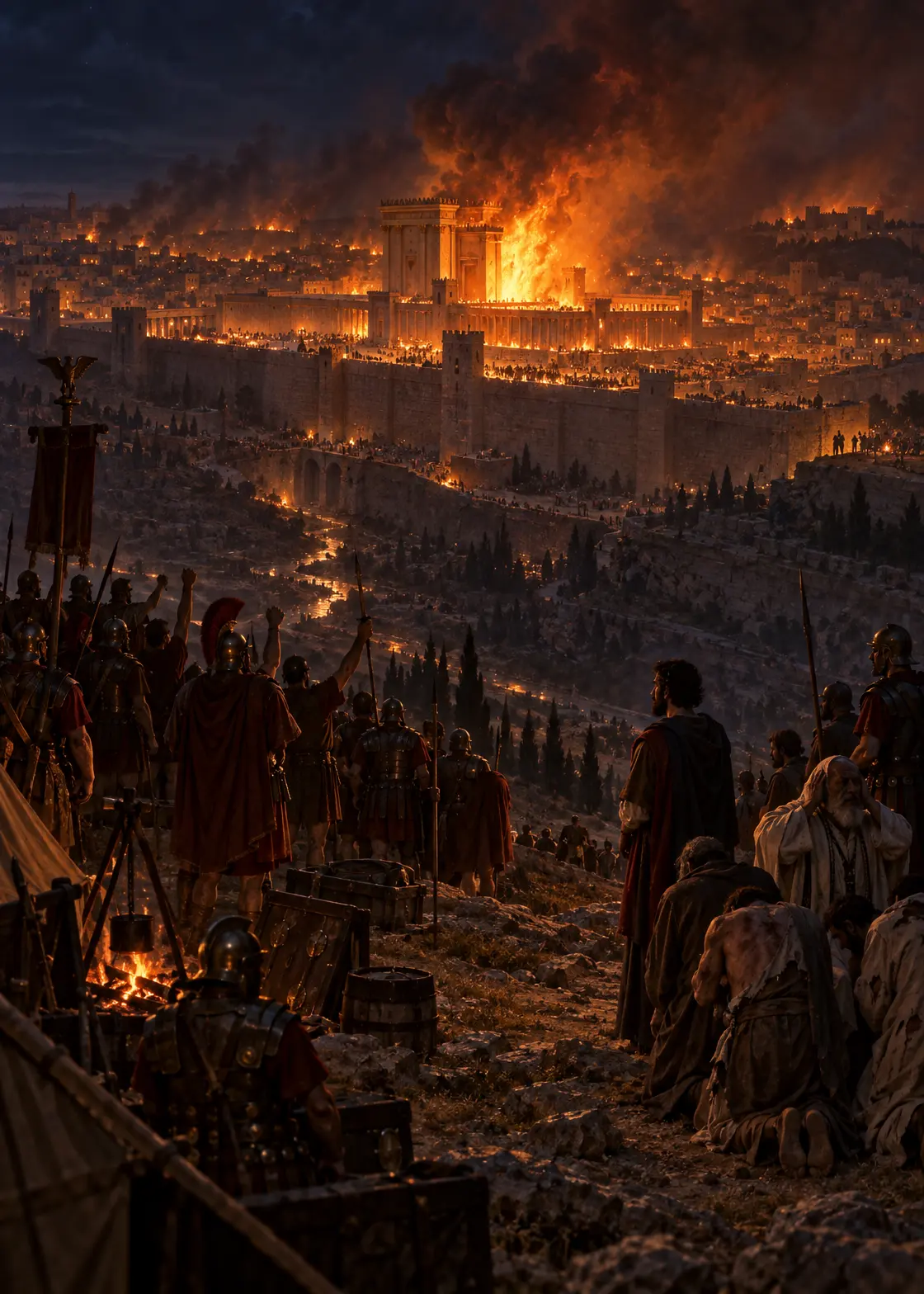
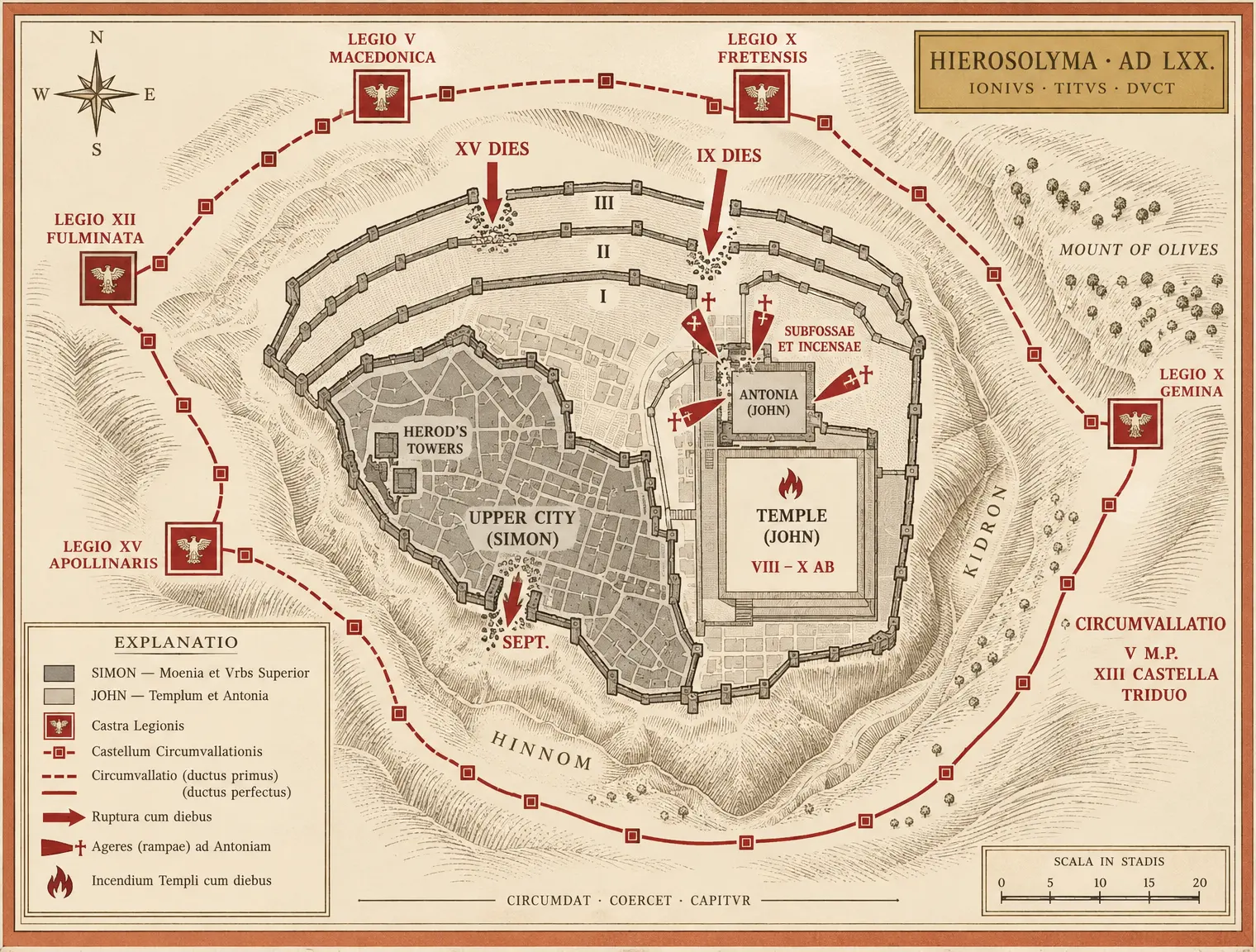
The Crossroads · Summer of 66 · The Temple, Jerusalem
The Daily Sacrifice
You are Eleazar son of Ananias, captain of the Temple in Jerusalem and a leader of the priests' faction.
Tensions in Judaea have reached breaking point after decades of friction between Jewish worshippers and Roman officials. The procurator Gessius Florus seized seventeen talents from the Temple treasury for Caesar's needs, answered the mockery of Jerusalem's alms-baskets with a punitive market-sack, and crucified Jews of Roman equestrian rank. Florus has now departed for Caesarea, demanding that the city prove its submission by marching out to greet his approaching cohorts. As captain of the Temple, you control the altar where the daily sacrifice is offered on behalf of Rome and the emperor. The priests' faction stands divided between outward compliance to avert legionary retribution and an irreversible liturgical rupture that will formalize defiance.
Do you halt the daily sacrifice offered for Rome and Caesar, or maintain the altar's liturgy and greet the Roman cohorts?
Weigh each course: open it to hear your own inner voice. Then decide. Nothing is scored.
- Your inner voiceThe course taken
Ceasing the sacrifice offered for Rome and the emperor makes the rupture absolute. Florus took seventeen talents from our treasury, betrayed our brethren at Caesarea, and answered mocked alms-baskets with blood and crosses. The altar cannot purchase peace with defilement. Halting the rite will rally the priests and the nation, but it means war against the empire. If legions march south, our walls and our faith will be all that remain between us and ruin.
- Your inner voiceThe course taken
Greeting Florus's cohorts and preserving the daily sacrifice for Caesar feels bitter after the market-sack and the crucifixion of Jews of Roman equestrian rank. Yet the altar would remain inviolate and the city spared a siege. We weathered Cumanus after the stampede at the Antonia; we can endure Florus until he departs. But our people despise us for yielding, and submission will only invite Caesar's ministers to rob the Temple treasury again.
- Your inner voiceThe course taken
We can refuse to greet the cohorts while keeping Caesar’s sacrifice upon the altar, dispatching envoys to Cestius Gallus in Syria. Florus’s outrages—the seventeen talents stolen, the market plundered, equestrians scourged—exceed his authority. Maintaining the liturgy keeps us within Roman law while demonstrating that our quarrel is with a corrupt procurator, not the empire. Yet Florus may strike before Syria responds, and the angry crowds will see hesitation as cowardice.
What was done
Eleazar and the priests ceased the daily sacrifice offered for Rome and the emperor, transforming liturgical refusal into a declaration of war. The Roman garrison in the upper city surrendered on terms and was massacred, save its commander who promised circumcision. That same hour, Caesarea's Greeks slaughtered twenty thousand Jewish neighbors, igniting reciprocal pogroms across the Levant. In autumn, Cestius Gallus, legate of Syria, marched south with the Twelfth legion reinforced, assaulted the Temple approaches, and then abruptly retreated. In the Beth-Horon defiles, Jewish fighters routed the column, killing 5,300 infantry and nearly 500 horse, capturing the artillery train and the Twelfth's eagle. The Temple aristocracy assumed the war it failed to prevent, minting the silver shekels of Year One—Jerusalem the Holy, the coinage's AGrade A witness that this was a war of liberation with a treasury—and commissioning regional commanders, among them Joseph son of Matthias for Galilee.
The evidence The Editor's Note cites Josephus's Bellum Judaicum (AGrade A author-is-subject, rebel commander for books 2–3, embedded Flavian interpreter thereafter), checked against the revolt's Year 1–5 silver shekels (AGrade A documentary and material). Independent controls include Tacitus Histories 5.1–13 (AGrade A, fragmentary), Suetonius (Vesp. 4–8, BGrade B), and Cassius Dio (65–66, BGrade B epitome).
If you choose to walk through itAt every scale
- Yourself
Can a priest who oversees sacred rites balance his personal piety and ancestral duty against the certain bloodshed his political refusal will unleash?
- Those beside you
What responsibility does the priestly aristocracy bear toward the city's inhabitants, who will suffer the consequences of defying Roman power?
- Rome
How far can an imperial administration provoke provincial religious customs through extortion and violence before the provincial elite has no choice but rebellion?
- The wider world
When a localized conflict erupts into communal violence, how does an act of sacred rebellion by one group endanger vulnerable diaspora communities living among hostile neighbors?
- Our own time
Under what circumstances do symbolic or procedural protests cease to be appeals for reform and become irreversible declarations of conflict?
In 1775, colonial assemblies in North America ceased honoring royal revenue acts and established extra-legal congresses following repeated military impositions and the seizure of local stores. Like the Temple priesthood, provincial leaders who had long mediated imperial rule felt compelled by administrative overreach and market crackdowns to abandon formal deference, transforming fiscal protests into sovereign institutions and minting their own paper currency to finance armed defense.
Where the comparison fails. Where the comparison fails: The American rebellion was framed in secular legal philosophy across broad geographic territories with oceanic buffers, whereas the Judaean revolt combined sacred liturgy with absolute theological rupture inside an encircled province governed directly by Roman legions.
What does the chapter tell us?
What act transformed unrest under Gessius Florus into an irreversible declaration of war against Rome?
The chapter explicitly states that when Eleazar son of Ananias, captain of the Temple, ceased the daily sacrifice offered for Rome and the emperor, that liturgical act was the declaration of war, making the priests' faction refusal irreversible.
the chapter's narrative
Why did Nero appoint Titus Flavius Vespasianus to command the campaign in Judaea in 67?
Nero selected Vespasian because he was the empire's available specialist in difficult terrain from his service in Britain, and safely employable because he had fallen out of imperial favor for sleeping during Nero's recitals.
the chapter's narrative
According to the Editor's Note, why must Josephus's account of the war be audited with special caution despite his AGrade A eyewitness status?
The Editor's Note grades Josephus as a AGrade A author-is-subject twice over, but notes he is structurally partisan: writing in the victor's household on a Flavian pension, he loaded blame onto tyrants and brigands while exculpating Titus and justifying his own survival.
Editor's Note (Josephus BJ, AGrade A/audited as stated)
What is the nature of the historical evidence concerning Titus's decision on the fate of the Temple?
The chapter terms this the war's great source-crux: Josephus stages a council where Titus voted to spare the sanctuary, while a rival tradition preserved in Sulpicius Severus claims Titus ordered its destruction, leaving the actual council decision unresolved.
Editor's Note (Sulpicius Severus Chron. 2.30, CGrade C; Cassius Dio 65–66, BGrade B)
What material evidence provides a AGrade A contemporary witness to the rebel regime's self-organization as a sovereign state?
The chapter highlights the rebel regime's silver shekels of Year One inscribed Jerusalem the Holy as a AGrade A material witness that the revolt organized itself as a state with its own treasury.
Editor's Note (revolt and CAPTA coinages, AGrade A, material)