Book VI · The Wars of the Early Principate
Chapter 7
The Year of the Four Emperors and the Batavian Revolt
The Fall of Nero and the Reign of Galba68 – January 69
The dynasty of Augustus ended not in battle but in a failure of nerve propagated at the speed of rumor, and the empire then discovered, across eighteen months, what a century of the Principate had been concealing: that the state was the army's, and the army was several. The unraveling began in Gaul in March 68 with the rising of the governor Vindex — a Romanized Aquitanian noble whose program was not separatism but a decent emperor, and whose candidate was Galba, the aged legate of Hispania Tarraconensis; it should have ended at Vesontio in May, where the Rhine legions under Verginius Rufus destroyed Vindex's levies in a battle their commanders may have been negotiating to avoid — twenty thousand dead, Vindex a suicide — and where the victorious legions then offered the purple to Verginius, who refused it with a constitutional scruple the age found antique. Nero's position dissolved regardless, from the center outward: the Praetorian prefect sold the Guard to Galba's agents for a promised donative, the Senate condemned the abandoned emperor to the ancient penalty, and Nero, hiding in a freedman's villa four miles from Rome, drove a dagger into his throat with secretarial assistance and the exit-line — qualis artifex pereo, what an artist dies in me — that the hostile tradition preserved as self-indictment and posterity as epitaph. He was thirty; the line of Augustus was extinct; and the succession, for the first time, was a question with no grammar to answer it. Galba's seven months demonstrated with textbook economy how not to inherit a military monarchy: seventy-three years old, of Republican-vintage severity, he decimated a legion of Nero's marine recruits at the Milvian bridge for petitioning too vigorously, refused the Praetorians their purchased donative with the sentence — legi a me militem, non emi, I levy my soldiers, I do not buy them — that Tacitus admired as principle and recorded as suicide, and on the first of January 69 heard the legions of Upper Germany tear his portraits down and swear to the Senate and People pending a better offer. Their offer arrived within forty-eight hours, when the Lower German army proclaimed its own amiable, gluttonous legate, Aulus Vitellius; and Galba's answering stroke — the adoption of the blameless young aristocrat Piso as heir, announced to the Guard without a denarius attached — merely fixed the price of the alternative. Marcus Salvius Otho, Nero's old companion, first husband of Poppaea, and the passed-over kingmaker of Galba's own coup, bought twenty-three Speculatores of the Guard; on the fifteenth of January Galba was carried into the Forum by a false alarm engineered for the purpose, abandoned by cohorts he had refused to purchase, and butchered by the Praetorian cavalry beside the Lacus Curtius — the old man offering his neck with the words, in one tradition, strike, if it be for the good of Rome; Piso was dragged from the temple of Vesta and killed at its door; and Otho, saluted that evening, is said to have picnicked among the heads. Tacitus opened his account of the year with the verdict this compendium has already adopted as a thesis — the arcanum imperii now public, emperors could be made elsewhere than at Rome — and the remainder of the chapter is that sentence, executed.
Otho and Vitellius: The First Battle of CremonaJanuary–April 69
The war of Otho and Vitellius was fought for Italy by armies that had never seen their principals reign. The Vitellian columns crossed the winter Alps in two great bodies — Valens with the Lower Rhine's forty thousand by the western passes, Caecina with thirty thousand of the Upper army over the Great St Bernard in the snow — while Otho held Rome with the Guard, the marines, and gladiator-cohorts, sent his fleet ravaging the Ligurian coast in a campaign chiefly remembered for its atrocities against its own provincials, and awaited the Danubian legions marching to him; the strategic question of the campaign, posed by his best officers, was simply whether to refuse battle until they arrived. The Othonian command — the capable Suetonius Paulinus of the Boudican war among them — argued delay; the emperor's circle argued nerves could not stand it; and Otho, withdrawing to Brixellum and taking the Guard's edge with him, ordered the offensive that his marshals had voted against. On the fourteenth of April, at the first battle of Bedriacum — fought along the Po-side road east of Cremona, in vineyards and canal-cut ground where no line could hold its dressing — the Othonian army, marched sixteen miles that morning under commanders it suspected of treason, met the united Vitellian forces in a soldiers' battle of murderous local collisions: the First Adiutrix, marines a fortnight into their legionary eagles, took the Twenty-First Rapax's standard and killed its front-rank centurions before the veterans avenged it; the day dissolved into rout, forty thousand dead by the round tradition; and the negotiated surrender at Bedriacum next morning ended, by the year's arithmetic, its first civil war. Its distinction was supplied by the loser. Otho, at Brixellum with forces intact, the Danube legions' vanguard already arrived, and every officer urging continuation, declined — announcing to his soldiers, in the speeches Tacitus and Plutarch built from a tradition too consistent to be invented whole, that others might hold the purple longer, none should learn to leave it better, and that he would not have Roman youth die twice over for one man's estimate of himself; he spent the evening calming his household, burned his correspondence to protect Vitellius's partisans from Vitellius's victory, distributed his cash, slept — the detail every source keeps — soundly, and at dawn fell on the single dagger he had tested at his pillow. He was thirty-six, had reigned ninety-five days, and received from the tradition the epitaph of paradox the compendium prints as the year's one credit entry: that he died better than he had lived, some of his soldiers killing themselves at his pyre. Vitellius's progress south supplied the year's corresponding debit: touring the Bedriacum field a month after, amid the unburied, he answered his companions' disgust with the observation the hostile tradition nailed to him forever — that the smell of a dead enemy was sweet, and of a dead fellow-citizen sweeter.
The Flavian War: The Second Battle of Cremona and the Burning of the CapitolJuly–December 69
The Danube legions that had marched too late for Otho did not disperse their grievance, and the eastern armies now produced the year's fourth name. The proclamation was staged with financial precision — the prefect of Egypt Tiberius Alexander administering the oath to Vespasian on the first of July, Judaea's legions following on the third, Syria under Mucianus within the fortnight — and the Flavian plan was Mucianus's: hold Egypt's grain as a garrote, march overland with a picked force, and strangle Vitellius by winter. The Danube armies made the plan obsolete. Antonius Primus — legate of the Seventh Galbiana, a convicted forger restored by the civil wars, and the year's one commander of genius — swept the Balkan legions into Italy at campaigning speed against every instruction to wait, seized Verona, and when Caecina, opening the Vitellian betrayal-market early, was arrested by his own soldiers for attempting to sell them, met the Vitellian army's night counter-offensive outside Cremona on the twenty-fourth of October in the second battle of the year fought on the same haunted ground — and the strangest great battle of the Roman age: a full-scale engagement in pitch darkness, eleven legions' worth of men fighting by password and rumor down the Postumian road, standards lost and retaken unseen, soldiers recognizing brothers by voice — Tacitus fixes the war's civil horror in one such recognition, a son stripping his father's corpse — the Flavian line breaking at moonset and rebuilt by Primus with the flat of his sword, until at dawn the Third Gallica, Syrian-posted for a generation, turned east and hailed the rising sun in the Emesene manner, and the Vitellians, mistaking the salute for the cheer of arriving reinforcements, broke. The sequel Tacitus made the year's moral center: Cremona — a Latin colony of two hundred and eighty-six years, guilty of quartering the victors of April — was sacked by its countrymen for four days with a completeness the historian itemizes through averted eyes, its population butchered or auctioned until the buying of Italians was shamed off the market, its temples burned to the foundations; Primus was bathing when the fires took hold and remarked that the water was just right. The road to Rome then ran through negotiations conducted over the head of a Vitellius attempting serially to abdicate a purple the German cohorts refused to let him doff; the city prefect Flavius Sabinus — Vespasian's elder brother, the year's designated decent man — accepted a transfer of power, was besieged by the mob and the cohorts on the Capitol, and on the nineteenth of December the temple of Jupiter Optimus Maximus, the house of the Roman state since the kings, in whose sight every triumph of this compendium had terminated and whose burning even the Gauls of Book I had not achieved, went up in flames set by Roman hands nobody afterward would own; Sabinus was dragged to the Gemonian stairs and hacked apart under Vitellius's helpless gaze; the eighteen-year-old Domitian escaped in the linen of an Isis-priest — a costume the reader will find him remembering. The Flavian army stormed the city on the twentieth against the Guard's last stand at their own camp — the Praetorians of Vitellius dying at their gates to a man, the one unpurchased loyalty of the year spent on its least deserving object — and Vitellius, discovered in a doorkeeper's lodge behind a mattress, was driven at sword-point through the Forum with his head held back by the hair, pelted, made to watch his own statues fall, and cut down at the Gemonian stairs after answering one mocking tribune with the only sentence of his reign the tradition thought worth keeping: and yet I was your emperor. The Senate voted Vespasian the powers the same evening; Mucianus arrived days later to govern in his name; and the year closed with the accounting Tacitus totaled — four emperors, three civil wars, the Capitol in ashes — and with the empire's edges, which had watched the center empty itself, already moving.
The Batavian Revolt69–70
The gravest movement was on the lower Rhine, where the year's civil recruiting had armed exactly the wrong genius. The Batavians — the empire's premier auxiliary nation, exempt from tribute in exchange for soldiers, their eight cohorts the army's stormtroops from the Medway to Mona — had grievances (the cohorts' veterans' insults, a press-gang levy seizing, Tacitus specifies, the tribe's boys for barracks vice) and a prince: Julius Civilis, twenty-five years an auxiliary officer, one-eyed like the Sertorius he consciously played, twice arrested on treason charges and surviving, who in the autumn of 69 raised the Rhine mouth for Vespasian — the Flavians' own agents soliciting exactly this diversion — and then, as Rome burned its Capitol, converted the diversion into the war it had pretended to be. The insurgent order of battle was the Roman system inverted: the eight Batavian cohorts, recalled toward Italy, wheeled north and joined him entire; the auxiliary regiments of the whole frontier followed by nations; two legions caught in the field were wrecked, and the survivors of the Rhine army — the same legions that had made Vitellius, now leaderless, unpaid, and despised — were penned into Vetera. The siege of Vetera ran all winter into the spring of 70, past the eaten grass and roots Tacitus records, past a relief army's mutinies, into the sequence that made the revolt the century's darkest mirror: the Gallic commanders Classicus and Tutor of the Treveri and the Lingones' Julius Sabinus, reading in the Capitol's ashes (the Druids had so construed it, Tacitus reports) the transfer of heaven's mandate, proclaimed an imperium Galliarum — an empire of the Gauls with Roman forms, Roman-titled officers, and a Roman-style oath; and the starving legions of Vetera, offered terms, marched out under pledge, were plundered and massacred at the fifth milestone, and the survivors — with the remnant garrisons of the whole province — swore allegiance to the Gallic empire: two eagles serving a foreign flag, the deepest formal disgrace in the army's history, exceeding Caudium and the Teutoburg because it was sworn. The recovery was Flavian order restored at Flavian speed: nine legions converged under Petillius Cerialis — the Ninth's mauled legate of the Boudican war, now the dynasty's fireman — who broke the Treveri at Rigodulum and Trier, retook the oath-stained legions into the line with a deliberate amnesty and a speech Tacitus composed as the imperial counter-manifesto to Calgacus (Gaul's choice, Cerialis argues, was never freedom or empire, but this empire or other masters; the peace of the legions is bought with the taxes that pay them), survived a night-infiltration of his own camp that cost the fleet its flagship, and pressed Civilis down the island of the Batavians through the amphibious autumn campaign of 70 until, with his people's lands flooded and his allies bidding him in for terms, the one-eyed prince met Cerialis on a severed bridge over the Nabalia river, each on his own broken end above the water — and there, mid-sentence in Civilis's speech of self-exculpation, the manuscript of the Histories breaks off forever: the war's settlement (the Batavians restored to their old treaty, tribute-free and soldier-bound; the fate of Civilis unknown) reconstructed from allusion, the compendium's most consequential torn page. The Editor closes the chapter on the double lesson the year and its sequel taught every reign that follows in this volume and the next: that the frontier armies now knew their price, and the frontier peoples now knew the frontier armies — and that the Flavian reconstruction, treated in the next chapter, was engineered, intelligently and admittedly too late, against both halves of that knowledge at once.
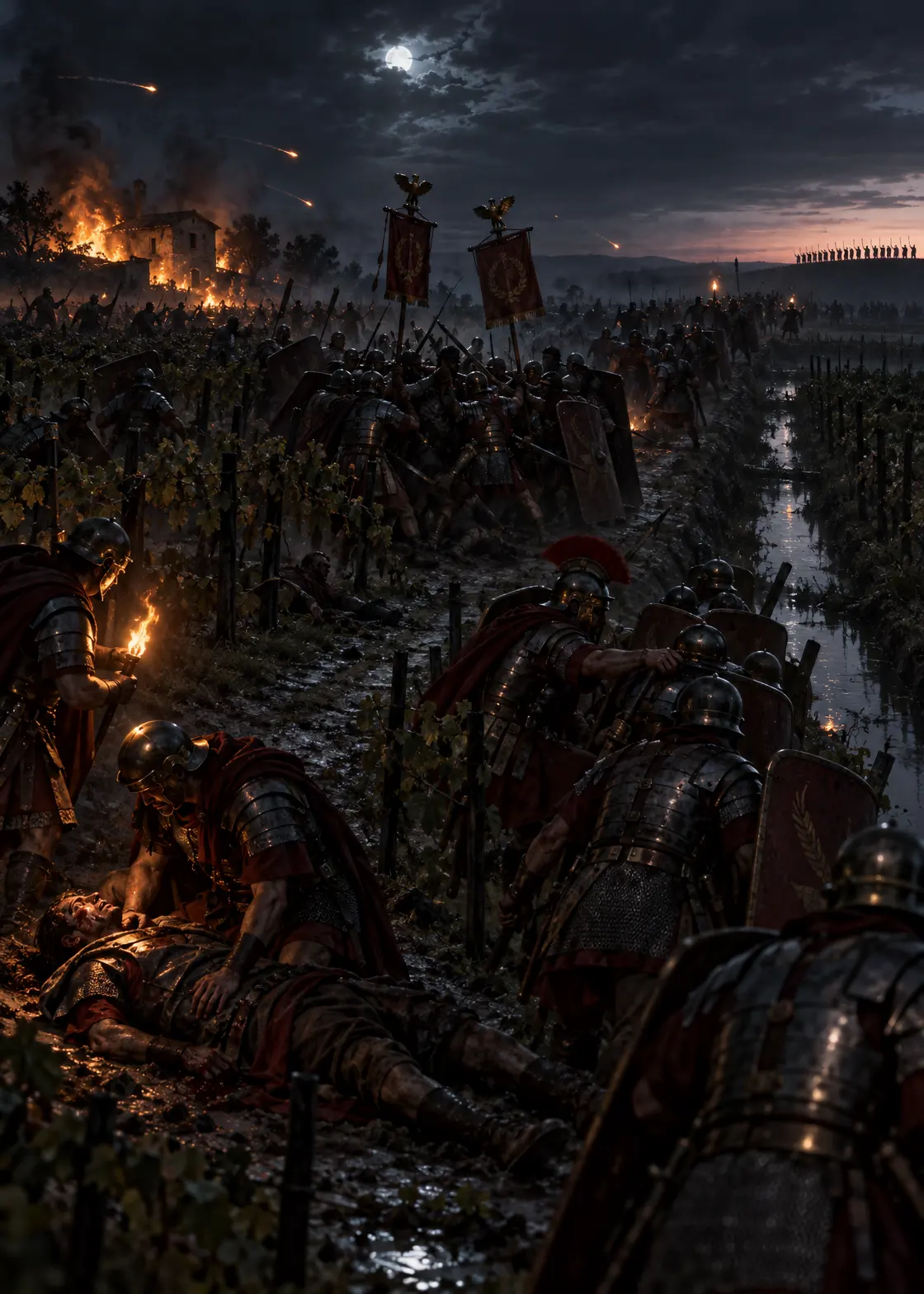
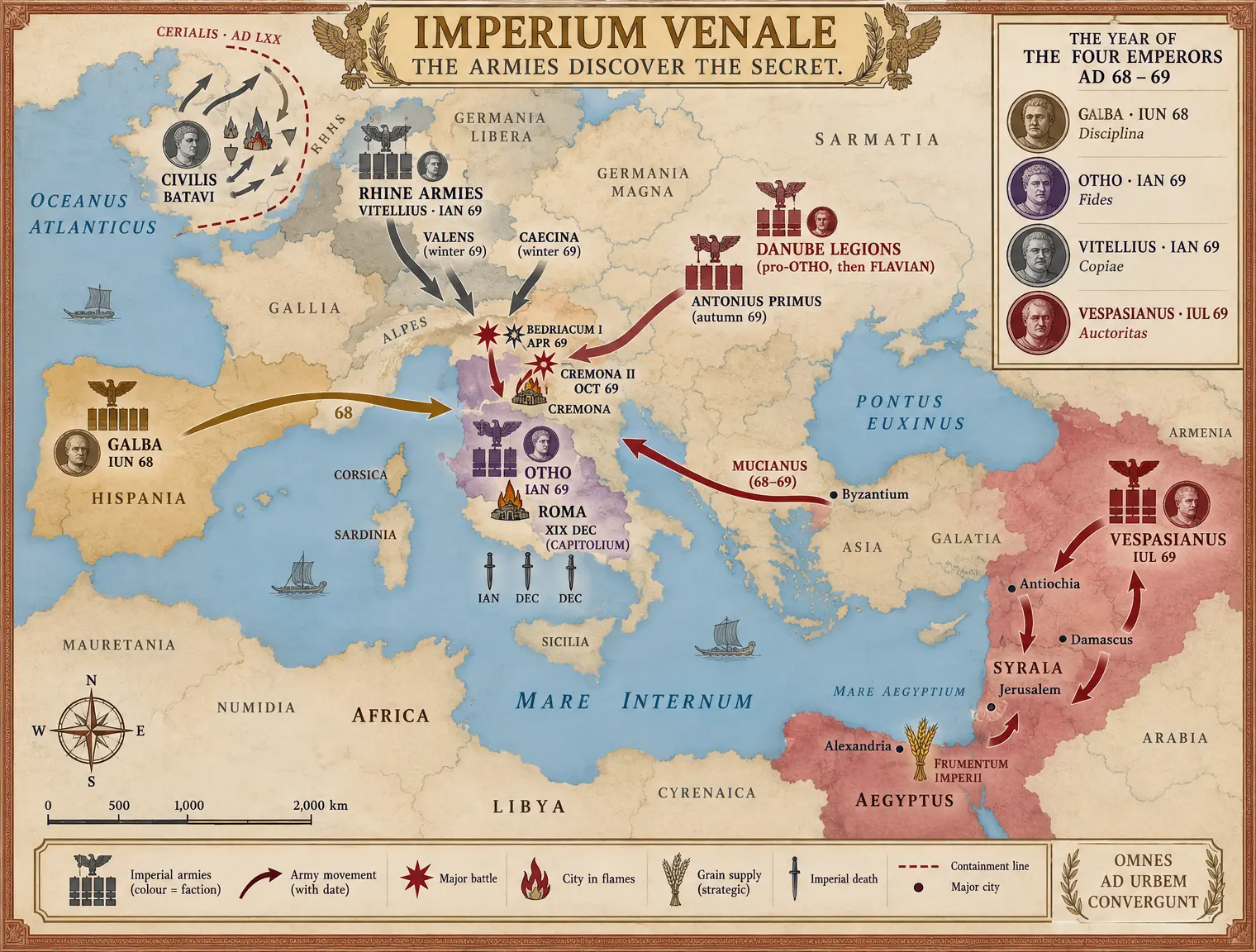
The Crossroads · April 69 · Northern Italy, along the Po near Bedriacum and Brixellum
The Strategic Council on the Po
You are Marcus Salvius Otho, emperor in Rome, holding council with your marshals in northern Italy.
The armies of the Rhine have invaded Italy to dethrone you. Moving in two great columns across the winter Alps—Valens leading forty thousand men of the Lower Rhine by the western passes, and Caecina bringing thirty thousand of the Upper army over the Great St Bernard in the snow—the Vitellian forces have entered the Po valley. You have marched north from Rome with the Praetorian Guard, newly raised marine legions, and gladiator-cohorts, while your fleet has raided the Ligurian coast. The Danubian legions are marching to your aid, but only their vanguard has begun to arrive. The Vitellians are concentrating near Cremona. Your senior marshals, led by the veteran Suetonius Paulinus, urge you to refuse battle and play for time. Your intimate circle counters that your soldiers' nerves cannot withstand the agony of delay, pressing you to launch an immediate offensive.
Will you delay along the Po to await the Danubian legions, or order an immediate offensive toward Cremona?
Weigh each course: open it to hear your own inner voice. Then decide. Nothing is scored.
- Your inner voiceThe course taken
If we are to strike before the Danubian legions arrive, we cannot do so with divided resolve. Withdrawing myself to Brixellum would only signal fear, depriving our line of the Guard's sharpest edge and leaving the soldiers to suspect their own generals of treachery. If we advance toward Cremona, I must ride at the army's head. Our raw marines and gladiators will fight with desperate courage only if they see their emperor sharing the front rank.
- Your inner voiceThe course taken
My circle understands our army better than the marshals do: our soldiers' nerves cannot endure prolonged inaction. Idle days in camp breed mutiny, and every hour of waiting lets rumor gnaw at their resolve. We must strike along the road toward Cremona before the Vitellian columns consolidate. By retiring to Brixellum with a reserve of the Guard, I safeguard the emperor's person, keep a fresh force in hand, and leave the field to professional commanders.
- Your inner voiceThe course taken
Paulinus proved his generalship when he broke Boudica, and his counsel is sound. Valens and Caecina command seventy thousand hardened veterans of the Rhine legions, whereas our ranks rely on new marine recruits, gladiators, and the Guard. If we hold our ground along the Po and refuse battle, the Danubian legions will join us and tip the balance. Delay costs us nothing but patience, while a hasty engagement risks the entire empire on an untried line.
What was done
Otho ordered the offensive that his marshals had voted against, withdrawing to Brixellum and taking the Guard's edge with him. On the fourteenth of April, at the first battle of Bedriacum—fought along the Po-side road east of Cremona in vineyards and canal-cut ground—his army marched sixteen miles under commanders it suspected of treason. The collision was murderous: the First Adiutrix, marines a fortnight into their legionary eagles, took the standard of the Twenty-First Rapax and killed its front-rank centurions before the Rhine veterans avenged it. The Othonian line dissolved into rout, leaving forty thousand dead by the round tradition (CGrade C). Next morning the army at Bedriacum negotiated its surrender. At Brixellum, with forces intact and the Danubian vanguard arrived, Otho refused his officers' pleas to continue, burned his correspondence to protect Vitellius's partisans, and at dawn fell on a single dagger (BGrade B), ending the year's first civil war.
The evidence Tacitus, Histories books 1–2 (AGrade A, audited from named eyewitness strata including Vipstanus Messalla, the elder Pliny, and Cluvius Rufus); Plutarch's Otho and Suetonius's Otho (BGrade B, drawing common strata independently); Cassius Dio 64 (BGrade B, epitomated). Interior councils and Otho's death scene carry BGrade B (consistent tradition, unverifiable); battle casualty figures carry CGrade C (round tradition); the battle topography near Bedriacum is only generally fixed.
If you choose to walk through itAt every scale
- Yourself
How does a ruler balance personal fear of appearing irresolute against the cold tactical requirement to wait?
- Those beside you
What obligation does a commander owe to veteran marshals whose seasoned counsel conflicts with the desperate clamor of political favorites?
- Rome
Can an imperial system that draws its mandate from the sword maintain political legitimacy when its armies begin slaughtering one another?
- The wider world
What happens to the provinces and subject peoples when the frontier legions turn inward to fight over the central government?
- Our own time
When organizational leadership faces intense pressure to produce immediate results, how can decision-makers distinguish between necessary patience and fatal hesitation?
In July 1861, at the onset of the American Civil War, political leaders and newspapers in Washington pressured Union commanders to launch an immediate offensive toward Richmond before raw three-month recruits were trained or coordinated. General Irvin McDowell warned that his forces were unready, but the administration insisted that public patience would break under delay. McDowell attacked at Bull Run, where his unseasoned levies broke and routed.
Where the comparison fails. The Union government possessed an intact constitutional framework, institutional depth, and vast industrial reserves that allowed it to absorb defeat and raise new armies. In 69, Rome had no constitutional mechanism for succession; the military monarchy rested entirely on the personal survival of the claimant, making a single battlefield rout fatal to the regime.
What does the chapter tell us?
Why did the aged emperor Galba lose the support of the Praetorian Guard and invite his own overthrow?
Galba refused the donative promised to the Praetorians by his agents, declaring legi a me militem, non emi (I levy my soldiers, I do not buy them). Tacitus recorded this antique Republican severity as political suicide, enabling Otho to bribe the Guard and butcher Galba.
Tacitus Histories 1 (AGrade A)
In the war council before the first battle of Bedriacum, what strategic argument did Suetonius Paulinus and the Othonian marshals make?
Suetonius Paulinus and Otho's best officers argued that the Othonian forces should refuse battle and delay until the Danubian legions arrived. However, Otho's immediate circle insisted that soldiers' nerves could not endure the waiting, prompting Otho to order the disastrous offensive.
Tacitus Histories 1–2 (AGrade A)
How was the night battle outside Cremona (the second battle of Bedriacum) between the Flavians and Vitellians decisively turned at dawn?
At dawn, the Third Gallica—which had been stationed in Syria for a generation—turned east and greeted the sun according to Emesene custom. The exhausted Vitellians mistook their cheers for the arrival of reinforcements from the east and broke in panic.
Tacitus Histories 3 (AGrade A)
What ideological event spurred the Gallic leaders Classicus, Tutor, and Julius Sabinus to proclaim an imperium Galliarum during the Batavian revolt?
When news reached the Rhine that Roman hands had burned the Capitol in Rome, Gallic leaders and Druids construed the destruction of Jupiter's temple as heaven's mandate departing from the Roman state, emboldening them to declare an independent Gallic empire with Roman forms.
Tacitus Histories 4 (AGrade A/B)
According to the Editor's Note, what critical gap occurs at the end of Tacitus's surviving Histories?
The surviving text of Tacitus's Histories breaks off mid-sentence while Julius Civilis speaks on a severed bridge over the Nabalia river. Consequently, the final treaty restoring the Batavians and the ultimate fate of Civilis must be reconstructed from allusions elsewhere.
Editor's Note / Tacitus Histories 5.26 (AGrade A/B)