Book VI · The Wars of the Early Principate
Chapter 8
The Flavian Consolidation and the Wars of Domitian
Vespasian: The Army Rebuilt70–79
The reconstruction was designed by men who had just read the year 69 as a engineer reads a collapse, and its first principle was that the failure had been structural. Vespasian and Mucianus disbanded outright the four legions whose record the civil war and the Batavian oath had made unsalvageable — I Germanica, IV Macedonica, XV Primigenia, XVI Gallica struck from the list, their numbers, like the Varian three, never reissued — and reconstituted the salvageable under new titles and new stations; the Rhine garrison was rebuilt with legions owing nothing to the Rhine's recent history, and the army's whole geography was reshuffled on the principle, stated by no source and legible in every posting, that no army group should again ripen into a faction: legions rotated away from provinces where they had grown roots, no more than two wintering together where four had brewed Vitellius. The deeper reform reached the auxilia, whose national blocs under native princes had given Civilis his instrument: the Batavian cohorts were re-formed, renumbered, and posted to Britain and the Danube — soldiering on, tribute-free, but far from home — and the pattern became system: auxiliary regiments henceforth recruited increasingly wherever they were stationed rather than where they were raised, officered by Roman equestrians rather than tribal notables, their ethnic names fading into administrative labels; the empire had learned to dilute what it could not do without. The fiscal reconstruction was of a piece — the census of 73–74, the reclaimed public lands, the provincial revenues rebased, the notorious ingenuities down to the urine-tax that produced, when Titus wrinkled his nose at it, the coin held to his face and the reign's motto: pecunia non olet, money does not smell — because the army reform's real substrate was solvency: the donative-auction of 69 was to be foreclosed by a treasury that could always outbid a usurper. On the frontiers the reign's signature was the quiet closure of strategic reentrants: in the East, Cappadocia converted from unarmed procuratorial province to a two-legion command facing Armenia, the client-kingdoms of Commagene and Lesser Armenia absorbed, the Euphrates road fortified — the eastern limes founded in a decade without a battle the sources thought worth narrating; and in the southwest angle of Germany, the reoccupation beyond Rhine and upper Danube of the Black Forest salient — the Agri Decumates — shortening the frontier's dog-leg and opening the lateral road between the army groups, the first installment of the policy Domitian's wars would complete. Titus's brief reign the compendium notes for its non-war: the eruption of Vesuvius in 79, which buried the Campanian towns whose excavation would one day teach the modern world most of what it knows of Roman daily life, and killed — leading the fleet's rescue-evacuation, the ancient world's largest — the elder Pliny, admiral, encyclopedist, and lost historian of the German wars this volume has mourned chapter by chapter; the amphitheater the war-spoils of Jerusalem had financed was dedicated in 80 with a hundred days of games; and in September 81 the succession passed, without a sword drawn, to the younger son.
Domitian: The Chattan War and the Dacian Emergency81–89
Domitian has descended to posterity through the senatorial tradition that survived him — Tacitus's and Pliny's generation, writing their acquittals after his murder — and the compendium's method requires the warning before the wars: the reign's military record must be read through sources committed to its contempt, against a documentary and archaeological record that persistently contradicts them. The Chattan war of 83, the emperor's first, is the test case: the literary tradition preserved it as theater — a manufactured campaign, slaves dressed as prisoners, a triumph Tacitus's Germania mocks in a clause — while the ground records the largest engineering advance of the century: the Taunus and Wetterau salients driven through the Chatti's approach-country, the watchtower chains and palisade traces of the earliest limes proper, the forts at the passes, and behind them the conversion, by the middle 80s, of the old military commands of the Rhine into the formal provinces of Upper and Lower Germany — the German project of Drusus ending, seventy years after the Teutoburg, not at the Elbe but as two tax-districts and a fortified line, which was the version that lasted. The Editor grades the triumph as the tradition's and the frontier as the emperor's, and passes to the war that was nobody's theater. In 85 the Dacians came over the frozen Danube — the kingdom Burebista had built and Caesar had scheduled for destruction, reconsolidated now in the Carpathian ring around Sarmizegetusa under a war-king the sources call Decebalus, "clever in war and clever in the doing of it," Dio's estimate, a match the empire had not met since Maroboduus — and destroyed the province of Moesia's field force, killing its governor Oppius Sabinus; Domitian came to the Danube in person, cleared the province, and in 86 authorized the punitive crossing under the Praetorian prefect Cornelius Fuscus, the dashing Flavian partisan of 69, who took the Guard and a battle-group over the river on a bridge of boats, marched into the Carpathian passes, and was annihilated — the prefect killed, a Roman field army destroyed entire in enemy country for the first time since Carrhae's scale, standards and siege-train lost into Sarmizegetusa's trophy-halls, and among the casualties, on the strong modern inference the Editor flags as inference, the Fifth Alaudae, Caesar's own Gallic larks, last heard of before this war and never after. Moesia was split into two consular provinces and the Danube's garrison began the climb — five legions toward nine — that would make it, within a generation, the heaviest frontier on earth; and in 88 the methodical counterstroke under Tettius Julianus came through the Iron Gates pass to Tapae, on the approaches to the Dacian capital, and broke Decebalus's army in the field. The kill was forfeited to the year 89: on the first of January the legate of Upper Germany, Antonius Saturninus, proclaimed himself at Mainz with two legions and the savings-deposits of their strongbox, in compact with the Chatti across the river — and the revolt collapsed in eleven days by the empire's oldest weather: the Rhine broke up early, the Chatti could not cross the moving ice, and the loyalist army of Lower Germany under Lappius Maximus destroyed the usurper at the Rhine — after which Lappius burned Saturninus's correspondence unread, the Pompeian gesture of Book V repeated under the monarchy, this time to save not the guilty but the emperor from what he would do with the names; Domitian, arriving with the Guard and his own suspicions, supplied the executions regardless, and the army reforms that followed wrote 69's lesson into regulation at last: no two legions to share a camp again — the great double fortresses broken up empire-wide — and the soldiers' deposit-funds capped below usurpation-financing size. The Danube war was then closed by the settlement of 89 that the senatorial tradition never forgave: Decebalus, beaten at Tapae but unbroken in his mountains, accepted client-kingship — the diadem conferred on his brother as proxy, the forms observed — and received in exchange subsidies in coin and, the scandal's core, Roman engineers and artillery-artificers for his fortresses; Dio's sneer and Pliny's echoes fixed it as tribute paid to a barbarian, and the Editor enters the stipulated defense: with Pannonia's own front collapsing that same season, the settlement bought the empire fifteen years of a two-front problem deferred — at the price, accounted in the next volume, of a Dacia armed and drilled by Rome for the rematch Trajan would require two wars and a hecatomb to win.
The Pannonian Wars and the End89–96
The Danube's other nations filled the reign's last decade. The Marcomanni and Quadi of the middle river — Maroboduus's heirs, client-managed for a century — had failed the Dacian war's call for auxiliaries; Domitian's punitive war against them and their Sarmatian neighbors the Iazyges of the Hungarian plain opened with a Roman defeat in 89 that helped price the Dacian peace, and flared again in 92 into the disaster the sources let slip in a clause: a legion — the Twenty-First Rapax, on the standard reconstruction — caught by Sarmatian heavy cavalry and destroyed with its legate, the second eagle-formation lost in six years; the emperor's eight-month personal campaign that followed restored the line and was marked at Rome, in January 93, not with a triumph but with a laurel laid silently on Capitoline Jupiter's knees — the gesture, for once, exactly calibrated to the facts, and the reign's Danubian ledger closing in balance: no conquest, two legions gone, the river held, and the strategic architecture — Pannonia's camps multiplying, the fleet patrolling, the roads doubling behind the bank — assembled for the wars of the next volume, which would be fought from Domitian's baseline by commanders Domitian had trained. Two army-measures of the reign outlasted every verdict on it: the pay-raise of 84 — the first since Julius Caesar, a third added to the legionary's three hundred sesterces a year, the professional army's wage finally repriced after a hundred and thirty years of inflation and mutiny-arithmetic — and the frontier itself as the reign left it: the palisade going up, the towers intervisible, the auxiliary forts strung at day's-march intervals from the North Sea to the Black Sea, the empire's edge become the empire's largest built object. The reign's end belongs to the political history this compendium enters only at the join: the terror of the 90s consumed senators, philosophers, and finally the emperor's own household's sense of safety, and on the eighteenth of September 96 Domitian was stabbed to death in his bedroom by a conspiracy of freedmen and chamberlains — the steward Stephanus, bandaged arm hiding the dagger, dying on the floor with him — with the empress cognizant and the Guard's prefects bought in advance. The Senate rejoiced, damned his memory, and had the arches pulled down; the armies, which had had their wage raised and their wars led in person, mourned him and said so — the Danube legions near mutiny, the Guard within a year extorting the delivery of the assassins and forcing the new regime to watch them die; and in the space between those two reactions, the aged senator Nerva, childless, adopted as son and heir the legate of Upper Germany, Trajan — the army's own — and the succession problem that had produced the year 69 was solved, for the span of the next volume's golden age, by the expedient of giving the army the choosing of the man the Senate would then be thanked for. On that hinge — the eighteenth of September 96, the last day of the last dynasty this volume treats — the compendium closes its narrative and turns to the audit.
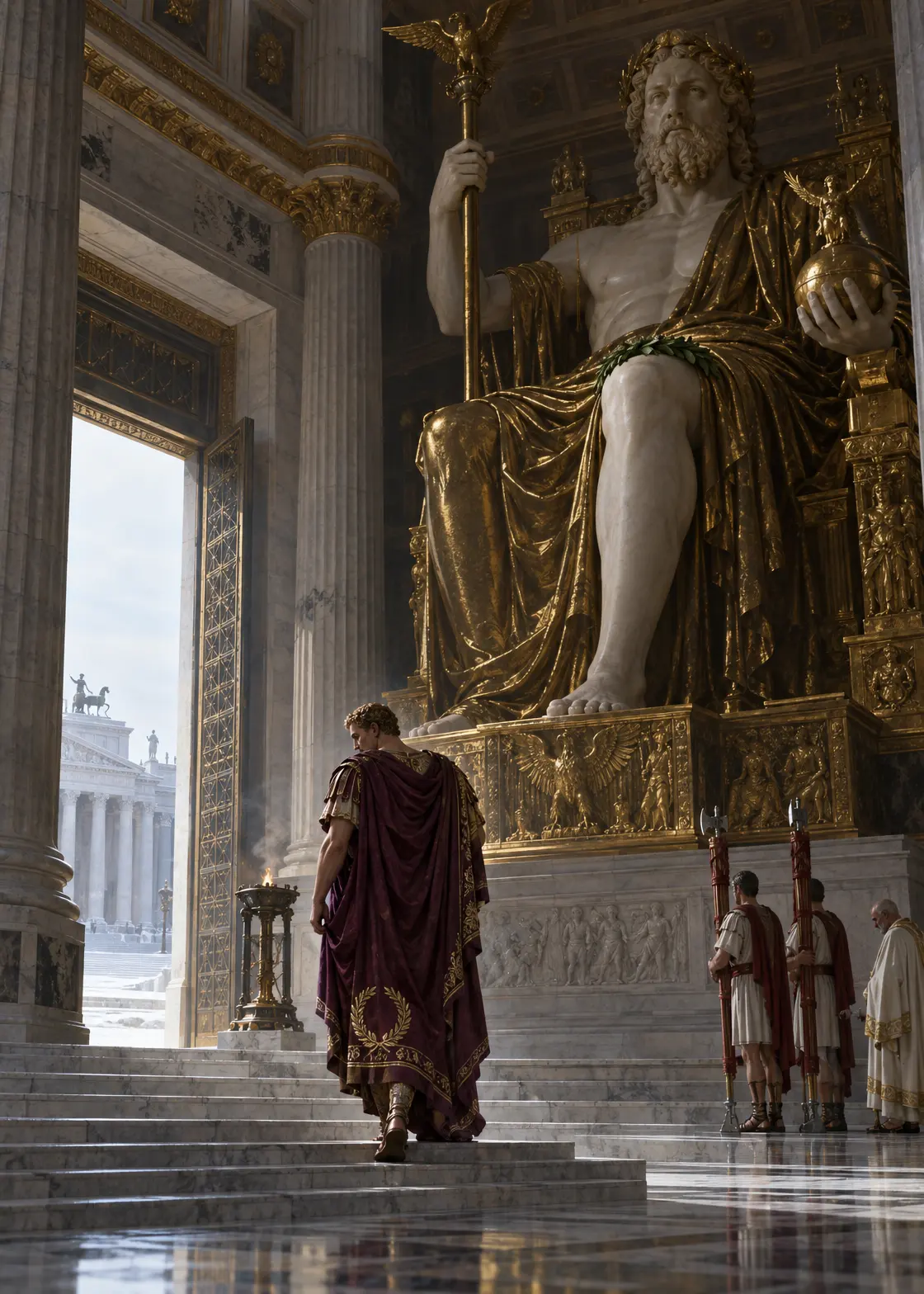
The Crossroads · AD 89 · The Danube frontier
The Dacian Compromise
You are the emperor Domitian, commanding imperial forces along the Danube.
In 88, Tettius Julianus broke Decebalus at Tapae, opening the approaches to Sarmizegetusa. But the kill was forfeited. On New Year's Day, Antonius Saturninus proclaimed himself at Mainz, and though Lappius Maximus crushed the usurpation on the Rhine, the empire's northern frontier remains profoundly shaken. Worse, the Marcomanni and Quadi have refused auxiliary service, and a Roman expedition sent against them and the Iazyges has just met defeat in Pannonia. Decebalus remains entrenched behind the Carpathian ring, yet he offers terms: he will accept client status under Roman forms, provided Rome pays annual subsidies in coin and sends engineers and artillery-artificers to his mountain strongholds.
How will you resolve the war with Dacia to secure the Danube front?
Weigh each course: open it to hear your own inner voice. Then decide. Nothing is scored.
- Your inner voiceThe course taken
Julianus broke them at Tapae; their army has yielded the field. If I turn away now, Fuscus's lost eagles and siege-train remain in barbarian trophy-halls unavenged, and Rome's majesty is diminished. Let Pannonia bleed or hold as it must. The Carpathians cannot protect Decebalus if we strike his capital directly. To stop short when the path is open invites contempt, branding our arms as hesitant and leaving an unbroken enemy upon our flank.
- Your inner voiceThe course taken
To give gold and artillery-artificers to a Dacian king is an outrage that will scandalize every senator in Rome. Better to refuse his humiliating terms, draw back across the river, and establish our defenses along the bank with watchtowers and palisades. We can contain Decebalus behind the water while we march to stabilize Pannonia. It yields the mountain approach, but it keeps Roman steel and siegecraft out of barbarian hands.
- Your inner voiceThe course taken
Pannonia's front is collapsing under the Marcomanni, Quadi, and Iazyges, and my legions cannot fight two savage wars across a thousand miles of river. Decebalus has been beaten in the field; his brother will take the diadem as proxy under Roman forms. Subsidies and engineers are a price, but they buy an immediate peace. I can pivot our strength west to secure the middle Danube and restore the frontier before the entire line gives way.
What was done
Domitian accepted the settlement of 89. Decebalus remained in his mountain kingdom, accepting client-kingship while his brother received the diadem by proxy to observe imperial forms. In exchange, Rome gave subsidies in coin and dispatched Roman engineers and artillery-artificers to strengthen Dacian fortresses. The senatorial tradition never forgave the treaty, branding it tribute paid to a barbarian (BGrade B/C via Cassius Dio and Xiphilinus; CGrade C for facts in Pliny's Panegyricus). Yet the settlement achieved its strategic purpose: with Pannonia collapsing after a defeat by the Marcomanni, Quadi, and Iazyges, the peace deferred a catastrophic two-front war for fifteen years. Domitian stabilized the river line, though the Pannonian conflict flared again in 92 when Sarmatian cavalry destroyed the Twenty-First Rapax. Ultimately, the settlement armed and drilled Dacia with Roman technique for the rematch Trajan would have to fight.
The evidence Cassius Dio 66–67 via Xiphilinus (BGrade B/C) preserves the narrative of the Dacian campaigns and the terms of the 89 settlement; Pliny's Panegyricus (CGrade C for facts) and Tacitus echo the senatorial condemnation of the peace; Suetonius's Domitianus (BGrade B) records biographical and administrative context. Documentary and material evidence—military diplomas, coinages, and frontier archaeology (AGrade A)—corroborates the Danubian garrison shifts and the immediate threat in Pannonia.
If you choose to walk through itAt every scale
- Yourself
How does a ruler balance personal military prestige and reputation against the unpalatable necessity of strategic compromise?
- Those beside you
What is owed to commanders who won victories in the field when wider imperial emergencies demand that their conquests be abandoned?
- Rome
Can an imperial administration retain political authority at Rome while adopting frontier settlements that the senatorial elite view as national disgrace?
- The wider world
How does transferring military engineering and wealth to a frontier client alter regional power dynamics over subsequent decades?
- Our own time
When is it justifiable for a modern power to purchase temporary peace through concessions that predictably strengthen an adversary for a future conflict?
A major power engaged across multiple operational theaters signs a contentious cease-fire with a resilient regional adversary, providing financial aid, dual-use equipment, and technical expertise to halt hostilities. Faced with immediate structural strains or emerging conflicts elsewhere, leadership prioritizes short-term stabilization over total victory, accepting the acknowledged hazard that the adversary will utilize the resources and operational pause to upgrade its defensive infrastructure for an eventual confrontation.
Where the comparison fails. Modern truces operate under institutional alliances, international trade monitoring, and formalized diplomacy, whereas Domitian's settlement rested upon personal oaths, dynastic proxies, and imperial command without constitutional oversight or public international law.
What does the chapter tell us?
Why did Vespasian and Mucianus permanently disband four legions after the civil war of 69?
Vespasian and Mucianus struck I Germanica, IV Macedonica, XV Primigenia, and XVI Gallica from the army list because their civil war record and swearing of the Batavian oath proved their structural failure.
Suetonius Vesp. (BGrade B) and the chapter's narrative
What core principle governed the Flavian reform of the auxiliary units (auxilia)?
To prevent auxiliary blocs from serving native rebellions like that of Civilis, regiments were posted far from home, recruited locally where stationed, and officered by Roman equestrian commanders rather than tribal nobles.
Military diplomas (AGrade A)
How does the archaeological record of the 83 Chattan war challenge the surviving senatorial literary tradition?
While senatorial authors mocked the campaign as staged theater with purchased slaves, archaeology shows the construction of watchtower chains, palisades, and salients in the Taunus and Wetterau, establishing the earliest limes proper.
Tacitus Germ. (AGrade A) and limes archaeology (AGrade A)
What strategic emergency prevented Domitian from exploiting Tettius Julianus's victory at Tapae in 88?
Saturninus's revolt on the Rhine on January 1, 89, combined with a collapsing front in Pannonia following a defeat against the Marcomanni, Quadi, and Iazyges, forced Domitian to halt the Dacian advance.
Cassius Dio 67 via Xiphilinus (BGrade B/C)
Which enduring military and administrative reforms did Domitian enact following the rebellion of Saturninus?
To prevent future military uprisings, Domitian banned double-legion winter camps, capped camp savings deposits below usurpation-financing size, and raised legionary wages by a third—the first pay increase since Julius Caesar.
Suetonius Dom. (BGrade B) and coinage standards (AGrade A)