Book VI · The Wars of the Early Principate
Epilogue
The World-State at 96
The Audit of the Settlement
The volume closes where it opened, on the instrument, and the first entry in the audit is that the instrument worked. The problem Augustus inherited — the client army that had eaten the Republic — was solved by the design this volume has watched operate for a century and a quarter: the soldier's oath, pay, discharge-farm, and glory all issuing from a single patron; and the proof of the solution is the volume's own casualty list of emperors set beside its list of provinces. Four emperors died violently in the century, one dynasty was exchanged for another in a year of civil war — and not one province was lost, not one frontier collapsed, not one foreign power converted Rome's convulsions into conquest: the Parthians in 69 offered Vespasian forty thousand horse-archers and were politely declined; Civilis's revolt, the century's outer limit of danger, was a rising of the army's own auxiliaries, suppressed by the army within eighteen months. The comparison the whole compendium has been assembling is now available: the Republic's military system, between 91 and 31 BC, converted its own energies into sixty years of intermittent self-destruction that burned from Rome to every frontier at once; the Principate's system, tested at its worst in 68–70, confined the fire to Italy and eighteen months. The year 69 exposed the design's one great concealed clause — the arcanum imperii, that the armies could make emperors — and the Flavian generation's response, audited in the last chapter, was not to repeal the clause, which was structural, but to manage it: the armies dispersed, diluted, repriced, and led in person; and the succession-solution improvised in the volume's final days — Nerva's adoption of the Rhine's own commander — was the clause's formal acknowledgment: the army's veto conceded in advance, and the peace of the next volume's golden age purchased with it.
The second entry is the army itself, at the close the finest instrument of organized force the ancient world produced, and changed in nature from everything the earlier volumes narrated. Twenty-eight legions at Domitian's death — some hundred and sixty thousand citizens under the eagles, with as many again in the auxilia, three hundred thousand professionals and more, one soldier for every two hundred inhabitants of the world they held: by the standards of every state before the modern era, an astonishingly thin garrison for an empire of sixty millions, and the thinness is the verdict — the empire was held by consent, habit, roads, citizenship, and the certainty of retribution, with the army as the certainty rather than the presence. Its center of gravity had migrated across the volume from the Rhine, where eight legions stood in AD 14, to the Danube, where nine would stand within a decade of the volume's close — the strategic pivot from the finished German question to the unfinished Dacian and Sarmatian one, and the map of the next four centuries' crises drawn in advance. Its composition had migrated likewise: the legions recruiting increasingly from the provinces and the camps' own children, the auxilia from everywhere, the citizenship flowing out through the diplomas at a rate that was quietly manufacturing, cohort by cohort, the provincial Roman world of the next volume — in which the emperors themselves would be Spaniards, then Africans, then Illyrians, the conquered administering the conquest. And its work had become the frontier: the limes at the volume's close was the largest artifact in human history to that hour — thousands of miles of road, palisade, tower, and fort from the Solway's approaches to the Euphrates — and the compendium has insisted on the Vindolanda letters at the volume's end for the reason the birthday invitation states better than any strategic summary: the terrible machine this series has followed out of a hilltop village now ran on strength-reports, beer-requisitions, and a garrison commander's wife asking her friend to a party — empire as administration, the wolf of the Batos' parable grown sedentary, numerate, and domestic, without ceasing to be the wolf.
The third entry is the cost-ledger this compendium keeps by charter, and the century's debits are of the new kind the Proem forecast: not the Republic's reciprocal massacre of citizens, but the world-state's administered violence against its subjects and neighbors — the Asturian valleys and the Alpine auctions; the Marsi at their festival and the ash-horizon of three British cities; Cremona's four days; the crosses before Jerusalem's walls and the tenth legion camped in the ruin; the punitive economics of the German raids; and the limes itself, which converted the free peoples beyond it into a managed exterior, subsidized, divided, recruited, and periodically harvested. Against these the credit column is real and the Editor enters it without irony: the interior peace of a Mediterranean world that within this century forgot the sight of war — no walls built, no fields burned, no citizen levies for two generations between the Alps and the African sand — the longest such peace in the recorded history of that sea before or since; the roads, the law, the water, the towns; and the strange, slow generosity of the citizenship, which no conquering state before it had ever franchised outward on such a scale. The moral arithmetic between the columns the compendium leaves, as always, unfooted: Calgacus's sentence and the Vindolanda invitation are both true, were written within a decade of each other about the same army, and the space between them is the Roman peace.
The last entry is the sources, because the next volume's shape is already set in this one's silences. The century of this volume was narrated for posterity by the generation writing at its close — Tacitus beginning the Histories as Trajan took the purple, the Annals to follow; Plutarch at his parallel lives; Suetonius in the archives; Josephus finishing in his Roman study — and the reader who has traveled the Editor's Notes knows the paradox they constitute: the age of the Principate's peace produced the literature of its indictment, the monarchy's stability financing the leisure that condemned it, and the compendium's controlling narratives for this volume were all written by men who had survived Domitian and wrote partly to explain having done so. Ahead, the source-country changes again, and the Editor gives warning as the Proem did: for the coming golden age — Trajan's Dacian and Parthian maximums, Hadrian's walls, the Antonine noon — the great narrative tradition thins to epitome and biography precisely as the empire crests, the Historia Augusta's swamp lies beyond, and the material record — the Column, the walls themselves, the tablets and papyri and stones — must carry burdens the vanished historians drop; the third century will be fought half in the dark. The compendium will go on as it has: grading what survives, mourning what is lost, and trusting the spade where the stylus fails. The wars of the Republic asked who Rome would be; the wars of this volume asked where Rome would stop, and answered on three frontiers of four; the wars of the next will ask — at Sarmizegetusa, at Ctesiphon, on the Danube in the plague years — whether the answers can be kept, and the volume after that will ask what happens when they cannot. On the eighteenth of September 96, none of it is yet written: the army on the Danube is in winter quarters; the couriers are on the roads with the news from the Palatine; and at a timber fort below the Stanegate, a garrison commander's household is drafting invitations — the world-state at its noon-before-noon, held, paid, provisioned, and watched over by the small figure this volume's frontispiece set at the rail of a Rhine tower, who now hands the watch to Book VII.
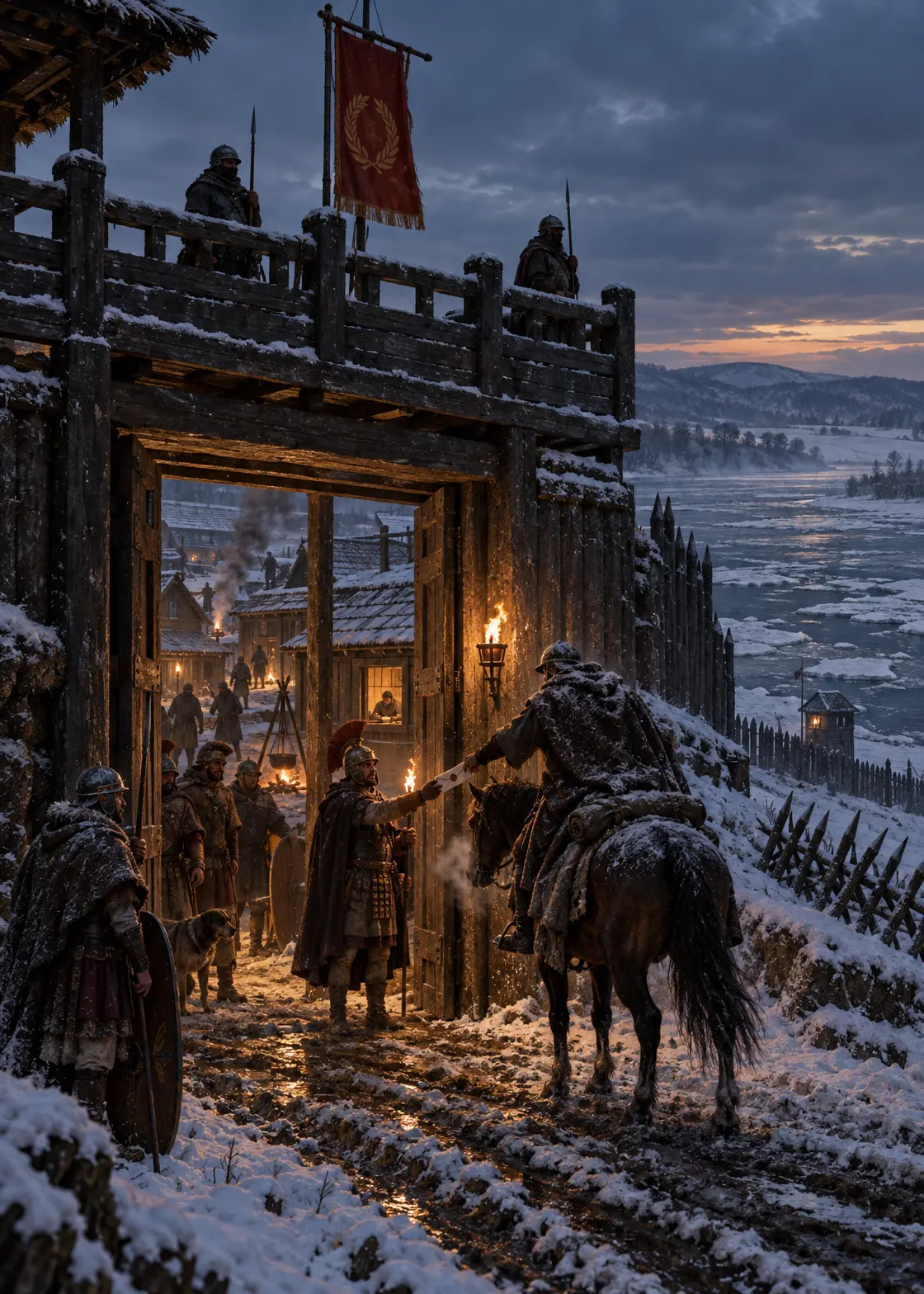
Here ends Book VI of Imperium Romanum: the Wars of the Early Principate, from the settlement of Augustus to the death of Domitian. Book VII will treat the wars of the high empire and the long crisis: Trajan's conquests at the empire's maximum — Dacia destroyed, Parthia entered — Hadrian's walls and the Bar Kokhba catastrophe, the Marcomannic wars of Marcus Aurelius in the years of the plague, the Severan militarization, and the third-century descent into the fifty years of iron and rust from which Diocletian's tetrarchy would haul the wreckage — the long afternoon of the world-state whose noon this volume has ended by describing, on the road that terminates, one volume beyond, at the last emperor of the West.