Book VI · The Wars of the Early Principate
Proem
Proem
The volume now opened treats the first century of a new kind of Roman war. The Republic's wars, across the five preceding volumes, were arguments — with foreign powers about who would rule the Mediterranean, and finally with itself about who would rule Rome; the wars of this volume are the operations of a settled world-state whose existence no defeat could any longer place in question, conducted along frontiers that were themselves a novelty, by an instrument that was the century's great institutional invention: the standing professional army of the Principate. The terminus a quo is the settlement of 30–27 BC, when the victor of Actium converted the client armies of the civil wars into a permanent establishment of the state; the terminus ad quem is the eighteenth of September, AD 96, when the last Flavian emperor died under his freedmen's knives and the army of the frontiers — for the first time in twenty-seven years — declined to make the succession its business. Between these termini the volume must range from the Cantabrian mountains to the cataracts of the Nile, from the Elbe to the Euphrates, and it will witness the four great military dramas of the age: the Augustan attempt upon Germany and its annihilation in the Teutoburg forest; the conquest of Britain and its near-loss to a queen's rebellion; the destruction of Jerusalem; and the year in which four emperors ruled and died while the legions of the Rhine, the Danube, and the East fought one another for the right to sell the world a master.
The instrument first, because everything else in the volume depends on it. What Augustus built between 30 BC and AD 6 was the solution to the problem that had destroyed the Republic — the client army seeking its patron — and the solution was to nationalize the patronage: one commander-in-chief in perpetuity, holding every frontier province and therefore every legion through his legates; a fixed establishment (twenty-eight legions until AD 9, twenty-five after, creeping upward under the Flavians toward thirty) of long-service professionals — sixteen years, then twenty, plus recall — with fixed pay, fixed discharge bounties, and, from AD 6, a dedicated military treasury, the aerarium militare, funded by inheritance and auction taxes so that the soldier's farm came from the state and not from his general's ability to menace it; an equal establishment of auxilia, non-citizen regiments of horse and foot whose discharge diploma carried the citizenship itself, the empire's most successful engine of Romanization; and at the center, the innovation whose price would be paid at intervals for three centuries, nine cohorts of Praetorians, the only army in Italy, guarding — and therefore owning — the person of the princeps. The oath ran to that person by name; the eagles stood beside his image in every camp shrine; the triumph became a family monopoly, generals outside the dynasty receiving ornamenta instead, since a real triumph was now a nomination speech. The reader who has followed the previous volume will recognize the design at once: it is the Marian client army made universal and hereditary, with the state itself as the sole remaining patron. The wars of this volume test the design — and its one catastrophic ambiguity, exposed in AD 69, was stated by its greatest analyst in a sentence this Proem borrows as the volume's second thesis: the secret of empire was out, that an emperor could be made elsewhere than at Rome.
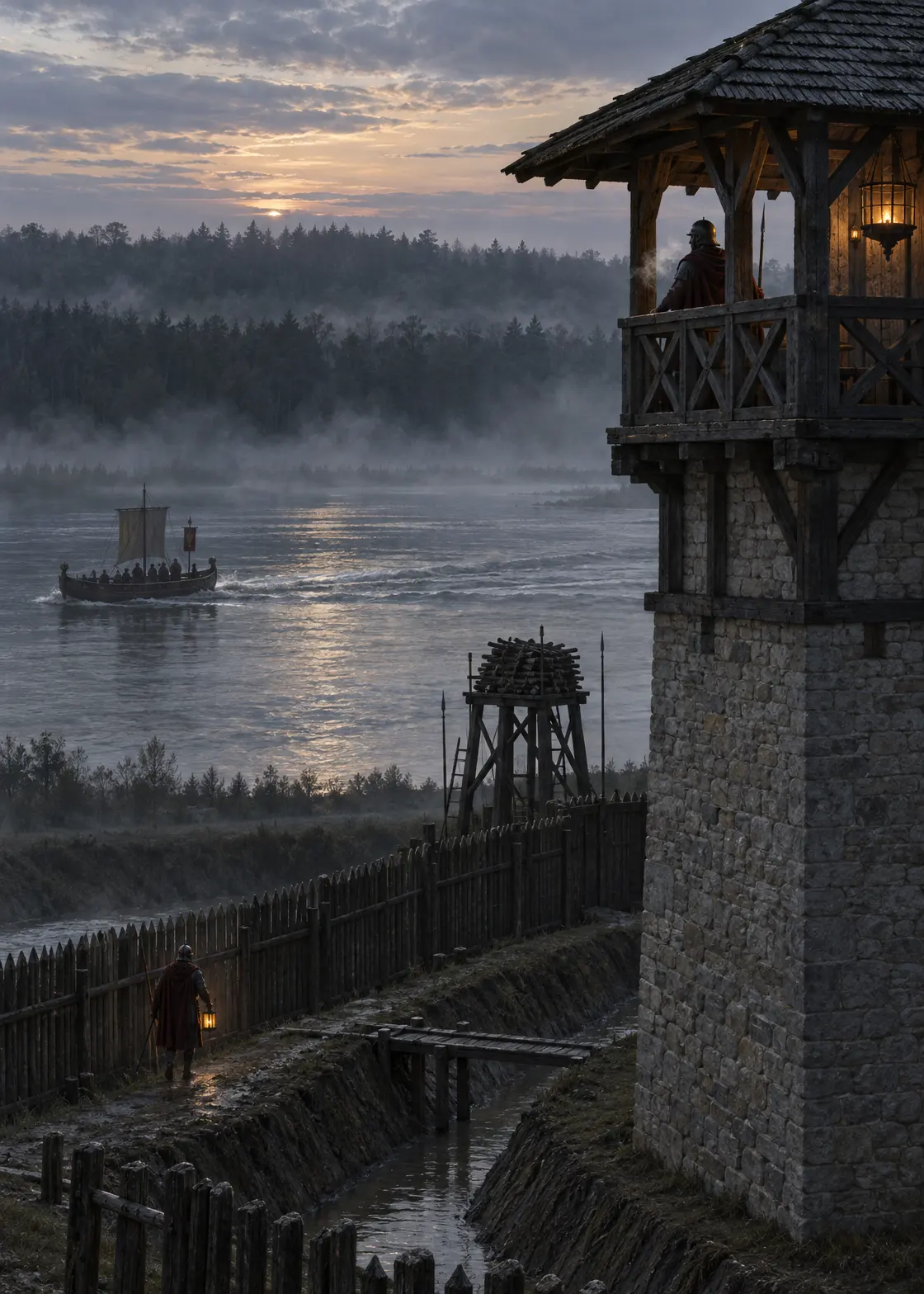
The strategic frame changed with the instrument. The Republic had campaigned; the Principate garrisoned. Across this century the reader will watch the improvised commands of the civil wars settle into a permanent geography — eight legions on the Rhine at the century's opening, the weight shifting decade by decade toward the Danube until, at the volume's close, the middle river carries the heaviest concentration of force in the world; three or four legions in Syria facing the one neighbor Rome acknowledged as a power; the garrisons of Spain, Africa, Egypt, and, from 43, Britain — and will watch the frontier itself harden from a direction of march into a built thing: the roads, the timber-and-turf forts rebuilding themselves in stone, the watchtower chains of the limes, the fleets on the Rhine, the Danube, the Channel, and the ocean. Expansion did not stop — this volume adds Britain, the Alpine and Danubian provinces entire, and, in the negative column, records the deliberate renunciation of Germany — but it became selective, budgeted, and reversible, a matter of imperial choice rather than aristocratic competition, because glory itself had been nationalized with the army that earned it.
The sources for this century are abundant, brilliant, and warped by a single new fact: they were written under the monarchy they describe. The greatest of them stated the problem himself, at the head of the greatest of them: after Actium, Tacitus wrote, the great minds went away; the historians of the new age wrote in ignorance of a public business now transacted behind doors, or in servility while the dynasts lived, or in hatred once they were safely dead — and his own program, to write sine ira et studio, without anger and without partisanship, is to be honored as an ambition and audited as a claim, for the Annals and Histories that anchor this volume are also the most powerful prosecution briefs ever drafted against a form of government. The Editor's Notes will therefore work a source-field of a new shape. Contemporary and eyewitness material stands at every major node: Velleius Paterculus, who commanded cavalry under Tiberius on the Elbe and in the Pannonian emergency and wrote it up as a courtier — AGrade A eyes, DGrade D independence; the elder Pliny's lost German Wars, visible beneath Tacitus's northern books; Josephus, who commanded a rebel district of Galilee, surrendered at Jotapata, prophesied to Vespasian, and composed the Jewish War in the conqueror's household — the volume's supreme case, after Caesar, of the AGrade A author-is-subject source requiring audit at every line; the Res Gestae posted in bronze; the arches, the columns, the diplomas, the coins. Above them stand the great narrative structures — Tacitus's Annals (AD 14–68, with its wounds: the lost books that took Caligula and the rise of Sejanus with them) and Histories (of which the surviving quarter covers, providentially, exactly the convulsion of 69–70); Suetonius with his archive access and his appetite; Cassius Dio, whose books for this period reach us partly whole and partly through Byzantine epitome. And beneath everything, this century for the first time, stands an archaeology rich enough to talk back: the battlefield of the Teutoburg identified at Kalkriese and excavated sling-bullet by mule-bell; the siege-works and ramp at Masada with the ostraca bearing the defenders' names; the legionary fortresses from Inchtuthil to Vindonissa; and — the period's quiet documentary miracle — the waterlogged writing-tablets of Vindolanda, on which the small change of frontier soldiering in the 90s survives in ink: strength reports, beer requisitions, a commandant's wife inviting her friend to a birthday party. The volume will use the spade as a control on the stylus throughout, and will flag, chapter by chapter, which of them is speaking.
A last word on the volume's emotional register, in the spirit of the warnings previous Proems have given. The darkness here is of a different kind than Book V's. That volume narrated a political community destroying itself; this one narrates a functioning world-state doing deliberately, with budgets and engineering, the things world-states do: the pacifications that emptied the Asturian valleys, the punitive economics of the German campaigns, a queen flogged and a province burned for it, the longest and most terrible siege in Roman history conducted against a city at festival-time, and the physics of the limes itself, which made the frontier a machine for converting the world beyond it into the world behind it. The compendium's method does not change: the sources speak, the grades are assigned, the gaps are confessed. But the reader should mark that in this volume, for the first time, one of the conquered peoples keeps its own record — Josephus wrote for the Flavians, but he wrote as a Jew, and through him a subject nation of the empire describes from inside what every other conquest in this series has suffered in silence — and the Editor has weighted the apparatus accordingly.
Let us begin where the last volume ended: in Egypt, in the first year of the peace, where the new master of the world is organizing his inheritance, and where the first war of the new age is already being prepared — not by the Senate, which will never again declare one that matters, but by a man examining maps of Spain.