Book VII · The High Empire and the Long Crisis
Chapter 1
The Dacian Wars of Trajan
The Unfinished Kingdom
The war was inherited before it was chosen. The settlement of 89, graded in the last volume as pragmatism purchased at usurious interest, had left Decebalus precisely what the Flavian emergency required and the Trajanic empire could not tolerate: a client-king with subsidies, Roman engineers, and fifteen years to spend both — a Carpathian state whose mountain ring around Sarmizegetusa Regia had been refortified in cut stone by men trained under the eagles, whose army had absorbed Roman drill and Roman deserters, and whose diplomacy ran east among the Sarmatian Roxolani and north among the free peoples with an anti-Roman consistency the intelligence files recorded season by season. Trajan — legate of Upper Germany at his adoption in 97, on the Danube through 98–99 reorganizing roads, fleets, and the towpath cut into the Iron Gates gorge whose inscription still overhangs the river — prepared the reckoning with the deliberation of a man who had decided the arcanum of 89 must be reversed in public: the subsidies stopped; the concentration assembled, perhaps nine or ten legions' worth with auxilia and the new specialist units the Column shows (Moorish horse under their prince Lusius Quietus, Syrian archers, the armored cataphracti answering the Sarmatian fashion); and in March 101 the emperor crossed the Danube on twin pontoon bridges with the largest Roman field force since the civil wars. Of this war the writing has perished — Trajan's own commentaries survive in one clause, inde Berzobim, deinde Aizi processimus, five Latin words of an emperor's prose left like a single vertebra of a vanished spine — and the reconstruction that follows reads, as the Proem warned, the stone: the Column's spiral, unwound scene by scene as the campaign's storyboard; the Adamclisi trophy's brutal provincial metopes; and the archaeology of the siege-works in the mountains.
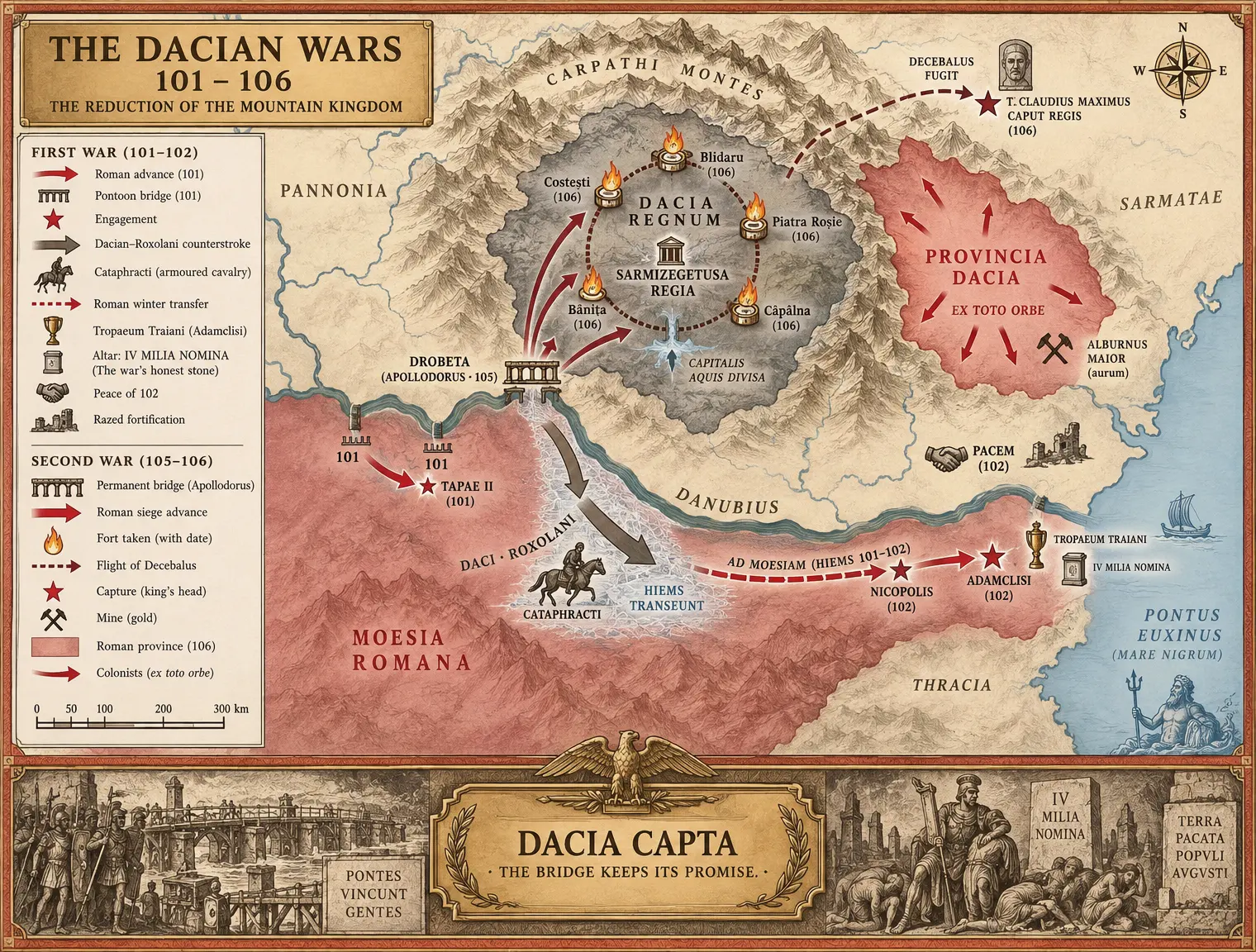
The first war (101–102) taught both commanders the shape of the second. Trajan advanced methodically up the Banat corridor — the Column's opening spirals are all engineering, ramparts and bridges and forts rising in ordered sequence, the army building its way toward an enemy who declines to appear — and met the Dacian main strength at the second battle of Tapae, at the approaches to the Iron Gates of Transylvania: a bloody, storm-broken Roman victory the tradition marks with the emperor tearing his own wardrobe into bandages, and with a thunderstorm the Dacians read as their sky-god's displeasure. Decebalus answered with the war's masterstroke: as winter closed the passes, he loosed the war across the frozen lower Danube — Dacians and Sarmatian Roxolani cataphracts pouring into Moesia behind the emperor's front, the counterstroke of a king who had studied his enemy's habit of assuming winter belonged to Rome. Trajan's response was the campaign's decision: the field force shipped and marched east down the river at winter speed, the invasion caught and broken in two battles — the second, near the future Nicopolis, remembered in the name the emperor gave the city he founded on the field — and at Adamclisi in the Dobruja, where the fighting reached an intensity the metopes render with none of the Column's classical composure: chain-scythed Sarmatian riders, Dacian falx-men in wolf-standards, legionaries in the reinforced arm-guards and crossed helmet-bracing the falx had taught the armories to issue. There Trajan raised, beside the great trophy dedicated to Mars the Avenger in 109, an altar inscribed with the names of some four thousand Roman dead — the largest casualty list in the empire's epigraphy, and AGrade A witness that the Dacian wars were not the parade the Column's serenity performs. The campaign of 102 converted the winter's victory into siege-progress up the Olt and through the passes; the mountain forts of the Orăștie ring began to fall to escalade and blockade — the Column shows the auxilia doing the assault-work, legions building — and Decebalus sued. The peace of 102 was Flavian in form and Trajanic in content: the king kept his throne and lost his war-making apparatus — walls to be razed, engineers and deserters surrendered, foreign policy Roman — and a permanent bridgehead remained: the stone piers of the great bridge Apollodorus of Damascus threw across the Danube at Drobeta, twenty piers over a kilometer of river, the longest bridge the ancient world ever built, whose stumps still stand in the water and whose meaning required no inscription. A bridge is a promise of return.
The Second War and the End of Dacia105–106
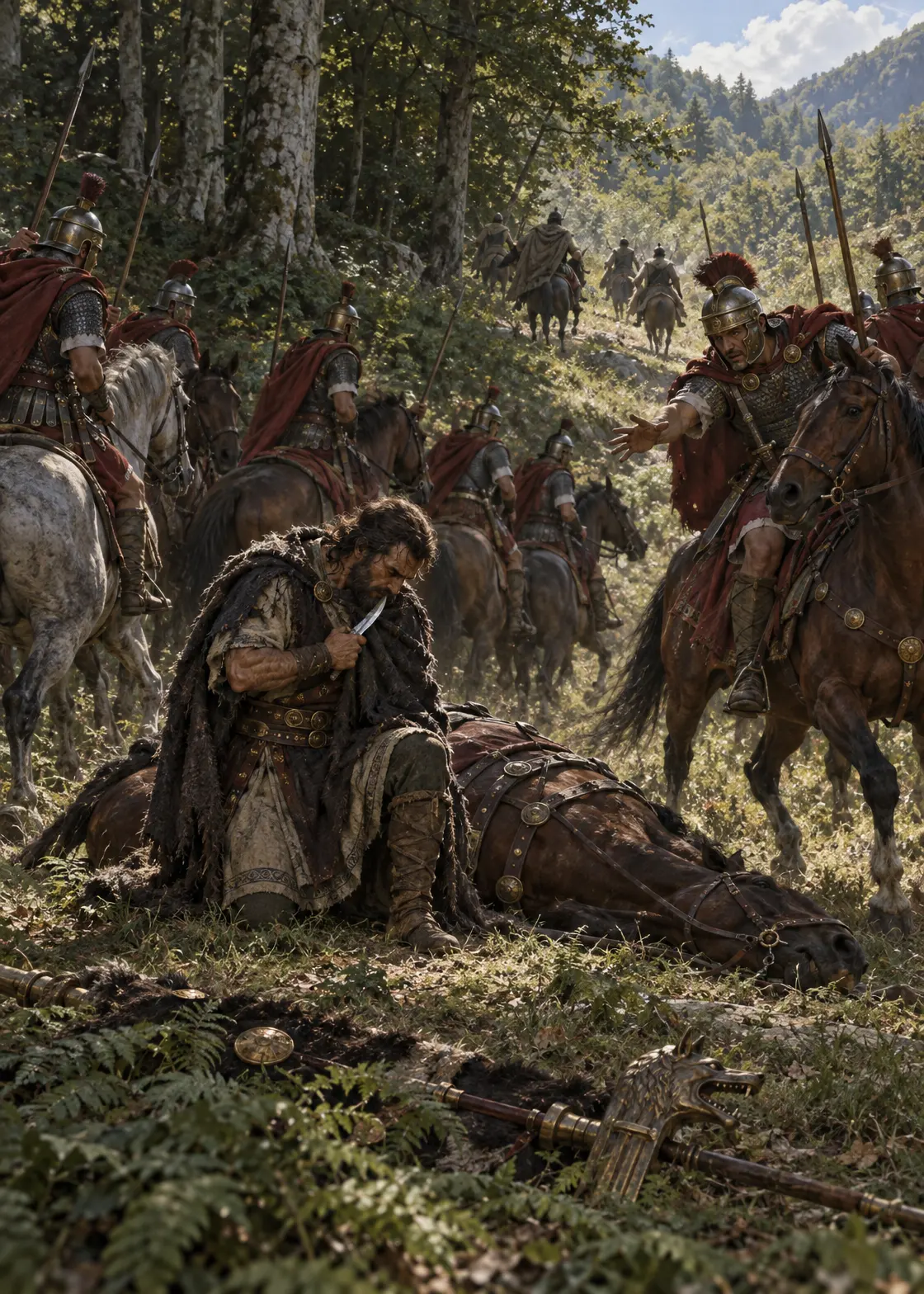
Both parties treated the peace as an armistice, and the sources — Dio's epitome here supported by the Column's second spiral — assign the breach to the king: the walls rebuilt, the deserters re-welcomed, the Iazyges attacked, the neighboring peoples pressed into a final coalition, and in 105 the war reopened with a Dacian surprise offensive that overran the Roman garrisons north of the river and, in the tradition Dio preserves, came within one forged safe-conduct of ending it — the captured Roman officer Longinus, held as a bargaining counter against the emperor's advance, closing the question by poison procured through his own freedman, a suicide the compendium sets beside Regulus in its small ledger of the discipline of captives. Trajan came back in 106 with the bridge under his feet and the patience gone. The second war was conquest, not chastisement: the Orăștie mountain ring reduced fortress by fortress — Costești, Blidaru, Piatra Roșie, the excavated burn-layers dating themselves to the season — the capital Sarmizegetusa Regia invested, its water-line cut (the Column shows the pipes being broken), stormed and razed to its foundations so thoroughly that its site reverted to forest until modern archaeology; the king's flight north with his cavalry, the Roman pursuit, and the end the compendium can document as it can document almost nothing else in this reign, because the man who made the capture wrote it on his tomb. Tiberius Claudius Maximus, a Philippi-born cavalryman risen through two wars to duplicarius, ran Decebalus down with his troop at the forest's edge; the king, ringed, drew the curved sica across his own throat; Maximus took the head and the right hand to the emperor at Ranisstorum, was decorated a second time, and retired at last in Macedonia under a stele — recovered at Grammeni in 1965 — that carves the scene in relief above the career: the rider, the falling king, the reaching hand. The head was thrown on the Gemonian stairs at Rome, where this compendium last stood with Vitellius; the royal treasure, betrayed by a courtier, was raised from the riverbed of the Sargetia where captives had buried it — the figures in the tradition (165 tons of gold, 331 of silver) are the ancient world's largest booty-claim, and the Editor prints them as claim while noting that the coin-output and building-programs of the following decade are their partial audit. Dacia became a province — the one great trans-Danubian exception to the Flavian frontier logic, planted with colonists ex toto orbe Romano, its mines under imperial procurators within the decade (the wax tablets of Alburnus Maior, miners' contracts in vulgar Latin, are the conquest's ground-floor paperwork) — and Rome celebrated for 123 days, with ten thousand pairs of gladiators, while Apollodorus laid out the Forum, the markets, and the Column whose hundred-and-fifty-five spiral scenes are at once the war's monument, its only surviving narrative, and — the Editor's closing grade for the whole chapter — the most magnificent primary source in this series that must never once be mistaken for a neutral one.
The Crossroads · Winter 101–102 · The Banat corridor and the approaches to the Iron Gates of Transylvania
The Winter Counterstroke
You are Trajan, Roman emperor and supreme commander of the legions along the Danube frontier.
After forcing your way up the Banat corridor and winning a costly victory at Tapae, winter has sealed the high passes leading to Sarmizegetusa Regia. As your legions prepare to winter in place, King Decebalus strikes an unexpected blow. Dacian forces and armored Sarmatian Roxolani cataphracts have crossed the frozen lower Danube into Moesia, attacking deep behind your front lines and threatening the settlements of Roman subjects who look to your legions for survival.
How do you respond to the enemy invasion across the frozen Danube into Moesia?
Weigh each course: open it to hear your own inner voice. Then decide. Nothing is scored.
- Your inner voiceThe course taken
The king has staked his best warriors on a desperate diversion far downriver, leaving his mountain sanctuary vulnerable. If we push through the snowbound passes now, we strike directly at Sarmizegetusa Regia before he can return to save it. It will cost heavily in cold and frostbite among the high ridges, but taking the royal forts could end the kingdom in a single blow, rendering the raid into Moesia entirely moot.
- Your inner voiceThe course taken
Winter belongs to no man, and moving nine or ten legions across hundreds of miles of frozen terrain invites catastrophe. We have built strong ramparts and forts throughout the Banat; we should hold them securely. The garrisons along the Danube and within Moesia must delay and bleed the raiders until thawing rivers trap them against our relief columns in the spring. We must not let panic dictate our strategy.
- Your inner voiceThe course taken
If I strip the front and drive my legions downriver through winter ice, I risk exhaustion and frozen supply lines before we even engage. Yet Moesia burns behind us. Rome cannot abandon provincial subjects to the Sarmatian lances and the Dacian falx while her emperor sits idle in winter quarters. I must move by fleet and forced march, catch them before they scatter, and crush this diversion where it lands.
What was done
Trajan chose the winter march, stripping his mountain front to embark and march the field force east down the Danube at winter speed. The gamble caught the invaders before they could consolidate. The Roman army intercepted and broke the invasion in two separate engagements: the first near the future site of Nicopolis, and the second at Adamclisi in the Dobruja. At Adamclisi, Roman legionaries in reinforced arm-guards and crossed helmets clashed with chain-scythed Sarmatian riders and Dacian falx-men in fighting of extreme savagery. There, beside the great trophy dedicated to Mars the Avenger in 109, Trajan raised an altar recording approximately four thousand Roman dead — the largest casualty list in the empire's epigraphy (AGrade A). Having broken the king's counterstroke, Trajan used the spring of 102 to reduce the mountain forts of the Orăștie ring, forcing Decebalus to sue for peace and accept a permanent Roman bridgehead at Drobeta.
The evidence The Editor's Note assigns AGrade A to the material monuments that attest this phase: Trajan's Column, whose relief spirals visually depict the river transport and campaign mechanics (discounting its artistic serenity), and the Adamclisi complex in the Dobruja, whose altar with its casualty list of roughly 3,800 names provides AGrade A material proof of the battle's ferocious cost. The literary sequence relies on Cassius Dio (68.6–14) preserved through Xiphilinus's epitome (BGrade B/C). Trajan's own commentaries survive only in a single five-word fragment (AGrade A), while operational sequences within campaigns receive BGrade B because the Column's order is compositional rather than diaristic.
If you choose to walk through itAt every scale
- Yourself
How does a commander balance his personal ambition for a decisive conquest against the immediate dread of losing thousands of his own soldiers to frostbite, river wreck, and winter ambush?
- Those beside you
What do you owe to the officers, auxiliary cavalry, and legionary comrades whom you must drive into forced winter marches and vicious close-quarters fighting against falx and lance?
- Rome
Does the credibility of the empire depend more upon protecting the lives and property of provincial subjects in Moesia or upon preserving the core field army from ruinous winter attrition?
- The wider world
How does a violent counter-offensive across a frozen river reshape the calculations of bordering kingdoms and allied peoples watching to see if imperial hegemony can be shattered?
- Our own time
When an adversary stages a sudden, asymmetrical diversion far behind an advancing front, how should modern defense planners weigh defending vulnerable rear areas against maintaining offensive momentum?
In December 1944, Allied forces preparing an offensive into Germany were surprised by a massive German winter counter-offensive through the forested Ardennes, striking deep behind the front lines. Rather than pausing or falling back, Allied command executed a rapid operational pivot: Third Army halted its eastern advance, wheeled ninety degrees in sub-zero winter weather, and marched north at breakneck speed across snowbound roads to strike the flank of the penetration and relieve the besieged crossroads at Bastogne.
Where the comparison fails. The comparison fails because modern mechanized logistics, aerial reconnaissance, and motorized transport permitted rapid repositioning across hundreds of miles within days, whereas Trajan's forced movement depended entirely on oars, sails, and marching boots through freezing mud without radio communication or real-time intelligence.
What does the chapter tell us?
What archaeological evidence provides AGrade A witness to the heavy Roman casualties suffered during the winter fighting in Moesia and the Dobruja?
At Adamclisi in the Dobruja, Trajan raised an altar inscribed with approximately four thousand Roman dead beside the trophy dedicated to Mars the Avenger in 109. The chapter grades this epigraphy as a AGrade A witness that the wars were far bloodier than the Column depicts.
Adamclisi altar (AGrade A)
Why was the political settlement of 89 under Domitian regarded by the Trajanic administration as an intolerable arrangement?
The settlement of 89 left Decebalus as a client-king equipped with Roman subsidies and engineers. Over fifteen years, he refortified Sarmizegetusa Regia in cut stone, absorbed Roman deserters, trained his army in Roman drill, and pursued an anti-Roman diplomacy with neighboring peoples.
the chapter's narrative
How does the chapter verify the specific circumstances of King Decebalus's death in 106?
The funerary stele of Tiberius Claudius Maximus, found at Grammeni in 1965, provides AGrade A author-is-subject epigraphy. The relief and inscription record how Maximus pursued Decebalus to the forest edge, where the king slit his own throat with a curved sica before capture.
Tiberius Claudius Maximus stele (AE 1969/70.583, AGrade A)
What primary function did the stone bridge built by Apollodorus of Damascus at Drobeta serve following the peace of 102?
Apollodorus threw a bridge of twenty stone piers over a kilometer across the Danube at Drobeta. The chapter notes that the peace of 102 left this permanent bridgehead intact as an unwritten, physical guarantee that Rome could and would return across the river.
the chapter's narrative
What critical limitation does the Editor's Note assign to Trajan's Column as a historical source for the Dacian Wars?
While graded A as contemporary visual material, the Column is simultaneously AGrade A imperial propaganda. Its 155 scenes are arranged for compositional impact rather than strict chronological diary (BGrade B for operational sequence), displaying a classical serenity that must not be mistaken for neutral reporting.
Trajan's Column (AGrade A / B)