Book VII · The High Empire and the Long Crisis
Chapter 2
The Eastern Maximum and the Great Recoil
The Parthian War of Trajan
The last war of Trajan was the empire's high-water mark and the first demonstration of its tide-tables, and the Editor states at the outset the source-poverty that makes its interpretation the oldest open argument in Roman studies: Dio's epitomated book 68 and scattered fragments are nearly all the narrative there is, and Dio himself already framed the question — whether the war was strategy (the Armenian buffer subverted when the Parthian king crowned a nephew at Ctesiphon's pleasure without Roman investiture, the Neronian settlement of Book VI thereby torn up) or appetite, the desire for glory of a sixty-year-old soldier-emperor with Alexander's itinerary in his head. The operations, as far as the fragments carry them: 113–114, Armenia entered from the Cappadocian bases Vespasian had built, the crowned nephew Parthamasiris presenting himself at Elegeia to receive his diadem back in the Neronian choreography — and receiving instead annexation, the kingdom declared a province, the prince dead days later "attempting escape" in the phrase the compendium has learned across six volumes to grade; 115, the descent into Mesopotamia, Nisibis and Batnae taken, Edessa's client-king Abgar charmed into submission by his own son's diplomacy, northern Mesopotamia organized as a second new province while the Parthian realm, deep in one of its dynastic civil wars, could not concentrate; 116, the maximum year — the Tigris crossed on a prefabricated boat-bridge hauled overland in sections from Nisibis, Adiabene overrun as a third province (Assyria, the shortest-lived name in the imperial roster), the twin capitals Seleucia and CTESIPHON taken, the Arsacid golden throne captured with the king's daughter, the emperor sailing the lower rivers to the Persian Gulf — where, watching a merchantman clear for India, he spoke the sentence Dio preserved as the whole campaign's epitaph: that were he younger, he would have crossed to the Indus as Alexander had. He was the first and last Roman ruler to stand on that shore.
The recoil began before the fleet had left the Gulf. The conquest had been a raid wearing a province's paperwork — garrisons thin, communications enormous, the Parthian field armies traded space rather than dying — and in 116 the whole occupied East rose at once behind the emperor: the Parthian counteroffensive under the king's nephew Sanatruces and son Osroes's generals retaking the Tigris line, Seleucia and Edessa and Nisibis in revolt, a Roman column destroyed with its general Maximus, the sixty-three-year-old Trajan reduced to firefighting — Lusius Quietus, the Moorish prince whose horsemen the Column had celebrated, storming Nisibis and burning Edessa; Seleucia burned by two other columns; and at Ctesiphon, in the war's most naked scene, the emperor of Rome personally crowning a Parthian client-king, Parthamaspates, before the assembled armies — annexation converted in twelve months to the puppet-diplomacy the annexation had been launched to transcend. The siege of the desert city of Hatra closed the ledger: the walls that would defeat two more emperors defeated this one, the cavalry-country and the flies and the heat breaking the assault, the emperor himself nearly struck by a bolt at the walls; and Trajan, failing visibly — the stroke came at Selinus in Cilicia on the road home, August 117 — died leaving the East in flames, the succession to a rumor, and to his successor the decision the next chapter opens with. The Editor closes the campaign ledger with its modern balance: the war destroyed the Neronian architecture that had kept the East quiet for fifty years, consumed the last offensive surplus of the Trajanic army, and demonstrated — the volume's recurring theorem, proved here at maximum scale — that the Principate's instrument could conquer anything and hold only what it could garrison; the provinces of a single summer were abandoned within a year of their creation, the only such surrender of conquered provinces in Roman history to that hour.
The War Behind the War: The Diaspora Revolt115–117
Entangled with the Parthian recoil, and graver in the modern accounting than the tradition's thin notices admit, ran the second Jewish war — the revolt of the diaspora, the tumultus Iudaicus the rabbis remembered as the War of Kitos. In 115–116, as the emperor stood at the Gulf, the Jewish communities of Cyrenaica, Egypt, and Cyprus rose in a coordinated fury the sources render apocalyptic: in Cyrene under a king-messiah the Greek sources call Lukuas or Andreas, the temples of the Greek gods thrown down (the burn-and-rebuild epigraphy of Cyrene's sanctuaries, dated by Hadrianic restoration inscriptions "destroyed in the Jewish tumult," is the revolt's AGrade A stratum); in Alexandria, reciprocal massacre and the destruction of the great synagogue; in Cyprus, Salamis wrecked with a slaughter the tradition numbers in the six figures the Editor prints only as the tradition's; in Mesopotamia, the Jewish communities joining the general rising against the occupation. The suppression was proportionate to the fear: the marine legions and the generals Marcius Turbo (by sea against Egypt and Cyrene) and Lusius Quietus (in Mesopotamia, with a thoroughness that put his name on the war), the fighting running past Trajan's death; Egypt's papyri carry the aftermath for decades — the confiscated Jewish property accounts, the village lists with the Jewish names gone, an Oxyrhynchus festival still celebrating the victory eighty years on — and Alexandrian Jewry, the diaspora's metropolis since the Ptolemies, never recovered its weight. Cyprus barred Jews from landing on pain of death, by a law the geographers still noted centuries later. The Editor grades the episode as this compendium's starkest case of a great war surviving almost solely in its debris-field — no Josephus this time, no narrative at all beyond epitome-paragraphs, only the burned temple-lists, the papyri, and the silence of communities that had been the Mediterranean's largest — and marks its structural place: with Judaea itself held down by garrison, the diaspora's destruction closed the second act of the tragedy whose third, under the next reign, will close the volume's Jewish file forever.
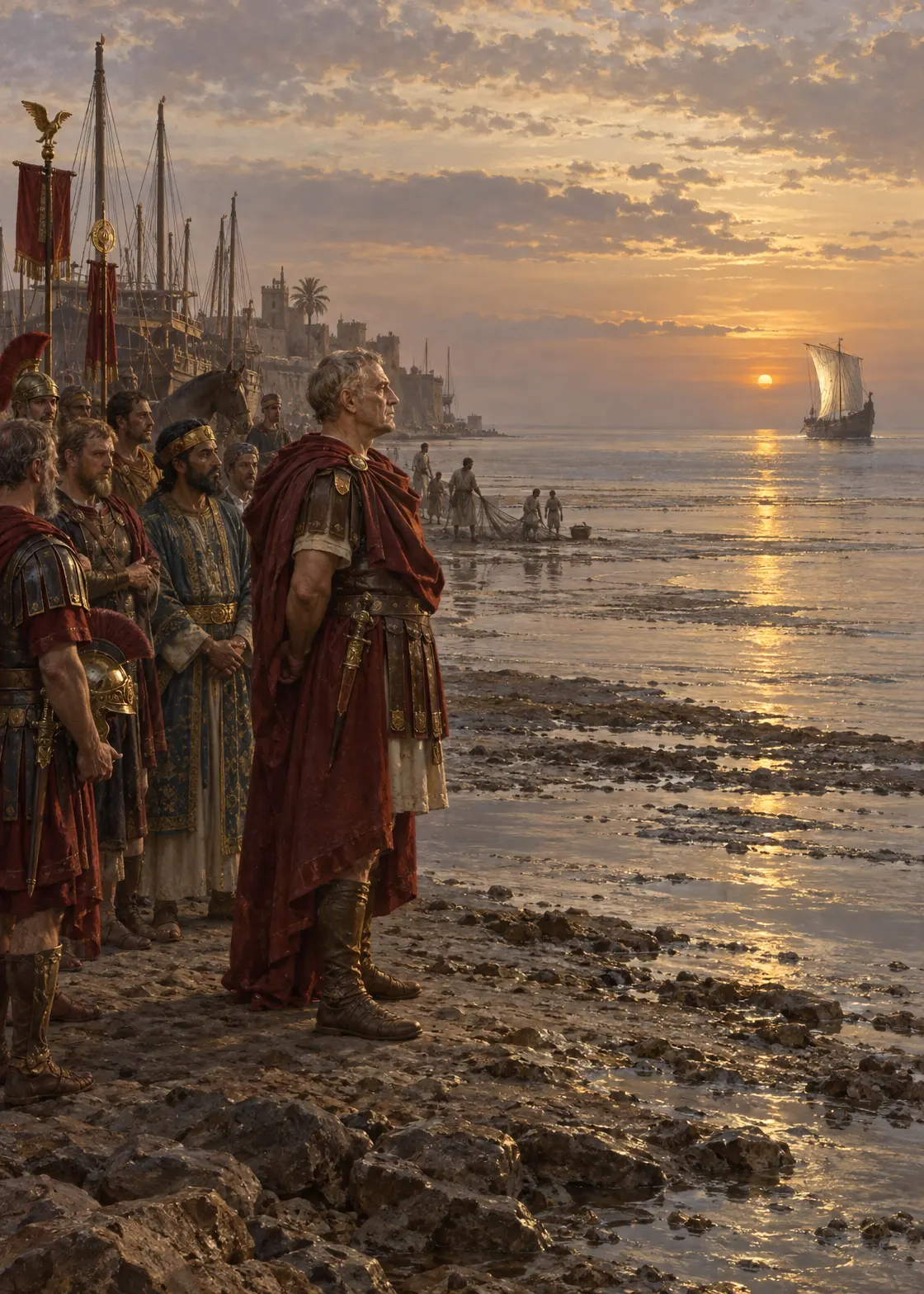
The Crossroads · 116 · Ctesiphon, on the Tigris
The Crown at Ctesiphon
You are the emperor Trajan, sixty-three years old, standing before your assembled legions in the captured Parthian capital of Ctesiphon.
You marched down the rivers, took Seleucia and Ctesiphon, seized the golden Arsacid throne and the daughter of King Osroes, and reached the Persian Gulf. But the recoil has begun. Seleucia, Edessa, and Nisibis have risen in revolt behind you. A Roman column has been destroyed and its general Maximus is dead. Sanatruces, nephew of the Parthian king, leads a counteroffensive along the Tigris line. Your Moorish prince Lusius Quietus is fighting to storm Nisibis and burn Edessa, while reports arrive of Jewish uprisings spreading across Egypt, Cyrenaica, and Mesopotamia. Garrisons are thin, communications are stretched across enormous distances, and you cannot hold southern Mesopotamia as a province while your rear burns.
How will you secure Ctesiphon and the southern rivers while attempting to suppress the revolts across your rear?
Weigh each course: open it to hear your own inner voice. Then decide. Nothing is scored.
- Your inner voiceThe course taken
I did not lead our legions to the Persian Gulf merely to bestow an Arsacid diadem. We captured the golden throne; we declared Mesopotamia and Assyria provinces of Rome. If I surrender Ctesiphon to a client now, imperial prestige dissolves. We must hold this capital with strong garrisons, split our forces to defend the Tigris line, and summon reinforcements, refusing to yield the territory won at such immense cost.
- Your inner voiceThe course taken
I must recognize what our garrisons can hold. Annexing this vast territory directly requires legions I do not possess while Nisibis and Edessa burn. By placing the diadem upon Parthamaspates before the assembled army, I install an Arsacid client to divide our enemies. It frees my soldiers from occupying Ctesiphon and the lower rivers, allowing me to march north to face Sanatruces and relieve Lusius Quietus, even if it surrenders direct provincial rule.
- Your inner voiceThe course taken
Our conquest was a raid wearing a province's paperwork. With Maximus dead, his column destroyed, and revolts spreading through Mesopotamia and Egypt, our thin garrisons invite disaster. Any divided force along the Tigris will be cut off and annihilated. We should burn Ctesiphon, concentrate every cohort, and conduct an orderly retreat to Vespasian's Cappadocian bases. It preserves the legions intact, though it surrenders every gain of the last three summers.
What was done
Trajan chose to invest a client-king. At Ctesiphon, before the assembled armies, the emperor personally crowned the Arsacid prince Parthamaspates with the diadem, converting direct annexation into client-diplomacy (attested by the REX PARTHIS DATUS coinage, AGrade A). Trajan then turned north to quell the spreading insurrection. Lusius Quietus stormed Nisibis and burned Edessa, while two other Roman columns burned Seleucia to crush its revolt. Yet the counteroffensive led by Sanatruces and the generals of Osroes pressed the Tigris line, while the diaspora revolt consumed Cyrenaica, Egypt, and Cyprus (AGrade A material stratum). Trajan's subsequent assault on the desert walls of Hatra was broken by cavalry, heat, and flies. Stricken by illness on the road home at Selinus in Cilicia, Trajan died in August 117, leaving the East in flames and his short-lived provinces to be abandoned by his successor (AGrade A).
The evidence Cassius Dio 68.17–33 in Xiphilinus's epitome and Excerpta fragments (BGrade B for campaign course, CGrade C for motives and councils); the REX PARTHIS DATUS and PARTHIA CAPTA coinages (AGrade A for imperial puppet-diplomacy); Arrian's lost Parthica (BGrade B fragments); and Eutropius and Festus summarizing the Kaisergeschichte (CGrade C). For the simultaneous recoil across the diaspora, Cyrene's destruction-and-restoration epigraphy and Egyptian papyri provide AGrade A material documentation.
If you choose to walk through itAt every scale
- Yourself
How does an aging commander who dreamed of Alexander's march to the Indus bear the personal humiliation of replacing imperial annexation with a client prince?
- Those beside you
What did commanders like Lusius Quietus and the veteran legionaries think when ordered to burn cities like Edessa and Seleucia which they had only recently conquered?
- Rome
Can the Principate sustain its imperial prestige when forced to admit publicly that its military surplus cannot garrison the distant territories it overruns?
- The wider world
How did the peoples of Mesopotamia and the Arsacid realm view a puppet ruler crowned by Roman arms while the occupying legions were already retreating?
- Our own time
When an occupying power finds direct governance unsustainable, what lasting hazards emerge from installing an allied surrogate to cover an operational withdrawal?
A powerful military state invades an adversary's territory to overthrow its regime and impose direct administrative control, but quickly faces widespread urban insurrections, severed supply lines, and mobile counterattacks. Recognizing that its garrison strength is insufficient to police the entire country, the invading government stages an expedient transfer of authority to a compliant local ruler, attempting to declare political victory while its combat formations fight rear-guard actions to withdraw.
Where the comparison fails. Trajan commanded an ancient empire with no mechanized transport, telecommunications, or mass media, where movements depended on foot marches and boat-bridges. Furthermore, Roman decisions rested entirely on an autocratic soldier-emperor without modern legal charters, sovereign treaties, domestic parliaments, or international alliances.
What does the chapter tell us?
What previous diplomatic arrangement was discarded when Trajan annexed Armenia as a province at Elegeia in 114?
Parthamasiris came to Elegeia expecting the traditional Neronian investiture, where Rome granted the diadem to an Arsacid prince. Instead, Trajan annexed Armenia outright, breaking the fifty-year diplomatic framework that had maintained eastern stability.
Cassius Dio 68.17–33 (BGrade B/C) and the chapter's narrative.
Why did the Roman provincial annexation of Mesopotamia collapse into general rebellion in 116?
The chapter notes that the conquest was a raid wearing a province's paperwork: Roman garrisons were thinly spread over vast distances, communications were enormous, and the Parthian armies gave up territory rather than fighting to destruction, leaving them intact to counterattack.
The chapter's narrative (BGrade B).
Which piece of AGrade A contemporary evidence records Trajan's installation of Parthamaspates at Ctesiphon?
The Editor's Note identifies the REX PARTHIS DATUS ('a king given to the Parthians') coinage as AGrade A minted confession of the war's terminal diplomacy, commemorating the moment Trajan crowned Parthamaspates client-king before the legions.
Coinages 114–117 (AGrade A).
What primary evidence supports the catastrophic destruction of the Diaspora Revolt (115–117)?
With no contemporary narrative surviving, the Diaspora Revolt is documented primarily through its debris-field: AGrade A epigraphy in Cyrene recording temples destroyed in the Jewish tumult, alongside Egyptian papyri listing erased Jewish property and village names.
Cyrene inscriptions and Egyptian papyri (AGrade A, material).
Which desert city's walls successfully repelled Trajan's assault during the recoil of 116–117?
Trajan's siege of the desert city of Hatra failed when cavalry-country, intense heat, and flies broke the Roman assault, with Trajan himself narrowly missing injury from a missile fired from the walls.
Cassius Dio 68.31–32 (BGrade B/C) and the chapter's narrative.