Book VII · The High Empire and the Long Crisis
Chapter 3
Hadrian: The Wall, the Army in Being, and the Last Jewish War
The Renunciation and the Perimeter
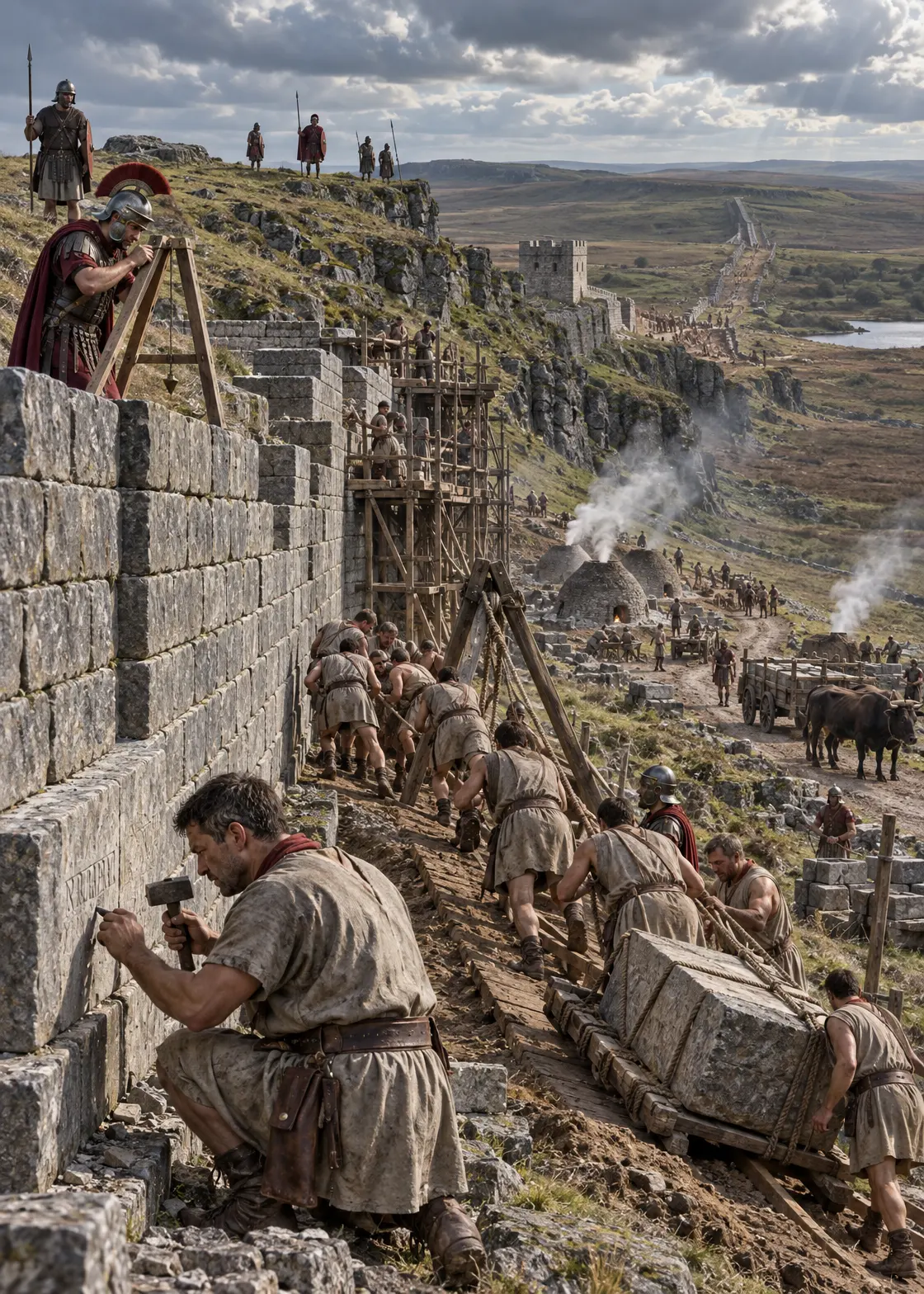
The reign opened with the volume's first great strategic decision, taken in weeks and defended for a lifetime: Hadrian — Trajan's ward, cousin, and legate of Syria, his adoption announced from the deathbed chamber with a timing his enemies never stopped auditing — abandoned the eastern conquests entire. Armenia reverted to client-kingship, Mesopotamia and Assyria were evacuated, Parthamaspates was compensated with Osrhoene's edge, and the Euphrates resumed its old office; within the year the reign's dangerous men — Lusius Quietus dismissed from his Moorish command and killed with three other consulars in the affair of the "four ex-consuls" that stained the accession — were gone, and the new policy had its manifesto in the new coinage's grammar: not CAPTA but DISCIPLINA AUGUSTI, not conquest but the army itself as the advertised achievement. The Editor grades the renunciation as the sources could not agree to: the fourth-century epitomators transmit the criticism (envy of glory, betrayal of the dead emperor's gains), the modern strategic literature largely the defense (the conquests were unfundable, the revolt-fires still burning, the Danube stripped), and the reign's own answer was built rather than argued — the twenty-one-year conversion of the empire's edge from a direction into a thing. Hadrian spent more of his reign with the frontier armies than any emperor before him, and the perimeter he toured he fixed: in Germany, the continuous oak palisade thrown along the limes line — the empire's first unbroken artificial frontier, hundreds of miles of split trunks whose post-trenches archaeology still sections; in Africa, the fossatum's desert ditch-and-wall; and in Britain, from Tyne to Solway, the work that bears the name: eighty Roman miles of stone and turf, mile-castles and turrets at engineered intervals, sixteen forts, the great ditch and the rearward vallum zone — a system, not a rampart, built by the legions whose centurial quarry-and-course inscriptions sign it foot by foot, and whose purpose (the one sentence of the Historia Augusta the archaeology endorses: to separate the Romans and the barbarians) was less to stop armies than to convert movement itself into an administered thing: the gate, the toll, the patrol, the watched economy of a managed exterior. The compendium marks the world-historical hinge without ceremony: with Hadrian, the empire of expansion formally became the empire of the perimeter, and every war in the rest of this series is fought either on that perimeter, over it, or — increasingly — behind it.
The instrument the perimeter enclosed he drilled to its historical peak. The reign's military texture survives in a document this compendium ranks with the Vindolanda letters as AGrade A voice-of-the-institution: the Lambaesis inscriptions of 128 — the emperor's own review-speeches to the Third Augusta and its auxilia, carved on the parade-ground column base in Numidia — Hadrian addressing cohort by cohort, praising a wall built in a fraction of standard time with stones of a size others would balk at, excusing a cavalry unit whose maneuvers lost polish because their strength had been drafted away, criticizing an over-daring charge with the review-ground maxim that where the ground demands, art must supply — the commander-in-chief as inspecting professional, fluent in the trade's smallest grammar. Under that regime the army of the 120s–130s was the finest peacetime force of antiquity — and the reign's one great war demonstrated what the volume's thesis requires: that its tests now came from within the perimeter as readily as beyond it.
Bar Kokhba132–136
The third Jewish war was the worst, and the least narrated. Its causes the sources split as they split Trajan's motives — Dio's epitome gives the refoundation of Jerusalem as the colony Aelia Capitolina with a temple of Jupiter on the Temple's site; the Historia Augusta a ban on circumcision; the rabbinic tradition its own martyrology — and its leader steps out of the epitomes' anonymity only through the volume's most literal AGrade A stratum: the letters. Shim'on ben Kosiba — Bar Kokhba, "son of the star," in the messianic reading his coinage's iconography endorses; Bar Koziba, "son of the lie," in the tradition that survived him — commanded a prepared insurgency: the underground hideout-complexes honeycombing the Judaean hills (excavated by the hundred: ventilation-shafted, water-stored, connected by crawl-tunnels — a countryside pre-fitted for war beneath its villages), a rebel administration minting over-struck denarii ("Year One of the Redemption of Israel," struck across the emperor's face), and a chain of command whose actual field-orders, on papyrus in Hebrew, Aramaic, and Greek, came out of the Cave of Letters in Yadin's 1960–61 seasons: the commander's own dispatches — requisitions of wheat and salt, a shipment of the four festival species for Sukkot in wartime, and the discipline of a hard-pressed chief ("I call heaven to witness... I shall put you in chains") — the only rebel commander's correspondence surviving from the ancient world. The war itself must be read from Dio's four epitome-paragraphs and the ground: no field battles — the insurgency declined them — but a countryside war of posts and tunnels that mauled the garrison beyond anything the tradition dared total (the XXII Deiotariana vanishes from the army lists in this generation, its fate probable and unproven; the war-diplomas show drafts converging from the whole empire); Hadrian summoned his best, Julius Severus from Britain, who conducted the reduction Dio describes in the passive voice of extermination — the strongpoints starved and stormed severally, fifty of them, and 985 villages razed, 580,000 rebels killed by the sword "and of those who perished by famine and disease no man could number"; the last act at Betar, the fortress southwest of Jerusalem where ben Kosiba died in the fall of 135/136, and in the refuge-caves above the Dead Sea, where the archaeology closes the file in its own medium — the Cave of Horror's starved skeletons under the cliff the garrison camped upon, and beside the Bar Kokhba letters in the Cave of Letters the bundled archive of Babatha daughter of Shim'on, a propertied widow's deeds, marriage contract, and lawsuits carried into the dark and never carried out: the war's civilian epitaph in one refugee's handbag. The sequel was erasure as policy: Judaea renamed Syria Palaestina, Jews barred from Aelia and its district on pain of death, the fiscus Judaicus continuing — and the cost acknowledged in the emperor's own dispatch, in the detail Dio thought worth his epitome: writing to the Senate, Hadrian omitted the formula every reader of this compendium now knows how to weigh — "I and the legions are in health." The Editor closes the chapter's ledger across both its halves: the reign that perfected the army and the wall fought its one great war against subjects inside them, at a price it declined to name; the perimeter, the volume's coming chapters will show, had the same property on its outer face.
The Crossroads · 117 · Syria
The Renunciation of the East
You are Hadrian, legate of Syria and Trajan's ward and cousin, newly acclaimed emperor following Trajan's death.
Trajan is dead, and your adoption announced from the deathbed chamber faces deep suspicion from rival commanders. The late emperor's eastern campaigns annexed Armenia, Mesopotamia, and Assyria, but these conquests are engulfed in revolt-fires and remain unfundable. Holding them drains resources while the Danube frontier has been stripped of troops. Formidable military men like Lusius Quietus watch your accession closely, ready to view any retreat as betrayal.
How will you resolve the eastern conquests and set the strategic posture of the empire?
Weigh each course: open it to hear your own inner voice. Then decide. Nothing is scored.
- Your inner voiceThe course taken
Evacuate Mesopotamia and Assyria completely, return Armenia to a client-king, and draw our line back to the Euphrates, giving Parthamaspates only Osrhoene's edge. The conquests are unfundable, revolt-fires still burn behind us, and the Danube has been dangerously stripped. The commanders will call it envy of Trajan and betrayal of his glory, but my duty is to preserve the legions and harden our perimeter, not bleed them away in endless sands.
- Your inner voiceThe course taken
Seek a middle course by retaining Armenia under direct Roman command while withdrawing from the south. Mesopotamia and Assyria are engulfed in revolt and impossible to garrison, but Armenia secures our northern flank and preserves a visible triumph of Trajan's campaigns. Parthamaspates can be left to defend what he can along the river. Yet half-measures may satisfy no one: the legions remain divided, the Danube stays under-strength, and our enemies will still smell weakness.
- Your inner voiceThe course taken
Hold every foot of Trajan's gains. We must maintain direct rule over Armenia, Mesopotamia, and Assyria, throwing our legions into extinguishing the revolt-fires wherever they burn. To abandon these lands will invite accusations of cowardice and betrayal from senior commanders like Lusius Quietus, whose loyalty is already fragile after my adoption. Yet keeping these vast territories leaves the Danube exposed to catastrophe, and our treasury may break beneath the strain of perpetual occupation.
What was done
Hadrian abandoned the eastern conquests entire. Mesopotamia and Assyria were evacuated, Armenia reverted to client-kingship, Parthamaspates was compensated with Osrhoene's edge, and the Euphrates resumed its old office. Within the year, Lusius Quietus was dismissed from his Moorish command and killed with three other consulars in the affair of the four ex-consuls that stained the accession—an episode the historical record leaves unresolvable. Fourth-century epitomators criticized the renunciation as envy of glory and betrayal of Trajan's gains, while modern strategic defense stresses that the conquests were unfundable, revolt-fires still burned, and the Danube had been stripped. This debate remains transmitted opinion on both sides, graded as such alongside the political narrative (BGrade B). The new reign turned from conquest to consolidation, striking coins reading DISCIPLINA AUGUSTI and creating engineered frontiers across Britain, Germany, and Africa (AGrade A), fixing the empire of the perimeter.
The evidence The Editor's Note cites fourth-century epitomators for the debate over the renunciation (transmitted opinion on both sides), Cassius Dio 69 epitomated by Xiphilinus (BGrade B), and the Historia Augusta life of Hadrian (BGrade B/C, drawing on Marius Maximus under audit). Hadrian's own autobiography is lost, along with Marius Maximus's original work. The four-consulars affair is designated an unresolvable gap. The physical turn toward perimeter defense and military discipline is attested by AGrade A material evidence: the DISCIPLINA coinage, the German palisade's post-trenches, the African fossatum, and the stone, turf, and centurial quarry-inscriptions of Hadrian's Wall in Britain.
If you choose to walk through itAt every scale
- Yourself
How does a new ruler balance the fear of appearing weak or disloyal to a predecessor's memory against the conviction that imperial survival requires immediate retrenchment?
- Those beside you
How can an untested emperor maintain authority over proud, entrenched commanders who won his predecessor's wars and view strategic withdrawal as personal betrayal?
- Rome
When an empire's military expansion outstrips its revenues and leaves vital frontiers dangerously exposed, should state policy prioritize traditional imperial prestige or fiscal and military sustainability?
- The wider world
What responsibility does an imperial power bear toward client-kings, allied populations, and borderlands when it unilaterally shifts its frontiers and vacates occupied territory?
- Our own time
Under what conditions can modern states terminate long, costly foreign military interventions without compromising their broader security alliances or eroding public trust?
In the mid-twentieth century, post-war powers facing depleted national treasuries, military overstretch, and widespread overseas unrest chose to terminate distant territorial commitments. Governments withdrew from historic bases east of Suez and liquidated expansive colonial garrisons, determining that maintaining distant occupations undermined solvency and left core home defenses vulnerable, even while political critics at home attacked the withdrawals as an abdication of national prestige and global responsibility.
Where the comparison fails. Modern strategic withdrawals are conducted by parliamentary democracies bound by international treaties, public legislative debate, and multilateral alliances. Hadrian operated as an autocrat answering to no parliament, who enforced his sudden strategic reversal through the summary execution of dissenting consular rivals and the unilateral consolidation of imperial borders.
What does the chapter tell us?
What immediate strategic actions did Hadrian take upon assuming power in 117 regarding Trajan's eastern conquests?
The chapter states that Hadrian abandoned the eastern conquests entirely: Armenia reverted to client-kingship, Mesopotamia and Assyria were evacuated, Parthamaspates received Osrhoene's edge, and the Euphrates resumed its traditional frontier role.
the chapter's narrative
According to the chapter, how did Hadrian's coinage advertise the strategic shift of his reign away from Trajan's expansionism?
The text notes that the new policy had its manifesto in coinage grammar: not CAPTA but DISCIPLINA AUGUSTI, advertising the army itself as the achievement rather than foreign conquest.
the chapter's narrative (supported by DISCIPLINA coinage, AGrade A)
What primary function did Hadrian's Wall and the European frontier works serve, according to the archaeology and the text?
As the chapter explains, the purpose of the Wall system was less to stop armies than to convert movement into an administered reality—the gate, the toll, the patrol, and the watched economy of a managed exterior.
Wall and palisade archaeology (AGrade A) and Historia Augusta (BGrade B/C)
Why does the chapter describe the Bar Kokhba war as a controlling anomaly in the volume's source material?
The Editor's Note highlights this controlling anomaly: the war is the best-documented insurgency of antiquity because of surviving rebel letters (such as the Bar Kokhba dispatches), yet it is the least-narrated great war in the literary tradition.
Editor's Note (AGrade A papyri / BGrade B/C Dio)
What detail in Hadrian's official report to the Senate reflected the severe losses suffered by the Roman army during the Bar Kokhba war?
Cassius Dio noted that when Hadrian reported to the Senate, he omitted the standard imperial opening formula, 'I and the legions are in health,' silently acknowledging the war's catastrophic military casualties.
Cassius Dio 69 (BGrade B, epit.)