Book VII · The High Empire and the Long Crisis
Chapter 4
The Antonine Noon and Its Wars
The Reign Without a Campaign
The twenty-three years of Antoninus Pius are the emptiest chapter in this compendium and the most important negative datum in it. An emperor who never in his reign left Italy, who commanded no army in person, celebrated no triumph he had earned, and whose military record the epitomators dispose of in clauses, presided over the longest stretch of interior peace the Mediterranean world ever knew — and the Editor's first task is to demonstrate that the peace was administered rather than merely enjoyed, because the frontier record, read from stone, is continuously busy. In Britain the reign's one deliberate advance carried the line north again: the Antonine Wall, turf on stone footings across the Forth-Clyde isthmus, thirty-seven miles with its nineteen forts, built c. 142 by the three British legions whose distance slabs — the finest sculptured unit-inscriptions in the empire, each marking its detachment's measured length of rampart, some with the Roman cavalryman riding down naked Caledonians — record simultaneously the engineering and the advertising; the campaign that preceded it, under Lollius Urbicus, is known from those stones, from a coin-legend, and from four words of biography. The wall was held perhaps twenty years and abandoned in the next reign, the frontier falling back to Hadrian's line: the volume's smallest and clearest lesson in the difference between what the army could take and what the treasury would keep. Elsewhere the reign's wars were the perimeter's normal weather, all of it attested epigraphically and none of it narrated: a Moorish war in the 140s serious enough to draw drafts from Europe into Mauretania and Baetica; the Dacian frontier reinforced against Sarmatian and Costobocan pressure and its provincial subdivision reorganized twice; the Egyptian, Achaean, and Jewish disturbances suppressed at police scale; a Brigantian rising put down; the Armenian question settled by letter, the Parthian king Vologases IV dissuaded from invasion — the reign's most consequential military act being one it did not have to perform. The Editor grades the whole reign's tradition frankly: the sources' unanimous praise (a senate that loved him, an heir who opened his Meditations by cataloguing his virtues) is credible precisely because it is uninformative, and the reign's true monuments are fiscal and legal — the treasury left full, the alimenta, the jurists at work — with one military consequence the next chapter will pay for. Twenty-three years without a major war produced an army magnificently drilled and wholly inexperienced, a frontier establishment at fixed strength while the world beyond it consolidated, and a strategic reserve that did not exist because nothing had required one. Antoninus died at Lorium in March 161, giving the watchword of the day to the tribune of the guard — aequanimitas — and turning to the wall to sleep; within six months his heirs had a Parthian war, and within eight years the perimeter was breaking at both ends at once.
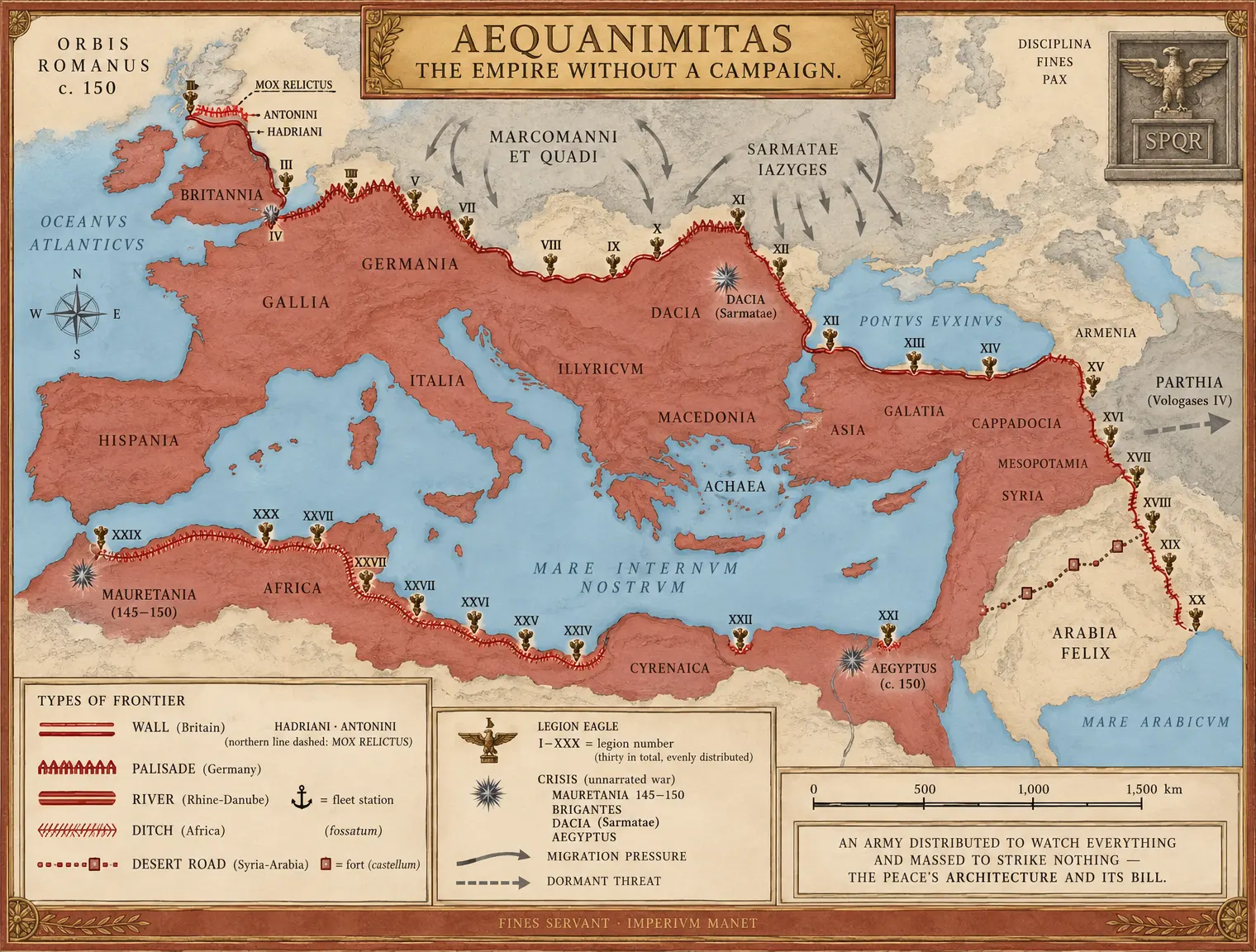
The Crossroads · c. 142 · Italy
The Advance to the Forth-Clyde
You are Antoninus Pius, emperor of Rome, governing from Italy without commanding armies in person.
Your reign has maintained interior peace, a full treasury, and careful legal administration, but Rome's frontiers remain busy. In Britain, your governor Lollius Urbicus commands three British legions stationed along Hadrian's line. While you manage imperial affairs from Italy without celebrating earned triumphs or leading campaigns in person, the frontier faces restless Caledonians beyond the established border. Advancing northward would allow Rome to seize ground up to the Forth-Clyde isthmus, thirty-seven miles across, but every mile of new turf rampart and each of nineteen forts requires quarrying, engineering, and permanent garrisoning paid from imperial funds.
Should you order Lollius Urbicus to advance the British frontier to the Forth-Clyde isthmus and build a new wall, or hold the line Hadrian established?
Weigh each course: open it to hear your own inner voice. Then decide. Nothing is scored.
- Your inner voiceThe course taken
If I command Lollius Urbicus to advance north with the three British legions, Rome can push the perimeter beyond Hadrian's line. The Caledonians will be defeated, and thirty-seven miles of turf on stone footings across the Forth-Clyde isthmus, guarded by nineteen forts, will secure the province. Yet quarrying stone, raising ramparts, and garrisoning a forward frontier will drain the treasury and lock our drilled soldiers into distant outposts far from Italy.
- Your inner voiceThe course taken
Lollius Urbicus could lead the three British legions north to strike the Caledonians, proving Roman military power without burdening the empire with thirty-seven miles of new turf ramparts and nineteen forts. A decisive campaign chastises enemies and protects Britain. Yet once our legions retire behind Hadrian's line, the Caledonians will reoccupy the Forth-Clyde isthmus, leaving the perimeter exactly where Hadrian left it.
- Your inner voiceThe course taken
Hadrian's line already provides a stone barrier across Britain. If I forbid Lollius Urbicus from advancing against the Caledonians, we risk no legionaries and avoid squandering silver from the treasury on new fortifications. Italy remains secure, and the state's wealth is preserved for the alimenta and the law. Yet inaction may embolden northern enemies, and an emperor who never commands a campaign risks being seen as unready for war.
What was done
Antoninus ordered the advance. Under Lollius Urbicus, the three British legions campaigned north (CGrade C) and built the Antonine Wall c. 142: thirty-seven miles of turf on stone footings across the Forth-Clyde isthmus with nineteen forts, attested by archaeology and distance slabs (AGrade A). Coins proclaimed IMPERATOR II and BRITANNIA (AGrade A). Yet the advance proved temporary. The wall was held perhaps twenty years and abandoned in the next reign, the frontier falling back to Hadrian's line: the clearest lesson in the difference between what the army could take and what the treasury would keep. Meanwhile, twenty-three years without major war produced an army magnificently drilled but wholly inexperienced, lacking any strategic reserve. When Antoninus died at Lorium in March 161, giving aequanimitas as his final watchword, his heirs faced a Parthian war within six months, and within eight years the perimeter broke at both ends.
The evidence The Antonine Wall's construction and troop movements are attested by distance slabs (RIB I 2139–2200 passim) and excavated construction and abandonment horizons, alongside British campaign coinage including the IMPERATOR II issues of 142 and the BRITANNIA series (all AGrade A, material). By contrast, Lollius Urbicus's campaign and Antoninus Pius's strategic rationale survive only in four words of imperial biography in the Historia Augusta (HA Ant. Pius, CGrade C) and fragmentary lines in Dio 70 (CGrade C), with late epitomators (Eutropius 8.8, Aurelius Victor 15, CGrade C) reducing the military record to brief notices.
If you choose to walk through itAt every scale
- Yourself
How should a ruler who never visits the frontier or witnesses battle weigh the desire for military prestige against a commitment to administrative equanimity?
- Those beside you
What duty does an emperor in Italy owe to commanders like Lollius Urbicus and legionaries who must build and defend fortifications in distant lands?
- Rome
How should the state balance the tactical ambition of advancing a border against the recurrent financial costs imposed on the treasury?
- The wider world
When an imperial frontier advances across an isthmus, what consequences fall upon the indigenous peoples living between the old line and the new?
- Our own time
How can modern governments identify when maintaining an expanded security perimeter costs more than the protection it delivers?
A modern state establishing forward operating bases along an unstable frontier faces an identical dilemma. Deploying forces forward into a buffer zone can temporarily deter cross-border incursions and display resolve. However, constructing hardened outposts, securing elongated supply lines, and maintaining garrison forces continuously consume resources that could support central reserves. When operational priorities change or fiscal pressures mount, administrations are often forced to withdraw forces back to their original defensive perimeters.
Where the comparison fails. Modern militaries utilize air transport, electronic surveillance, and rapid motorized communications, allowing bases to be supplied or evacuated within days. In the ancient world, shifting a frontier required marching legions on foot, quarrying stone and cutting turf by hand, and navigating months of administrative delay across sea and land, making frontier construction far slower and abandonment far more permanent.
What does the chapter tell us?
Why does the chapter characterize the twenty-three-year reign of Antoninus Pius as an important negative datum despite its internal peace?
The chapter explains that twenty-three years of peace created an army magnificently drilled but wholly inexperienced, with no strategic reserve, leaving his heirs to face major Parthian and frontier invasions almost immediately after his death.
the chapter's narrative
What archaeological and epigraphic evidence directly records the construction and imperial presentation of the Antonine Wall?
The construction of the wall across the Forth-Clyde isthmus is attested by the distance slabs of the three British legions, which recorded both their measured lengths of turf rampart and imagery of cavalry trampling Caledonians.
Antonine Wall epigraphy and archaeology (AGrade A)
What strategic and fiscal lesson does the chapter draw from the abandonment of the Antonine Wall after approximately twenty years?
The chapter presents the brief twenty-year occupation of the Antonine Wall and the subsequent withdrawal to Hadrian's line as the volume's smallest and clearest lesson in the difference between what the army could conquer and what the imperial treasury could afford to maintain.
the chapter's narrative
How does the chapter evaluate the surviving literary narratives for the military events of Antoninus Pius's reign?
The narrative sources for Antoninus Pius are rated CGrade C; the Historia Augusta reduces military notices to brief lists and four words on Lollius Urbicus, requiring historians to reconstruct the busy frontier from inscriptions and coins.
HA Ant. Pius and Dio 70 frr. (CGrade C)
How did Antoninus Pius handle the threat of invasion from Parthian king Vologases IV regarding Armenia?
Antoninus resolved the Armenian crisis and dissuaded Vologases IV from invading by letter, an act the chapter notes as the reign's most consequential military measure precisely because Rome did not have to fight it.
the chapter's narrative