Book VII · The High Empire and the Long Crisis
Chapter 5
Marcus Aurelius: The Double Emergency
The Parthian War and the Plague161–169
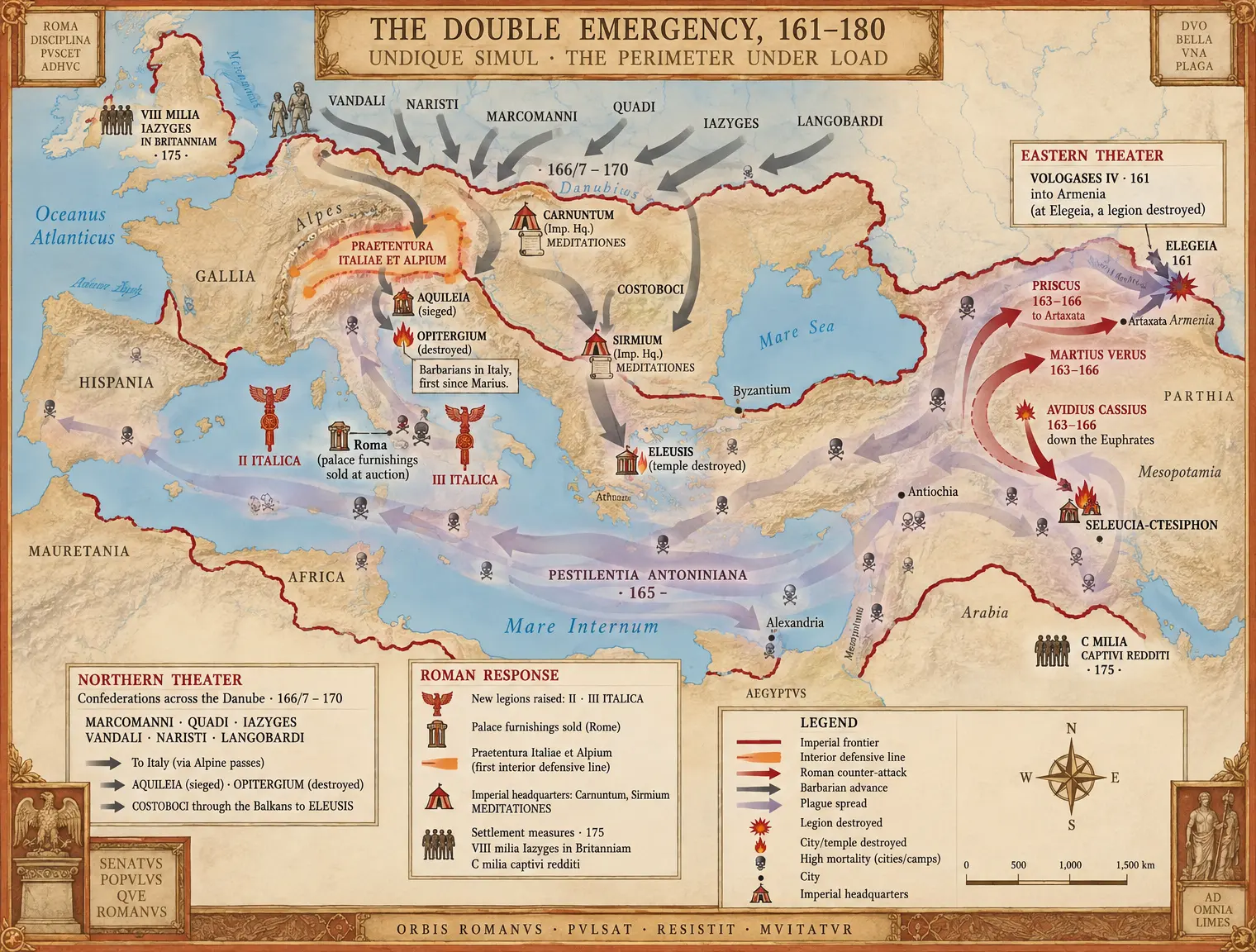
The new reign's opening lesson was that a perimeter has two ends. Antoninus was five months dead when Vologases IV moved: the Roman client on the Armenian throne expelled, a Cappadocian legion — the Ninth Hispana's eastern successor formation under the legate Severianus, urged on by an oracle — annihilated at Elegeia with its commander's suicide, the governor of Syria beaten in the field, and the Euphrates provinces open. The war that followed (162–166) was conducted for the co-emperor Lucius Verus, who held the court at Antioch, by the professionals whose careers it made: Statius Priscus retaking Armenia and storming Artaxata in 163; Avidius Cassius — the Syrian legate whose name the volume will meet again — driving down the Euphrates in 164–165, breaking the Parthians at Dura-Europos and Sura, taking Seleucia and burning Ctesiphon's palace; Martius Verus securing the north. The settlement restored the Neronian architecture with Roman interest: an Arsacid client in Armenia, northern Mesopotamia's approaches garrisoned, Dura and Nisibis held permanently — the frontier pushed to a line the Severans would inherit. And out of Seleucia in 165–166 the army carried home the reign's true enemy. The Antonine plague — smallpox on the modern reading, arriving with the returning legions and running the empire's roads for a generation, recurring to 189 when Dio records two thousand dying daily at Rome — is the volume's largest and least narratable event: mortality estimates range from a tenth to a third of the population, the papyri show Egyptian villages losing a third of their taxable men, the frontier armies were gapped, the mints thinned, and Galen, who fled it and described it, becomes for this compendium's purposes a military source, because an army that cannot be recruited cannot hold a line. The triumph of 166 was celebrated over Parthia with the disease already in the city.
The Marcomannic Wars166/7–180
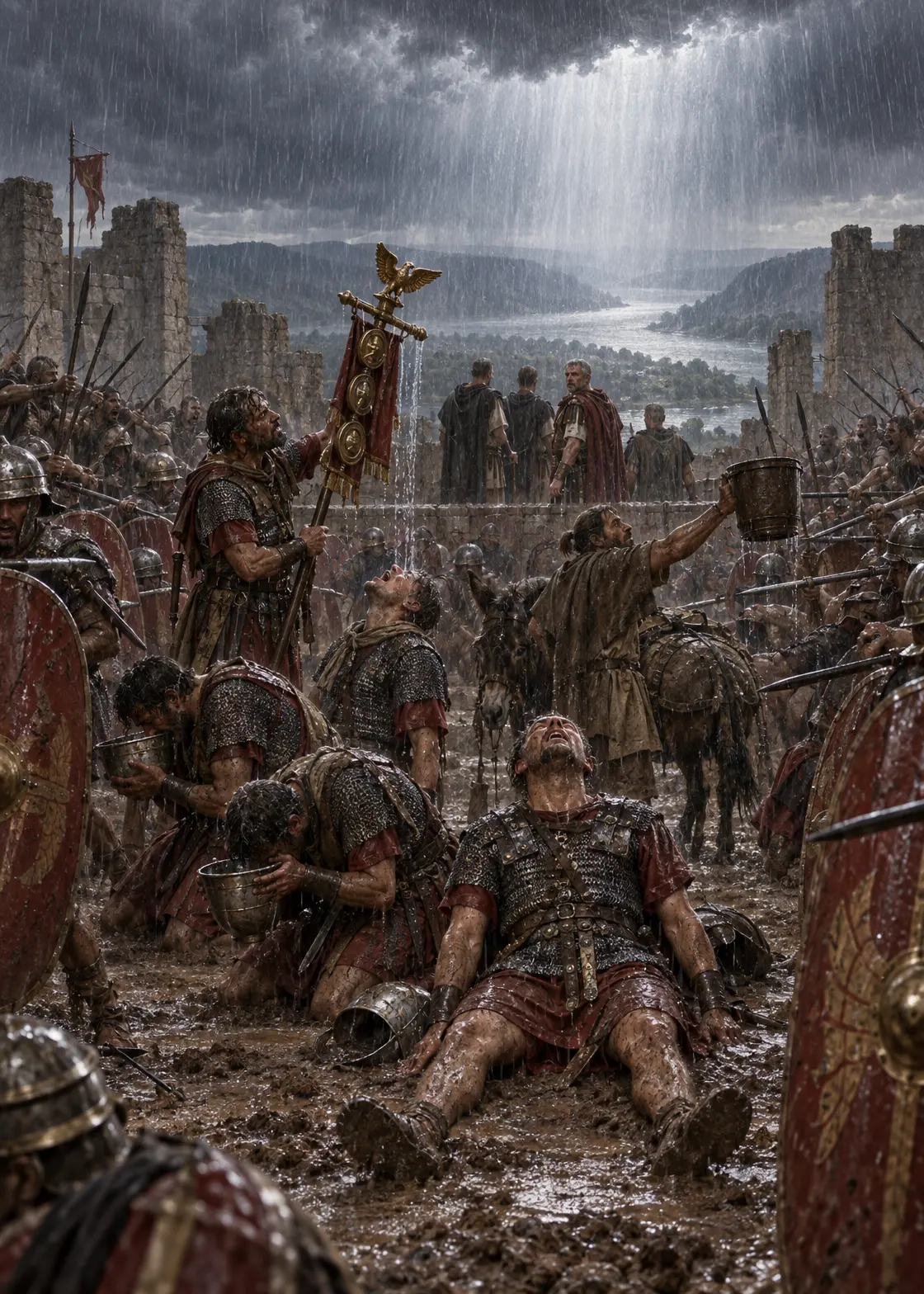
Into that weakened perimeter, at the moment of its weakness, came the northern movement — and the Editor states its character as the modern evidence permits: not a raid but a pressure, whole peoples in motion across the middle Danube's far bank, the Marcomanni and Quadi of Book VI's client-system leading a coalition that included Sarmatian Iazyges, Vandals, Naristi, Cotini, and, in the reign's most alarming intelligence, the Lombards and Obii appearing on the river with six thousand men in 166/7. The first shock (167–170) broke through: the frontier forced, Dacia's approaches raided, the praetorian prefect Furius Victorinus dead with his army in an unrecorded disaster, and in 170 the invasion that reached the Adriatic — Opitergium destroyed, Aquileia besieged, barbarians in Italy for the first time since Marius, while the Costoboci simultaneously drove through the Balkans to sack the sanctuary at Eleusis. The emperor's response was total mobilization by improvisation: two new legions raised (II and III Italica), gladiators, bandits, Danubian irrigation-workers, and German auxiliaries taken into service; the imperial ornaments and the palace furnishings auctioned in the Forum to fund it; and the establishment of a new command architecture — the praetentura Italiae et Alpium, Italy garrisoned as a theater for the first time in three centuries. From 171 to 175 Marcus fought the northern war in person from Carnuntum and Sirmium, and the counteroffensive's episodes survive chiefly as images on the Aurelian column and reliefs: the Quadi trapped and destroyed on the frozen Danube — the Roman infantry, Dio says, bracing shields on the ice against the enemy's slipping horses; the "rain miracle," a thunderstorm breaking an encircled legion's thirst that pagan and Christian traditions promptly claimed for rival divinities, carved on the column as a rain-god with water streaming from his arms; the Sarmatian settlement of 175 that returned a hundred thousand Roman captives and took eight thousand Iazyges horsemen into Roman service, five and a half thousand of them posted to Britain. The war was interrupted by the revolt of Avidius Cassius in Syria (175, three months, ended by a centurion's initiative) and resumed in 177 when the Danube broke again; Marcus went north for the last time with his son Commodus, and the campaigns of 178–180 drove into the Quadi and Marcomanni homelands with what the sources represent as a plan for annexation — two provinces, Marcomannia and Sarmatia, on the Trajanic model. The emperor died in camp at Vindobona or Sirmium on 17 March 180, of plague or exhaustion, aged fifty-eight, having spent the last decade of the empire's most philosophical reign in a tent — and the Meditations, written in those camps, enter this compendium as its strangest primary source: a commander-in-chief's private notebook, containing no campaign, no enemy, and no strategy, and testifying more precisely than any narrative to what the war cost the man conducting it. His son made peace within months on terms the tradition calls a betrayal and the modern literature largely calls arithmetic — subsidies and client-status rather than provinces — and the Editor's verdict follows the strategic logic: the annexation was unaffordable in a plague-thinned empire, and the frontier Commodus bought held for fifty years.
The Crossroads · 170 · Rome
The Emergency at the Adriatic
You are the emperor Marcus Aurelius at Rome, facing the invasion of Italy while the Antonine plague ravages the empire.
The middle Danube frontier has collapsed under a massive northern migration. The praetorian prefect Furius Victorinus is dead along with his army in an unrecorded disaster. The Marcomanni, Quadi, and their coalition have forced the river, crossed the Alps, destroyed Opitergium, and besieged Aquileia, placing barbarians inside Italy for the first time since Marius. Simultaneously, the Costoboci have driven through the Balkans to sack the sanctuary at Eleusis. At the same time, the Antonine plague brought back from Seleucia continues to ravage the provinces: Egyptian tax papyri show villages losing a third of their men, the frontier armies are gapped, and the mints are thinned. The imperial treasury is empty, recruitment rolls are dry, and the Italian homeland itself is under direct assault.
How will you raise the forces and funds needed to break the siege of Aquileia and secure the northern frontier?
Weigh each course: open it to hear your own inner voice. Then decide. Nothing is scored.
- Your inner voiceThe course taken
To hawk the palace ornaments in the public Forum debases imperial dignity, and to place weapons in the hands of bandits and arena gladiators invites internal ruin. The plague has bled our people dry; we cannot sustain an endless war across the Danube. We should use our remaining treasury reserves to purchase peace, detaching the Marcomanni and Quadi with subsidies and client treaties. Paying coin preserves Roman lives while our devastated provinces recover.
- Your inner voiceThe course taken
We have no coin to recruit citizen legions, and the plague leaves our rolls hollow. I must strip the palace of its ornaments and auction our imperial furnishings in the Forum. If we must arm bandits, gladiators, Danubian irrigation-workers, and German auxiliaries alongside two new legions, so be it. Italy cannot remain undefended; we shall fortify the Alps, and I will take the field myself on the Danube, whatever the cost to my spirit.
- Your inner voiceThe course taken
With Furius Victorinus dead and an entire army lost, marching directly to the middle Danube risks total annihilation. The pestilence fills our camps with corpses and leaves the mints thinned. We must withdraw behind the Alps, garrisoning the passes to protect Italy while letting the northern coalition exhaust itself in the Balkan provinces. Until our population recovers from the sickness, we cannot afford to wage offensive war beyond our mountain borders. Italy must be our sole sanctuary.
What was done
Marcus chose total mobilization through unprecedented improvisation. Rather than levy ruinous taxes on plague-stricken cities, he auctioned the imperial ornaments and palace furnishings in the Forum. He raised two new legions, II and III Italica (AGrade A), and bolstered them by drafting gladiators, bandits, Danubian irrigation-workers, and German auxiliaries into service. To shield the peninsula, he established the praetentura Italiae et Alpium, garrisoning Italy as a military theater for the first time in three centuries. From 171 to 175, Marcus commanded the northern counteroffensive in person from Carnuntum and Sirmium (BGrade B). His campaigns broke the invasion: the Quadi were shattered on the frozen Danube, the encircled army was delivered by the famous rain miracle, and the 175 settlement recovered one hundred thousand Roman captives while enlisting eight thousand Iazyges cavalry. Marcus spent the remainder of his life conducting war from a camp tent, recording his philosophical reflections in the Meditations until his death in 180.
The evidence The Editor's Note rates the material reality of the northern invasion, the new legions (II and III Italica), and the Danubian fort-building horizons at AGrade A, evidenced by archaeology, military diplomas, and the Column of Marcus Aurelius. The phases of the Marcomannic counteroffensive rest on Cassius Dio books 71–72 in Xiphilinus's epitome (BGrade B) and the Historia Augusta life of Marcus (CGrade C). Marcus's personal ordeal in camp is attested by his own Meditations (AGrade A as an interior document), while the demographic collapse constraining his mobilization is documented by Galen (AGrade A) and Egyptian tax papyri.
If you choose to walk through itAt every scale
- Yourself
How does a committed Stoic ruler reconcile personal philosophical detachment with the violent, unsparing realities of leading a protracted frontier war in person?
- Those beside you
What do intimate companions, courtiers, and senatorial advisers feel when an emperor sells the palace's heritage in the Forum and departs Rome to spend years in a military tent?
- Rome
Can the traditional Roman military order preserve its cohesion and legitimacy when forced to enlist outlaws, gladiators, and rural laborers alongside regular citizen legions?
- The wider world
How do the northern peoples—facing migration pressures, winter freezes, and Roman counteroffensives—view imperial diplomacy when Rome shifts between extermination, captive exchange, and auxiliary conscription?
- Our own time
When an unprecedented catastrophe strikes a state during a severe public health crisis, what are the moral and political costs of resorting to emergency measures that breach constitutional traditions?
In 1940, facing imminent invasion after the collapse of France, the British state enacted total mobilization under extreme resource scarcity. The government liquidated overseas private assets to purchase munitions, conscripted women and non-combatants into war production, and armed a volunteer Home Guard of civilians to defend the home territory. Like Marcus Aurelius, the state abandoned normal fiscal prudence and peacetime legal conventions, treating domestic defense as an emergency theater requiring the improvisation of all available manpower and wealth.
Where the comparison fails. The comparison breaks down because modern Britain possessed centralized bureaucratic administration, national industrial output, and rapid oceanic logistics, whereas Marcus governed a pre-industrial agrarian empire simultaneously decimated by an uncontrollable, lethal epidemic that gutted the very population he sought to mobilize.
What does the chapter tell us?
Why does the chapter treat the physician Galen as a significant military source for Marcus Aurelius's reign?
Galen was a contemporary physician who witnessed and described the Antonine plague. The chapter notes he functions as a military source because an epidemic that empties populations and depletes recruitment directly undermines the empire's capacity to hold its frontiers.
Galen (AGrade A) and the chapter's narrative
How did Marcus Aurelius fund the emergency mobilization and the creation of Legions II and III Italica during the crisis of 170?
Rather than imposing destructive taxes on provinces already suffering from the Antonine plague, Marcus raised funds for his two new legions and emergency forces by selling the palace furnishings and imperial ornaments at an auction in the Roman Forum.
the chapter's narrative and HA Marcus (CGrade C)
What command architecture did Marcus Aurelius establish to protect the Italian peninsula from northern invasion?
Following the destruction of Opitergium and the siege of Aquileia, Marcus instituted the praetentura Italiae et Alpium. This measure garrisoned Italy as a distinct military operational theater for the first time in three centuries.
the chapter's narrative
What outcome concluded the Sarmatian campaign of 175 along the middle Danube?
The 175 settlement with the Sarmatian Iazyges secured the return of one hundred thousand Roman captives. It also drafted eight thousand Iazyges horsemen into Roman service, five and a half thousand of whom were sent to garrison Britain.
the chapter's narrative and Danubian archaeology and diplomas (AGrade A)
According to the chapter's Editor's Note, what is the attestation grade and evidentiary status of the tradition that Marcus Aurelius planned to annex two new provinces, Marcomannia and Sarmatia?
The Editor's Note assigns CGrade C to the annexation plan for Marcomannia and Sarmatia. The note points out that the claim derives from literary accounts hostile to Commodus and cannot be independently verified from material or administrative records.
the Editor's Note (CGrade C)