Book VII · The High Empire and the Long Crisis
Chapter 6
The Auction and the Severan Reconstruction
The Second Auction of the Empire192–197
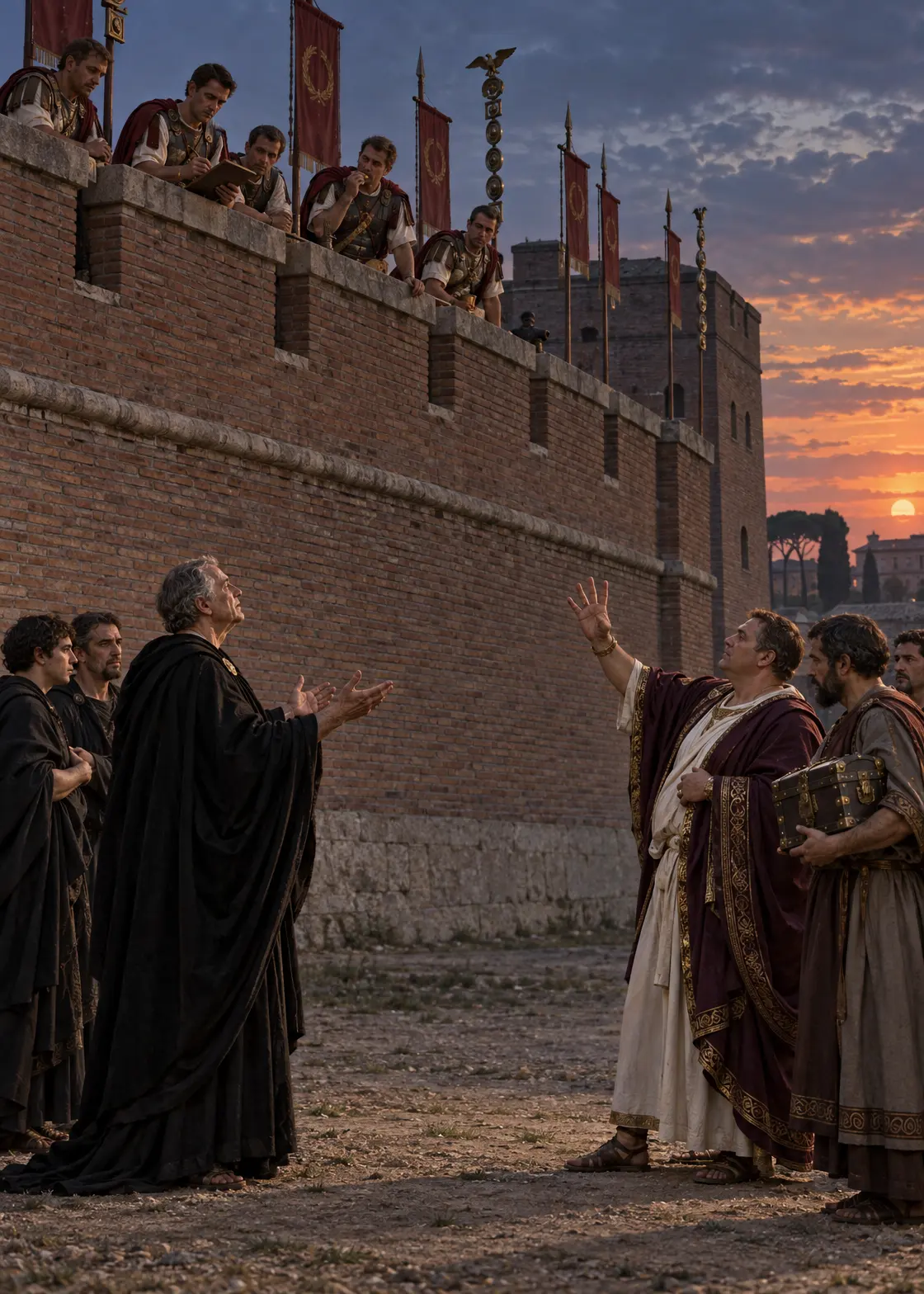
The dynasty of Marcus ended as the dynasty of Augustus had, in a bedchamber, and produced the same discovery on a larger scale. Commodus — thirty-one, ruling through favorites, fighting in the arena as Hercules Romanus, renaming the months and the legions after himself — was strangled by his wrestling-partner on the last night of 192 after the poison in his bath failed, and the year that followed reran 69 with the Praetorians' price now openly posted. Pertinax, the elderly city prefect who had risen from a freedman's household through the Marcomannic wars to the throne, attempted discipline and was killed in the palace after eighty-seven days; and there followed the scene the tradition preserved as the Republic's final obituary: the Guard on its camp wall taking bids for the empire from two candidates below, Sulpicianus the murdered emperor's father-in-law against Didius Julianus the millionaire senator, the purple knocked down at twenty-five thousand sesterces a man to the higher offer. Julianus reigned sixty-six days, cursed in the streets. The armies answered as in 69 and with the same geography: Syria proclaimed Pescennius Niger, Britain Clodius Albinus, and Pannonia — the heaviest concentration of force on earth since Domitian's day — proclaimed its governor, Lucius Septimius Severus of Lepcis Magna in Africa, who reached Rome first, executed Julianus, disbanded the Praetorian Guard entire and reconstituted it from Danubian legionaries, and then fought the two civil wars his accession required: Niger destroyed at Issus in 194 on the ground where Alexander had beaten Darius; Albinus at Lugdunum in February 197 in the largest battle Romans ever fought against Romans — Dio's figure of a hundred and fifty thousand a side is the tradition's arithmetic, the day's near-loss and Severus's own unhorsing are not, and the sack of Lyon that followed removed Gaul's greatest city from the first rank permanently. Between the wars the reign's eastern campaigns opened: Osrhoene and northern Mesopotamia annexed as a province in 195, the Parthian capital taken again in 197–198 — Ctesiphon sacked, a hundred thousand captives claimed, the emperor's Parthicus Maximus — and Hatra, twice besieged in 198–200, twice holding, the desert city's second defeat of a Roman emperor. The Editor marks the strategic settlement: the frontier advanced to the Tigris approaches with Nisibis as a fortress-capital, two new legions (I and III Parthica) raised to hold it, and Parthia left so weakened that within a generation its own vassals overthrew it — the volume's sharpest instance of a victory that manufactured a worse enemy.
Enrich the Soldiers197–235
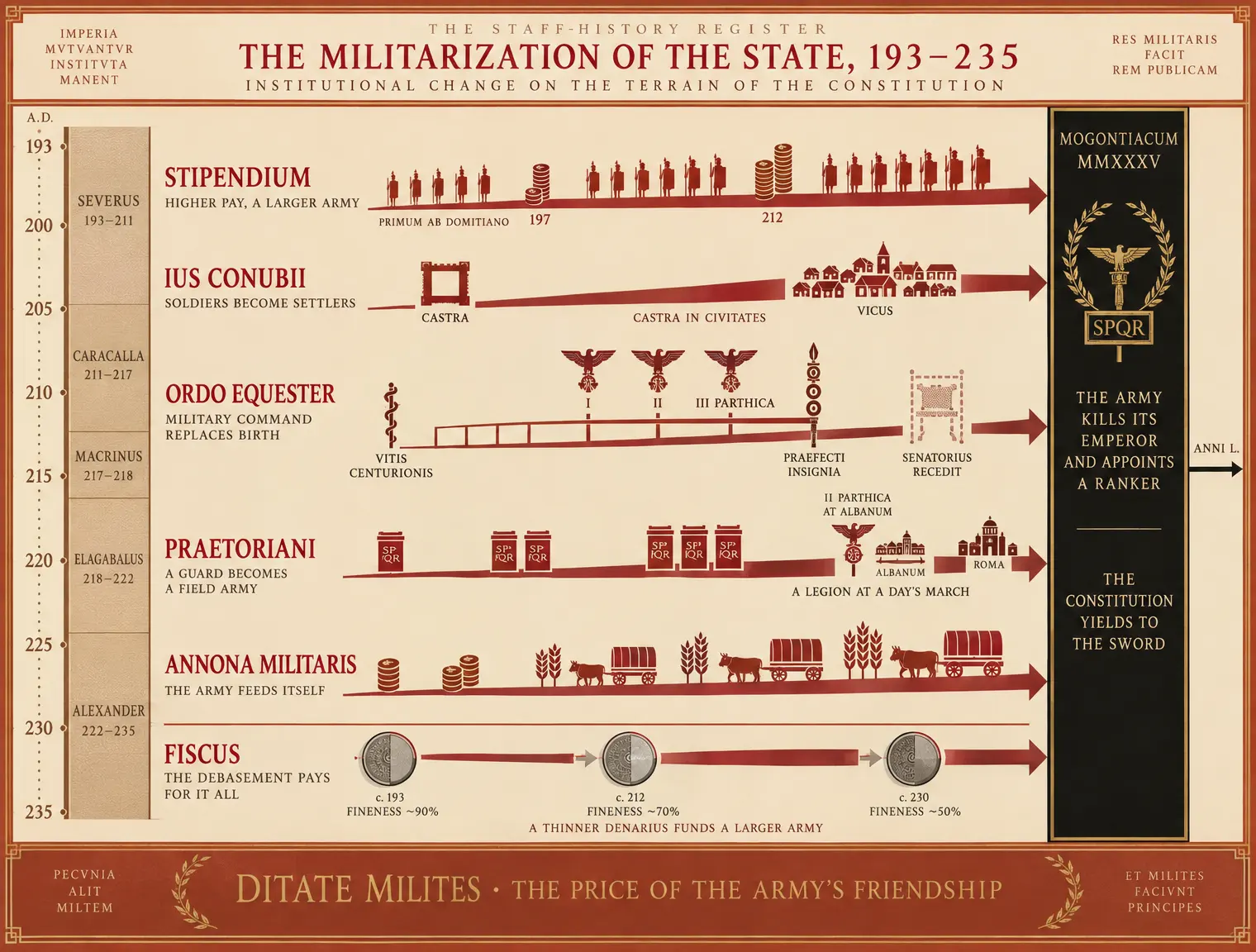
Severus's reconstruction was the militarization of the state, executed deliberately and defended without embarrassment; the dying advice the tradition puts in his mouth — agree with each other, enrich the soldiers, and despise everyone else — is the reign's program whether or not he said it. Pay was raised substantially for the first time since Domitian and again under his son; the marriage-ban on serving soldiers was lifted, legalizing the vici outside every fort and converting the frontier garrisons into rooted communities; the primipilate opened wider paths into the equestrian order, and equestrian prefects began commanding the new legions — the beginning of the senatorial order's displacement from military command that the next chapter completes; the Praetorian Guard was quadrupled in size and Italy garrisoned by II Parthica at Albanum, a legion within a day's march of Rome; and the annona militaris began the conversion of taxation-in-kind into the army's supply system. The costs were met by confiscation, by the deliberate debasement of the denarius to roughly half fine silver, and by an administrative expansion that the jurists of the reign — Papinian, Ulpian, Paul, the greatest generation of Roman law, serving as praetorian prefects and secretaries — organized into the machine the crisis would run on. The reign's last campaign returned to Britain: 208–211, Severus with his sons and a great army driving into Caledonia in the punitive war Dio describes as a march against an enemy who would not stand, its logistics still visible in the marching-camp chains north of the Tay, its object (annexation, or the demonstration Dio thought it) unachieved when the emperor died at York in February 211. What followed ran the Severan cycle to its end: Caracalla murdered his brother Geta in their mother's arms within the year, bought the army with another pay rise, granted universal citizenship to the empire's free population in 212 — the Constitutio Antoniniana, an act of taxation, patronage, and genuine consequence, the completion of the process this compendium has watched since the Social War — massacred in Alexandria in 215, campaigned inconclusively on the Danube and against Parthia, and was stabbed at a roadside latrine near Carrhae in 217 by an officer he had slighted, at his praetorian prefect Macrinus's contrivance. Macrinus, the first emperor never to have been a senator, bought peace from Parthia after the drawn battle of Nisibis and was destroyed the next year by a boy: the fourteen-year-old priest of Emesa proclaimed as Caracalla's son, Elagabalus, whose four years of religious revolution at Rome ended with his own Guard killing him and his mother in 222; and his cousin Severus Alexander's thirteen years — administered by his mother Julia Mamaea and the jurists — closed the dynasty in the volume's decisive twin crisis. In 224–226 the Sasanian revolution replaced the Arsacids: Ardashir I, from Fars, overthrew Artabanus IV, founded a centralized empire with an official Zoroastrian ideology and an announced claim to all the lands of the Achaemenids, and struck at Mesopotamia. Alexander's eastern campaign of 231–233 was mismanaged and mutinous; the Rhine crisis that followed drew him north; and at Mogontiacum in March 235 the army — offered negotiation and subsidies instead of a war — killed the twenty-six-year-old emperor and his mother in their tent and raised its own senior officer, the Thracian ranker Maximinus. With that murder the Principate's convention that emperors came from the governing class ended, and the fifty years the next chapter narrates began.
The Crossroads · 197 · Rome
The Severan Reconstruction
Lucius Septimius Severus, emperor of Rome
The civil wars are won, but at terrifying cost. You marched from Pannonia to Rome, executed Didius Julianus, and replaced the treacherous Praetorian Guard with your own Danubian troops. To secure your throne, you fought Romans against Romans across the Mediterranean: Pescennius Niger was crushed at Issus, and Clodius Albinus was destroyed at Lugdunum in the bloodiest battle of imperial history, leaving Lyon sacked and Gaul crippled. Pertinax attempted to enforce discipline and was butchered in his palace after eighty-seven days; Julianus bought the throne at auction from the Guard for twenty-five thousand sesterces a man and reigned sixty-six days, cursed by the people. The empire's treasury is depleted, the frontier armies are conscious of their supreme power, and senatorial loyalty is poisoned by years of civil bloodshed. You now hold undivided rule, but you must decide the foundations upon which your reconstruction will stand.
How will you reconstruct the imperial state to secure your dynasty and stabilize Rome?
Weigh each course: open it to hear your own inner voice. Then decide. Nothing is scored.
- Your inner voiceThe course taken
Pertinax had the right instinct, even if he lacked the force to survive the Guard. The treasury is exhausted after Commodus's squandering and five years of civil conflict. If we bribe the soldiers with pay rises and concessions, their appetite will only grow until no treasury on earth can satisfy them. We must compel the legions in Britain, Syria, and Pannonia to submit to traditional discipline, curtail donatives, and restore lawful order without debasing the coin.
- Your inner voiceThe course taken
If I turn the empire into a military despotism, every provincial legate will believe he can seize the purple by outbidding me. We must reconcile with the senatorial order, leave commands in their hands, and keep Italy free of stationed legions. Preserving the fine silver of the denarius avoids financial ruin, and maintaining the marriage ban keeps our legions unencumbered and mobile. A ruler who depends solely on the sword will eventually fall to it.
- Your inner voiceThe course taken
The Senate cannot keep an emperor alive. Pertinax offered them respect and died within eighty-seven days; Julianus bought the Guard and died cursed. My Danubian legions won the empire at Issus and Lugdunum, and only their steel holds it. We must raise pay substantially, permit soldiers to marry, station the Second Parthica at Albanum, and debase the denarius to pay for it all. We must enrich the soldiers and despise everyone else.
What was done
Severus chose deliberate militarization, elevating the army as the undisputed pillar of the state (AGrade A). Legionary pay was raised substantially for the first time since Domitian, and the marriage-ban was lifted, legalizing fort vici and rooting frontier garrisons into local communities. To secure Rome and Italy, the Praetorian Guard was quadrupled from Danubian troops, and Legio II Parthica was permanently stationed at Albanum. Equestrian prefects displaced senators in commanding new legions, while the jurists Papinian, Ulpian, and Paul organized the expanding administrative machine and the annona militaris. To finance this military reconstruction, Severus confiscated rivals' estates and deliberately debased the denarius to roughly half fine silver (AGrade A). The policy secured Severus's dynasty temporarily, but it bound the empire to an insatiable military machine: Caracalla raised pay again after murdering Geta, and by 235 the legions at Mogontiacum slaughtered Severus Alexander for offering negotiations instead of war, breaking the Principate entirely.
The evidence Cassius Dio 73–80 provides contemporary senatorial evidence (AGrade A for what he witnessed in Severus's councils, BGrade B for reports), reflecting the losing senatorial order's hostility toward militarization. Herodian 2–6 offers an independent second narrative (BGrade B/C). The institutional machinery of the reforms—including the annona militaris and equestrian commands—is documented by the Severan jurists in the Digest (AGrade A). The deliberate debasement of the currency is independently verified by modern metallurgical analyses of the denarius (AGrade A), while military papyri from Dura and the cessation of auxiliary diplomas corroborate the structural changes in the Roman army (AGrade A).
If you choose to walk through itAt every scale
- Yourself
Can a ruler who seizes power through civil war ever govern through moral authority, or does the fear of assassination inevitably compel him to rely on naked force?
- Those beside you
How far should a commander privilege the demands of the soldiers who bled for him over the safety and status of the traditional governing class?
- Rome
When a state debases its currency and militarizes its administration to survive an immediate crisis, does it protect its institutions or ensure their eventual collapse?
- The wider world
What happens to frontier provinces and subject populations when military garrisons become permanent, self-interested local dynasties backed by state supplies?
- Our own time
In modern societies facing institutional deadlock or economic stress, why does the promise of decisive executive or military authority remain so seductive?
Modern military-backed governments often preserve power by insulating security forces from economic distress, granting officers lucrative state contracts, tax privileges, and inflated salaries while the broader economy suffers inflation or currency depreciation. Sidelining civilian parliaments and bureaucratic checks ensures short-term regime survival and guards against coups, but it creates a bloated, privileged armed class that demands perpetual payoffs and resists any return to civilian fiscal discipline.
Where the comparison fails. Modern states operate within global bond markets, formal constitutions, and diversified national economies where central banks manage fiat currencies. Severus acted in an agrarian empire with no public debt system, where debasing the physical silver coinage and extracting direct agrarian levies (annona militaris) were among the few mechanisms available to finance state survival.
What does the chapter tell us?
What led directly to the Praetorian Guard auctioning the imperial purple to Didius Julianus in 193?
Pertinax rose from a freedman's household and attempted to restore discipline, but the Praetorians murdered him in the palace after eighty-seven days. The Guard then mounted their camp wall and auctioned the empire to Didius Julianus for twenty-five thousand sesterces a man.
Cassius Dio 73–80 (AGrade A) and the chapter's narrative
How did Septimius Severus finance his substantial pay rises for the army and his administrative expansion?
The chapter notes that the immense costs of Severus's military expansion and pay rises were met by confiscation, the annona militaris (taxation-in-kind), and deliberate debasement of the silver denarius to roughly half fine silver, verified by metallurgical analysis.
Coin analyses (AGrade A) and Cassius Dio 73–80 (AGrade A)
What structural transformation resulted from Septimius Severus lifting the marriage-ban on serving legionaries?
Lifting the marriage ban legalized the civilian settlements (vici) outside frontier forts, transforming rotating garrisons into permanently rooted communities. At the same time, equestrian prefects began replacing senators in military commands.
Digest Severan jurists (AGrade A) and Dura papyri (AGrade A)
Why does the chapter describe Septimius Severus's eastern settlement as a victory that manufactured a worse enemy?
By annexing northern Mesopotamia, advancing to the Tigris approaches with Nisibis as a fortress-capital, and sacking Ctesiphon, Severus critically weakened Parthia. Within a generation, its vassal Ardashir I of Fars overthrew Artabanus IV and established the more centralized, aggressive Sasanian state.
the chapter's narrative
What immediate event caused the army at Mogontiacum to assassinate Severus Alexander and Julia Mamaea in 235?
Following a mismanaged and mutinous eastern campaign against the Sasanians, the army at Mogontiacum turned on Severus Alexander and his mother when he offered negotiations and subsidies instead of waging war on the Rhine, raising the Thracian ranker Maximinus.
Herodian 2–6 (BGrade B/C) and the chapter's narrative