Book VII · The High Empire and the Long Crisis
Chapter 7
The Breaking, 235–260
The Emperors of the Frontier235–249
The half-century the ancients called nothing and the moderns call the Third-Century Crisis begins as a military phenomenon and must be narrated as one: between 235 and 284 some twenty men held the purple with senatorial recognition and perhaps as many again claimed it without, and of that first twenty all but two died violently — the empire's political system reduced to its army groups' competitive proclamations, conducted while the perimeter was breached at both ends by enemies who had learned, in the volume's central lesson, to attack simultaneously. The first phase's pattern was set by Maximinus Thrax (235–238), the ranker-emperor who never entered Rome, campaigned successfully across the Rhine and on the Danube, and was destroyed not by an enemy but by fiscal war on his own propertied class: the African revolt of the two Gordians, the Senate's desperate elevation of its own commissioners Pupienus and Balbinus, the Guard's murder of both, and Maximinus's death before the walls of Aquileia at his own soldiers' hands during a siege they could not feed — six emperors in the single year 238, and the significant novelty that the Senate had fought a field campaign and lost it to the Praetorians who then handed the throne to a thirteen-year-old. Gordian III's six years (238–244) restored appearances and were run by the praetorian prefect Timesitheus, whose eastern campaign against Ardashir's son Shapur I recovered Mesopotamia's fortresses — Hatra, which had defeated Trajan and Severus, fell in 240/241 not to Rome but to Persia, and its garrison-graffiti stop — before the prefect's death and the young emperor's own at Zaitha near Circesium in 244; the two versions of that death are the volume's clearest single specimen of its source-problem, the Roman tradition reporting a mutiny arranged by the successor Philip, the Persian rock-inscription at Naqsh-e Rustam declaring flatly that Gordian was killed in battle at Misiche and that Philip paid five hundred thousand denarii for peace and became tributary. The Editor prints both and grades them: contemporary official Persian against later Roman literary, with the coinage's PAX FUNDATA CUM PERSIS legend arguing that a payment was made and dressed. Philip the Arab's five years (244–249) carried the empire's millennium — the Secular Games of 248, the thousandth year from the founding, celebrated in a capital whose currency was collapsing while the lower Danube gave way: the Carpi and, behind them, the Goths crossing in force, the Balkan provinces raided to the Aegean, and the general sent to restore the front, Decius, proclaimed by his own troops and destroying Philip at Verona.
Abritus, Dura, and Edessa249–260
The decade that followed brought the three catastrophes that convinced contemporaries the world was ending, and the Editor narrates them together because they were experienced together. In 250 the Gothic king Cniva crossed the Danube with a great host, took Philippopolis with a slaughter the tradition counts at a hundred thousand, and was intercepted in 251 in the marshes at Abritus in the Dobruja by Decius and his son — where, in the boggy ground the Goths had chosen, the Roman army was destroyed and the emperor killed with his heir, the first Roman emperor to fall in battle against a foreign enemy: his body was never recovered from the mud. In the same years the plague returned — the Plague of Cyprian, from 251, whose mortality the Christian bishops describe as pastoral crisis and whose demographic effect the papyri register as a second thinning — and the frontier's collapse became general: the Alamanni into Gaul and Italy (Aemilianus's brief revolt, Valerian's elevation in 253), the Franks to the Pyrenees and by sea to Spain and Africa, the Goths taking to the Black Sea in captured shipping to raid Bithynia, Trebizond, Ephesus, and eventually Athens, the Carpi and Sarmatians into Dacia, and in the east Shapur into Syria: Antioch, the empire's third city, sacked in 253 and again in 260. The garrison-town of Dura-Europos on the Euphrates, taken in the mid-250s, is the volume's forensic exhibit — a city killed and abandoned mid-siege, its Roman military archive on papyrus in situ, its painted synagogue and Christian house-church buried in the defensive embankment, and beneath Tower 19 the countermine where a Persian sulphur-and-bitumen fire trapped a Roman assault party: nineteen skeletons in mail with their coins in their purses, and the earliest physical evidence of chemical warfare known to archaeology. And in 260, near Edessa, the war's third act: the emperor Valerian, campaigning with a plague-weakened army, was defeated and taken alive — the only Roman emperor ever captured by a foreign enemy — with his praetorian prefect, his senators, and his staff. The Persian record of it, carved in three languages on the cliff at Naqsh-e Rustam with an accompanying relief in which the King of Kings sits mounted while a Roman emperor kneels at his horse's head, is this compendium's single most valuable non-Roman document: Shapur, King of Kings of Iran and non-Iran, lists the emperors he fought, names the seventy thousand of Valerian's army taken with him, and enumerates the cities destroyed and the captive craftsmen resettled in Persia to build his own — the reader who has followed six volumes of Roman monuments listing conquered peoples is asked to note the register's exactness, and its provenance. Valerian died in captivity; the later Christian tradition's flaying and stuffing is DGrade D polemic, but the fact requires no ornament. The empire's answer that year was not recovery but fragmentation, treated next: with the Rhine armies proclaiming Postumus and the East passing to the client-dynasty of Palmyra, the world-state's territorial unity ended for a decade, and the volume's readers may take this paragraph as the low-water mark of the entire compendium — the perimeter broken at every point, the coinage nearly silverless, the capital's population halved by plague, an emperor in a Persian palace, and no Roman historian left alive whose account of it we possess.
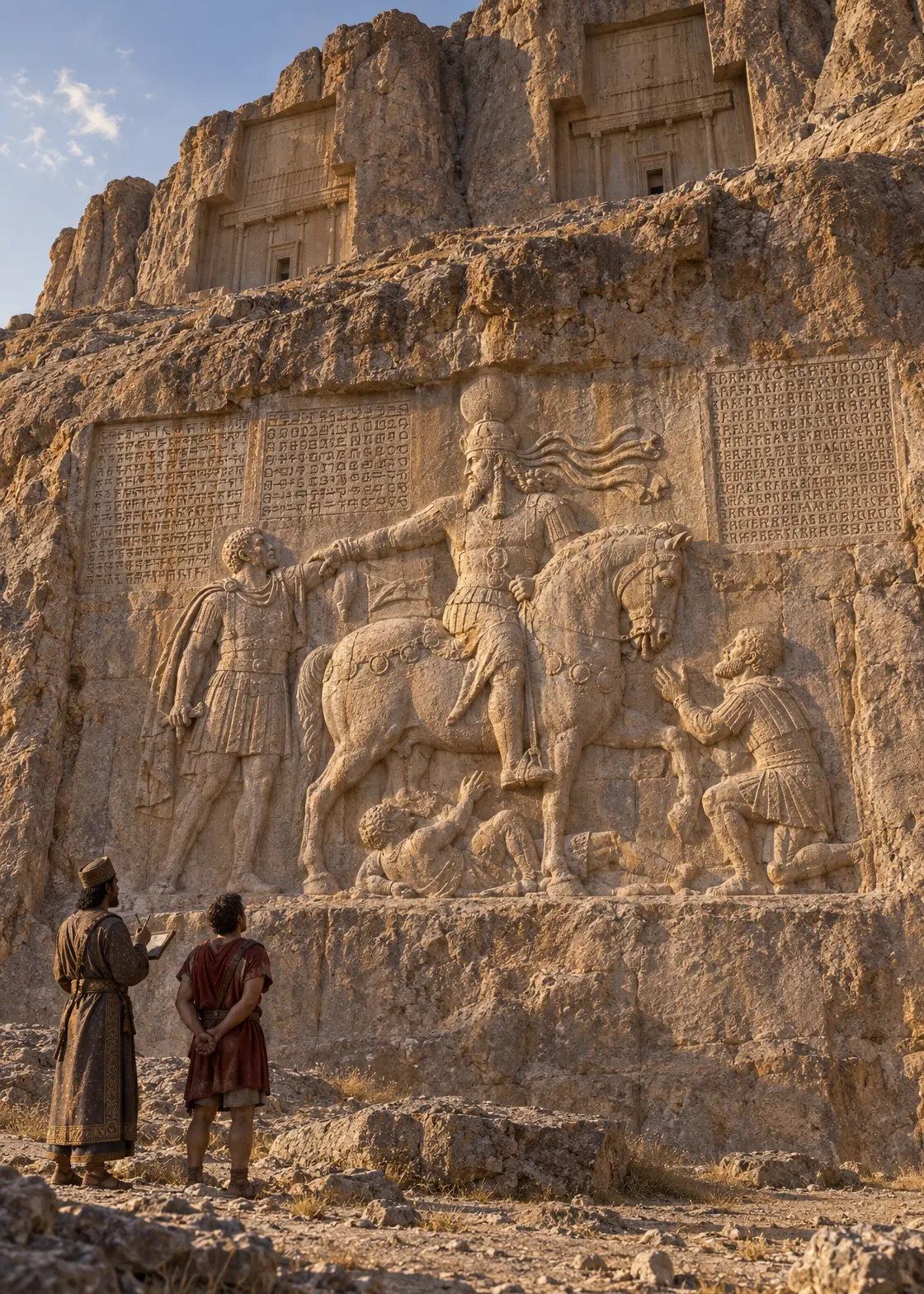
The Crossroads · 244 · Mesopotamia, near Zaitha and Misiche
The Price of Peace at Zaitha
You are Philip, praetorian prefect of the eastern expedition, standing at the head of the Roman legions in Mesopotamia following the sudden death of Gordian III near Zaitha and Circesium.
Timesitheus has died after recovering Mesopotamia's fortresses from Shapur I, son of Ardashir. Hatra had already fallen to Persia, and now the young emperor Gordian III is dead near Zaitha, or slain in battle at Misiche. As praetorian prefect, command falls upon you. The Roman army is isolated deep in Mesopotamia facing Shapur's forces, and the King of Kings demands five hundred thousand denarii and tributary status to grant peace and permit your legions to withdraw, while the throne in Rome stands vacant.
Will you pay Shapur five hundred thousand denarii and accept Persian tributary terms to save the army, or will you refuse and continue fighting in Mesopotamia?
Weigh each course: open it to hear your own inner voice. Then decide. Nothing is scored.
- Your inner voiceThe course taken
Timesitheus gave his life recovering Mesopotamia's fortresses from Shapur, and we cannot surrender those gains for Persian promises. Trajan and Severus marched this soil without submitting to tribute. If I offer five hundred thousand denarii now, the legions will despise me as weak, and Shapur will only demand more once we yield. Our duty is to avenge Gordian, engage the Persian host in open battle, and preserve Rome's frontier through force of arms.
- Your inner voiceThe course taken
Paying five hundred thousand denarii or accepting tributary status would dishonour the empire forever. Yet attacking Shapur deeper in Mesopotamia with an army shaken by Gordian's fall risks total destruction. We should refuse Persian terms entirely, break camp, and march our legions steadily back toward the Euphrates and Syria. We will abandon the outlying Mesopotamian fortresses if we must, but we will preserve our soldiers, retain our silver, and concede nothing in writing to the King of Kings.
- Your inner voiceThe course taken
I must save this army and reach Rome before another rival claims the purple. Five hundred thousand denarii is a bitter sum, and becoming tributary wounds Roman majesty, but Shapur holds the desert and my soldiers are isolated far from the Euphrates. We can strike coins proclaiming an established peace with Persia, PAX FUNDATA CUM PERSIS, to soothe the capital. Survival and the throne require that we buy our way home.
What was done
Philip chose to pay Shapur the five hundred thousand denarii for peace and accepted tributary status, as recorded in Shapur's contemporary trilingual inscription at Naqsh-e Rustam (AGrade A). In Roman territory, the settlement was dressed on the imperial coinage with the legend PAX FUNDATA CUM PERSIS to present the withdrawal as an established peace. Philip returned west to secure his rule, presiding over his five-year reign (244–249) and celebrating Rome's thousandth anniversary at the Secular Games of 248. Yet the peace purchased in the east could not arrest the state's unraveling. The currency collapsed, stripping silver from the coinage, while the lower Danube gave way to heavy crossings by the Carpi and Goths. When Philip dispatched Decius to restore the Balkan frontier, the Danubian troops proclaimed their commander emperor. Decius marched on Italy and destroyed Philip in battle at Verona in 249, leaving the empire to face even darker trials.
The evidence Res Gestae Divi Saporis at Naqsh-e Rustam (AGrade A, contemporary official Persian inscription recording the battle at Misiche, the five hundred thousand denarii payment, and Roman tributary status); imperial coinage bearing the legend PAX FUNDATA CUM PERSIS (AGrade A material evidence confirming the payment was made and dressed); fourth-century epitomators based on the Kaisergeschichte (CGrade C, chronological spine for Philip's reign and defeat by Decius); Zosimus 1 (CGrade C, drawing on Eunapius and Dexippus for Gordian's mutiny and Philip's accession); Historia Augusta (Maximini–Valeriani, DGrade D, suspect Roman literary tradition reporting a mutiny arranged by Philip).
If you choose to walk through itAt every scale
- Yourself
Does securing imperial power through a humiliating financial payment compromise a ruler's legitimacy before his reign even begins?
- Those beside you
Can soldiers trust a prefect-turned-emperor who bought their safe withdrawal from an enemy rather than leading them into battle?
- Rome
How does disguising a costly tribute as an established peace affect the authority and honesty of imperial governance?
- The wider world
When an empire pays tribute to a rival superpower, does the transaction deter further aggression or invite attacks on other frontiers?
- Our own time
Under what circumstances does a state justify paying an adversary to resolve a military crisis while publicly claiming diplomatic victory?
Modern governments facing costly overseas military entanglements often negotiate expensive withdrawal agreements or release frozen assets to hostile regimes in exchange for the safe extraction of personnel and an end to hostilities. Such settlements are routinely framed for domestic audiences as negotiated settlements or historic breakthroughs, masking the reality that financial and territorial concessions were made under duress to avoid an unsustainable military collapse.
Where the comparison fails. Modern states operate within multilateral treaty networks and formal international bodies where financial transfers are heavily scrutinized, whereas Philip operated as an autocrat answering only to his legions and the Senate, where a perceived loss of prestige frequently triggered an immediate military coup.
What does the chapter tell us?
Why does the Editor prefer the Persian account of Gordian III's death and the subsequent settlement over the Roman literary tradition?
The rock-inscription at Naqsh-e Rustam provides contemporary official Persian testimony (AGrade A) that Gordian died in battle at Misiche and Philip paid five hundred thousand denarii for peace. Roman coins proclaiming PAX FUNDATA CUM PERSIS confirm a payment was made and dressed, outranking later Roman literary claims of a mutiny.
Res Gestae Divi Saporis (AGrade A) and Editor's Note
What historically unprecedented outcome occurred when Decius confronted the Gothic king Cniva at Abritus in 251?
Decius and his son were defeated and killed in the boggy ground chosen by the Goths at Abritus in the Dobruja. Decius became the first Roman emperor to fall in battle against a foreign enemy, and his body was never recovered from the mud.
The chapter's narrative (CGrade C for battle narratives)
What exceptional archaeological evidence of siege warfare was discovered beneath Tower 19 at Dura-Europos?
Beneath Tower 19 at Dura-Europos, archaeologists uncovered a countermine where nineteen skeletons in mail with coins in their purses were trapped by a Persian sulphur-and-bitumen fire. This assemblage represents the earliest physical evidence of chemical warfare known to archaeology.
Dura-Europos archaeology (AGrade A)
According to the contemporary record at Naqsh-e Rustam, what was the fate of the emperor Valerian in 260?
Valerian was defeated near Edessa while leading an army weakened by the Plague of Cyprian. He was taken alive by Shapur I alongside his praetorian prefect, senators, and staff, becoming the only Roman emperor ever captured by a foreign foe, as documented at Naqsh-e Rustam (AGrade A).
Res Gestae Divi Saporis (AGrade A)
According to the chapter, what fundamental military dynamic drove the political collapse between 235 and 284?
The chapter identifies the crisis as a military phenomenon where the political system was reduced to competitive proclamations by army groups, while the perimeter was breached at both ends by enemies who had learned to attack simultaneously across the Rhine, Danube, and Euphrates.
The chapter's narrative