Book VII · The High Empire and the Long Crisis
Chapter 8
The Recovery, 260–284
Gallienus and the Threefold Empire260–268
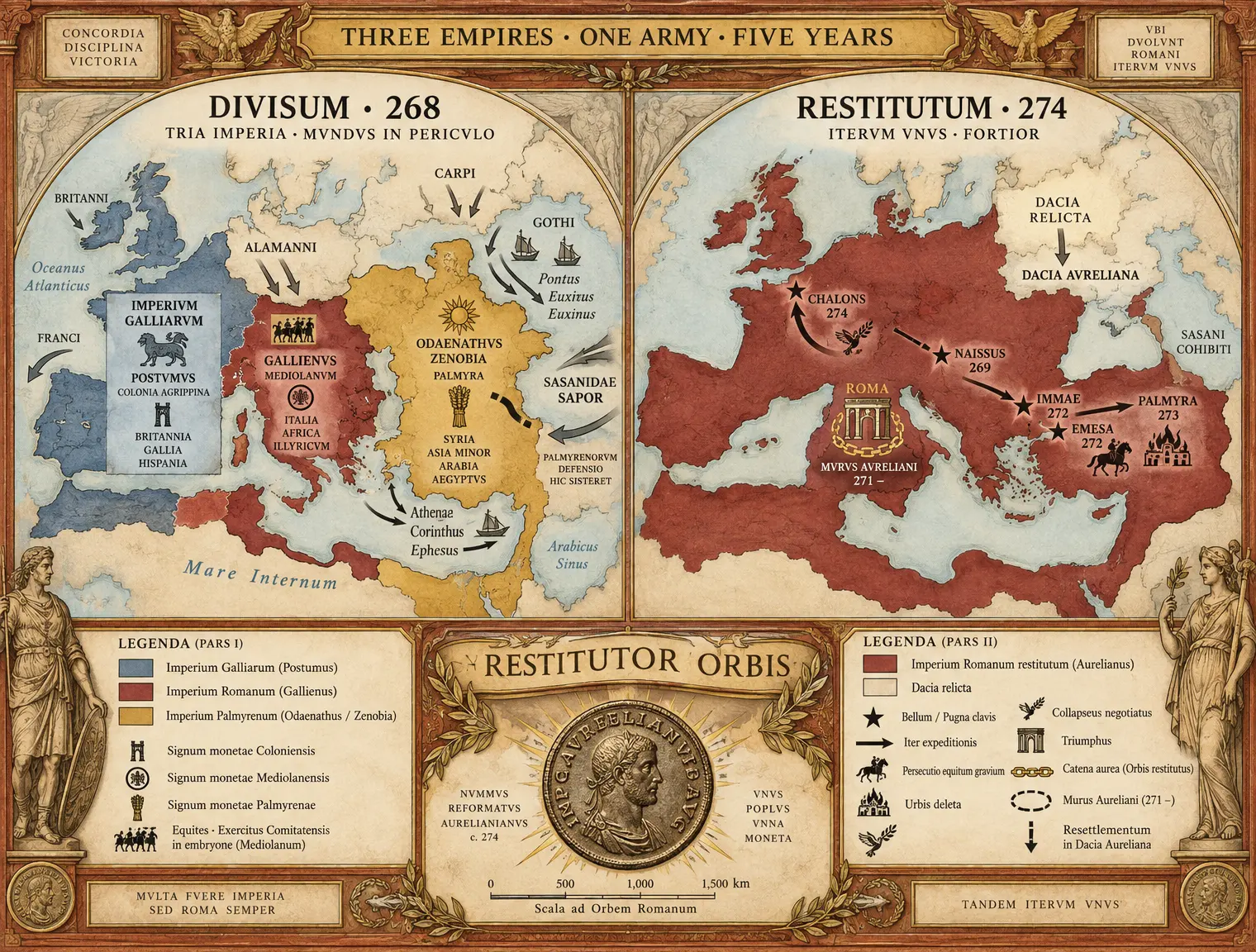
The recovery began in the worst year and with the worst-served reputation in Roman historiography. Gallienus, sole emperor after his father's capture, ruled eight years over an empire from which the Rhine armies had seceded under Postumus — the imperium Galliarum of Book VI reborn with senate, consuls, and coinage, holding Gaul, Britain, and Spain and, the point the hostile tradition suppresses, holding the Rhine frontier competently while it did so — and in which the East had passed to Odaenathus of Palmyra, the caravan-city's prince who avenged Valerian by driving Shapur back from the Euphrates and was rewarded with the extraordinary title corrector totius Orientis: a client left to govern Rome's eastern half because Rome could not. Between them Gallienus held Italy, Africa, the Danube, and Illyricum against Alamannic invasions (checked at Mediolanum in 260 and 268), a Gothic sea-storm that sacked Athens, Corinth, Sparta, and Argos, and a chain of usurpations he suppressed one by one; and while doing it he executed the volume's decisive military reform. Barred from senatorial command by the crisis's own logic, he completed the transfer of legionary command to equestrian praefecti — after Gallienus no senator commands a legion, the constitutional revolution of the Principate's military settlement finished by attrition — and, more consequentially, assembled at Mediolanum a central mobile field army built around massed cavalry: the equites corps of Dalmatian and Moorish horse, promoted, paid, and stationed centrally rather than distributed along the perimeter. This was the structural answer to the crisis's structural problem: a linear frontier cannot meet simultaneous attacks, but a linear frontier plus a mobile reserve can meet them in sequence. Every emperor for the next two centuries fought with the instrument Gallienus improvised, and his own officers — the Illyrian cavalry generals Claudius, Aurelian, and Probus — were its first products, and his assassins: he was killed at Mediolanum in 268 besieging the last usurper of his reign, by a conspiracy of the men who would spend the next sixteen years using his army to save the empire he was afterward blamed for losing. Claudius II earned his cognomen Gothicus on it at Naissus in 269, breaking the greatest of the Gothic invasions in a battle whose casualty-claim of fifty thousand the Editor prints as claim and whose strategic effect — the Balkans cleared for a generation — is not in doubt; he died of plague within two years, and the recovery passed to the volume's central figure.
Aurelian, Restitutor Orbis270–275
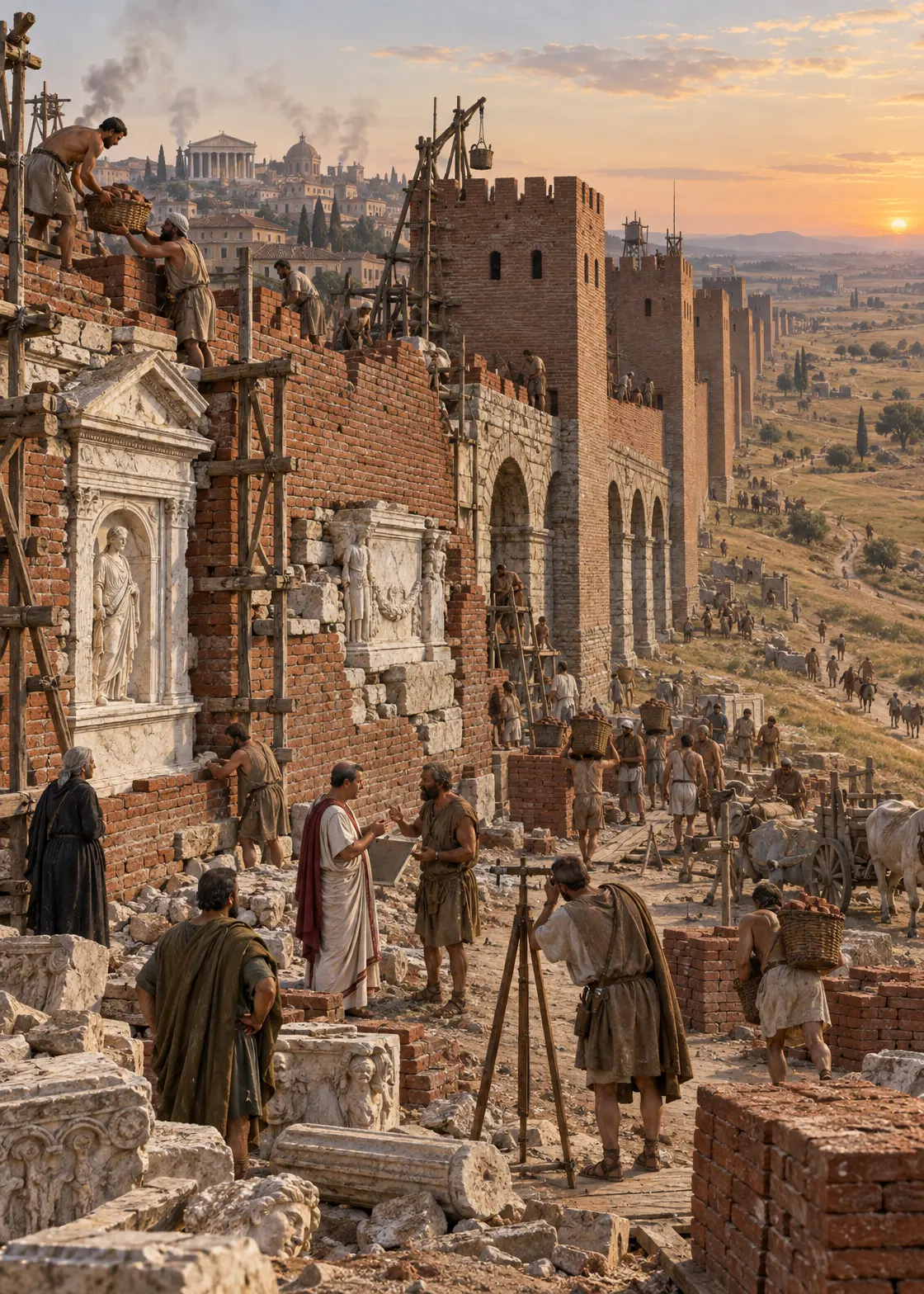
Aurelian's five years reversed the crisis in every dimension, and the chapter narrates them as the compendium's fastest campaign-sequence. He began by fighting for Italy: the Vandals thrown back across the Danube, and then the Iuthungi and Alamanni, who broke into the peninsula and beat him at Placentia — the war's crisis, the road to Rome open — before being destroyed at Fanum Fortunae and Ticinum in 271. That emergency produced the volume's greatest monument: the wall of Rome, nineteen kilometers of brick-faced concrete with three hundred and eighty-one towers and eighteen gates, begun in 271 and built in less than a decade, incorporating whatever stood in its path — an amphitheater, tombs, an aqueduct's arches, the Pyramid of Cestius — the capital of the world, unwalled since the kings, putting on armor because the army could no longer promise that no enemy would reach it. He then abandoned Dacia, evacuating the province Trajan's Column celebrates and resettling its Roman population south of the Danube in a new Dacia Aureliana: the volume's second surrender of conquered territory, executed for the reason the first was, that the line could not be held with the force available — and the Editor marks the strategic honesty as the recovery's precondition. Then the reunification. In 272 he marched east against Palmyra, where Odaenathus's widow Zenobia, regent for her son Vaballathus, had converted the corrector's mandate into an empire — Syria, Arabia, Asia Minor to Ankara, and in 270 Egypt, the grain-source — and defeated her generals at Immae near Antioch and at Emesa with the same tactic twice: a feigned cavalry withdrawal drawing Palmyra's magnificent armored clibanarii into pursuit and exhaustion, then the infantry, then the Palestinian club-men against the armored horse. Palmyra was besieged, taken, and, when it revolted the next year, destroyed; Zenobia was captured at the Euphrates and walked, in gold chains, in the triumph of 274. Between the two Palmyrene campaigns he turned west: the Gallic empire, its fourth ruler Tetricus commanding an army that no longer believed in it, met him at Châlons in 274 and dissolved — Tetricus, by the tradition, having negotiated his own defeat, and receiving a governorship in Italy for it. The empire was whole for the first time in fourteen years, and its restorer took the title the coinage proclaims — RESTITUTOR ORBIS — reformed the currency toward a stabilized silver-washed aurelianianus, put the mint's own rioting workers down at the cost, Dio's successors say, of thousands of lives in Rome, dedicated the temple of the Unconquered Sun as an imperial monotheism-in-waiting, and was murdered in Thrace in 275 by his own staff officers, tricked into it by a secretary who had forged a proscription-list to save himself. The Editor lets the manner of his death stand as the crisis's epitaph: the man who reassembled the Roman world was killed by a clerk's lie, and his soldiers, discovering it, killed the clerk and asked the Senate to choose the next emperor.
To Diocletian275–284
The last nine years completed the pattern and produced the successor. Tacitus, the elderly senator the armies accepted, campaigned against Gothic raiders in Asia Minor and died within a year. Probus (276–282), the best of Aurelian's remaining lieutenants, cleared Gaul of the Franks and Alamanni in a campaign the sources credit with four hundred thousand square miles recovered and sixteen tribes broken, restored the German and Danubian lines, settled defeated barbarians inside the empire as laeti farming under obligation to serve — the beginning of the practice that will define Book VIII's frontier — put down three usurpers, and was killed by his own soldiers at Sirmium in 282 for setting them to drain marshes. His praetorian prefect Carus reigned two years, drove into Persia in 283 in the last successful Roman eastern offensive for a generation, took Seleucia and Ctesiphon — and died in his tent beyond the Tigris, by lightning in the official version, which the Editor grades as the version the army's officers preferred; his sons Carinus and Numerian divided the empire, and when Numerian died on the road home from Persia in 284 — carried in a closed litter, his death discovered by the smell — the army at Nicomedia held an inquest, executed the praetorian prefect Aper as the murderer, and on 20 November 284 acclaimed the commander of the household cavalry, a Dalmatian of obscure birth named Diocles who would style himself Diocletianus. He defeated Carinus at the Margus in 285 and then did what none of the soldier-emperors had managed: he reorganized the state so that the crisis could not recur in the same form — the empire divided into administrative halves and then quarters under colleagues, the provinces subdivided and grouped into dioceses, civil and military commands separated, the army enlarged and restructured around frontier troops and mobile field forces, the currency and taxation rebuilt on the annona's foundations, and the emperorship itself removed from human reach into the sacral, purple-veiled majesty of a Dominate. That reorganization, and the world it made, belong to Book VIII. This volume ends at the acclamation.
The Crossroads · 271 · The Danubian frontier, facing Dacia
The Strategic Honesty at the Danube
You are Aurelian, emperor of Rome, surveying the northern frontier after throwing the Vandals back across the Danube and checking the invasions of Italy.
The empire is broken into three hostile parts. In the west, the Gallic empire under Tetricus holds Gaul, Britain, and Spain; in the east, Zenobia of Palmyra controls Syria, Arabia, Asia Minor to Ankara, and the grain supply of Egypt. Italy itself was nearly lost when the Iuthungi and Alamanni defeated you at Placentia before being destroyed at Fanum Fortunae and Ticinum, prompting the construction of a nineteen-kilometer wall around Rome. Across the Danube lies Dacia, conquered under Trajan and commemorated on his Column. Its defense ties down veteran legions on an exposed linear perimeter that cannot withstand simultaneous assaults, leaving you without the forces needed to reunite the Roman world.
How will you resolve the unsustainable defense of Dacia before turning your armies against the eastern and western secessions?
Weigh each course: open it to hear your own inner voice. Then decide. Nothing is scored.
- Your inner voiceThe course taken
We need not formally abandon the province nor pour our scarce reserves into its deep forests. Let the frontier cohorts hold the fortified centers and watch the passes as best they can, acting as a forward screen. This preserves imperial claim without exhausting our strength, allowing us to wheel the main field army east to recover Egyptian grain and Syrian taxes before deciding Dacia's ultimate fate.
- Your inner voiceThe course taken
To pull back across the Danube is a bitter confession. Trajan's Column immortalizes the blood spent to win Dacia, and Roman pride will call its abandonment cowardice. Yet pride will not staff the river forts or repel another wave of barbarians. By bringing the settlers and legions south, I can establish a new Dacia sheltered behind the water, shorten the perimeter, and free our veteran swords to face Zenobia and Tetricus.
- Your inner voiceThe course taken
We cannot surrender what our ancestors bought with so much slaughter. If an emperor yields Trajan's conquest without a total defeat in the field, every border legion will question his courage and every barbarian tribe across the Rhine will smell weakness. By anchoring our horsemen and legions in Dacia, we keep the war north of the river, far from Italy, proving to Rome and our mutinous rivals that the empire's boundaries remain inviolate.
What was done
Aurelian evacuated Dacia, surrendering the province celebrated on Trajan's Column and resettling its Roman population south of the Danube in a newly established Dacia Aureliana. The strategic withdrawal shortened the northern line, releasing the mobile army for imperial reunification. In 272 Aurelian marched east against Palmyra, breaking Zenobia's armored clibanarii at Immae and Emesa (CGrade C) with feigned cavalry retreats before besieging Palmyra and taking Zenobia captive. In 274 he marched to Gaul; at Châlons (CGrade C), Tetricus's dispirited army dissolved. Fourteen years of division ended, and Aurelian assumed the title Restitutor Orbis (AGrade A). Yet the military settlement remained volatile: after suppressing mint riots in Rome and dedicating the temple of the Unconquered Sun, Aurelian was murdered in Thrace in 275 by his own staff officers, deceived by a secretary's forged proscription list.
The evidence The evacuation of Dacia is documented through the cessation of coinage in the abandoned province and the epigraphy of the resettled Dacia Aureliana communities (AGrade A). The narrative framework and sequence of Aurelian's reign derive from fourth-century epitomators based on the Kaisergeschichte (Aurelius Victor, Eutropius 9, Festus, and the Epitome de Caesaribus, CGrade C) and Zosimus 1.37–73 (CGrade C). The Editor notes that the physical scale and logistical completeness of the Dacian evacuation remain archaeological deductions rather than fully preserved administrative records, and dismisses the Historia Augusta (Divus Aurelianus, DGrade D) as entirely unused.
If you choose to walk through itAt every scale
- Yourself
How does an emperor bear the political and personal stigma of surrendering land won by a revered predecessor to preserve military reality?
- Those beside you
How do veteran Danubian officers and soldiers react to an order to retreat across the river from ground they have not lost in battle?
- Rome
Can an imperial state founded on perpetual expansion and martial majesty preserve its authority once it openly contracts its frontiers?
- The wider world
What happens to provincial populations and indigenous neighbors when an empire decides a border territory is no longer worth defending?
- Our own time
Under what conditions can modern nations acknowledge overextension and withdraw from peripheral commitments without causing domestic demoralization?
In 1968, facing acute economic crises and currency devaluation, the British government decided to withdraw all permanent military garrisons east of Suez. Despite decades of treaty commitments and the global prestige of imperial reach, the state recognized it lacked the financial and military resources to maintain both domestic recovery and an extended defense perimeter, choosing instead to concentrate its forces within the European theater.
Where the comparison fails. Unlike Aurelian's withdrawal, the British decision involved relocating military personnel and closing naval stations rather than uprooting and resettling an entire provincial civilian population into newly created domestic territory under immediate threat of armed barbarian incursions.
What does the chapter tell us?
What was the strategic logic behind Gallienus's creation of a central mobile cavalry reserve at Mediolanum?
The chapter explains that a linear frontier cannot withstand simultaneous attacks along the perimeter; adding a centrally stationed mobile cavalry reserve enabled the empire to confront border breaches in sequence.
the chapter's narrative
Why did Aurelian decide to evacuate Dacia and create Dacia Aureliana south of the Danube?
Aurelian abandoned Dacia because its extended line could not be defended with the force available, making the evacuation and establishment of Dacia Aureliana a precondition for strategic recovery.
Eutropius and fourth-century epitomators (CGrade C), confirmed by coin-cessation and epigraphy (AGrade A)
By what tactical method did Aurelian defeat Zenobia's forces at both Immae and Emesa?
Aurelian used the same tactic twice: feigning a cavalry withdrawal to lure Palmyra's heavy armored clibanarii into an exhausting pursuit, after which infantry and Palestinian club-men destroyed the horsemen.
Zosimus (CGrade C)
Why does the Editor dismiss the Historia Augusta's accounts of Aurelian and Zenobia as DGrade D material?
The Editor notes that the Historia Augusta relies on forged documents and presents Zenobia as a fictionalized novel, making it the primary reason modern popular views of the period are distorted.
the Editor's Note (DGrade D, unused)
What frontier innovation did Probus introduce, and why did his soldiers assassinate him at Sirmium in 282?
Probus settled defeated tribes inside the empire as laeti bound to farm and provide military service, and his soldiers mutinied and killed him at Sirmium when ordered to perform manual labor draining marshes.
fourth-century epitomators (CGrade C)