Book VII · The High Empire and the Long Crisis
Proem
Proem
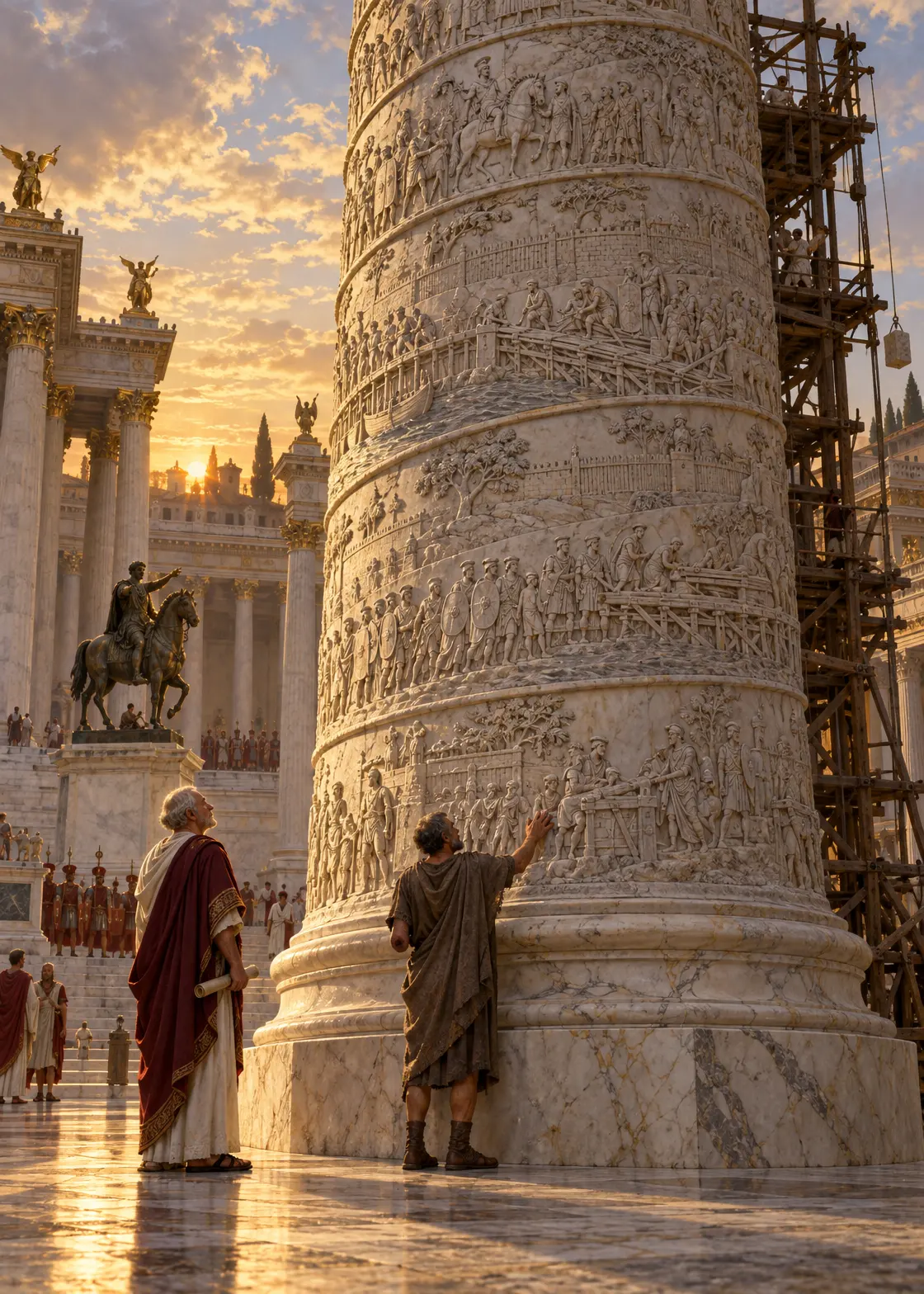
This volume carries the compendium across its widest arc and its strangest inversion. In span it must travel from the empire's absolute maximum — the year 117, when Roman garrisons stood on the Persian Gulf and the world-state governed from the Tyne to the Tigris — down through the long noon of the Antonines, the fever-crisis of the Marcomannic wars, the militarized recovery of the Severans, and into the fifty years the ancients themselves experienced as the world breaking: the third-century crisis, when emperors were minted and melted like the debased coinage that is its truest chronicle, when a Roman emperor knelt as a Persian king's mounting-block, when the empire split three ways and was hammered back into one by soldier-emperors from the Danube provinces whose grandfathers the legions had conquered. And in evidence the volume passes through the inversion its predecessor's Epilogue forecast: this is the best-attested age of Rome by stone and the worst by narrative. For Trajan's conquests — the greatest since Caesar — no history survives at all: the emperor's own commentaries are one sentence, Tacitus and Pliny stop short, and the wars must be read from a marble scroll wound around a column, from a trophy on the Dobruja steppe, and from the tombstone of the cavalry sergeant who caught Decebalus. For the crisis decades the situation is worse: Dio fails in 229, Herodian in 238, and beyond them yawns the swamp of the Historia Augusta — a collection of imperial biographies posing as six authors that is in fact one late liar of genius, whose every unsupported statement this compendium will treat as fiction wearing a toga. The Editor's Notes will therefore promote, more decisively than ever, the witnesses that cannot lie in prose: the coins, whose mints, weights, and silver-content graph the crisis better than any historian; the inscriptions and diplomas; the papyri; the walls, roads, and burnt villa-horizons; and the extraordinary new voice this volume admits from the far side of the frontier — the rock-cut trilingual boast of a Persian king, listing the Roman emperors he broke.
The volume's military thesis is the long stress-test. The instrument perfected in Book VI — the professional frontier army, some thirty legions and their auxilia strung along a fortified perimeter — meets in this volume every failure mode latent in its design. Against Dacia and Parthia it demonstrates its offensive ceiling: the world-state could still, when a soldier-emperor massed it, destroy any organized enemy on earth — and could not afford to hold what it took. Under Hadrian it is deliberately converted from a weapon into a wall, drilled to a peacetime perfection an emperor's own voice still praises from the parade-ground stone of Lambaesis, and the conversion's price falls due under Marcus, when plague and a moving world of peoples strike the perimeter at multiple points and the empire discovers that a linear defense has no depth, no reserve, and no answer to simultaneity. The Severans repair it with the only currencies available — pay, privilege, and expansion of the military establishment — and thereby complete the army's transformation into the empire's dominant political class; the third century is that class governing: emperors made and unmade by army groups, the frontier armies fighting each other for the purple while the frontiers themselves cave in, until the same Danubian officer-corps that had broken the empire builds, in the volume's final chapters, the new model that saves it — the mobile cavalry armies, the walled cities, the strategic depth — and hands it, in 284, to the Dalmatian soldier who will reorganize the world. Across the whole arc runs the deeper transformation the Editor will keep in view: the enemies change species. The tribal war-bands of Book VI consolidate into confederations — Marcomanni into the age of the Alamanni and Franks and Goths — and beyond the Euphrates the shabby-genteel Arsacids are replaced in 224 by the Sasanian revolution: a centralized, aggressive, ideological Persia, the first peer competitor Rome had faced since Hannibal, and the volume's true second protagonist.
A word on the sources' geography, since the apparatus must work differently here. The narrative spine, such as it is: Cassius Dio 68–80, contemporary and senatorial from Commodus onward (he commanded armies and survived councils he describes), but epitomated by Xiphilinus precisely across Trajan and the Antonines; Herodian, 180–238, readable and slippery; Fronto's correspondence with Marcus, and the emperor's own Meditations — a war-camp document from the Danube, admitted here as the interior voice of the Marcomannic wars; Ammianus's backward glances; the fourth-century epitomators (Aurelius Victor, Eutropius, Festus) drawing a lost common source of real value the moderns call the Kaisergeschichte; the Historia Augusta under permanent caution; Zosimus and the Byzantine excerptors for the crisis; Dexippus of Athens — the historian who fought the Herulians from his own city's barricades — recovered in fragments, some only lately, from palimpsest. Documentary and material, the volume's true archive: Trajan's Column and the Adamclisi trophy; the Tiberius Claudius Maximus stele; Hadrian's Lambaesis addresses and the Vindolanda-to-Wall continuum; the Bar Kokhba letters and the Babatha archive from the Judaean caves — a rebellion and a refugee's handbag, preserved verbatim; the Dura-Europos excavations, a garrison town killed mid-siege in the 250s with its papyri, its painted synagogue, and the oldest surviving physical evidence of chemical warfare in the mine under Tower 19; the Res Gestae Divi Saporis, the Persian king's trilingual rock inscription at Naqsh-e Rustam; the coin-hoards whose burial-dates map the invasions like seismographs; and the walls — above all the walls of Rome itself, begun by Aurelian, the volume's most eloquent single document: the capital of the world, unfortified for six centuries, putting on armor.
The reader is owed, finally, the same candor about register the previous Proems have given. This volume contains the empire's noon, and the compendium will not begrudge it: the Antonine peace was real, and a Mediterranean world of sixty millions living without war inside the perimeter is a human achievement the ledger must weigh. But the volume's darkness is of the crisis kind — cities that had forgotten walls learning to build them from their own tombstones and theater-seats; the plagues, the first in 165 and the second in 251, that may have killed more Romans than every enemy in this series combined; the depopulated fields and debased faith of the mid-century; and the price of the recovery, which was the militarization of everything, paid forward into the world of Book VIII. The method holds: the sources speak, the grades bind, the gaps are confessed — and where the narrative fails entirely, the Editor will say so plainly and read the stones.
We begin in 98, on the Rhine, where the new emperor — the first ever chosen by adoption for pure capacity, a Spaniard, a soldier the soldiers trusted — is inspecting the winter garrisons and reading intelligence files on a kingdom across the Danube that a treaty of Book VI left armed, subsidized, and unfinished.