Book VIII · The Last Age of the West
Chapter 1
The Tetrarchy and the Wars of Constantine
Diocletian: The Reorganized War284–305
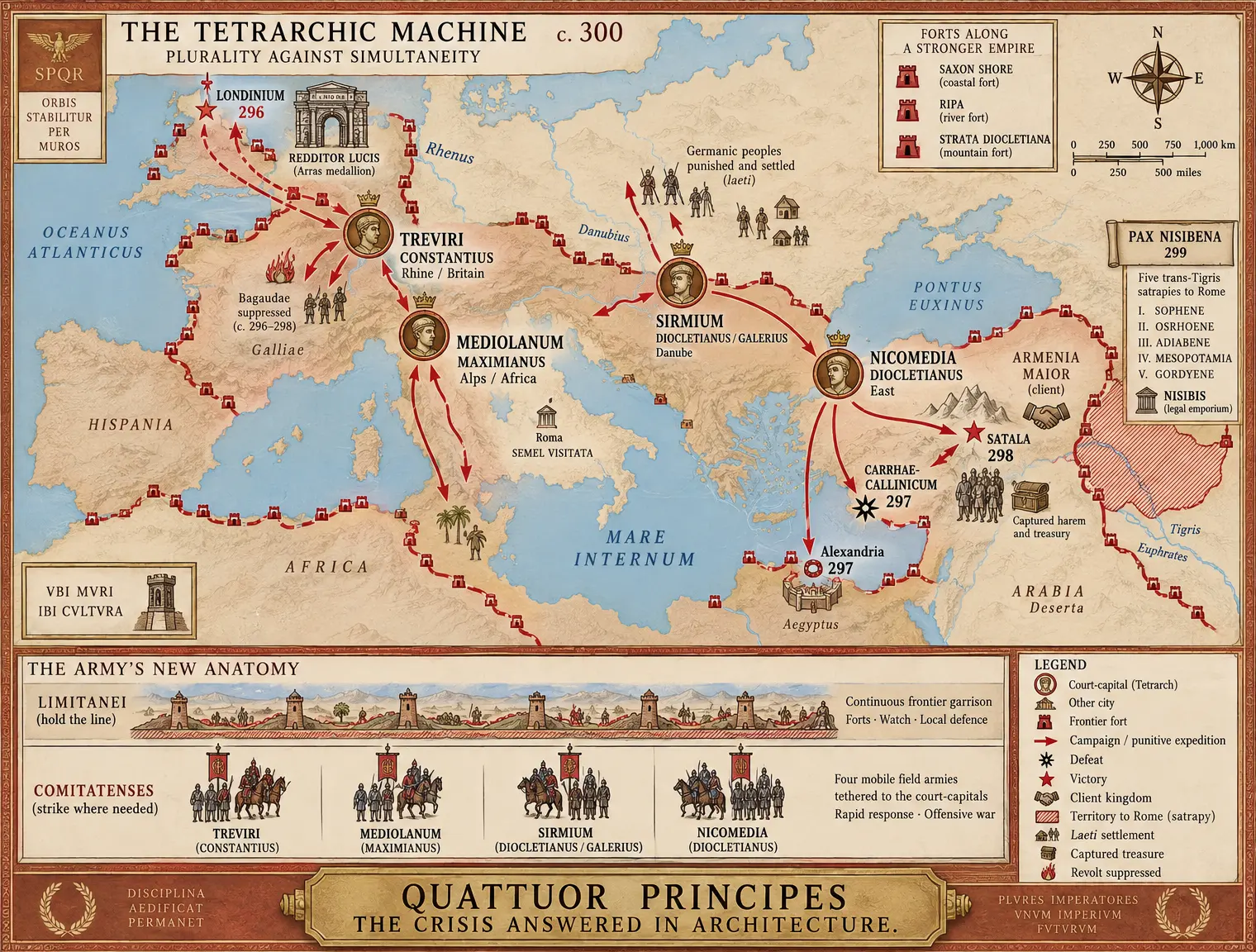
The reorganization the last volume ended by announcing was executed across twenty-one years with a system-builder's patience, and its military record — obscured by the reign's greater fame as an administrative revolution and a persecution — was the most successful of any reign in this compendium's second half: every war won, every frontier restored, no field disaster, and an abdication. The structure came first: within a year Diocletian had taken Maximian as colleague for the West (Augustus by 286), and in 293 completed the Tetrarchy with two Caesars, Constantius and Galerius — four emperors, four courts, four field armies, stationed not at Rome (which Diocletian visited once, late, and left early) but at the working capitals the strategy dictated: Nicomedia, Sirmium, Mediolanum, Trier. The system's military logic was the crisis's lesson: simultaneity answered with plurality, an emperor for every threatened front, usurpation pre-empted by making the probable usurpers colleagues. The reign's wars, compressed: on the Rhine and upper Danube, Maximian and Constantius broke Frankish and Alamannic incursions and settled the defeated inside the line as laeti; the Bagaudae — Gaul's peasant risings, the interior's first appearance in this series as a theater — were suppressed; Britain, seized in 286 by the fleet-commander Carausius (whose coinage, styling him a colleague of the emperors he defied, is the revolt's AGrade A voice) and held after him by his treasurer Allectus, was recovered in 296 by Constantius in a two-pronged Channel crossing through the fog, the event commemorated on the Arras medallion — the mounted emperor received at London's gate as REDDITOR LUCIS AETERNAE, restorer of the eternal light; Egypt's revolt under Domitius Domitianus was reduced by Diocletian in person with the eight-month siege of Alexandria (297), after which the southern frontier was drawn back to Philae and the Nobades subsidized to hold it; and in the East the reign fought the volume's first Persian war. Narses, Shapur's son, attacked Armenia in 296; Galerius, beaten in open country between Carrhae and Callinicum in 297 — the reign's one defeat, answered, the tradition says, by the emperor letting his purple-clad Caesar walk a mile before his carriage — rebuilt, struck through Armenia in 298, surprised the royal camp at Satala, captured the king's treasury, harem, and wives, and dictated the Peace of Nisibis of 299: Mesopotamia confirmed Roman with five trans-Tigris satrapies, Armenia enlarged under its Roman client, Nisibis the sole legal emporium — the most one-sidedly victorious eastern settlement in Roman history, and it held for forty years. Behind the wars, the machine: the provinces doubled in number and grouped under dioceses, civil and military career-paths severed, the army expanded (the fourth-century establishment's paper strength perhaps half a million) and re-equipped from state fabricae, the frontiers rebuilt in the squat, thick-walled, artillery-bearing fort-architecture whose remains from Britain's Saxon Shore to the Syrian strata Diocletiana are the reign's signature in stone; the whole funded by the new census and the annona's regularization — the crisis's emergency requisitions converted into the empire's permanent tax. On the first of May 305, in a ceremony on the hill outside Nicomedia where he had been acclaimed, Diocletian — first of all Roman emperors — abdicated, compelled his reluctant colleague to do the same, and retired to the palace-fortress at Split to grow, by the famous report, cabbages; the Editor marks the system's one great failure as the succession it was designed to solve: the Second Tetrarchy dissolved within eighteen months of its author's departure, because the sons the system had passed over — Maxentius in Rome, Constantine at York — declined to stay passed over, and the reorganized army proved as willing as the old one to be the instrument of its commanders' inheritance.
Constantine: The Civil Wars and the Christian Army306–337
The wars that ended the Tetrarchy occupied eighteen years and remade the world's religion, and the compendium narrates them as what they operationally were: the reunification of the empire by its best general. Constantine, acclaimed by his father's army at York in July 306, spent six years consolidating Gaul and Britain — Frankish kings thrown to the beasts at Trier, the Rhine bridged in stone at Cologne — while the system collapsed elsewhere (six Augusti at one point in 310, the count itself the verdict); in 312 he struck into Italy against Maxentius with a small, veteran field force, took Turin and Verona in the campaign's real fighting, and arrived before Rome, where Maxentius — abandoning the Aurelian walls that had defeated Galerius's and Severus's armies against every strategic logic, on the day of his accession-anniversary, with the Sibylline oracle promising the death of Rome's enemy — gave battle at the Milvian Bridge with the Tiber at his back and his bridge of boats behind him. The battle was brief: Constantine's cavalry broke the wings, the mass collapsed onto the pontoon crossing, the bridge failed, and Maxentius drowned in the press, his body recovered next day for its head. Above the campaign the tradition placed the vision — the cross of light over the sun, in hoc signo vinces, the dream, the Chi-Rho painted on the shields — transmitted in versions (Lactantius's dream, Eusebius's daylight sign sworn to him by the aged emperor decades later) that disagree in every particular except consequence; the Editor grades the vision as the compendium graded Sulla's dreams and the rain miracle — unrecoverable as event, AGrade A as the army's adopted fact — and notes what is materially certain: the Chi-Rho appears on Constantinian coinage and standards (the labarum) within the decade, the Arch of Constantine at Rome (315, built from spolia of Trajan, Hadrian, and Marcus — the visual history of Book VII dismantled to decorate its sequel) attributes the victory with studied vagueness to instinctu divinitatis, and the army of the West marched thereafter under a Christian monogram. The eastern reckoning came in two wars against Licinius — Cibalae and Campus Ardiensis in 316–317, the decade of armed truce, then the great campaign of 324: Adrianople stormed by feint and river-crossing in July, the Hellespont cleared by Crispus's fleet against Licinius's larger one, and the decision at Chrysopolis in September, after which the last colleague was interned at Thessalonica and, within the year, hanged. Constantine's sole reign (324–337) completed the military architecture this volume inherits: the field army formalized (comitatenses distinguished in law from ripenses by 325), the Guard abolished forever — the Praetorians, having backed Maxentius, were disbanded after the Milvian Bridge and their camp's walls slighted, closing an institution this compendium has watched kill emperors since Sejanus — and replaced by the scholae palatinae; the magistri militum created; Constantinople founded on the Bosporus (dedicated 330) as the strategic answer to the empire's actual center of gravity, equidistant from the Danube and the Euphrates; the Danube re-crossed in force (the Gothic war of 332, a client-treaty imposed on the Tervingi that held a generation; the stone bridge at Oescus; the Sarmatian interventions of 334) — and the reign ended in 337 with the emperor baptized on his deathbed at Nicomedia while the army he had rebuilt prepared the Persian war he did not live to fight, and his dynasty opened its succession, in the compendium's oldest pattern, with a massacre of its own collaterals.
The Crossroads · 312 · Before Rome, at the Tiber and the Aurelian walls
The Choice at the Milvian Bridge
You are Maxentius, holding Rome against the advancing army of Constantine.
In 312, Constantine struck into Italy with a small, veteran field force, taking Turin and Verona in hard fighting, and has arrived before Rome. You hold the city with your mass of troops and the Praetorian Guard. Rome is enclosed by the Aurelian walls, which successfully defeated the invading armies of Galerius and Severus. But today is your accession-anniversary, the Sibylline oracle has promised the death of Rome's enemy, and your bridge of boats spans the Tiber toward the Milvian Bridge. You must decide whether to shelter behind the fortifications or offer battle outside.
Will you hold the Aurelian walls against Constantine, or march out across the Tiber to give battle at the Milvian Bridge?
Weigh each course: open it to hear your own inner voice. Then decide. Nothing is scored.
- Your inner voiceThe course taken
The Aurelian walls have already defeated the armies of Galerius and Severus against every assault. Constantine commands only a small field force after the fighting at Turin and Verona, and he cannot breach these fortifications. Rome is well supplied, our defenses are secure, and we need not gamble our Praetorians in the open. If we stay behind our ramparts, his campaign will starve and dissolve outside the gates.
- Your inner voiceThe course taken
Today is the anniversary of my accession, and the Sibylline oracle has promised that the enemy of Rome will perish this day. We cannot cower behind stone while an invader threatens our city. With the Praetorian Guard and our superior mass, we can overwhelm his small force in open country. We will cross the bridge of boats, deploy at the Milvian Bridge, and destroy Constantine before Rome.
- Your inner voiceThe course taken
Deploying across the Tiber leaves the river at our back, where any reverse could turn our pontoon crossing into a trap. Yet waiting passively behind the Aurelian walls surrenders the approaches without a blow. We should dismantle the crossings, hold the southern riverbank with our mass, and contest the river line directly. Constantine's cavalry cannot charge across the water, and his veterans will stall before Rome.
What was done
Maxentius abandoned the Aurelian walls and gave battle at the Milvian Bridge with the Tiber at his back and his bridge of boats behind him. The battle was brief: Constantine's cavalry broke the wings, the mass collapsed onto the pontoon crossing, the bridge failed, and Maxentius drowned in the press, his body recovered the next day for its head. Constantine entered Rome in triumph. His victory remade the state's military and religious order: the Praetorians, having backed Maxentius, were abolished forever and their camp's walls slighted, while the army of the West marched thereafter under the Christian Chi-Rho monogram. The campaign's famous vision remains unrecoverable as an event but stands as the army's adopted fact (AGrade A). In 315, the Arch of Constantine at Rome attributed the victory with studied vagueness to instinctu divinitatis, decorating the monument with spolia dismantled from Trajan, Hadrian, and Marcus.
The evidence The battle-tactics and interior course of the Milvian Bridge are rated CGrade C, reconstructed from partisan accounts and a relief. Motive-assignments in Lactantius (De mortibus persecutorum, BGrade B for Nicomedia events, DGrade D for motives) and providential causation in Eusebius (Vita Constantini, AGrade A for quoted documents, CGrade C–D for narrative) carry DGrade D. The Latin panegyrics provide the campaign framework (BGrade B), supplemented by Zosimus 2, Aurelius Victor 39–41, and Eutropius 9–10 (all CGrade C). Material evidence includes Constantinian coinage and the Arch of Constantine (AGrade A). The Editor notes that the topography of the Milvian Bridge is only generally fixed.
If you choose to walk through itAt every scale
- Yourself
How far should a ruler trust prophecies, religious omens, and auspicious anniversaries when they urge action contrary to established military logic?
- Those beside you
What obligation does a commander owe to the veteran troops and palace guards whose lives depend directly on the tactical position he selects?
- Rome
When an empire splits between rival claimants, does preserving the capital behind impregnable fortifications protect its political legitimacy, or does refusal to meet an invader in the field surrender moral authority?
- The wider world
How does the sudden collapse of an imperial regime reshape the religious allegiances and military balance of surrounding subject peoples?
- Our own time
In moments of acute crisis, why do political and military leaders often abandon cautious, defensive strategies in favor of high-risk gambles for absolute victory?
During the 1759 siege of Quebec, the defending French command held an elevated, fortified city that had resisted British naval bombardments throughout the summer. When the British army made an unexpected landing on the heights above the river, the defenders chose not to endure a siege behind their stone ramparts. Instead, fearing the enemy would consolidate, they marched out onto the Plains of Abraham for an immediate pitched battle, where their formations broke within minutes, forfeiting the fortress.
Where the comparison fails. The comparison fails because the defenders at Quebec faced potential starvation from a complete maritime blockade and had no vast numerical superiority, whereas Maxentius enjoyed secure urban depots, the formidable Aurelian walls, and a numerically superior force within his own capital.
What does the chapter tell us?
Why did Diocletian's Tetrarchic succession system collapse within eighteen months of his abdication in 305?
The chapter explains that the Second Tetrarchy failed because the passed-over sons, Maxentius in Rome and Constantine at York, refused to remain sidelined, and the reorganized army proved just as eager as the old one to serve as the vehicle for commanders' dynastic inheritance.
the chapter's narrative
Why was Maxentius's decision to offer battle at the Milvian Bridge considered contrary to strategic logic?
Maxentius abandoned the massive Aurelian walls that had already defeated the full-scale invasions of Galerius and Severus. By sallying out, he placed his army in open country with the Tiber and a fragile bridge of boats at his back.
the chapter's narrative
How does the chapter evaluate the traditional accounts of Constantine's vision before the Milvian Bridge?
The Editor treats the vision like Sulla's dreams: unrecoverable as a factual event due to conflicting sources (Lactantius and Eusebius), but AGrade A as the army's adopted fact, since the Chi-Rho appeared on standards, coins, and the western army's shields.
Editor's Note (AGrade A / CGrade C–D)
What major institutional reform immediately followed Constantine's victory at the Milvian Bridge?
Because the Praetorians had supported Maxentius, Constantine disbanded the Guard permanently and slighted their camp walls, terminating an institution that had intervened in imperial accessions since Sejanus, and replaced them with the scholae palatinae.
the chapter's narrative
According to the Editor's Note, which source provides the narrative framework for Carausius's revolt and much of the Rhine warfare, and what grade does it carry?
The Editor's Note states that the Latin panegyrics are official occasion-prose rated BGrade B for campaign frameworks once flattery is removed, and they serve as the sole narrative for Carausius's fall and Rhine campaigns.
Editor's Note (BGrade B)