Book VIII · The Last Age of the West
Chapter 2
The House of Constantine at War: Persia, Strasbourg, and the Road to Ctesiphon
The Brothers' Wars and the Persian Front337–353
The dynasty opened with the murder of most of itself — the summer massacre of 337, in which the army at Constantinople killed two half-brothers of the dead emperor and seven cousins, sparing two boys, and the tradition's assignment of responsibility to Constantius II was contested then and is unresolvable now — and then divided the world three ways among the sons: Constantine II the far West, Constans Italy-Africa-Illyricum, Constantius the East, an arrangement that lasted until 340, when the eldest invaded his brother and died in an ambush at Aquileia, and 350, when Constans was hunted down by the agents of the usurper Magnentius, a Frankish-descended field officer proclaimed in Gaul. The decisive fraternal war was therefore Constantius against Magnentius, and its decision at Mursa in Pannonia on 28 September 351 was the fourth century's costliest day: the epitomators' figures — twenty-four thousand of Magnentius's fifty-four thousand, thirty thousand of Constantius's eighty — are tradition's arithmetic, but the tradition's verdict is unanimous and the Editor endorses its substance: a Roman bloodletting, cavalry-decided (the eastern clibanarii and mounted archers breaking the western legions against the Drava), from which the western field army never fully recovered, its veterans spent three years before the Rhine's defense would need them; Magnentius fell back through Italy and Gaul to die on his own sword at Lyon in 353. Meanwhile the East fought the war Constantine had left in the files. Shapur II — crowned before birth, by the tradition, and reigning seventy years — reopened the Mesopotamian war in 337/8, and for twenty-five years it ran as a siege-war on the fortress-line the Peace of Nisibis had drawn: Nisibis itself thrice besieged (338, 346, 350) and thrice held — the third siege the epic of the age, Shapur damming the Mygdonius to float siege-craft and collapse the wall by flood, the breach assaulted by elephants and armored cavalry across the mud and the city living because the garrison walled the gap in a night — Singara the site of the one great field battle (344 or 348), a Roman day lost by night when the pursuing army stormed the Persian camp and was destroyed in it by moonlight and archery; Amida's nine-week agony belongs to the next section because Ammianus was inside it. The Editor marks the front's character for the volume's argument: this was positional, engineering-heavy, attritional warfare between peer states — the limitanei and the fortress-architecture of Chapter 1 doing exactly what they were built for — and it held.
Julian: Strasbourg and the Persian Catastrophe355–363
The reign's last decade belongs to the cousin the massacre spared. Julian — twenty-three, a student of philosophy with no military hour behind him — was created Caesar in 355 and sent to a Gaul wrecked by the civil war's stripping of the Rhine: Cologne fallen, forty-five towns sacked, the Alamanni settled on the left bank. What followed made him, and the compendium has the luxury, unique in this volume, of narrating it through a great historian who served in the theater: Ammianus's books carry the campaigns of 356–358 — Cologne recovered, the Rhine line re-bridged, the supply-fleet from Britain reinstituted — and their crown at STRASBOURG (Argentoratum), August 357: Julian with perhaps thirteen thousand against the confederated Alamanni under Chnodomar, thirty-five thousand by the account; the Roman cavalry broken at the outset — the mailed cataphracti bolting through their own infantry, rallied by the Caesar in person with the shame-speech Ammianus stages; the infantry battle the account's core, the Alamannic wedge splitting the first line, the primani legion holding the second like a wall; the collapse and the drowning pursuit to the Rhine, six thousand Alamanni dead on the field against two hundred and forty-three Romans by the historian's count — printed as the historian's — and King Chnodomar taken. Strasbourg restored the Rhine for a generation, and the sequel restored the pattern of the age: the army of Gaul, ordered east in 360 to feed Constantius's Persian war, mutinied at Paris and raised Julian on a shield — the acclamation German in form, the historian notes, as the army now half was — and civil war was prevented only by Constantius's death in Cilicia in November 361, leaving Julian sole Augustus: the last pagan, the emperor-philosopher, and the author of this compendium's final author-is-subject corpus, whose reign of twenty months was consumed by the religious restoration and the preparation of the war that ended it. The Persian expedition of 363 was the East's largest offensive since Trajan: sixty-five thousand men, a fleet of over a thousand river-craft, a feint through Armenia under Procopius, the main army down the Euphrates — Ammianus marching in it — through the canal into the Tigris, the fortress-towns stormed or bypassed in sequence, a pitched victory won under the walls of CTESIPHON in late May; and then the campaign's self-destruction, in the sequence the sources dispute and the Editor prints as the participant reports it: the council's judgment that the capital could not be besieged, the decision to march inland to join Procopius, and the burning of the fleet — a thousand ships, the army's bridge and granary, fired at the emperor's order to free their crews for the column and deny them to Persia, the act every subsequent tradition treated as the death-warrant; then the scorched-earth withdrawal up the Tigris in the June heat, the Persian shadow-army's daily stings, and on 26 June, in a rearguard action near Samarra (Maranga), the emperor — riding unarmored into the melee — took a spear through the ribs and died at midnight in his tent, thirty-one years old, discoursing (the deathbed scene is Ammianus's, who says he was there or nearly) on the soul. The army, starving and boxed, elected the guards-officer Jovian, and the price of extraction was the Peace of 363: the five trans-Tigris satrapies of 299 returned, Singara and the fortresses ceded, and NISIBIS — thrice-defended, never taken — handed to Persia intact, its Roman population marched out; Ammianus, who watched the evacuation, made it the Res Gestae's bitterest page, the crowds at the gates, the man carrying his household gods, the city that had held the East given away by treaty; and the Editor closes the chapter on his verdict and its audit: the historian blamed the shameful peace; the arithmetic blamed the burned fleet; and the frontier the treaty drew — Nisibis Persian, the line withdrawn — proved, in the volume's longest irony, durable: the East's next great war with Persia was a hundred and forty years away.
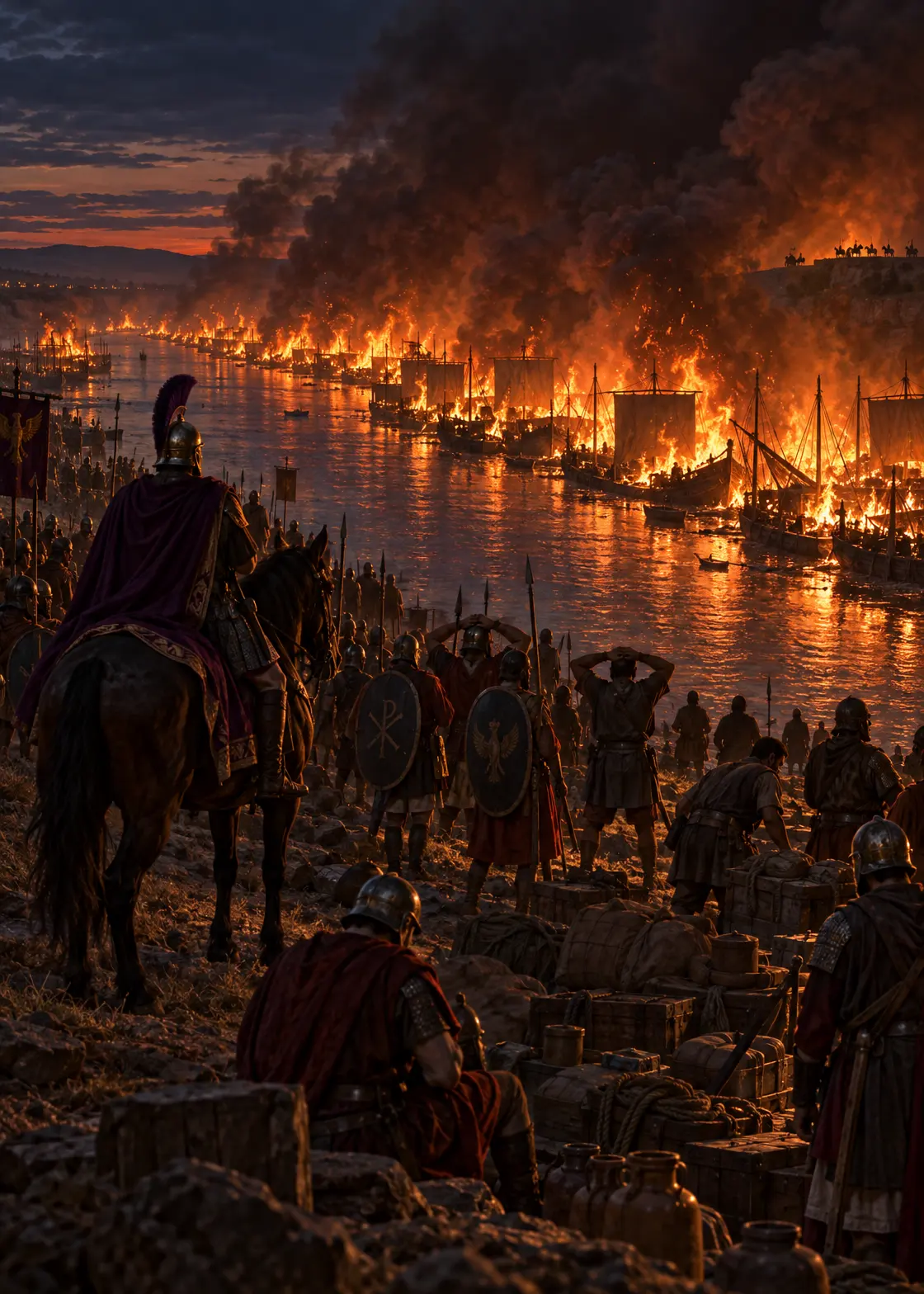
The Crossroads · Late May 363 · Outside the walls of Ctesiphon, on the Tigris
The Fleet at Ctesiphon
You are Julian, sole Augustus, commanding the Roman expeditionary army outside the Persian royal capital of Ctesiphon.
Your army of sixty-five thousand men has marched down the Euphrates, crossed through the canal into the Tigris, and won a pitched victory under the walls of Ctesiphon. Yet the capital stands heavily fortified, and your council of war concludes it cannot be besieged. Upstream, a separate Roman force under Procopius operates in Armenia, but you have no link with it. Your thousand river-craft supply the army as a bridge and floating granary, but they cannot easily be towed upstream against the Tigris current, and guarding them ties down thousands of men while Shapur's shadow-army gathers.
Do you lay siege to Ctesiphon, withdraw back along the river with the fleet, or burn the ships and strike inland to link with Procopius?
Weigh each course: open it to hear your own inner voice. Then decide. Nothing is scored.
- Your inner voiceThe course taken
If Ctesiphon cannot be besieged, prudence urges us to fall back along the waterways we opened from the Euphrates. Keeping the thousand river-craft preserves our food, our bridge, and our wounded under steady protection. Yet rowing or towing against the river current will be painfully slow, exposing our flank to Persian cavalry while forfeiting any link with Procopius or a decisive triumph over Shapur.
- Your inner voiceThe course taken
We hold the field outside Ctesiphon after our victory beneath its ramparts, yet the council concludes the capital cannot be taken by siege. To invest such fortifications deep in hostile territory risks pinning our sixty-five thousand men under the summer sun while Shapur gathers his forces. Yet turning away from the royal seat after defeating them at their gates admits our offensive has reached its end.
- Your inner voiceThe course taken
Our thousand vessels cannot ascend the Tigris against the strong current, and guarding them drains fighting men from our ranks. If I fire the fleet, those crews join the marching column, the ships are denied to Persia, and we can strike inland to join Procopius. It is a daring hazard, for we destroy our floating granary and bridge, staking everything on uniting our armies.
What was done
Julian ordered the thousand river-craft burned to deny them to Persia and free their crews for the ranks, then turned the army inland to march up the Tigris toward Procopius (AGrade A). The campaign rapidly unraveled in the June heat. Marching through scorched earth while harassed daily by the Persian shadow-army, the Roman column starved. On 26 June 363, near Samarra (Maranga), Julian rushed unarmored into a rearguard skirmish, took a spear through his ribs, and died at midnight in his tent at thirty-one years old (BGrade B). The trapped, starving army acclaimed the guards-officer Jovian and purchased extraction through the Peace of 363: returning the five trans-Tigris satrapies, ceding Singara and border fortresses, and surrendering the intact fortress of Nisibis, whose weeping citizens were evacuated from the city that had repelled three Persian sieges (AGrade A).
The evidence Ammianus Marcellinus 14–25 (AGrade A participant history, audited); Julian's own works (AGrade A, parti pris); Festus 28–29 and Eutropius 10 (BGrade B/C, campaign veterans); Zosimus 2–3 (CGrade C, preserving Magnus of Carrhae's participant account); Libanius 17–18 (CGrade C); and Ephrem the Syrian's Carmina Nisibena (AGrade A local witness to the evacuation). The Editor notes that the fleet-burning and the inland march are AGrade A as events, but remain permanently disputed as strategic decisions.
If you choose to walk through itAt every scale
- Yourself
Did Julian's philosophical confidence and desire to rival Trajan blind his judgment to the material constraints of desert warfare?
- Those beside you
How far should military advisers press their dissent when an emperor's strategic conviction puts the lives of sixty-five thousand men at hazard?
- Rome
Can an empire's prestige survive the deliberate sacrifice of long-defended border fortresses to purchase the survival of an encircled field army?
- The wider world
How did the sudden transfer of Nisibis and the frontier satrapies reshape the security of Mesopotamian populations living between two rival empires?
- Our own time
Under what pressures do expeditionary leaders convince themselves that eliminating their own logistical safety net will compel tactical success?
In 1941, during deep armored thrusts into the Soviet interior, military commands frequently outran their logistical railheads and supply depots, gambling that rapid offensive encirclement would collapse enemy resistance before fuel and food failed. When defending armies scorched the countryside and held fortified centers, advancing spearheads found their operational mobility paralyzed by distance, climate, and supply exhaustion.
Where the comparison fails. Unlike ancient river fleets, modern industrial warfare depends continuously on bulk petroleum, mechanized transport, and aerial replenishment, leaving armored forces incapable of surviving even brief self-inflicted logistical cuts, whereas Roman legionaries could still attempt an overland march on carried rations.
What does the chapter tell us?
At the Battle of Strasbourg in 357, what tactical development prevented a Roman defeat after the cavalry broke?
Ammianus records that after the mailed cataphracti bolted through their own lines, Julian rallied them in person while the primani legion held the second line like a wall against the Alamannic wedge, turning the battle.
Ammianus Marcellinus 14–25 (AGrade A, audited)
Why does the chapter characterize the Battle of Mursa in 351 as the fourth century's costliest day?
Mursa pitted Constantius II against Magnentius, costing an estimated fifty-four thousand Roman casualties. The slaughter gutted the western field army three years before the stripped Rhine frontier faced major Alamannic invasions.
Zonaras and the Epitome (CGrade C)
What primary rationale led Julian to order the destruction of his river fleet outside Ctesiphon?
The fleet of over a thousand craft could not navigate upstream against the strong Tigris current without huge escorts. Julian chose to burn them to reinforce his infantry with their crews and prevent enemy capture.
Ammianus Marcellinus 14–25 (AGrade A)
What territorial concessions were required by the Peace of 363 to allow Jovian's army to escape?
To extract the starving, surrounded army, Jovian yielded the five satrapies taken in 299, surrendered Singara and frontier fortresses, and handed over Nisibis intact, forcing its Roman citizens to evacuate.
Ammianus Marcellinus 14–25 (AGrade A) and Ephrem the Syrian (AGrade A)
How did the frontier drawn by the Peace of 363 function over the long term?
Although Ammianus condemned the treaty as shameful, the border established by Jovian's concessions held firm, and Rome did not fight another major war with Persia for a hundred and forty years.
the chapter's narrative