Book VIII · The Last Age of the West
Chapter 3
Adrianople and the Gothic Settlement
The Pannonian Brothers and the Fortified Peace364–375
The election that followed Jovian's brief reign (he died in his sleep on the road home, of charcoal fumes or surfeit, eight months after signing the peace) produced the last effective military dynasty of the undivided empire: Valentinian I, a Pannonian officer of harsh competence, who took the West and gave the East to his brother Valens — the division of 364 at Naissus, the field armies and their commanders partitioned by list, was meant as administrative and proved, in retrospect, the empire's permanent parting. Valentinian's eleven years were the frontier's last great maintenance overhaul, and Ammianus, who admired the work and feared the man, records both: the Alamannic war fought to a decision at Solicinium (368) and settled by fortification and assassination alike; the Rhine-Danube line rebuilt in the reign's signature program — the burgi, watchtowers, and bridgehead-forts whose building inscriptions cluster in the 360s-370s more densely than any period since Hadrian, the emperor himself dying of apoplexy in 375 while berating Quadic envoys who had complained of a fort built on their bank; Britain restored by the elder Theodosius after the "barbarian conspiracy" of 367 — Picts, Scots, and Saxons in concert with mutinied frontier-scouts, the diocese overrun and re-secured in two campaigning seasons; Africa's Firmus revolt broken by the same general, whose reward, in the age's grammar, was execution in a court intrigue at Carthage in 375/6. The Editor marks the reign for the volume's ledger as the demonstration that the fourth-century system, adequately led and funded, still worked: every breach sealed, every field war won, the frontier physically stronger at Valentinian's death than at any hour since the Severans — and its keeper's death leaving the West to a four-year-old (Valentinian II) and a sixteen-year-old (Gratian), and the East to the brother whom Ammianus introduces with the epithet the next section justifies: ignavus was never said, but every page implies a man promoted past his ceiling.
The Crossing and the Catastrophe376–378
The crisis began as a humanitarian appeal. In 376 the Tervingian Goths — Constantine's clients of 332, their world broken by the Hunnic irruption out of the steppe that had destroyed the Greuthungi and killed Ermanaric — appeared on the lower Danube in the tens of thousands begging admission: land for military service, the laeti-bargain this volume has watched work for a century. Valens, at Antioch with his army committed against Persia, granted it — a controlled crossing of the Tervingi under Fritigern, the Greuthungi refused — and the operation's execution converted policy into catastrophe: the crossing barely controlled (Ammianus's image is Vergil's leaves and sands), the disarmament corrupted away, and the provisioning plundered by the very commanders responsible — the count Lupicinus selling the refugees dog-flesh at the price of a child per dog, the detail the historian records as the war's true cause; when Lupicinus then bungled an assassination of the Gothic leadership at a banquet in Marcianople (377), the people he had starved became the army he had armed, and Thrace burned for two years — the refused Greuthungi crossing unopposed, Gothic slaves and miners guiding the columns to the hidden granaries, Roman field forces fighting the drawn nightmare at Ad Salices, the passes lost, Hun and Alan horse hired into the Gothic mass. The reckoning came on 9 August 378 outside ADRIANOPLE. Valens, back from the East with the eastern field army — perhaps twenty to thirty thousand, the modern range — declined to wait for Gratian marching from the West with the victorious army of the Rhine (the sources divide between jealousy of his nephew's laurels and intelligence underestimating Fritigern's numbers at ten thousand; the Editor prints both and notes they are compatible), marched eight miles in August heat, and deployed against the Gothic wagon-laager with negotiations still half-open when two Roman units charged without orders. The battle Ammianus reconstructs is Cannae's shape reassembled by accident: the Roman cavalry of the left committed piecemeal and shattered by the sudden return of the Gothic horse — Alatheus and Saphrax's Greuthungian and Alan cavalry, absent foraging, arriving onto the field's flank "like a thunderbolt" at the precise fatal minute — the infantry mass compressed by its own numbers against the laager until, in the historian's terrible phrase, the field was so packed the dead could not fall; the rout at dusk; two-thirds of the eastern field army destroyed, thirty-five tribunes, the magistri Traianus and Sebastianus, and the emperor — dead in the press by one account, burned alive by another in a farmhouse his guards defended too well, his body never found. Ammianus, closing his history with the disaster, reached for the comparison this compendium has been holding since Book II and used it: no battle in our annals brought such slaughter save Cannae — and the Editor audits the sentence the way the whole series has taught: as arithmetic it is wrong (Cannae's dead were greater); as history it is exact, because the Republic of Book III could replace its dead and the East of 378 could not, and because Cannae's victor had no way to stay, while Adrianople's victors were already inside the walls' world, with their families, their wagons, and nowhere to be sent back to.
Theodosius and the Price of the Peace379–395
The settlement that followed created the fifth century. Theodosius — the executed general's son, called from Spanish retirement by Gratian in 379 — spent four years learning what Adrianople had proved: the Goths could not be destroyed (his rebuilt army's one major attempt broke), could not be expelled, and could no longer be dissolved into the recruitment-stream individually as every previous admitted people had been; and the treaty of 3 October 382 accordingly conceded what no treaty had: settlement in Thrace as an intact people under their own chieftains, land, annual subsidies, and military service as allied contingents under their own commanders — foederati in the new, fatal sense, an armed nation inside the empire, bound to the emperor personally rather than to the state. The Editor grades the deal as its makers could not: it was the least-bad option available in 382, it restored the Balkans within the decade, it supplied the armies that fought the reign's civil wars — and it created the template by which the western empire would, over the next ninety years, transfer province after province to the management of allied kings, and the precedent that a people's price rose with its service. The reign's remaining wars were Roman against Roman, and they consumed exactly the armies the frontier needed: Magnus Maximus, Britain's usurper, who killed Gratian in 383 and took the West to the Alps, destroyed in 388 at the Save; and the war of 394 against Eugenius — the rhetoric-teacher raised by the Frankish generalissimo Arbogast after Valentinian II was found hanged — decided on 5–6 September at the FRIGIDUS in the Julian Alps: the first day a slaughter of the Gothic federate vanguard (ten thousand dead, the sources' figure, and Orosius's cold observation that Theodosius won two wars there); the second day the famous bora — the mountain wind that blew down the pass into the western army's faces, tearing shields from arms, canonized instantly as the Christian God's answer to Jupiter's statues on the ridge; the Editor grades the wind as the rain of Book VII was graded — meteorologically ordinary, evidentially certain, theologically annexed within the year. Theodosius died at Milan four months later, in January 395, the last man to rule the whole empire; the division between his sons Arcadius and Honorius — ten and eighteen, both ciphers — was intended as every division since 364 had been intended, and became, because no hand ever again joined the halves, the end of the undivided Roman state; and at the same hour, in the Balkan federate settlements, the subsidies lapsed, the treaty's personal bond to the dead emperor dissolved, and the Goths of 382 elected as their king the young officer who had led their contingent up the Frigidus pass and counted the ratio of Gothic to Roman dead: Alaric. The volume's last act stands assembled.
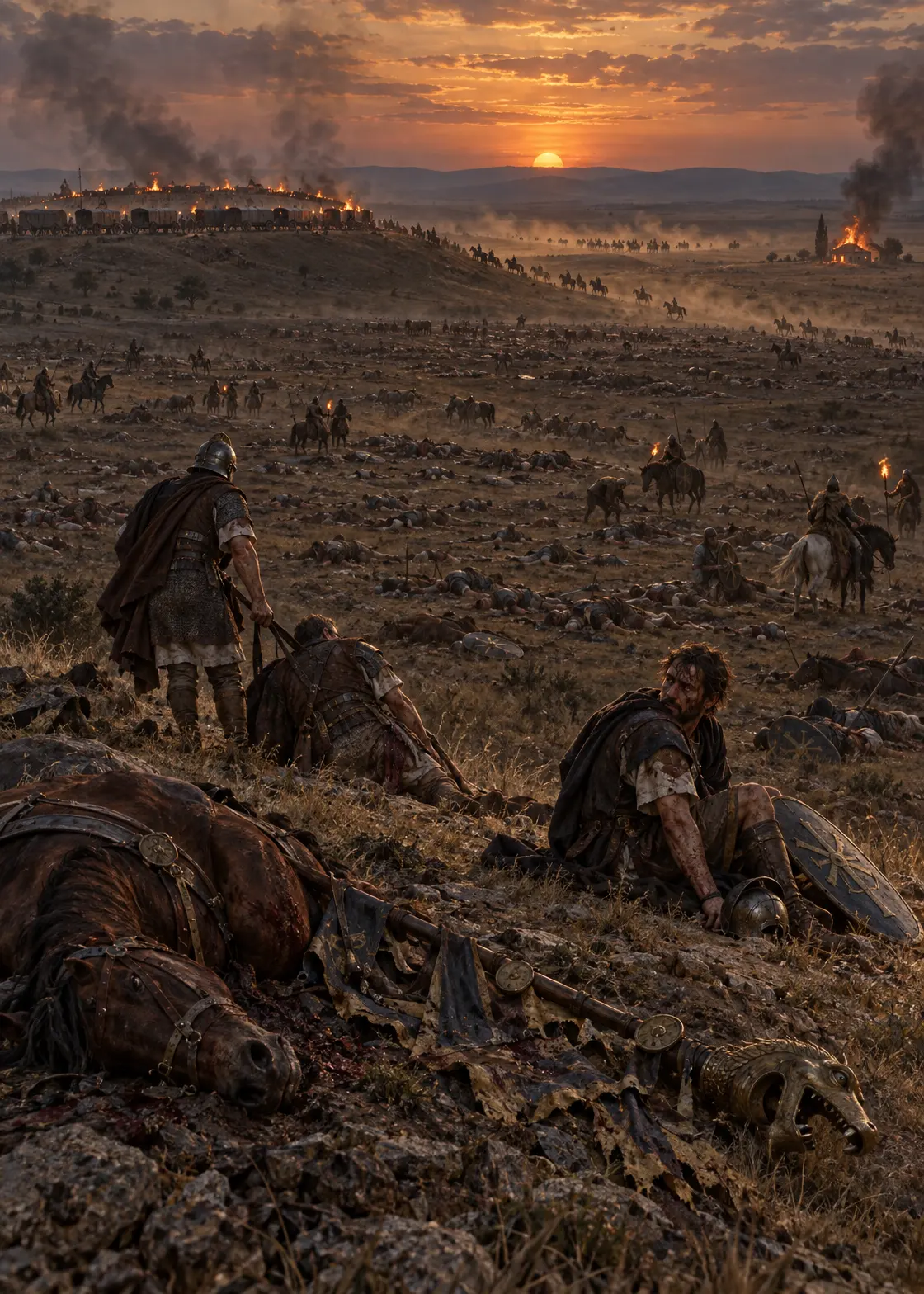
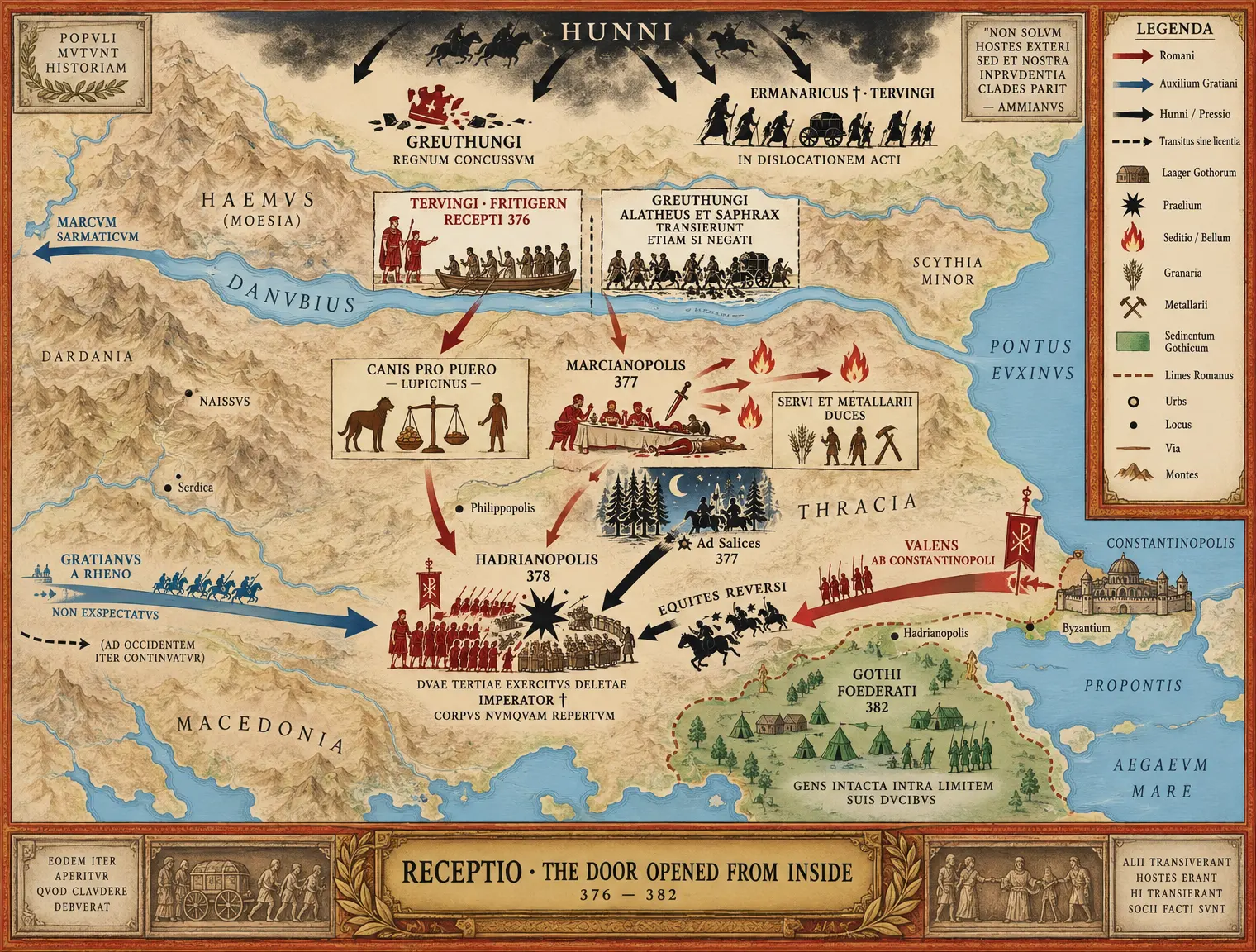
The Crossroads · 9 August 378 · Eight miles outside Adrianople, Thrace
The Road to the Wagon-Laager
You are Valens, Augustus of the East, encamped outside Adrianople with your eastern field army.
After two years of devastation across Thrace sparked by Lupicinus's catastrophic mismanagement and the slaughter at Marcianople, you have returned from the Persian frontier with the eastern field army. Fritigern's Goths are entrenched behind their wagon-laager eight miles away, with intelligence placing their force at ten thousand men. Meanwhile, your nephew Gratian marches from the West with the victorious army of the Rhine, urging you to await his arrival so both imperial armies can strike together. Gothic envoys have arrived offering negotiations, but your staff is split between those urging caution and those eager to seize a solitary triumph before the Western court arrives to claim the laurels.
Do you hold your positions to unite with Gratian's incoming Western legions, or march immediately to destroy the Gothic wagon-laager under your own command?
Weigh each course: open it to hear your own inner voice. Then decide. Nothing is scored.
- Your inner voiceThe course taken
Gratian's Rhine veterans are already marching eastward through the Balkans. Uniting our field forces guarantees overwhelming numerical superiority against the barbarian laager and spares my soldiers unnecessary hazard. Yet waiting means sharing imperial prestige with my sixteen-year-old nephew, whose court already celebrates his youthful victories while whispering of my delays. It also leaves Thracian estates to burn beneath Gothic foraging parties while two emperors hesitate behind camp ramparts.
- Your inner voiceThe course taken
Fritigern has sent envoys and parleys remain half-open. These Tervingi originally sought our protection as clients two years ago; if we can renew the pact of land in exchange for military recruitment, we salvage vital manpower without rolling the iron dice of pitched battle. Yet trusting chieftains whose children were starved at Marcianople is perilous, and my legions, burning for revenge, will interpret parley as imperial weakness.
- Your inner voiceThe course taken
Intelligence reports Fritigern commands barely ten thousand warriors behind his barricade. My eastern field army numbers twenty to thirty thousand strong, seasoned and eager to avenge two years of Thracian humiliation. If we march those eight miles now, the victory belongs to the East and to me alone, silencing every critic who calls me sluggish. Why should Gratian claim the harvest of a campaign my treasury has carried?
What was done
Valens chose not to wait. He marched his army eight miles through the August heat and deployed before the Gothic wagon-laager outside Adrianople while negotiations were still half-open. Two Roman units charged without orders, precipitating a general engagement. The battle reassembled Cannae by accident: the Roman left-wing cavalry committed piecemeal and was shattered when Alatheus and Saphrax's Greuthungian and Alan horse returned unexpectedly from foraging onto the flank like a thunderbolt. Pressed against the laager, the Roman infantry was so densely packed that the dead could not fall. By dusk, two-thirds of the eastern field army was destroyed, including thirty-five tribunes and the magistri Traianus and Sebastianus. Valens perished—whether cut down in the press or burned inside a defended farmhouse—and his body was never found (AGrade A for the battle's occurrence and emperor's fall; BGrade B for tactical sequence; CGrade C for motives).
The evidence Ammianus Marcellinus books 26–31 provides a contemporary AGrade A account of the crossing, the provisioning scandal, the battle's occurrence, and the emperor's death, though his tactical reconstruction is graded B and Valens's inner motives CGrade C. The church historians Socrates and Sozomen preserve transmitted facts (BGrade B) but offer theological explanations (DGrade D). Eunapius (via Zosimus 4) offers a hostile parallel tradition (CGrade C). The exact battlefield remains unlocated.
If you choose to walk through itAt every scale
- Yourself
How does the fear of being judged inadequate or overshadowed by a younger colleague distort a commander's assessment of military risk?
- Those beside you
When senior advisers suspect that field intelligence undercounts enemy numbers, what responsibility do they bear to challenge a sovereign eager for battle?
- Rome
Can an empire partitioned administratively between two imperial courts maintain strategic unity when both halves compete for military glory?
- The wider world
What obligations of justice and protection does an imperial power owe to a refugee population once its own provincial officers break faith?
- Our own time
How can modern alliances prevent member states from launching unilateral operations driven by domestic political prestige rather than collective security?
In September 1944, during Operation Market Garden, Allied commanders launched an aggressive airborne thrust deep into the Netherlands to seize Rhine bridges before winter. Spurred partly by rivalry between competing allied army groups and relying on flawed intelligence assessments that discounted surviving German armored strength, the isolated British airborne division at Arnhem was overwhelmed by unexpected elite armor before ground columns could arrive.
Where the comparison fails. Market Garden was an airborne spearhead within an industrialized coalition that rapidly replaced its materiel losses and evacuated surviving personnel, whereas the Roman disaster at Adrianople destroyed irreplaceable field armies and permanently compromised imperial frontier security.
What does the chapter tell us?
What primary catalyst transformed the Tervingian crossing of the Danube in 376 from a managed admission into an armed uprising?
Ammianus records that Roman officers, notably Count Lupicinus, exploited the refugees by trading dog-flesh for children and subsequently bungled an attempt to assassinate Gothic leaders at a banquet in Marcianople, driving the starved Goths to open rebellion.
Ammianus 26–31 (AGrade A)
Why does the chapter argue that Adrianople was historically comparable to Cannae despite Cannae having a higher death toll?
While Cannae involved greater arithmetic casualties, the Roman Republic had the reserves to rebuild its armies while Hannibal could not remain permanently; after Adrianople, the empire could not replace its field army and the Goths were already settled inside the borders.
the chapter's narrative
What tactical development turned the battle outside Adrianople into a catastrophic Roman defeat?
While Roman cavalry engaged piecemeal, the absent Greuthungian and Alan cavalry led by Alatheus and Saphrax returned unexpectedly from foraging like a thunderbolt, shattering the Roman horse and compressing the infantry against the wagon-laager.
Ammianus 26–31 (AGrade A/B)
What unprecedented concession characterized Theodosius's treaty with the Goths on 3 October 382?
Unlike previous practice that dissolved foreign groups into individual recruits, the 382 treaty permitted the Goths to settle in Thrace as an intact people under their own chiefs, serving as foederati tied personally to Theodosius.
Themistius Or. 16, 34 and narrative (AGrade A/C)
Why does the Editor's Note assign a DGrade D to the explanations provided by church historians like Socrates and Sozomen for the defeat at Adrianople?
The Editor assigns DGrade D to the ecclesiastical historians for causation because they explain a complex logistical and tactical collapse as providential retribution for Valens's Arianism, though their factual details carry BGrade B.
Socrates, Sozomen (DGrade D as causation, BGrade B for transmitted facts)