Book VIII · The Last Age of the West
Chapter 4
Stilicho, the Rhine Crossing, and the Sack of Rome
The Generalissimo's War395–408
The West after Theodosius was governed from behind the throne, and the volume's remaining chapters are structured by that fact: the emperors — Honorius reigning twenty-eight years without once commanding in the field — recede to Ravenna (the court moved into the marshes in 402, the capital choosing unassailability over everything), and policy passes to the magistri militum whose succession is the real fifth-century king-list. The first and greatest was Stilicho — half-Vandal by his father, Theodosius's nephew by marriage and designated guardian of both his sons, in fact master of the West and claimant to the East's guardianship too; and his thirteen years were consumed by a three-body problem the Editor states as the chapter's frame: Alaric's Goths seeking a settlement worth having (a generalship, a province, the subsidies restored — the king's aims, visible across every negotiation, were a place inside the empire, not its ruin); the eastern court at Constantinople, which twice declared Stilicho a public enemy and used Alaric against him as often as against itself; and the trans-Rhenane world, moving. Stilicho fought Alaric to draws he declined to make destructions — in Greece in 395 and 397 (the eastern government protesting his presence), in Italy at Pollentia and Verona in 402 when the Goths first invaded it (Easter Sunday battle, the royal camp and Alaric's family taken, the king allowed to withdraw; the tradition's charge that Stilicho spared him as a tool is the hostile version of the visible policy that Gothic manpower was worth more hired than dead) — and his defense of Italy was real: the invasion of Radagaisus in 405/6, a vast pagan confederacy out of the middle Danube (the sources' four hundred thousand graded to the modern tens of thousands), was destroyed entire at Faesulae by blockade, the king executed, twelve thousand of his warriors taken into the army, and so many enslaved that the market broke. The price of Italy's defense was the provinces': the field army concentrated south of the Alps, Britain's and Gaul's garrisons thinned — and on the last day of 406 (or 405; the chronicle-date is disputed and the Editor flags it) the Rhine frontier, held for four hundred and fifty years, was crossed in force near Mogontiacum by a coalition the frozen river may or may not have assisted: Vandals (Hasding and Siling), Alans, and Sueves, with the Franks on the bank fighting them first as federates and then not at all. No Roman field army met them. The crossing rolled through Gaul for three years — the coin-hoard horizon and the burnt villa-belt map it; Jerome's letter catalogues the cities, Moguntiacum captured and destroyed, Worms fallen after long siege, Rheims, Amiens, Arras... Toulouse spared thus far by its bishop — while Britain, cut off, raised its own emperors, the last of them Constantine III crossing to Gaul with the island's remaining field troops in 407: the departure from which, in the retrospect the chapter's Note will grade, Roman Britain never returned. Stilicho, holding Italy against Alaric's renewed pressure (the Senate, at his insistence, voting the king four thousand pounds of gold as arrears — "not peace but a pact of servitude," the senator Lampadius protested, and was believed), was destroyed by the politics his monopoly had created: the anti-barbarian party at Honorius's court, the mutiny at Ticinum that massacred his officer-corps, and on 22 August 408, at Ravenna, the generalissimo — who had declined to raise his own visibly loyal barbarian regiments in his defense — stepped out of sanctuary and was executed on his ward's warrant. The sequel was the West's own act of amputation: the Roman garrisons' families in the Italian cities massacred the federate soldiers' dependents, and thirty thousand of Stilicho's barbarian regulars marched to Alaric — the Editor prints the figure as tradition's and the desertion as the hinge: the court had killed its shield and conscripted its besieger.
The Three Sieges and the Sack408–410
What followed was not a war but a two-year negotiation conducted by siege, and the compendium narrates it as the sources force: Alaric before Rome three times, asking each time for the settlement Ravenna would not grant. The first siege (winter 408–409) starved the city to cannibalism-rumor and was lifted for ransom — five thousand pounds of gold, thirty thousand of silver, the melted ornaments of temples, the Senate's embassy warned, when it spoke of the people's desperate numbers, in the king's recorded sentence: the thicker the hay, the easier mowed; the second (409) ended in the political theater of Alaric's own puppet emperor — the city prefect Attalus, crowned by Gothic acclamation, who then refused his maker the African expedition that alone could feed Rome, and was uncrowned in a field ceremony as publicly as he had been made; the third followed the final insult (an ambush on the king's column by a rival federate as he rode to a settlement conference under safe-conduct), and on 24 August 410 the Salarian Gate opened — treachery, hunger, or slaves, the traditions divide — and the Goths held Rome for three days. The sack the compendium grades with the care its shock deserves: it was real — the Gardens of Sallust burned, the Basilica Aemilia's floor still carries the fire's fused coins, the torture of senators for hidden gold is multiply attested, the captives included the emperor's sister Galla Placidia, and the refugee wave reached Africa and Palestine, where Jerome wrote that the city which had taken the whole world was itself taken; and it was, by this compendium's own eight-volume standard of sacks, restrained — three days against Cremona's four and Jerusalem's months, the great churches declared asylum and the immunity substantially kept, the Christian king's Christian army sparing what Brennus's and the Vandals' would not; Orosius within seven years was already minimizing it, Augustine was already building the City of God on its debris — the event's largest consequence being intellectual, the demonstration that the urbs aeterna was mortal, and the whole Christian-imperial synthesis requiring reconstruction on the spot. Alaric marched south for Africa — the grain, always the grain — was wrecked by storm at the straits, and died at Cosentia before the year's end; the tradition of the burial under the diverted Busento river, the slaves killed to hide the place, is Jordanes's, graded romance and printed because no reader of eight volumes would forgive its omission. His brother-in-law Athaulf led the nation north, married Galla Placidia at Narbonne in 414 — the captive princess in Roman wedding-ceremony, a Gothic king declaring (the report is Orosius's, from a witness) that he had once meant to replace Romania with Gothia and had learned the Goths could not obey laws, and would therefore restore the Roman name by Gothic arms — and the nation was settled at last, by the patrician Constantius's blockade and treaty, in Aquitaine in 418: the second great federate implantation, this one holding a Roman diocese's heart, and the model — land, kingship, alliance — for everything the next chapter distributes. The Editor closes on the ledger-entry that outweighs the sack: in the same years, unopposed because every Roman and federate army was engaged in the Gothic negotiation, the Vandal-Alan-Suevic coalition crossed the unwatched Pyrenees (409) and partitioned Spain by lot; the West had lost, between 406 and 418, the effective revenues of Britain, most of Gaul's north, and much of Spain — and the volume's fiscal thesis begins its work.
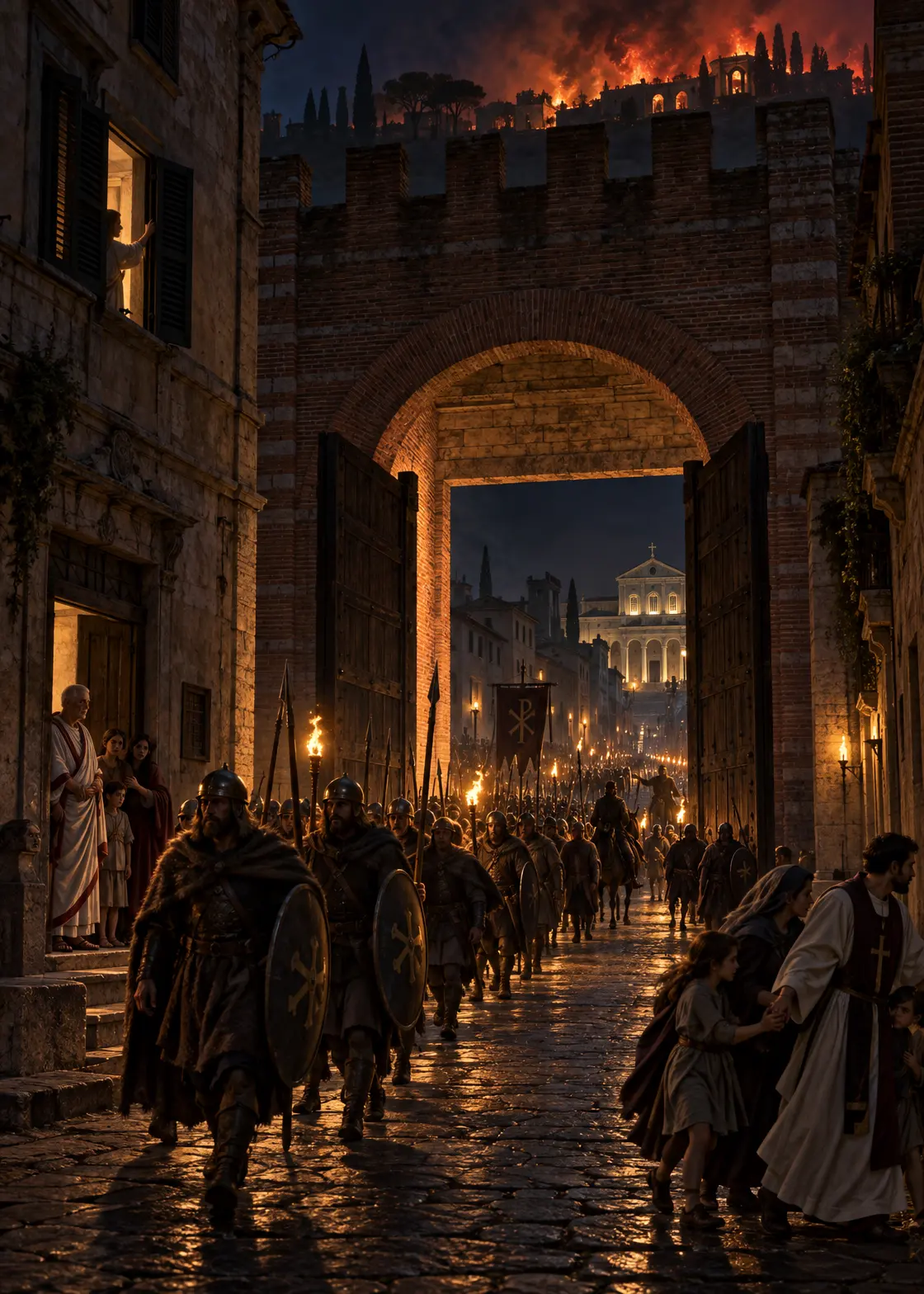
The Crossroads · 22 August 408 · Ravenna
Sanctuary at Ravenna
You are Stilicho, magister militum, designated guardian of Honorius, and supreme military commander of the Western Roman Empire.
For thirteen years you have preserved the West from behind the throne, holding Italy at Pollentia, Verona, and Faesulae, and defending against Alaric and Radagaisus. To maintain Italy's defense, field armies were concentrated south of the Alps, leaving Gaul open to the Rhine crossing of 406 and losing Britain to Constantine III. In Rome, you forced the Senate to vote four thousand pounds of gold to pacify Alaric, drawing fierce aristocratic condemnation. Now, the anti-barbarian faction at the imperial court has struck: a military mutiny at Ticinum has slaughtered your officer-corps. Honorius, secure behind Ravenna's marshes, has issued an imperial warrant for your execution. You have taken sanctuary inside a Ravenna church. Outside, your barbarian regiments remain armed and visibly loyal, awaiting your orders.
Do you summon your loyal regiments to fight the court or step out to face the emperor's warrant?
Weigh each course: open it to hear your own inner voice. Then decide. Nothing is scored.
- Your inner voiceThe course taken
The mutiny at Ticinum massacred my officer-corps, and the anti-barbarian party at Honorius's court now claims my life. Outside, my barbarian regiments remain visibly loyal and ready to fight. If I give the word, they will strike Ravenna and destroy the court faction before they destroy me. Yet that means turning barbarian troops against the imperial court I was appointed to protect, shattering the empire from within through civil war.
- Your inner voiceThe course taken
The sanctuary shields me while I remain within. The anti-barbarian party holds the emperor's ear, but they dare not violate sacred sanctuary while my visibly loyal barbarian regiments wait outside Ravenna. I will not step outside, nor will I loose the regiments. I will hold fast within sanctuary and force Honorius to treat with me. We can reach an accommodation without yielding my neck or setting my soldiers against the court.
- Your inner voiceThe course taken
For thirteen years I have governed the West, defending Italy at Pollentia, Verona, and Faesulae, preserving the throne for Theodosius's sons. If I summon my barbarian regiments to defend me, Roman will fight barbarian inside Italy, and the state will tear itself to pieces. I must refuse to raise the regiments. I will step out of sanctuary and submit to my ward's warrant, trusting that my service and the law will protect Rome.
What was done
Stilicho declined to raise his visibly loyal barbarian regiments in his defense. On 22 August 408, at Ravenna, he stepped out of sanctuary and was executed on Honorius's warrant (BGrade B). The sequel was an immediate act of imperial self-amputation: Roman garrisons in Italian cities massacred the federates' dependents, driving thirty thousand barbarian regulars (CGrade C figure) straight to Alaric. By eliminating its generalissimo, the court destroyed its shield and conscripted its besieger. Alaric advanced into Italy unopposed, laying siege to Rome three times between 408 and 410 while Honorius remained behind Ravenna's marshes. When negotiations repeatedly foundered, the Salarian Gate opened on 24 August 410, and the Goths sacked Rome for three days (AGrade A event). The sack shattered the inviolability of the eternal city and demonstrated that the Western empire could no longer defend its historic center.
The evidence Olympiodorus of Thebes provides the lost master-narrative for 407–425, surviving in Photius's summary and serving as the BGrade B substrate for Zosimus (books 5–6) and Sozomen (book 9). The chapter notes that the political and military narrative of Stilicho's fall is BGrade B at one remove, while Stilicho's personal intentions remain CGrade C, caught between Claudian's court panegyric and later hostile anti-barbarian traditions.
If you choose to walk through itAt every scale
- Yourself
When an emperor you have guarded for thirteen years orders your death, does honor require submission to the imperial office or the armed defense of your life?
- Those beside you
If a general surrenders to preserve civil peace, what responsibility does he bear for the comrades, officers, and dependent families left vulnerable to massacre?
- Rome
Can an empire survive when the civil administration in its capital and the military command on the frontier come to regard one another as existential enemies?
- The wider world
When an imperial power relies on federate soldiers whom its citizens refuse to assimilate, how can border defense avoid collapsing into civil butchery?
- Our own time
How do modern states prevent factional suspicion between civilian political leaders and military establishments from undermining national security?
In 2003, the Coalition Provisional Authority in Iraq issued Order Number 2, abruptly disbanding the Iraqi military and security institutions rather than reforming them. Anxious to purge the state of Ba'athist influence, the civilian leadership expelled hundreds of thousands of trained soldiers and officers without pensions or employment. Cast out and humiliated, large contingents of former regulars and officers joined insurgent and sectarian factions, providing military leadership that fueled devastating instability across the country.
Where the comparison fails. The coalition authority in 2003 was an occupying power restructuring a defeated state, not a legitimate domestic dynasty reliant on federates for defense. Furthermore, Stilicho chose personal submission over civil rebellion, whereas the disbanded Iraqi command had no single leader who stepped forward to accept state execution to preserve constitutional legitimacy.
What does the chapter tell us?
What was the direct strategic consequence of Stilicho concentrating the Western field armies south of the Alps to protect Italy?
The chapter emphasizes that the price of defending Italy was stripping Britain and Gaul of garrisons to concentrate the field army south of the Alps, leaving the Rhine unwatched when Vandals, Alans, and Sueves crossed in 406.
the chapter's narrative
Why did thirty thousand of Stilicho's barbarian regulars defect to Alaric after Stilicho was executed in 408?
After Stilicho's execution, the families of federate soldiers in Italian cities were massacred by Roman garrisons. This act of violence alienated Stilicho's barbarian regulars, prompting thirty thousand to defect to Alaric as Italy's besiegers.
Olympiodorus frr. (BGrade B)
What physical evidence corroborates the devastating passage of the 406 Rhine crossing through Gaul?
The chapter's Editor's Note highlights the Rhine-crossing coin-hoard horizon of 406–411 and Gallic destruction archaeology, which map the destructive passage of Vandals, Alans, and Sueves across Gaul as attested in Jerome's letter.
hoard-horizons and destruction archaeology (AGrade A)
How does the compendium characterize the Visigothic sack of Rome in 410 compared to ancient sacks such as Cremona or Jerusalem?
By the compendium's standards, the sack was restrained: it lasted three days (compared to Cremona's four and Jerusalem's months), and the Christian Goths respected sanctuary in the great basilicas, even as senators were tortured for gold and buildings were burned.
the chapter's narrative
According to the chapter, what fiscal catastrophe outweighed the symbolic shock of the 410 sack of Rome?
The chapter concludes with a critical ledger entry: while Rome was besieged, invaders crossed the Pyrenees to partition Spain, and the West lost the revenues of Britain, northern Gaul, and Spain, initiating the empire's terminal fiscal crisis.
the chapter's narrative