Book VIII · The Last Age of the West
Chapter 5
Aetius, Africa, and Attila
The Loss of Africa429–442
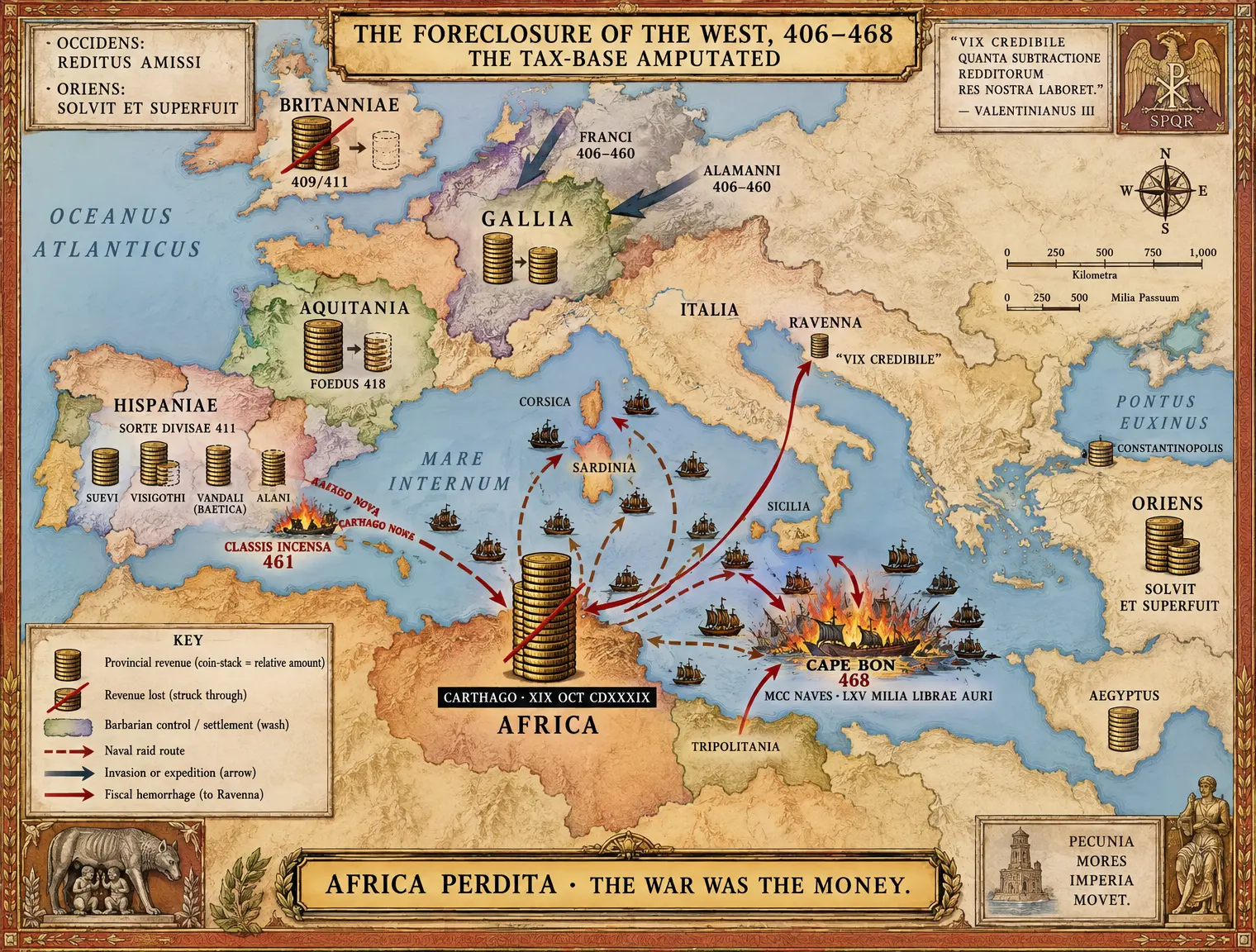
The forty years after the sack were dominated in the histories by the Huns and decided, this compendium will argue, by a fleet that sailed from Spain in May 429. The Vandals — Hasding survivors of the Rhine crossing, hammered in Spain by Romano-Gothic campaigns until their king Gaiseric, the fifth century's ablest founder, concluded that safety lay across water — crossed the straits to Mauretania with their whole people (eighty thousand souls by Victor of Vita's transmitted count, the volume's most-debated number, printed as transmitted), and marched east along the African coast against the one diocese the western fisc could not lose: the grain, the oil, and the tax-yield that fed Rome and paid the field army. The defense failed in sequence — the count Boniface beaten in the field, Hippo Regius besieged fourteen months (Augustine dying within the walls in the siege's third month, his library ordered preserved), a combined eastern-western relief army under Aspar beaten in turn — and the treaty of 435, settling the Vandals in the Mauretanias and Numidia as nominal federates, bought four years; on 19 October 439, by surprise assault in deep peace, Gaiseric took CARTHAGE — the city Book IV watched razed and Book V's successors rebuilt into the West's second capital — with its arsenal, its mint, and the African fleet's harbors, and the western empire's fiscal spine was severed. The Editor promotes the event over every battle in this chapter: the laws of the 440s record the arithmetic — Valentinian III's novels pleading that the revenues lost "can scarcely be believed," the army's pay and recruitment visibly failing in the same decade — and the strategic geometry inverted: with Carthage's harbors, the Vandals were a naval power inside the empire's inner sea, Sicily and Sardinia raided at will, Rome itself now a coastal city facing a hostile fleet. The eastern empire understood, and twice mounted the recovery this volume treats as the West's actual last chance: the armada of 441, assembled in Sicily, recalled when Attila chose that summer to break the Danube; and the great expedition of 468, held for the next chapter's accounting. Between them, in 442, Ravenna made the peace that conceded Africa Proconsularis and Byzacena to Gaiseric outright — the first Roman soil ever formally ceded to a barbarian king in full sovereignty, the foedus-fiction dropped at last — and the compendium marks the date as the moment the western state became, fiscally, a Gallic-Italian rump administering its own decline.
Aetius and the Hun Bargain425–450
The West's soldier of the age governed it for thirty years without ever wearing the purple, and his career is the era's system in one biography. Flavius Aetius — a Danubian officer's son, hostage in youth to Alaric and then to the Huns, whose friendship became his instrument — climbed through the usurpation-crisis of 423–425 (arriving three days late for the battle with a Hun army hired for the usurper, and pardoned because sixty thousand Huns required pardoning), destroyed his rivals Felix (executed 430) and Boniface (defeated at Ariminum 432, dead of the wound) in the West's private civil wars, and from 433 ruled as patrician and generalissimo for the empress-mother Galla Placidia's son. His achievement was Gaul, and its method was the bargain the chapter's title names: with Hunnic auxiliaries hired from his friends beyond the Danube, Aetius broke the Visigoths' sieges of Narbonne (436) and fought them to treaty at Toulouse; suppressed the Bagaudae of Armorica; settled the Alans on the Loire and the remnant Burgundians — after his Hun allies had annihilated their Rhine kingdom in 436/7, twenty thousand dead with King Gundahar, the catastrophe that seeded the Nibelung legend, graded here as the one certain historical event beneath that poetry — in Sapaudia (443); and held the Rhineland's Franks as federate satellites. The Editor grades the system as its results earned: for twenty years Aetius maintained a Roman Gaul with almost no Roman field army, by playing every settled people against every unsettled one, with Hunnic force as the reserve currency — a masterpiece of management that had mortgaged itself to a single counterparty; and in 445, when Attila murdered his brother Bleda and unified the Hun empire — a tribute-state stretching from the Rhine to the steppe, extracting six thousand pounds of gold a year from Constantinople after the Balkan campaigns of 441–443 and 447 had razed the Danubian cities and destroyed an eastern field army at the Utus — the counterparty called in the mortgage. Attila's pivot west in 450–451 came dressed in pretexts the sources relish — the princess Honoria's smuggled ring and appeal (the emperor's sister, disgraced, offering herself and claimed by Attila with half the West as dowry: the story is Priscus's, and the Editor, grading it improbable in ornament, notes its acceptance by every contemporary), a Frankish succession dispute, a claim to Aetius's friendship turned to its inversion — and behind them the structural fact: the Hun empire lived on extorted gold, Constantinople's new emperor Marcian had stopped paying, and the softer target was the West.
The Catalaunian Plains, Italy, and the Two Murders451–454
The campaign of 451 was the largest the West had seen in a century. Attila crossed the Rhine in spring with the Hun army and the subject nations — Gepids under Ardaric, Amal Goths, Rugians, Sciri, Thuringians, the East's whole tributary world — sacked Metz, and drove on Orléans, whose Alan garrison-king was negotiating surrender; Aetius, with the small Italian field force, achieved the diplomatic masterpiece his whole career had rehearsed: the Visigothic kingdom brought into the field — old Theodoric I marching with his nation — with Burgundians, Salian Franks, Saxons, Armorican Bagaudae-levies, and his own regulars: the coalition Jordanes calls, without irony available to him, "the Roman side." Orléans was relieved at the wall's breach-point (the tradition's timing, graded homiletic), and Attila fell back into Champagne to ground of his choosing: the CATALAUNIAN PLAINS (the campi Mauriaci near Troyes; the field, in the series' recurring pattern, unlocated). The battle — 20 June 451, or September; even the date divides the sources — survives principally in Jordanes's set-piece a century after: the ridge taken by the Roman-Gothic right before the Huns could crest it; Attila's speech to his nations (a composition, graded as all such); the collision Jordanes dresses in the age's apocalyptic register — a brook running with blood, one hundred sixty-five thousand dead, the wounded drinking gore-thickened water — figures and furniture the Editor prints as the sixth century's memory of a horror, not as arithmetic; the certain core: the fight was frontal, prolonged, and terrible; King Theodoric died in it, thrown and trampled, and his Goths' vengeance-charge broke the Hun left; Attila withdrew into his wagon-laager prepared, the tradition says, to burn himself on a pyre of saddles rather than be taken — and was not taken: Aetius let the ring stand open, the Visigoths (their new king Thorismund steered home by Aetius's own counsel to secure his throne before his brothers did) departed, and the Hun army recrossed the Rhine intact. The tradition indicted the generalissimo for sparing his life's counterweight; the Editor enters the structural defense — a destroyed Attila meant an unemployable coalition and a Visigothic Gaul — and the audit: the calculation assumed the Huns would return to being a reserve currency, and instead, in 452, Attila came again, into Italy. Aquileia — the fortress-city that had turned every invader since the Marcomannic wars — was taken after a three-month siege and erased so completely that Jordanes's generation could scarcely find it (its refugees' flight into the lagoons is the seed, in tradition, of Venice); the Po cities opened or burned; Milan was occupied and the famous panel of Roman emperors enthroned above dead Scythians repainted, at Attila's order, with the roles reversed; and the empire, its field force spent at the Plains and its granary Vandal, sent not an army but the embassy of 452: the consular Avienus, the prefect Trigetius, and Pope Leo, meeting Attila at the Mincio — after which the Hun withdrew. The tradition gave the credit to Leo and the apostles visible over his shoulder; the sober ledger the sources themselves half-admit gives it to the famine and pestilence eating the horde in a plague-struck, harvest-failed Italy, to Marcian's eastern army operating against the Hun homelands across the Danube, and to a treasury of Italian ransom already loaded; the Editor prints all four causes and declines the choice. Attila died within the year — a burst vessel on the night of his last wedding, drowned in his own blood, the kingdom buried with him: at the Nedao in Pannonia (454) the subject nations under Ardaric's Gepids destroyed the Hun empire in one battle, and the steppe power that had bent both empires for a decade dispersed into the Balkans' federate settlements within a generation. The West's deliverance completed its own decapitation: in September 454 Valentinian III — resentful ward, thirty-five years emperor and never once a commander — summoned Aetius to the palace at Ravenna to audit accounts, and killed him at the council-table with his own sword, the eunuchs finishing the work; the epitaph the tradition preserves was spoken to the emperor's face by a courtier asked to approve: you have cut off your right hand with your left. Six months later two of Aetius's veterans killed Valentinian on the Campus Martius while his guards — Aetius's men all — watched without moving; with him ended the house of Theodosius in the West, and the volume's last chapter opens on a state with no dynasty, no Africa, no field army worth the name, and twenty-two years to live.
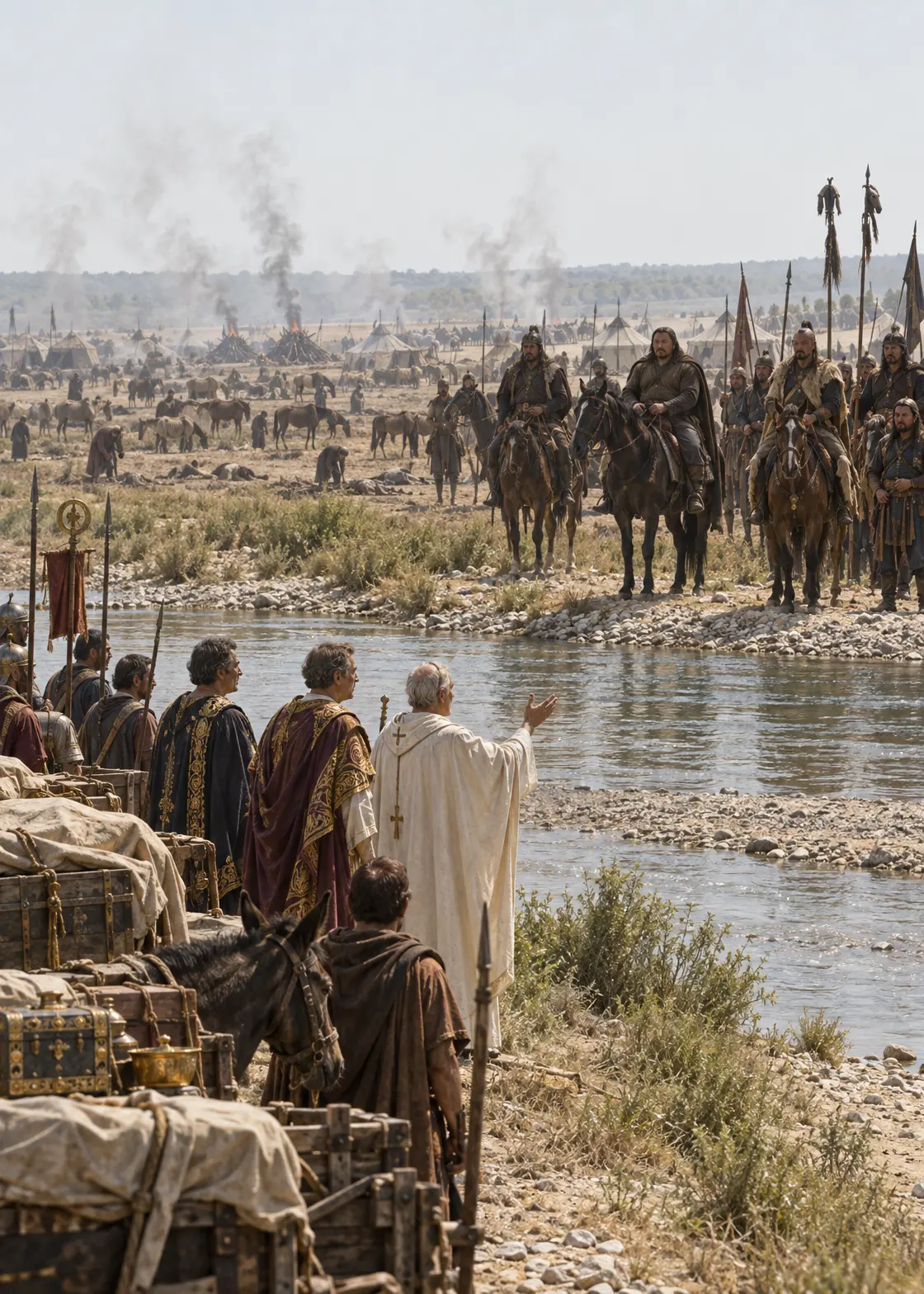
The Crossroads · 451 · The Catalaunian Plains (campi Mauriaci near Troyes)
The Wagon-Laager on the Catalaunian Plains
Flavius Aetius, patrician and generalissimo of the Western Roman Empire
Attila has crossed the Rhine with his tributary nations and driven across Gaul. At the Catalaunian Plains near Troyes, your coalition—the small Italian field army alongside King Theodoric's Visigoths, Burgundians, Salian Franks, Saxons, Alans, and Armorican levies—met the Hunnic horde in a frontal, bloody collision. King Theodoric fell thrown and trampled, but his Goths' vengeance-charge broke the Hun left. Attila has fallen back into his wagon-laager, reportedly ready to burn himself on a pyre of saddles. His archers bristle behind the barricade, while around you, your battered barbarian allies hold the field in the dusk.
Do you storm the wagon-laager to destroy Attila, or allow the ring to open and preserve the Huns as a counterweight against your barbarian allies?
Weigh each course: open it to hear your own inner voice. Then decide. Nothing is scored.
- Your inner voiceThe course taken
If Attila is destroyed, what restrains the Visigoths? King Theodoric is dead; his son Thorismund commands the largest army in Gaul. If the Huns cease to exist, the Goths will have no rival, and Roman Gaul will be swallowed whole by our own allies. By sending Thorismund home to secure his throne against his brothers, the coalition disperses peacefully. Attila will limp across the Rhine, humbled, remaining the reserve currency my diplomacy requires.
- Your inner voiceThe course taken
A direct rush against those barricades invites unnecessary slaughter when thirst and starvation can do our work. If we entrench around the laager and hold the allied kings together, Attila cannot break out across these open plains. We risk our unruly coalition fracturing as rations dwindle and autumn rains set in, but a tight investment will force the Huns to yield their plunder and give up their king without another bloody charge.
- Your inner voiceThe course taken
Attila is cornered behind his carts. If we order the assault now, many of our men will die against his archery, but the steppe empire that razed the Danube cities and bled the East will be broken forever. With Attila dead or captured, Gaul is delivered from the terror of the horde, and no barbarian king will dare dictate terms to Ravenna again. We must finish what we began.
What was done
You let the ring stand open. You counseled Thorismund to depart at once for Toulouse to secure his succession before his brothers could move, and the Visigoths broke camp. With the allied coalition dispersing, Attila led his army back across the Rhine intact. The decision spared Gaul immediate Gothic hegemony, but the calculation that the Huns would quietly return to serving as an external reserve currency failed. In 452, Attila invaded Italy, razing Aquileia and occupying Milan, before famine, disease, Danubian pressure from Emperor Marcian, and Italian ransom prompted his withdrawal. Attila died the following year, and the Hun empire shattered at the Nedao in 454. That September, Valentinian III murdered you with his own sword in the palace at Ravenna during an audit of accounts. Six months later, your loyal veterans struck the emperor down, leaving the Western Empire bankrupt, uncommanded, and sliding toward collapse (narrative CGrade C, murders AGrade A).
The evidence The Editor grades the Catalaunian Plains tactical narrative as CGrade C, deriving from Jordanes (Getica, 551), who digested the lost history of Cassiodorus and fragments of Priscus of Panium (AGrade A/B). The battle's arithmetic of casualties is DGrade D. Contemporary Gallic and Italian chronicles (Prosper, Hydatius) confirm the general campaign. Merobaudes's fragmentary panegyrics offer contemporary court perspective (BGrade B) on Aetius's statecraft. The Editor emphasizes that Aetius left not a single surviving line or staff-history to explain his actions.
If you choose to walk through itAt every scale
- Yourself
When you have maintained your authority for twenty years by playing rivals against one another, how do you distinguish between what serves the empire and what merely keeps your own balance of power intact?
- Those beside you
How do you explain to Roman officers and veteran soldiers who bled on the ridge that an arch-enemy cornered behind his wagons should be allowed to retreat unharmed?
- Rome
Can an empire that has lost its richest provinces and its own field armies survive without outsourcing its defense to the very adversaries who threaten it?
- The wider world
What becomes of federate peoples like the Visigoths or Franks when Rome relies on their blood to fight its battles while secretly fearing their triumph?
- Our own time
When powerful states preserve destabilizing regional adversaries rather than eliminate them, out of fear that a vacuum or a local ally will grow too strong, what long-term hazards do they invite?
In modern strategic doctrine, major powers frequently intervene in regional proxy conflicts by arming local coalitions and maintaining a deliberate balance of power. Commanders and diplomats sometimes choose not to press an advantage to total victory against an aggressive rogue state, fearing that destroying the regime entirely will empower regional allies beyond control or unleash an unmanageable power vacuum. They preserve a damaged adversary as a continuing counterweight, seeking stability through exhaustion.
Where the comparison fails. Modern powers possess vast industrial bases, institutional succession, and treaty-bound alliances, whereas Aetius commanded a bankrupt state lacking native legions, reliant entirely on personal barbarian networks and private armies.
What does the chapter tell us?
Why does the Editor argue that Gaiseric's capture of Carthage in 439 was more decisive for the Western Empire than any battle in the chapter?
The chapter states that Carthage's loss severed the empire's fiscal spine, eliminating essential tax revenues and grain that fed Rome and paid the field army, while giving the Vandals a fleet to raid Sicily, Sardinia, and Italy at will.
The chapter's narrative and Valentinian III's Novels (AGrade A)
What was the foundation of Flavius Aetius's system for maintaining control of Roman Gaul between 425 and 450?
The chapter describes Aetius's twenty-year governance of Gaul as maintaining Roman authority with almost no Roman field army, playing settled and unsettled nations against one another using Danubian Hunnic force as his strategic reserve currency.
The chapter's narrative and Merobaudes (BGrade B)
Why did Aetius encourage Thorismund and the Visigoths to leave the Catalaunian Plains rather than storm Attila's trapped wagon-laager?
The chapter enters the structural defense that a destroyed Attila would have made the barbarian coalition unemployable and produced a Visigothic Gaul, leaving Rome with no counterweight against its ambitious federates.
Jordanes, Getica (CGrade C narrative carrying BGrade B substance) and the chapter's narrative
Which of the following is NOT one of the four causes the chapter credits for Attila's withdrawal from Italy in 452?
The chapter rejects single-cause explanations (including miraculous apparitions) and lists four factors: Italian famine, pestilence, Marcian's eastern army striking across the Danube, and an Italian ransom treasury. No Roman naval victory is mentioned.
Prosper and the chapter's narrative (BGrade B/C)
What was the historical significance of the treaty Ravenna concluded with the Vandals in 442?
The chapter notes that by ceding Africa Proconsularis and Byzacena outright to Gaiseric in 442, Roman soil was for the first time formally ceded to a barbarian king in full sovereignty, dropping the foedus fiction.
The chapter's narrative (AGrade A)