Book VIII · The Last Age of the West
Chapter 6
The Dissolution
The Sack, the Fleets, and the Last Soldier-Emperor455–468
The end came not as a fall but as a foreclosure schedule, and the compendium narrates its last two decades at the tempo the evidence keeps: by regime. Petronius Maximus, the senator behind both murders of 454–455, reigned seventy-eight days — long enough to force Valentinian's widow into marriage and thereby, the tradition says, to bring the fleet: Gaiseric, whose son was betrothed to Valentinian's daughter and whose treaty had died with the dynasty, sailed for Rome, and Maximus was stoned by the crowd as he fled the city he had not attempted to defend. The VANDAL SACK of June 455 was the sack of 410's methodical elder: fourteen days against three, unresisted, negotiated at the gates by Pope Leo to the sparing of fire and slaughter and executed as systematic asset-stripping — the palace plate, the temple treasures (the spoils of Jerusalem, resident since Titus's triumph in Book VI, shipped to Carthage: the compendium notes the relay), the gilded half of the Capitol's roof, the empress and her daughters carried to Africa as dynastic stock — and the Editor grades its damage as the ancients did: materially greater than Alaric's, humanly lighter, politically terminal, because it proved the capital could be emptied at will by sea. What remained of the West was governed, from 456, by the master of soldiers Ricimer — Suevic-Gothic by blood, barred by it from the purple, and for sixteen years the maker and breaker of the emperors the East would or would not recognize: Avitus (the Gallic senator raised by the Visigoths, deposed by Ricimer at Placentia 456), then the one reign this chapter must slow for. MAJORIAN (457–461) — Aetius's officer, the last western emperor to command armies in person, legislate seriously (his novels on tax-remission, curial protection, and the stripping of Rome's monuments for building-stone are the rump-state's most intelligent self-diagnosis), and attempt the only strategy that mattered: Africa. His three years assembled it — Gaul reconciled after a Burgundian-Gothic war, Spain's approaches cleared, and in the harbors of Cartagena a fleet of three hundred hulls for the crossing to Mauretania; in May 461 Gaiseric's agents, by treachery the sources assert and cannot specify, burned or took the fleet at anchor in the bay of Cartagena. Majorian, returning stripped of his instrument, was arrested by Ricimer at Tortona, deposed, and beheaded five days later — the Editor marks the judgment of the next generation's historian: Procopius's flat sentence that Majorian surpassed every emperor who had ruled the West; and the structural verdict: the West's last self-rescue died in a Spanish harbor, unfought. There followed the shadow-procession — Libius Severus (Ricimer's unrecognized cipher), two years of interregnum, then the eastern solution: ANTHEMIUS, Constantinople's candidate and son-in-law of its late emperor, installed in 467 with eastern money for the operation that is this volume's true final battle. The joint expedition of 468 was the ancient Mediterranean's last great amphibious effort — eleven hundred ships and a hundred thousand men by the transmitted figures, sixty-five thousand pounds of gold from the eastern treasury by its own later accounting, three converging forces (Marcellinus taking Sardinia, Heraclius landing from Egypt to take Tripolitania, the grand fleet under the emperor's brother-in-law Basiliscus for Carthage itself) — and at CAPE BON, forty miles from Carthage, Basiliscus anchored to await... the sources say a five-day truce Gaiseric requested and used: when the wind turned onshore, the fire-ships came down it into the packed anchorage by night, and the armada burned — the mastered sea lit end to end, the comes Joannes refusing Vandal quarter and leaping armored into the sea with the last recorded words of the Roman West's last offensive: that he would not surrender to dogs. Basiliscus fled to sanctuary in Constantinople; the eastern fisc did not attempt Africa again for sixty years; and the Editor closes the section on the volume's fiscal thesis, proven now in the negative twice: 461 and 468 were the war; everything after is probate.
476: The Notice468–476
The last eight years the compendium gives as the chronicle-tempo demands. Anthemius and Ricimer came to open war in 472 — the generalissimo besieging his emperor in Rome, taking it by storm in July (the city's third capture in the volume), Anthemius beheaded by Ricimer's Burgundian nephew Gundobad; Ricimer dead of hemorrhage forty days later, his puppet Olybrius following within months. Gaul meanwhile ended: the Visigoth Euric, having killed his brother for the throne in 466, read the 468 fire-light correctly, renounced the federate fiction, and took the diocese by open conquest — Arvernum (Clermont) holding four years under Sidonius's leadership and his brother-in-law Ecdicius's eighteen-horseman sorties, only to be traded to Euric in the treaty of 475 for a Provence the empire could no longer use: Sidonius's letters, the volume's last Roman voice in Gaul, curse the bargain from the bishop's house of a Gothic city. In Italy the Pannonian officer Orestes — once Attila's Latin secretary, the age's résumés being what they were — was made master of soldiers by the emperor Julius Nepos (the East's last nominee, 474), rose against him within the year, watched Nepos sail for Dalmatia, and crowned his own young son: Romulus, called Augustulus, the little Augustus, a boy whose name yoked the founder of the city to the founder of the empire and whose reign of ten months existed for one transaction. The army of Italy — by 476 substantially the federate remnants of Attila's dissolved world, Sciri, Heruls, Rugians, Torcilingi — demanded what every federate settlement in this volume had received: land, a third by the transmitted formula, in Italy itself; Orestes refused; and the soldiers found, as the compendium's armies always had, a commander who would not: Odoacer, a Scirian officer, son of Attila's envoy Edeco. Orestes was taken at Placentia and executed on 28 August; Ravenna fell within the week; and on 4 September 476 the boy-emperor abdicated before Odoacer, who — the sources agree on the mercy and the pension — spared him for his youth and beauty and retired him to the Lucullan villa on the bay of Naples with six thousand solidi a year: the last emperor of the West pensioned into the pleasure-palace of the Republic's most famous gourmet, a coincidence no dramatist would risk. What followed was the notice this volume's Proem promised: the Senate's embassy to Constantinople, returning the western imperial regalia with the declaration — preserved in Malchus's fragment — that the West no longer required a separate emperor, that one sufficed for both parts, and that Odoacer, who had taken the title of king, would administer Italy if granted the patrician rank; the eastern emperor Zeno, harboring Nepos and his own troubles, answered with a lawyer's ambiguity, and Italy proceeded. The Editor executes the grading the chapter has prepared: nothing fell in 476 — no battle was fought for the West's existence, no city burned for its end, the consuls continued, the Senate sat, the Roman population of Italy noticed chiefly a change of tax-recipient, and Nepos remained the lawful western emperor in Dalmatia until his murder in 480, which is the pedants' better date; the year's epochal weight was assigned a generation later, in the eastern chronicle of Marcellinus Comes — the western empire of the Roman people... perished with this Augustulus — written in the Constantinople of the 510s, where the demonstration that the West was finished and had been for decades served the ambitions of the emperor then preparing to reconquer it. The fall of the western Roman empire is, in its date, historiography; in its substance — the process this volume has audited, the provinces transferred, the fisc amputated, the army become its own successor — it was complete before the boy ever wore the diadem; and this compendium, which has graded eight centuries of victors' claims, closes its last political chapter by grading the ending itself: AGrade A as process, CGrade C as event, and DGrade D as the single dramatic moment posterity required and the sources decline to supply.
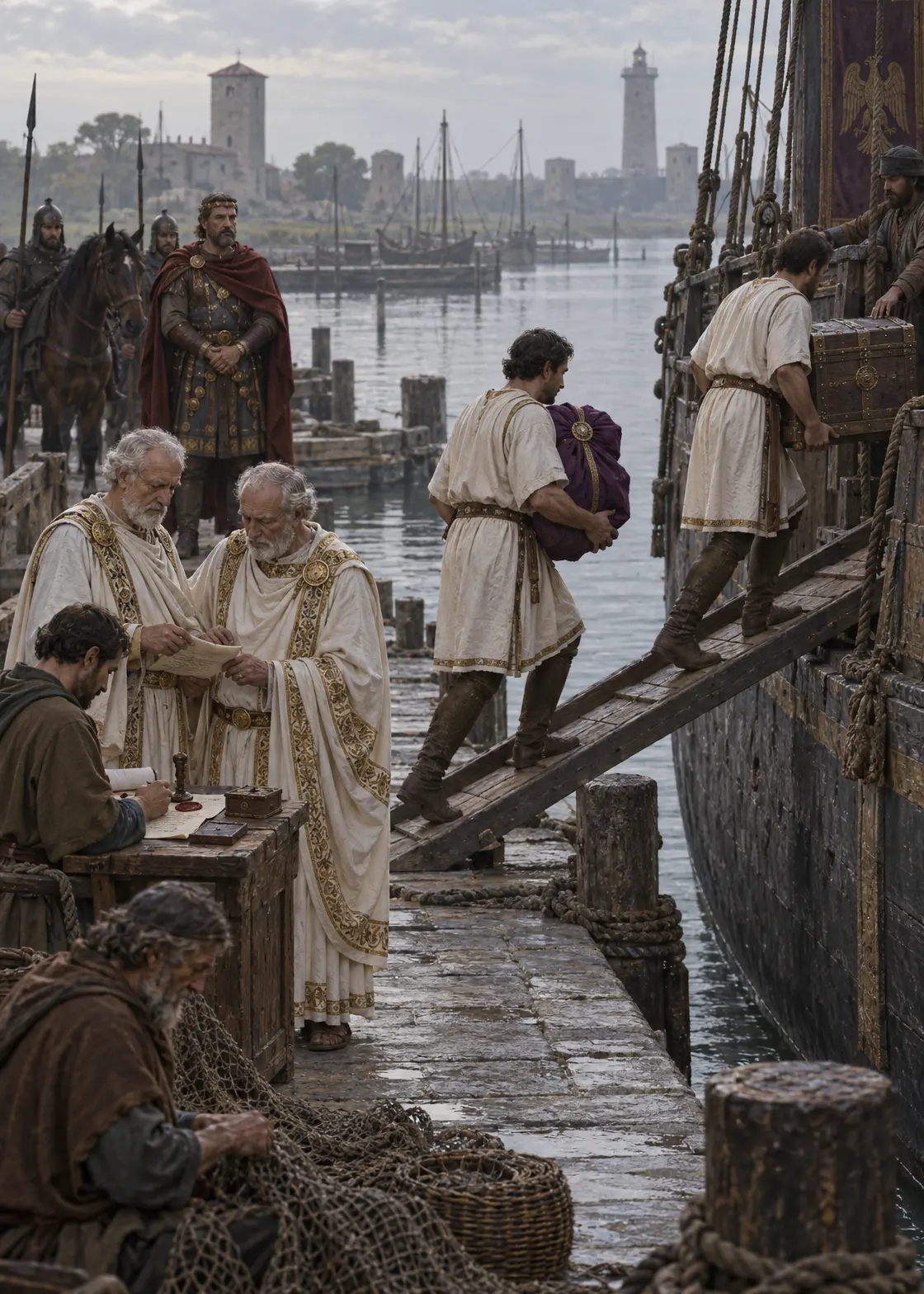
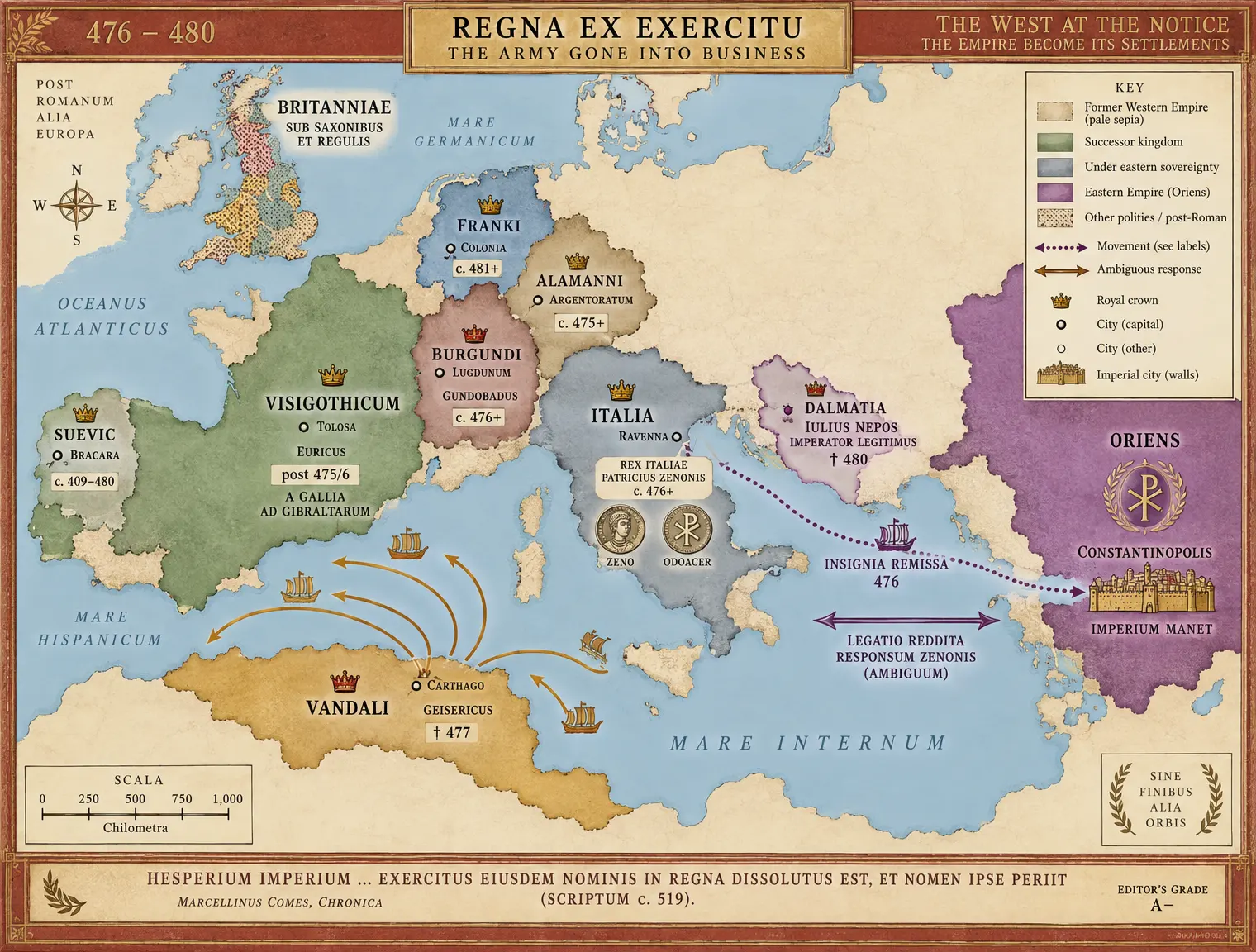
The Crossroads · August 476 · Ravenna and Placentia, Italy
The Partition of Italy
You are the Pannonian officer Orestes, master of soldiers in Italy and former Latin secretary to Attila, governing on behalf of your young son, the emperor Romulus Augustulus.
Ten months after driving Julius Nepos to Dalmatia and raising your son Romulus to the throne, your army has confronted you with an ultimatum. The Italian forces—substantially the federate remnants of Attila's dissolved empire, including Sciri, Heruls, Rugians, and Torcilingi—demand what every federate settlement across the provinces has received: land, one-third by the transmitted formula, but this time in Italy itself. With the western fisc amputated and provincial revenues lost, you have no treasury left to pay their arrears in coin. If you yield, Roman landholders across Italy will lose a third of their estates to barbarian soldiers. If you refuse, the army will turn against your house and seek a general willing to grant their demand.
Do you grant the federate army a third of the land in Italy, or refuse their demand?
Weigh each course: open it to hear your own inner voice. Then decide. Nothing is scored.
- Your inner voiceThe course taken
Refuse the demand outright. Italian soil is the sacred center of the empire, not a barbarian province to be partitioned by federate treaties. If we surrender a third of Italy to the Sciri, Heruls, Rugians, and Torcilingi, Roman property and senatorial dignity are destroyed, leaving our imperial house ruling over ghosts. These barbarians are sworn soldiers of my son Romulus. Let them obey their master of soldiers; we will not dispossess Italian landlords.
- Your inner voiceThe course taken
Yield to their demand and grant the third in Italy. Every federate settlement in Gaul and Spain followed this formula, and our amputated fisc has neither coin nor revenue left to satisfy their pay. The Sciri, Heruls, Rugians, and Torcilingi make up the entire army of Italy. Dispossessing Italian estates will anger senators, but it binds these barbarian warbands to my son's diadem. Without their spears, Romulus has no shield against rival claimants.
- Your inner voiceThe course taken
Refuse the partition of Italy, but offer these federates settlement in Provence. We traded Arvernum to Euric to secure Provence, a diocese the empire can no longer use or garrison. Directing the Sciri and Heruls into Gaul protects Italian estates and senate wealth from confiscation. It risks their mutiny if they insist on soil under their feet, but it preserves Italy while we seek eastern recognition from Zeno for my son.
What was done
Orestes refused the federates' demand. The army turned immediately to Odoacer, a Scirian officer and son of Attila's envoy Edeco, who promised them the Italian land they sought. Orestes was captured at Placentia and executed on 28 August 476; Ravenna fell within the week. On 4 September 476, the young Romulus Augustulus abdicated before Odoacer, who spared the boy for his youth and beauty, granting him a pension of six thousand solidi a year at the Lucullan villa on the bay of Naples. The Senate sent an embassy to Constantinople returning the western imperial regalia, declaring that one emperor sufficed for both realms and requesting that Zeno grant Odoacer patrician rank to govern Italy. The transition proceeded as an administrative settlement (AGrade A): the consuls continued, the Senate sat, and the western empire ended not by fire or battle, but through fiscal foreclosure.
The evidence The Editor grades the mechanics of the 476 transaction, the regime-sequence, and the land settlements as AGrade A. The primary witnesses are the load-bearing fragments of Malchus of Philadelphia (BGrade B) recording the Senate's embassy and Zeno's response; the Anonymus Valesianus (pars posterior) alongside the Ravenna tradition and Italian fasti (BGrade B/C); and Odoacer's coinage struck in Zeno's name, confirming the political arrangement (AGrade A). Marcellinus Comes provides the retrospective sixth-century chronicle entry marking the fall, graded as Justinianic historiography rather than contemporary fact.
If you choose to walk through itAt every scale
- Yourself
When your survival depends upon denying the very troops whose swords raised you, does honor require standing upon principle, or does it become vanity?
- Those beside you
How far can a father go in risking his son's crown and life to protect the ancestral estates of senators who will abandon both of you the moment the army revolts?
- Rome
Can an empire survive once its core territory is subjected to the same partition and fiscal amputation that dissolved its outer provinces?
- The wider world
When federate soldiers can no longer be paid in gold from imperial taxes, is the formal handover of territory to barbarian generalissimos the end of state order or merely its recognition?
- Our own time
When essential public institutions can no longer fund their basic obligations, do leaders preserve stability by defending the legal fiction of solvency or by acknowledging the terms dictated by those who hold real power?
A modern parallel occurs in bankrupt municipal or state governments when public pension systems and emergency obligations consume all operational tax revenues. Administrators face the choice between defaulting on bonded debt owed to external creditors or seizing funds allocated to municipal workers and security services. When revenue fails completely, the creditors and public servants effectively dictate the liquidation or restructuring of civil governance, stripping away local administrative sovereignty under receivership while nominal civic titles and council sessions continue as legal formalities.
Where the comparison fails. The comparison fails because modern financial receivership operates within an intact larger constitutional order with enforceable bankruptcy courts. Orestes faced an armed, ethnically distinct military caste with a complete monopoly on violence, operating in a collapsed imperial economy where land ownership was the only remaining source of wealth and no higher sovereign existed to enforce contracts.
What does the chapter tell us?
Why did Emperor Majorian's strategic effort to recover Africa collapse in 461 before crossing to Mauretania?
Majorian spent three years reconciling Gaul, clearing Spain, and assembling three hundred hulls at Cartagena for the crossing to Mauretania, but Gaiseric's agents burned or took the fleet at anchor through unspecified treachery in May 461, ending the campaign unfought.
the chapter's narrative (BGrade B for naval catastrophes)
What was the primary structural consequence of the eastern Roman armada's catastrophe at Cape Bon in 468?
The joint expedition of 468 cost the eastern treasury sixty-five thousand pounds of gold. After the fire-ships destroyed the armada at Cape Bon, the eastern fisc abandoned further offensives against Africa for six decades, leaving the West without fiscal or military rescue.
Candidus frr. and Procopius BV (BGrade B/C)
What exchange did the western imperial government make in the treaty of 475, as lamented in the letters of Sidonius Apollinaris?
Arvernum held out for four years under Sidonius and Ecdicius, only to be traded by the imperial court to the Visigothic king Euric in 475 in return for Provence, a diocese the crumbling western empire had no capacity to govern or utilize.
Sidonius Apollinaris, Epp. (AGrade A)
What specific demand by the federate army in Italy triggered the rebellion of Odoacer and the execution of Orestes in 476?
The Italian army, composed of Sciri, Heruls, Rugians, and Torcilingi, demanded what federates in other provinces had previously received: one-third of the land by imperial formula, but within Italy. When Orestes refused, the soldiers acclaimed Odoacer, who promised to execute the partition.
the chapter's narrative (AGrade A for regime-sequence and settlements)
Why does the Editor grade the fall of the western empire in 476 as 'AGrade A as process, CGrade C as event, and DGrade D as a single dramatic moment'?
In 476, no city burned and no battle was fought for the West's existence; the Senate sat, consuls were appointed, and Nepos remained lawful emperor until 480. Marcellinus Comes assigned 476 epochal weight in the 510s to serve Constantinople's reconquest ambitions.
Marcellinus Comes and Malchus frr. (BGrade B/Historiography)