Book VIII · The Last Age of the West
Proem
Proem
The final volume of this compendium narrates an ending, and the Editor's first duty is to say precisely what kind. The Roman West did not fall as Carthage fell, or Jerusalem, or Sarmizegetusa — no siege, no sack-and-interdiction, no final field. It ended as a process this volume will watch operating for eighty years: provinces that stopped being governed without ever being conquered; an army that became, by recruitment, settlement, and treaty, indistinguishable from the peoples it was raised against; a treasury that lost, one region at a time, the tax-base that paid for everything; and a sequence of emperors who shrank from commanders-in-chief to the wards of their own generalissimos, until in September 476 a German officer of the Italian army, having deposed a usurper's teenaged son, declined to appoint another and mailed the western regalia to Constantinople with the observation that one emperor sufficed. Contemporaries did not agree that the world had ended that year — the chronicler who first made 476 an epoch wrote a generation later, and the volume will grade the "fall" itself as historiography — but the process was real, it was substantially military, and its narration is the proper terminus of a compendium that began with a war-band crossing the Allia: Rome enters this series sacked by Gauls, and leaves it governed by them.
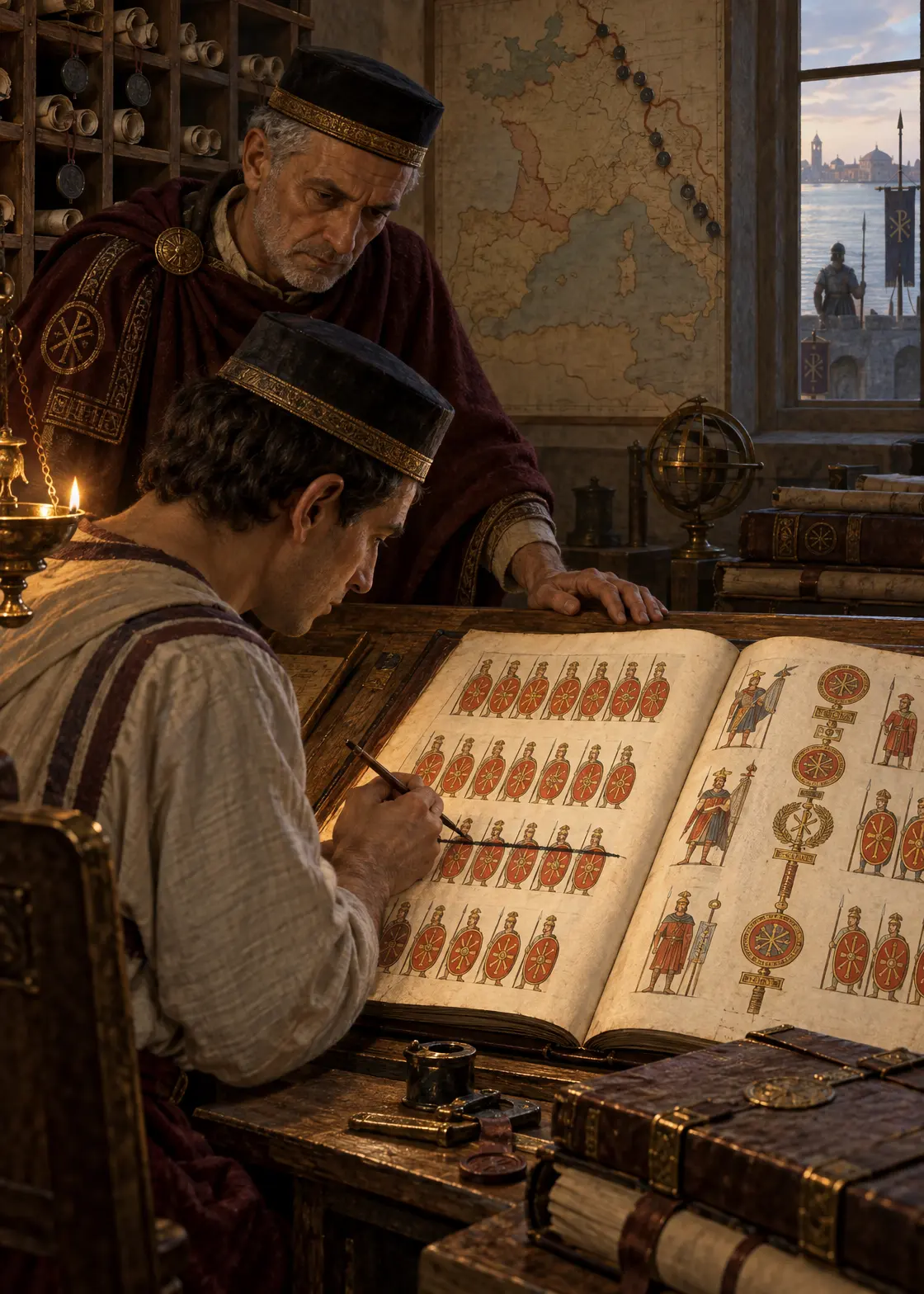
The instrument, first, as every volume has begun. The army Diocletian and Constantine rebuilt out of the third century's wreckage was the crisis's lesson written into structure: the frontier held by limitanei — garrison troops, settled, hereditary, lower-paid, and (the Editor will insist against their later reputation) still soldiers; behind them the mobile field armies, the comitatenses, Gallienus's improvisation made permanent — cavalry-heavy, imperially attached, commanded by the new masters of soldiers, the magistri militum, whose office this volume will watch devour the throne it served; the whole establishment larger on paper than the Principate's (the Notitia Dignitatum, the empire's surviving order of battle, lists units by the hundred) and thinner in the field, its regiments a fraction of the old legions' size, its recruitment sustained increasingly by the peoples beyond and then inside the frontier — Franks, Alamanni, Goths, Sarmatians, Huns — first as recruits, then as regiments, then as allied nations under their own kings serving by treaty: the foederati, the volume's fatal word. The Editor states the thesis at the outset rather than let it accumulate as insinuation: "barbarization" did not destroy the western army — barbarian officers from Merobaudes to Stilicho to Aspar were among the empire's most loyal servants, and the fifth century's best Roman armies were its least Italian. What destroyed the western army was fiscal amputation: the loss of Africa's revenues in 439 and the failure of the two great armadas launched to recover them are, in this volume's accounting, the death-wound, and the political disintegration of the 460s and 470s is that wound closing.
The sources restore themselves at this volume's threshold and thin again before its end. For the fourth century the compendium has, at last and once more, a great contemporary narrative: Ammianus Marcellinus — a serving staff-officer, a Greek writing Latin history in Rome, a pagan of studied fairness, present in person at the siege of Amida and on the road to Ctesiphon — whose surviving books (353–378) are the finest sustained military history in the Latin language after Tacitus, and the Editor will use him as the standard against which the volume's other witnesses are weighed. Around him: the panegyrics, official occasion-prose whose facts must be unwrapped from their flattery; the church historians — Eusebius, Socrates, Sozomen, Theodoret — for whom the age's wars are the scenery of doctrine; Lactantius's pamphlet on the persecutors; the emperor Julian's own orations and letters, an author-is-subject source in the Caesarian class; the legal codes of Theodosius and Justinian, the state describing itself in imperatives; and the Notitia. For the fifth century the narrative thins to fragments and chronicles precisely as the West dissolves: Olympiodorus, Priscus — whose embassy-report from Attila's own hall is the volume's great eyewitness set-piece — Hydatius counting disasters in Gallaecia, Prosper, the Gallic chroniclers, Sidonius Apollinaris writing letters of exquisite Latin from inside the Gothic kingdom that had absorbed his world; Jordanes's Getica, a sixth-century Gothic house-history preserving (and bending) the lost Cassiodorus; Procopius looking back from Justinian's wars. And beneath the texts, as in every volume, the ground: the walls and burgi, the coin-hoards of 406–410 mapping the Rhine catastrophe, the ash-horizons, the shrinking cities, the villas that become villages, the belt-fittings of federate soldiers in Gallic graves — the archaeology of an empire becoming its successor kingdoms, which is this volume's second narrative and, in its final chapters, nearly its only one.
Register, last. This volume contains less battle and more attrition than any predecessor; its catastrophes are administrative as often as military, and its darkest pages concern not slaughter but abandonment — the letters that stop, the coinage that stops, the provinces told in writing to look to their own defense. The compendium's method does not change at the end: grade the sources, name the gaps, let the evidence carry what it can. But the Editor permits himself, in this last Proem, one note of orientation for the reader who has traveled from the Allia: the story that follows is not the death of a people or a civilization — the people remained, the language remained, the law and the Church and the cities and the roads remained, and east of the Adriatic the empire itself remained for a thousand years more. What ends in this volume is a state: the specific machine of taxation, command, and legitimacy this series has watched being built since a hilltop federation levied its first legion. Machines are mortal. That is the volume's subject, and the series'.
We begin at Nicomedia, the morning after the acclamation, with a Dalmatian cavalry general examining the same problem that closed the last volume — how to make the world work — and deciding, first of all, that it was too large for one man.